en
enVotre panier est vide.



France is not getting enough sleep, and the figures make that plain. In a 2016 INSV/MGEN survey, only 67% of French people said they slept at least seven hours on weekdays, while one in four reported daytime drowsiness. Yet in much of the West, a nap is still too often dismissed as a luxury, or worse, a sign of laziness. That is precisely why the micro-nap deserves a second look: in less than ten minutes, it can help restore energy and concentration without tipping into a long, groggy sleep.
What makes the subject so striking is the contrast between how common fatigue has become and how reluctant many people still are to treat rest as a practical tool. We will spend money on coffee, supplements and productivity tricks, yet hesitate over the simplest intervention of all: closing our eyes for a few minutes before tiredness hardens into irritability, poor judgement or that dull mental fog that makes every task feel heavier than it is.
Attitudes to napping have never been universal. They shift with climate, culture and working habits, and in some countries the practice is treated with far more seriousness than it is in France. China recognises rest for workers in law, some Japanese companies have created spaces specifically for micro-naps, and in Spain the working day has long left room for a proper pause, even if that tradition is evolving.
In short: what is a micro-nap?
A micro-nap is a very short rest period, usually under 10 minutes, designed to restore alertness without entering a long sleep cycle. It is less about sleeping deeply and more about stepping out of effort long enough for the nervous system to reset.
- Keep it short enough to avoid grogginess.
- Use it before fatigue becomes a crash.
- Set a timer so the mind can let go safely.
- Treat it as recovery hygiene, not laziness.
If you need a brief transition cue before resting, try the free Mental Reset Session. For deeper sleep context, read the Mental Waves guides to sigma spindles and the K-complex.
Far from being something reserved for children or older people, the micro-nap sits at the lighter edge of sleep — a brief moment of relaxation and light dozing, still responsive to the outside world — and, as sleep specialist Dr François Marchand notes, it allows a person to wake and be immediately operational.
That last point matters more than it may seem. A micro-nap is not about disappearing from the day; it is about stepping out of the strain for a moment so that you can return with steadier attention. In a culture that often admires endurance for its own sake, that can feel almost counter-intuitive. Yet anyone who has pushed through an afternoon in a state of quiet exhaustion knows how expensive that false toughness can be.
Why the micro-nap deserves a place in modern life
A simple habit too often mistaken for laziness
Many people in France are simply not getting enough sleep. In the West, a restorative nap is still too often seen, wrongly, as an indulgence or even a sign of laziness. Yet the figures tell a different story. According to a 2016 INSV/MGEN survey, only 67% of French people sleep at least seven hours on weekdays, while 25% describe themselves as sleepy. Even so, only one person in five takes a nap at least once a week to make up for that shortfall. In that context, the micro-nap deserves far more attention: in less than ten minutes, it can help restore energy and concentration.
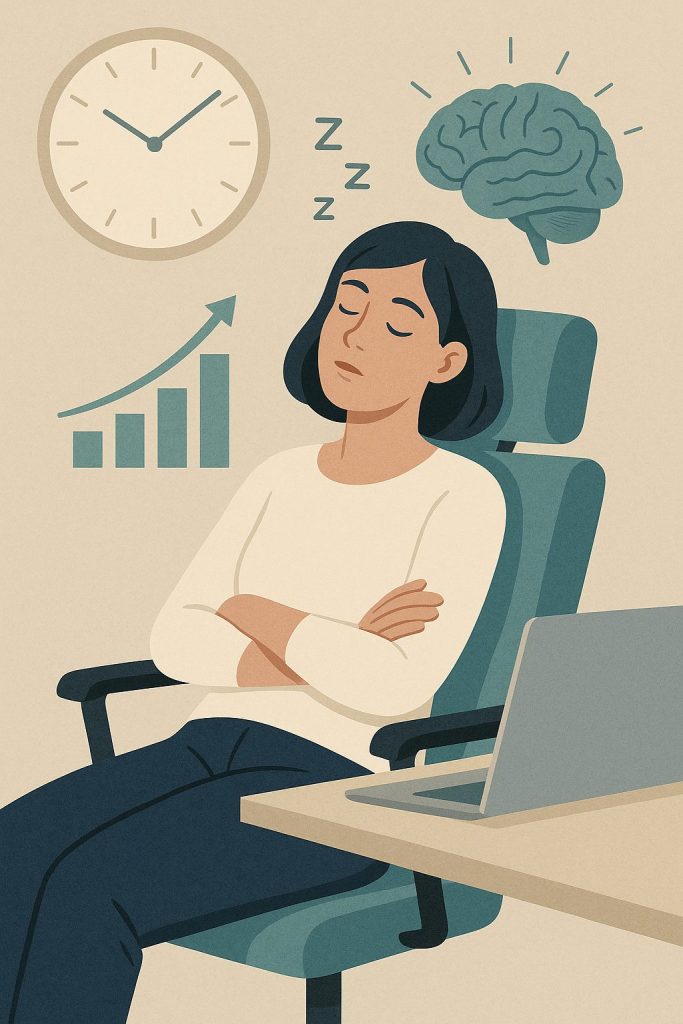
There is also a quiet moral judgement attached to tiredness in many professional settings. If you admit you need rest, it can sound as though you are not coping well enough, not disciplined enough, not robust enough. But the body is not persuaded by workplace mythology. When sleep debt accumulates, concentration frays, patience shortens and even simple decisions begin to cost more effort. A short, well-timed pause is often less a retreat than a way of preventing the slow waste that fatigue creates.
Its place in daily life varies widely from one country to another. Attitudes to napping are shaped by climate, culture, habits and individual needs. In many places, when the sun is at its highest, working through intense heat is neither natural nor productive. That is one reason why the siesta, a word of Hispanic origin, has long been associated with genuine benefits, both psychological and physical: less stress, better efficiency, stronger performance, improved heart protection and better overall health. And despite the cliché, napping is not only for children or older people. In China, for instance, “the nap is a right written into the constitution” under Article 43 concerning workers’ rights.
In Quebec, some hotels and motels even offer special nap rates for a set period. In Japan, certain companies have gone further by creating dedicated spaces for micro-naps. In Spain, office hours have traditionally left room for a siesta, even if the government has tried to shift those habits.
These examples are useful not because every country should copy another, but because they remind us that our suspicion of rest is learned. It is cultural, not inevitable. Once you see that, the old prejudice begins to look rather flimsy. A society can either pretend human beings function like machines all day long, or it can make modest room for the rhythms that are already there.
- France: widespread sleep debt, but napping still underused
- China: a recognised workers’ right
- Japan and Spain: workplace and cultural habits that make room for rest
What makes a micro-nap different
Not all naps are the same. There is the so-called “royal” nap, lasting an hour or more, the power nap of around 10 to 30 minutes, and the micro-nap, sometimes called a flash nap, which lasts for less than 10 minutes. This shortest form is especially valued for the way it encourages relaxation without dragging the body into deep sleep. It lowers the body’s rhythms while leaving you responsive to what is happening around you, which means you can wake and return to what you were doing almost at once. There is nothing to stop you taking several micro-naps across the day if needed.
That distinction is more than a matter of timing. A longer nap can be deeply restorative, but it can also leave some people with that heavy, disorientating feeling that comes from waking in the wrong phase of sleep. The micro-nap avoids much of that risk. It is brief enough to refresh without pulling you too far away from the day, which is precisely why it suits working life, revision periods, travel and those moments when you need relief without losing momentum.
Dr François Marchand, a sleep specialist at the Pitié-Salpêtrière Hospital in Paris and co-author of Des nuits sans insomnie : pour en finir avec les troubles du sommeil, explains it clearly: “This period corresponds to the first phases of sleep: drowsiness and light sleep. The person relaxes but remains sensitive to external stimuli. Once awake, they are immediately operational.” That is precisely what makes the micro-nap so useful. It is not only a matter of sleeping for a few minutes, but of entering a brief state of release in which the brain shifts towards light sleep. Some specialists even broaden the definition to include that very state of deep relaxation.
With a little practice, some people can reach it in just a few minutes, sometimes in the space of a few slow, deep breaths.
In practical terms, this means the micro-nap is accessible even to people who insist they “cannot nap”. Often what they mean is that they do not fall into a long, obvious sleep. But a micro-nap does not always look dramatic from the outside. It may simply be a short descent into stillness: the jaw unclenches, the breath deepens, thoughts lose their grip, and a few minutes later the mind feels less crowded. That, too, is part of its value.
- Royal nap: 1 hour or more
- Power nap: 10 to 30 minutes
- Micro-nap: under 10 minutes, with quick recovery on waking
The proven benefits of micro-naps and how to make them work
Why a few minutes can make such a difference
Bruno Comby, polytechnic engineer, specialist in preventive medicine and author of Eloge de la sieste, argues that a micro-nap can restore energy worth 10 to 15 times its actual duration. That helps explain why this habit is so common among people living with pressure, fatigue and constant demands: politicians, business leaders, sales professionals and elite athletes, to name only a few. In practice, a micro-nap can be a real support before revising for an exam, heading into an important meeting, improving performance in education, politics or sport, finishing an urgent task with a clearer head, staying motivated despite a heavy workload, or simply avoiding dangerous drowsiness at the wheel.
Its effects are widely recognised for a simple reason: when the muscles loosen, breathing slows and the heart rate settles, the body and mind enter a state of deep relaxation not unlike meditation, easing both physical and psychological fatigue.
Related offer
Sleep induction
Set against a natural backdrop, this session guides your brain into a state of sleep...
View product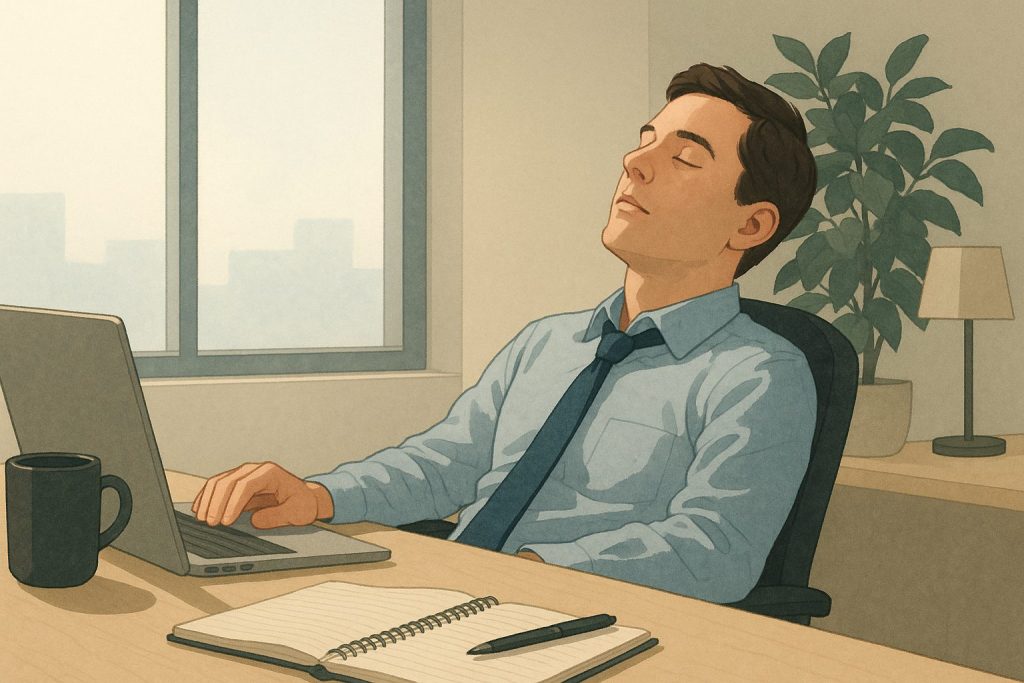
There is something deceptively modest about five or six minutes of rest. Because it is short, people assume it cannot do very much. Yet anyone who has felt the difference between pushing on in a depleted state and pausing just long enough to reset knows how disproportionate the benefit can be. The mind becomes less brittle. Irritation softens. Memory retrieval improves. Tasks that felt oddly insurmountable recover their proper scale. The change is not miraculous; it is simply the nervous system being given a chance to stop bracing.
Micro-naps can also be valuable because they interrupt the spiral by which tiredness feeds more tiredness. When we are worn down, we often compensate badly: more caffeine, more screen stimulation, more internal pressure, less sensitivity to what the body is asking for. A brief nap can break that pattern before it deepens. It is a small act, but sometimes small acts are exactly what preserve the rest of the day.
France still tends to lag behind some of its European neighbours when it comes to embracing the micro-nap, even though the need is hardly rare. We now know that alertness drops roughly every 90 minutes during the day, and many people feel that familiar dip at the start of the afternoon. Yet the main obstacle is often not the desire to rest, but the belief that it is impossible to do so on command. As Bruno Comby notes, many people know it is possible to fall asleep for a very short time, but assume they themselves are incapable of it. Some do it naturally; others need practice.
In the end, though, it is a skill that can be learned.
That is an encouraging thought, because it shifts the question from talent to habit. You do not need to be naturally gifted at napping. You need to recognise your own signs of fatigue, stop a little earlier than usual, and create a repeatable ritual that tells the body it is safe to let go. Over time, that transition often becomes easier. The body learns what is being asked of it.
- before an exam or important appointment
- to stay sharp during intense work periods
- to reduce the risk of dozing off while driving
Simple ways to ease into a micro-nap
So how do you make it work in real life? The best moment is often when your body starts sending clear signals: heavy eyelids, wandering attention, a drop in concentration or that familiar post-lunch lull. At that point, the aim is not to force sleep, but to create the conditions for it by releasing muscular tension and calming the mind through deliberate breathing. If surrounding noise is a problem, soft music through headphones for five to ten minutes can help, discreetly and, in a workplace, ideally with your colleagues’ agreement.
If you worry about slipping into deeper sleep, set a quiet alarm, ask a colleague to wake you, or use an old but effective trick: hold a bunch of keys in your hand so that, as you relax, they eventually fall and wake you.
The setting does not need to be perfect. That is worth saying, because many people imagine they need silence, darkness and a proper bed before a nap becomes possible. In reality, a chair with head support, a parked car before driving on, a quiet corner of an office, or even a few undisturbed minutes on a sofa can be enough. Comfort helps, of course, but perfection is not the point. The real skill lies in lowering the threshold: making rest possible in ordinary life rather than reserving it for ideal circumstances that rarely arrive.
It can also help to keep the ritual consistent. Sit or recline in the same way, loosen the shoulders, unclench the hands, let the tongue rest, and lengthen the exhale slightly. Some people find that closing the eyes is enough; others benefit from an eye mask, a scarf, or simply turning away from visual stimulation. The body responds well to repetition. If you approach the micro-nap in the same spirit each time, it often becomes easier to enter that state quickly.
You can also use a very simple exercise drawn from Taiji Qigong for health: close your eyes, place your hands gently over your eyelids, stretch, and take several slow, deep breaths. Cardiac coherence, often recommended by doctors, can also offer a useful five-minute recovery break. Seen this way, the micro-nap becomes more than a pause: it is a discreet but powerful way of bringing body and mind back together. In Provence, there is a saying that the sun rises twice: once in the morning, and once again after the nap. Older generations understood something we often forget — that balance and wellbeing sometimes depend on very modest rituals.
On that point, our grandparents may still have much to teach us.
Related offer
Mental and Physical Recovery
This session uses waves with extremely precise frequencies that target healing and recovery. Guidance...
View productAnd if sleep itself does not come every time, the pause is not wasted. A few minutes of genuine stillness, with slower breathing and reduced stimulation, can already soften the edge of fatigue. That is one of the most useful things to remember. The micro-nap is not an exam to pass. It is a practice of recovery. Some days you drift into light sleep; some days you simply rest more deeply than you would have done otherwise. Both can help.
- relax the muscles and slow the breath
- use a discreet alarm or a bunch of keys if needed
- try a short Taiji Qigong or cardiac coherence exercise
The Mental Waves Micro-Rest Framework
The Mental Waves approach frames a micro-nap as a transition ritual. You are not trying to force sleep; you are creating a small protected interval where the brain can stop pushing.
- Reduce input: dim the screen, lower sound and stop new information.
- Set a boundary: choose five to ten minutes and use a timer.
- Anchor attention: use breath, silence or one gentle sound cue.
- Return slowly: open the eyes, stretch and take one simple next action.
For a broader routine around short sound-based resets, see Mental Reset sound rituals.
Editorial note from Mental Waves
Micro-naps can support daily recovery, but persistent daytime sleepiness, unsafe drowsiness while driving or major sleep disruption should be discussed with a qualified health professional.
Conclusion
Seen in that light, the micro-nap is not a sign of idleness at all, but a modest, intelligent way of working with the body rather than against it. Its value lies precisely in its simplicity: a few minutes of genuine release can restore clarity, steady the nerves and help us return to the day without the heaviness that longer sleep sometimes brings. It is less about escaping life than about rejoining it in better shape.
What also emerges from this wider perspective is that our suspicion of rest is cultural, not inevitable. Other countries have made more room for short pauses, while in France the habit still struggles against old prejudices. Yet the principle is disarmingly practical: notice the signs of fatigue, create a brief moment of calm, and allow the mind and body to reset before exhaustion takes over. Sometimes, a few stolen minutes are not a weakness, but a form of balance.
Perhaps that is the quiet wisdom at the heart of the micro-nap. It asks us to stop treating tiredness as a personal failure and to see it instead as information. The body signals, we respond, and the day becomes more liveable. There is nothing grand about it, which is exactly why it is so useful. A habit does not need to be dramatic to be transformative; sometimes it only needs to be humane.
Frequently Asked Questions About Micro-naps
What is a micro-nap?
A micro-nap is a short rest pause, often under 10 minutes, used to refresh attention and energy without entering a long sleep cycle.
How long should a micro-nap last?
Many people aim for five to ten minutes. The goal is to rest lightly, not to sink into a long nap that may leave you groggy.
When is the best time for a micro-nap?
Early afternoon often works well, especially when energy naturally dips. Avoid napping too late if it disrupts your night sleep.
Can micro-naps improve focus?
They may help when fatigue is the main problem. A short rest can reduce mental fog and make the next task feel less heavy.
Are micro-naps a sign of laziness?
No. A well-timed micro-nap is a recovery tool. It can be more responsible than forcing productivity while exhausted.
What if I cannot fall asleep?
You do not have to sleep deeply. Closing the eyes, lowering input and resting the body for a few minutes can still be useful.
Should I use a timer?
Yes. A timer helps the mind relax because you are not worrying about oversleeping. Keep the sound gentle enough not to startle you.
Can micro-naps replace a full night of sleep?
No. They can help manage temporary fatigue, but they do not replace regular, sufficient night sleep.
What is the main takeaway?
Micro-naps work best as short, intentional pauses. Keep them brief, protect the setting and use them before fatigue becomes a full crash.