en
enVotre panier est vide.


Auditory system
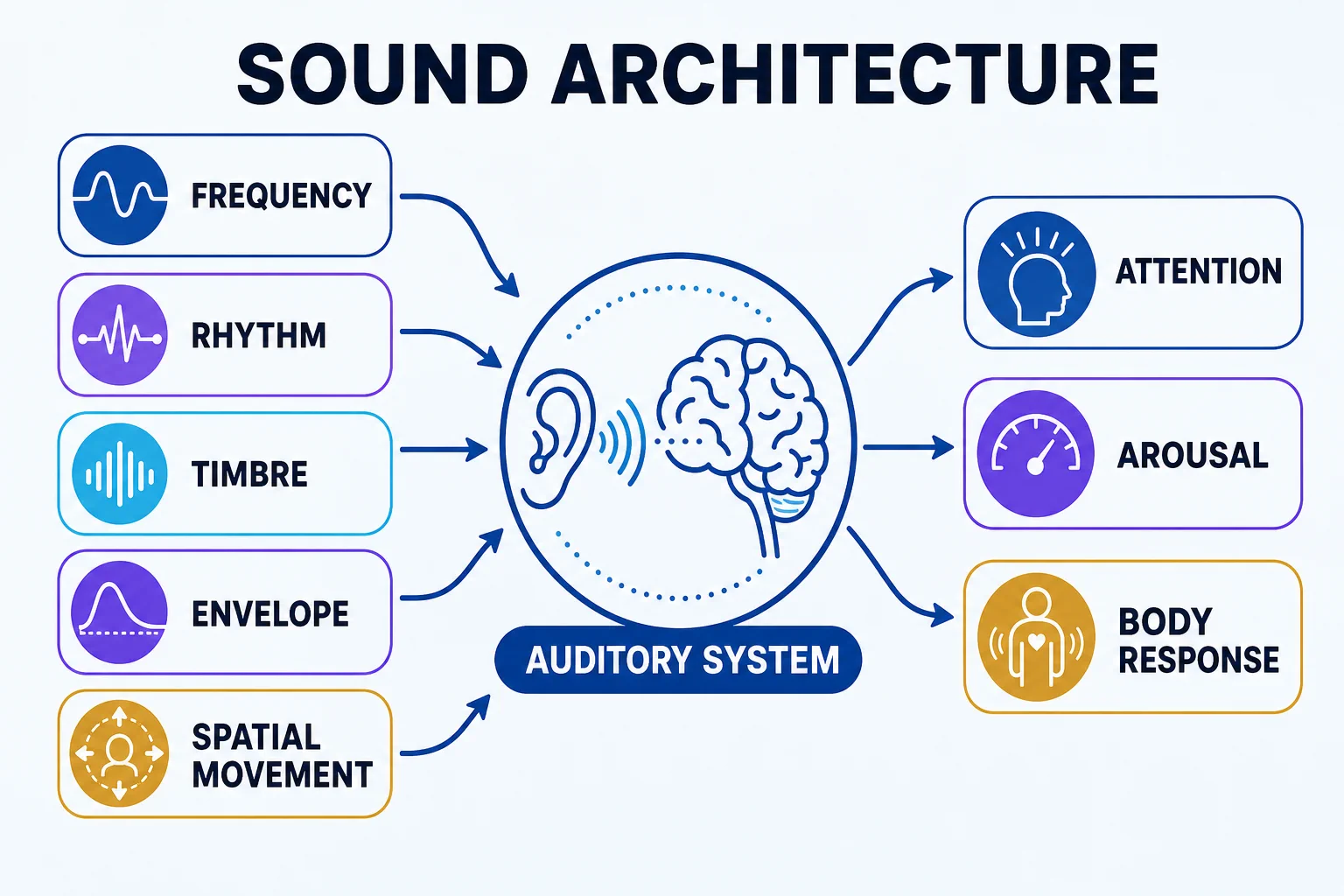
The ear decodes frequency, intensity, timbre and movement before transmitting information to the brain.
Foundation guide
A sound is never only an atmosphere. It is a vibration, a neurological signal, a bodily stimulus and sometimes an emotional trigger. This guide explains how sound stimuli interact with the ear, the nervous system and brain rhythms through binaural beats, isochronic tones, monaural beats, white noise, psychoacoustic design and immersive listening.
Pillar pages
This page follows body resonance and cymatics by looking at the mechanisms of sound inside the nervous system and the brain.
From vibration to response
Sound travels as pressure waves. When it reaches the body, it continues through the ear, bones, tissues, fluids and nervous system. The response is not limited to hearing.
Frequency and physiology
Different frequency ranges tend to be received differently, but the full effect depends on the entire sound structure.
Low frequencies can feel grounding and bodily. Mid-range frequencies are important because they overlap with the voice and social listening. Higher frequencies can increase alertness and clarity, which is why they are often explored in memory and cognition contexts, but they may become tiring when overused.
A sound is not defined by frequency alone. The envelope of the sound, its rhythm, its harmonic richness, its spatial movement, the way it evolves through time and the listener’s own state all influence the final experience.
This is why a static tone and a carefully designed soundscape can have very different effects even when they contain similar frequency ranges. The brain does not only receive frequencies; it receives pattern, expectation, contrast and movement.
Brainwave entrainment
Since the 20th century, researchers have explored how rhythmic sound stimulation may interact with electrical brain activity. The most widely known approaches are binaural beats, isochronic tones and monaural beats.
Each technology creates a rhythmic stimulus in a different way. Each becomes most useful when integrated into a well-designed listening protocol with a clear purpose.
Research on binaural beats remains mixed but meaningful. For example, a 2019 meta-analysis studied effects on memory, attention, anxiety and pain, while later reviews have highlighted the importance of protocol design, listening conditions and individual response. PubMed: binaural beats meta-analysis
Two slightly different tones are sent separately to each ear; headphones are required.
A single tone is switched on and off rhythmically, creating a clear pulse that does not require headphones.
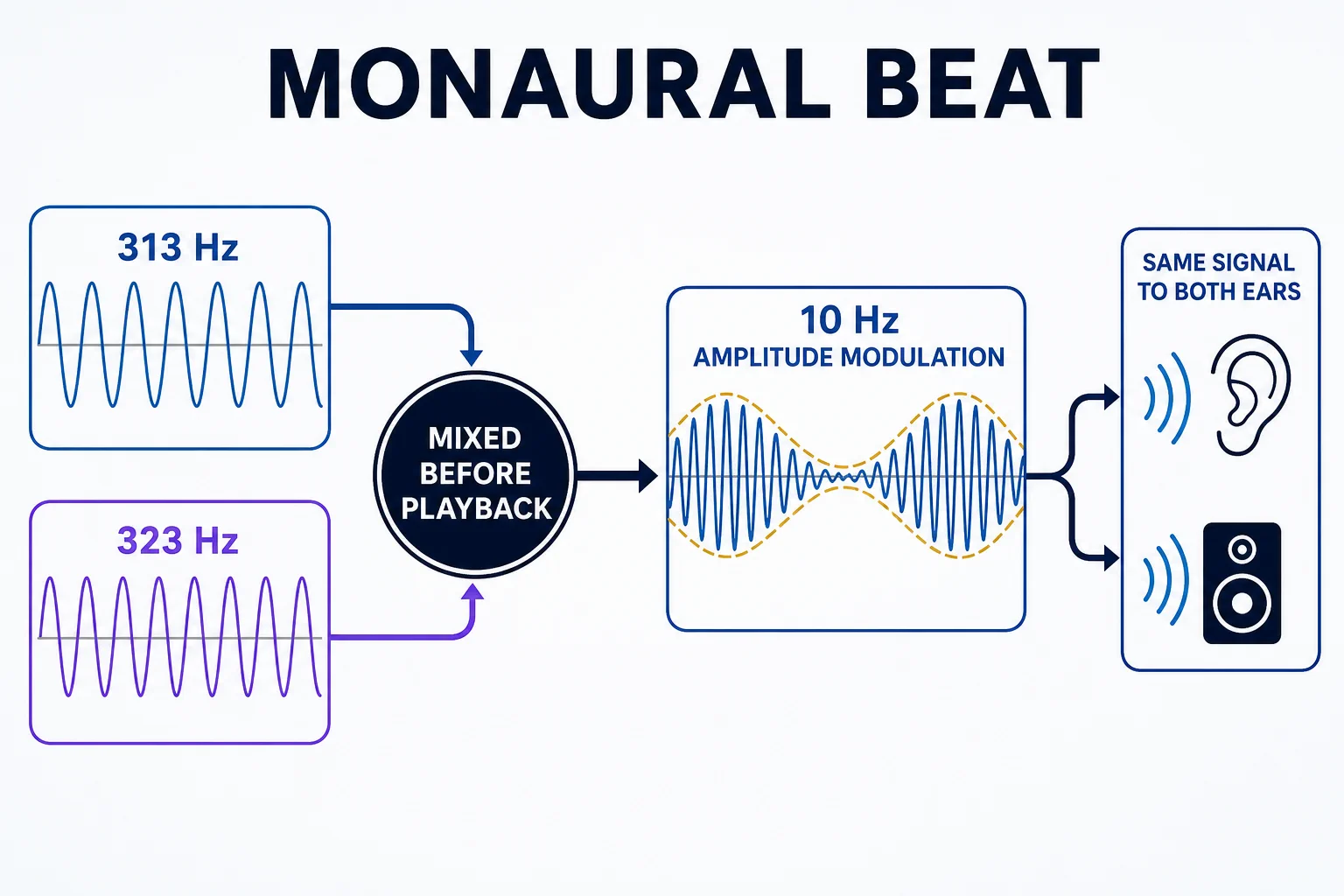
The beat exists physically in the audio signal itself before reaching the ear.
Effects depend on the listener, the protocol, the sound design and the context of use.
Binaural beats
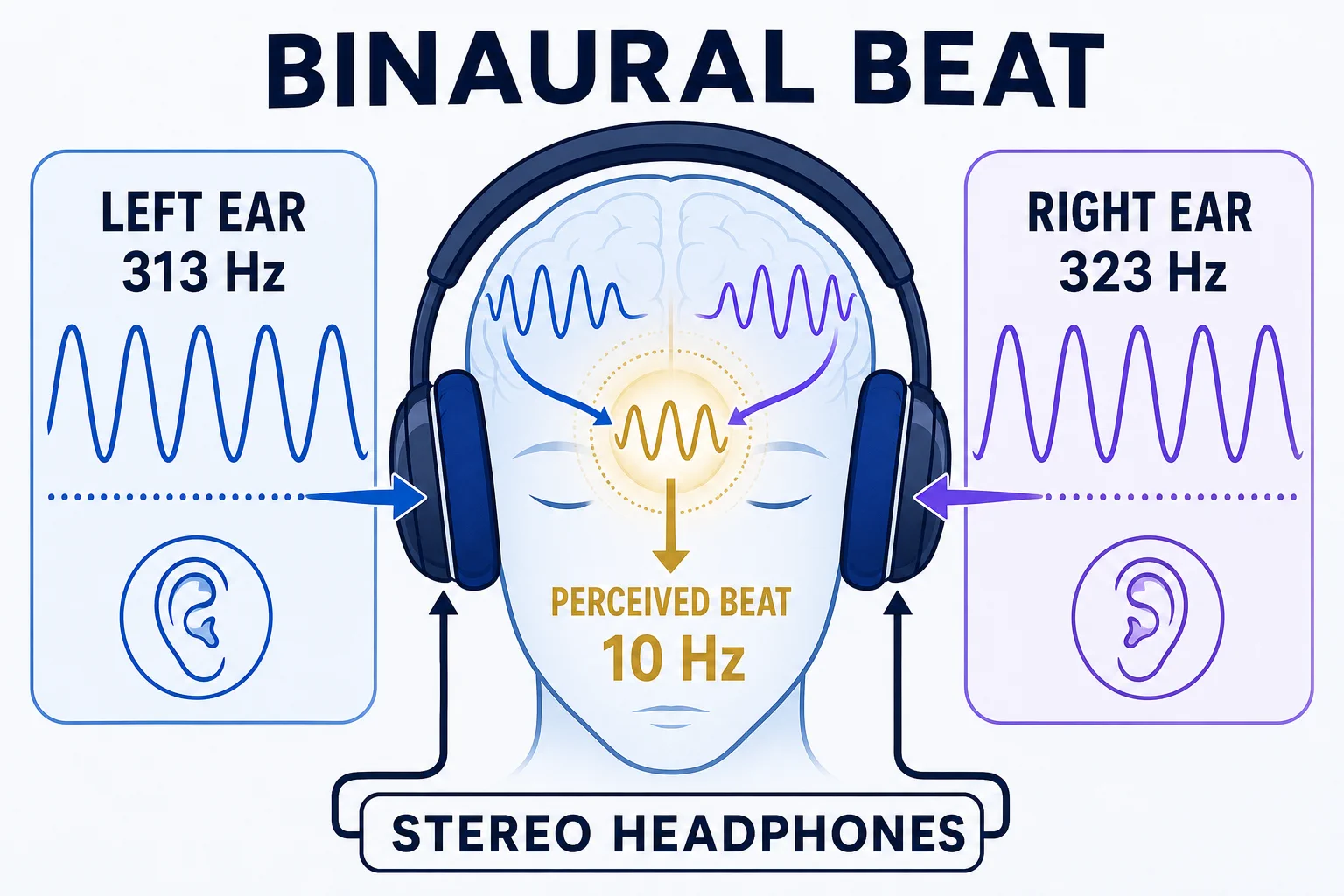
Binaural beats occur when each ear receives a slightly different frequency and the brain perceives the difference as an internal rhythmic beat.
For example, if one ear receives 313 Hz and the other receives 323 Hz, the brain may perceive a 10 Hz beat. This is why binaural beats are often associated with brainwave ranges such as alpha, theta or delta.
The effect requires stereo headphones. Without separation between the two ears, the binaural mechanism does not work as intended. This is why headphone quality and listening setup matter.
Studies such as Lane et al. explored how binaural beats may affect vigilance performance and mood, but the broader scientific literature remains cautious and protocol-dependent. PubMed: binaural beats, performance and mood
Isochronic and monaural
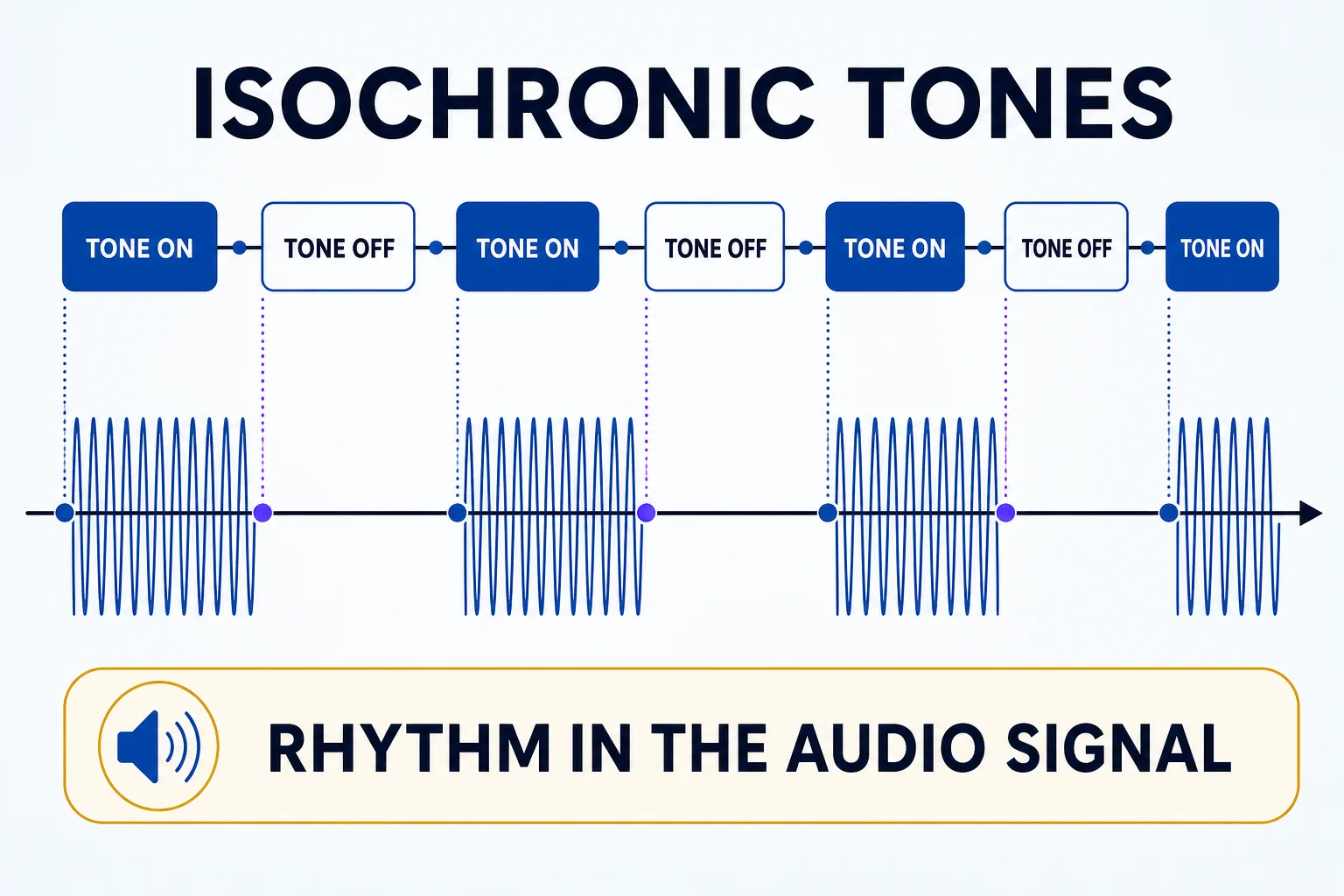
Isochronic tones and monaural beats are different from binaural beats because the rhythm exists in the sound signal itself.
An isochronic tone is a single tone that pulses on and off at a precise speed. This creates a clear external rhythm that the brain can easily detect. It can be used with speakers or headphones.
A monaural beat is created by combining two similar frequencies before playback. The amplitude modulation is already present in the audio, so the ear receives a real rhythmic pulse rather than reconstructing it internally.
In practice, these methods can feel more immediate for some listeners. They are often integrated into broader sound environments instead of being used as isolated laboratory signals.
Acoustic pulse
With monaural beats, the pulse is not an internal illusion. It is already present in the air as a modulation of volume.
This makes monaural beats easier to perceive for many listeners and technically easier to integrate into music, nature sounds or immersive sound design. They do not require headphone separation in the same way binaural beats do.
The listener still matters. Sensitivity, fatigue, expectation, attention and listening environment all influence how the experience is received.
Beyond beats
Sound stimulation is not limited to repetitive pulses. Some of the most useful approaches are based on texture, masking, natural variation and immersion.
Research orientation
The strongest evidence comes from broader sound and music interventions, while research into specific frequency protocols continues to develop.
Good sound design is not about forcing the brain. It is about creating conditions the nervous system can use.
For a broader scientific perspective, see research on binaural beats, white noise and music therapy: systematic review on binaural beats, white noise and sleep, and music therapy and stress reduction.Sound design matters
A pleasant sound can make the moment softer. A carefully designed listening protocol goes further: it considers frequency, progression, rhythm, texture, spatialization, emotional tone and the listener’s capacity to receive the session.
This is where Mental Waves differs from a simple track of relaxing frequencies. The work is not only to select a number in hertz, but to create a coherent sonic journey.
A few hertz can change the target rhythm or the way the sound is perceived.
The brain often responds better to gradual movement than to abrupt changes.
Harmonics, textures, ambience and space help the listener enter the session more naturally.
Duration, intensity, pacing and spatial placement shape the depth of the experience.
Frequency families
Some sound traditions focus less on laboratory entrainment and more on symbolic, ritual or vibratory meaning.
Mental Waves method
Mental Waves does not reduce sound work to a single technique. Binaural beats, isochronic pulses, monaural movement, white noise, spatialized sound and psychoacoustic textures can all play a role depending on the intention of the session.
The real work is integration: building a coherent experience that the listener can enter, follow and feel. A protocol should respect the body’s rhythm instead of forcing a state. For practice-oriented listening, see 3D Meditation, the Meditation-Relaxation set or the Memory-Cognition Pack depending on the intention.
This is why Mental Waves sessions are designed as structured sound environments rather than isolated frequency demonstrations.
The session is built around a target state such as relaxation, focus, sleep or mental reset.
The listener is guided gradually instead of being pushed abruptly into a frequency target.
Frequency work is embedded in musical, spatial and emotional context.
Mental Waves sessions bring sound design, intention and personal listening into one coherent practice.
Scientific orientation
Sound-based practices are promising because they are accessible, non-invasive and deeply connected to attention and emotion.
At the same time, effects vary. The same sound may help one person relax and leave another person indifferent. The same protocol may feel powerful one day and too stimulating another day. This is why personal context matters.
The most useful question is which listening environment helps this person enter a more constructive relationship with their body and attention in this moment.
This is the Mental Waves frame: sound as guidance, structured experience and a supportive inner environment.
Useful resources
These internal resources connect this page to the full Mental Waves foundation path.
See how vibration can organize matter into visible patterns.
Open page →Understand alpha, theta, delta, beta and gamma states.
Open guide →Learn how Mental Waves protocols are built beyond simple frequencies.
Open page →Use breath as a bridge between sound, body and nervous-system regulation.
Open guide →Frequently asked questions
Some sound and music interventions have been studied for stress, sleep, attention and anxiety. However, evidence varies by method, protocol and population. Specific frequency claims should be treated with nuance.
Binaural beats require different frequencies in each ear and therefore need stereo headphones. Isochronic tones use a single pulsed sound. Monaural beats create a real rhythmic modulation in the audio signal itself.
For binaural beats, yes. For isochronic or monaural sounds, good speakers can work. Headphones are still recommended for immersive Mental Waves sessions, especially when spatialized audio is used.
For most people, moderate listening at a comfortable volume is generally well tolerated. Do not listen while driving, and consult a professional if you have epilepsy, neurological conditions or concerns about intensive use.
A Mental Waves protocol combines frequency, rhythm, spatial movement, texture, silence and progression to create a coherent experience around a specific listening intention.
Many sessions are designed for 15 to 40 minutes. The best rhythm depends on the goal, your sensitivity and your state that day. Regular gentle practice is usually more useful than forcing long sessions.
Foundation path
Each page adds one layer: resonance, visible form, body-brain interaction, brainwaves and sound technology.
Begin with sound
Understanding sound technologies is useful. Experiencing a well-built session is different. Explore Mental Waves protocols designed for sleep, focus, mental reset and deeper listening.
Explore Mental Waves sessions