en
enVotre panier est vide.


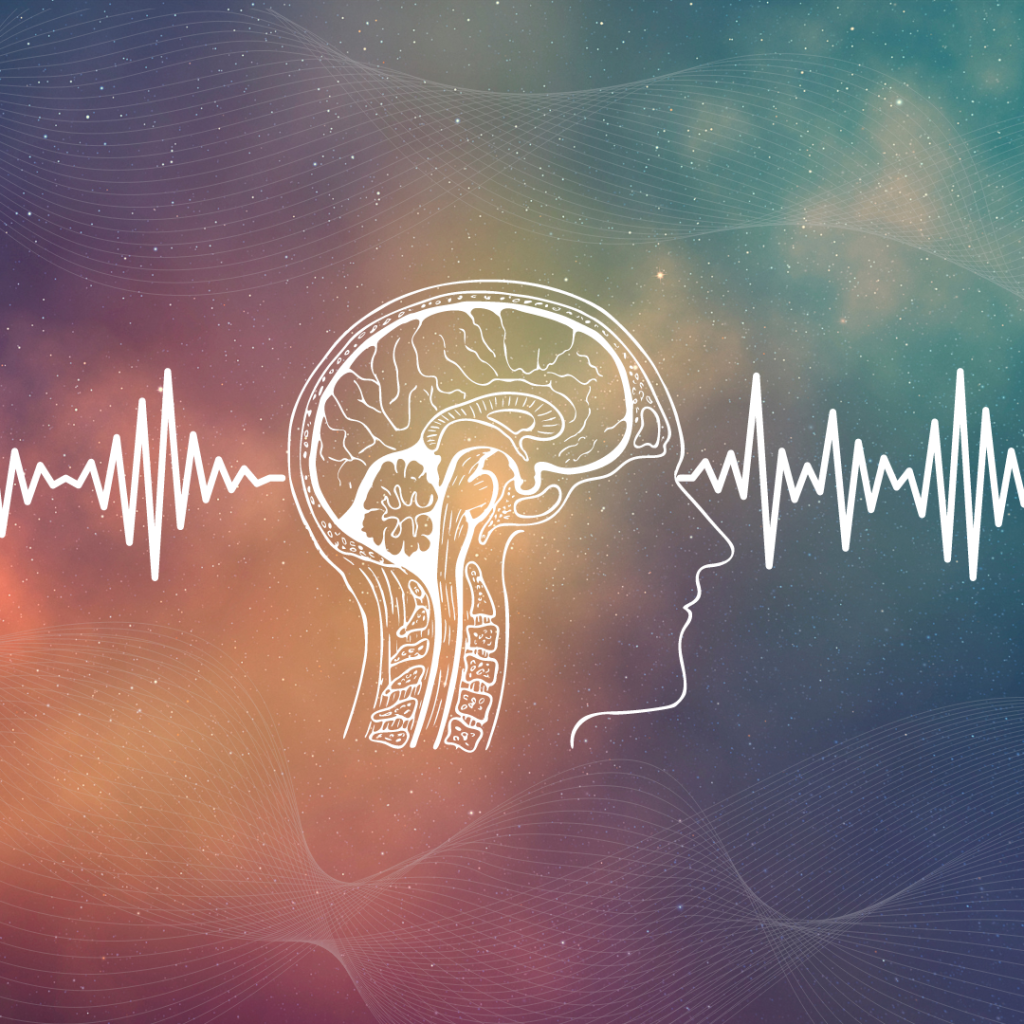
The K-complex is one of the most distinctive patterns seen on an EEG during sleep: a brief, high-amplitude brain wave that appears most often in stage 2 light sleep. First described in 1937 in the private laboratories of A. L. Loomis, it has long attracted attention because it seems to sit at a crucial threshold between perception and rest. In practical terms, it is associated with the brain’s ability to register a stimulus without necessarily tipping the sleeper into full wakefulness — a reminder that sleep is not a passive shutdown, but a carefully regulated state.
That makes the K-complex especially interesting in both neuroscience and sleep medicine. It can arise spontaneously at regular intervals, particularly in the frontal cortex, but it may also be triggered by a brief sound, a touch, or even an internal disturbance such as a pause in breathing. Although its exact function is still not fully understood, current interpretations suggest that it may help preserve sleep by dampening unnecessary arousal, while also playing a part in the transition towards deeper sleep and, perhaps, in memory consolidation. In that sense, the K-complex offers a precise window into how the sleeping brain filters the world, protects its own continuity, and may continue processing the traces of waking experience.
In short: what is a K-complex?
A K-complex is a brief, high-amplitude EEG wave that appears mainly during stage 2 sleep. It is important because it shows that the sleeping brain is still evaluating information: a sound, touch or internal signal can be registered without necessarily waking the person.
- It is one of the clearest EEG signatures of stage 2 sleep.
- It can appear spontaneously or after a mild stimulus.
- It may help the brain preserve sleep by limiting unnecessary arousal.
- It is often followed by sigma activity, which links it to the wider rhythm of light sleep.
The Mental Waves Sleep-Gating Framework
The K-complex is best understood as a sleep gate: a moment where the brain checks a signal without fully reopening consciousness. Mental Waves can use this topic to explain sleep protection without promising to control the wave directly.
- Stimulus arrives: a sound, touch or internal event reaches the sleeping brain.
- Signal is evaluated: the brain briefly decides whether the event matters.
- Arousal is limited: if the event is harmless, sleep may continue.
- Rhythms coordinate: K-complexes, spindles and slower waves shape the sleep state together.
- Rest remains active: sleep is protected by regulation, not by total shutdown.
That framing keeps the article useful for readers who want to understand sleep architecture before choosing any practical audio path.
How K-Complexes Help the Brain Preserve Sleep
A distinctive EEG wave first identified in sleeping brains
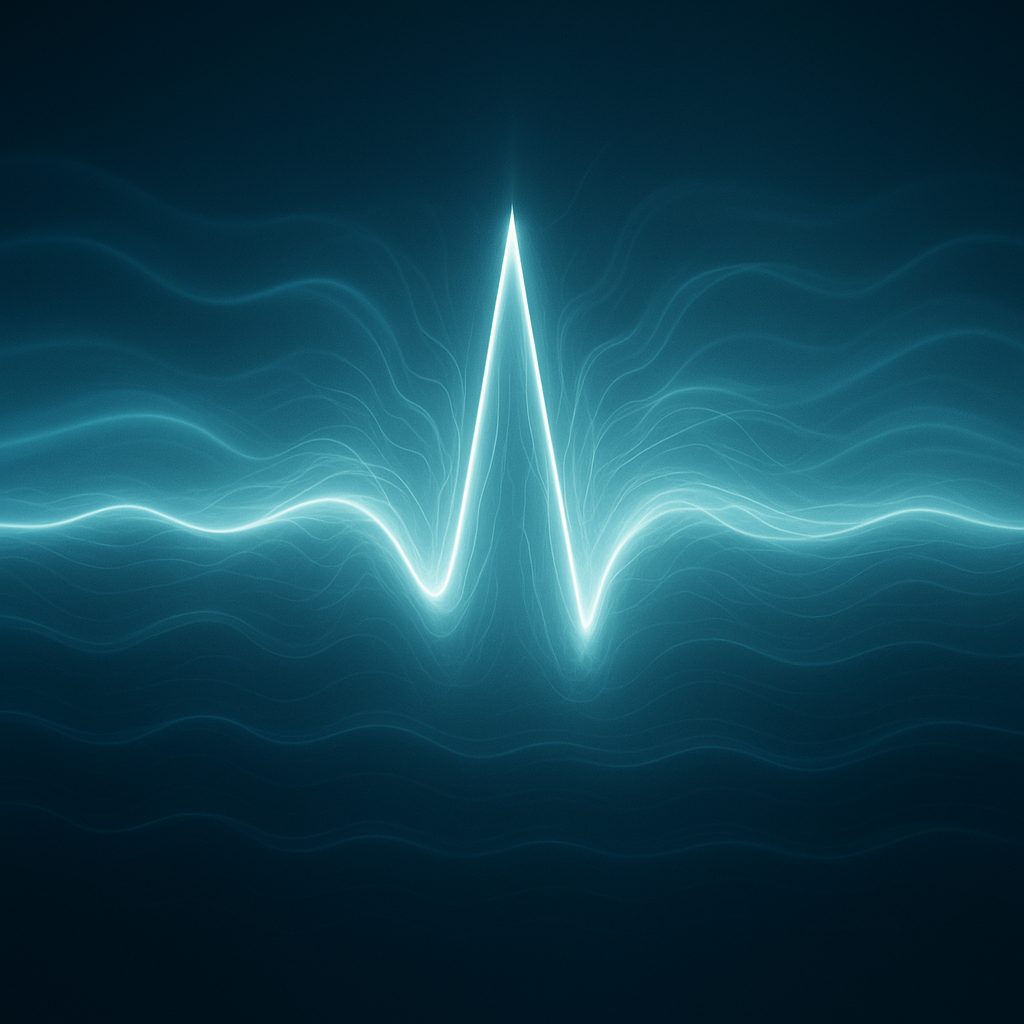
The K-complex is a brief, high-amplitude brain wave seen during sleep. On an EEG, it appears as a marked negative deflection that is thought to help preserve sleep by reducing the brain’s response to incoming stimulation. First described in 1937 in the private laboratories of A. L. Loomis, it has a very recognisable profile: a large depolarisation peak, usually greater than 100 microvolts, followed 300 to 500 milliseconds later by a slower repolarisation phase, and then a smaller negative peak at around 900 milliseconds.
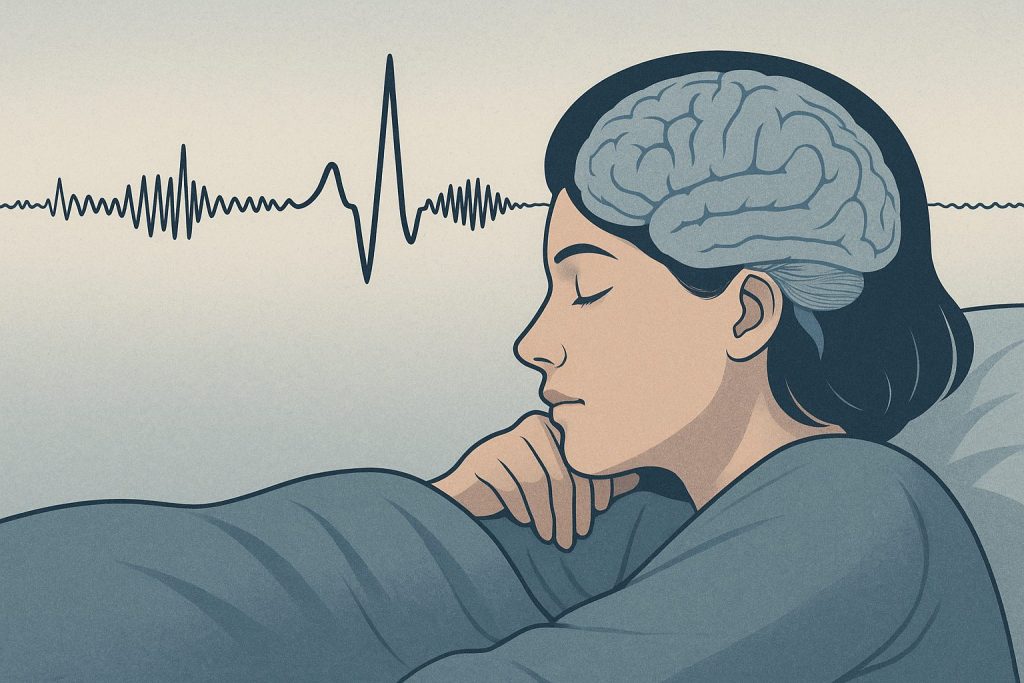
This pattern is often followed by a train of Sigma waves — brief bursts of high-frequency, low-amplitude activity lasting at least half a second. Although K-complexes can occur across a wide proportion of the cerebral cortex, they are especially prominent in the frontal cortex. In practical terms, they are one of the clearest signs that the sleeping brain is not simply switched off: it remains active, selective and capable of regulating how much of the outside world is allowed to disturb rest.
From a neurophysiological point of view, the K-complex is often discussed as a large-scale cortical event rather than a purely local fluctuation. Its amplitude and broad distribution suggest that substantial neuronal populations are being recruited in a coordinated way. This is one reason it has remained so important in sleep research: it offers a visible marker of how the cortex can briefly reorganise its activity while the person remains asleep.
It is also useful to distinguish the K-complex from other familiar sleep signatures. Sleep spindles, for example, are faster rhythmic bursts in the sigma range, whereas the K-complex is slower, larger and more sharply contoured. The two often occur together, which has encouraged the view that stage 2 sleep is not a uniform state but a dynamic pattern of alternating protective and regulatory processes.
- Large negative EEG wave of high amplitude
- Often above 100 microvolts
- Frequently followed by Sigma activity
- Particularly prominent in the frontal cortex
Why they appear when sleep is challenged
K-complexes are observed periodically during stage 2 light sleep, typically every 1 to 1 minute 45 seconds, but they can also be triggered by stimulation. That stimulation may be external, such as pressure on the skin or a brief sound, or internal, such as an inspiratory interruption. Their exact function is still not fully understood, yet their timing strongly supports the idea that they contribute to a form of sleep protection. During sleep, perceptible events seem to be processed in a limited way so that the brain can assess whether they are significant enough to justify waking.
A K-complex tends to appear when a stimulus has been detected but sleep is not broken. In that sense, it may reflect a temporary inhibition of the usual waking response, allowing the sleeper to remain asleep despite harmless sensory input. This helps explain why K-complexes are relevant to several sleep disorders linked to repeated stimulation during the night, including frequent awakenings and sleep apnoea. Rather than being a sign of passivity, they suggest that the brain is actively filtering experience, deciding moment by moment whether to protect sleep or interrupt it.
This selective filtering is central to the lived experience of sleep. Most sleepers do not awaken to every minor sound, shift in temperature or change in bodily sensation, yet the brain does not ignore such events completely. The K-complex may represent one of the mechanisms by which the sleeping brain briefly acknowledges a stimulus, evaluates its possible relevance, and then suppresses a full arousal response when no action is required.
That interpretation fits with a broader understanding of sleep as a state of regulated sensory gating. In waking life, attention is continuously drawn towards novel or salient events. During sleep, by contrast, the nervous system appears to maintain a more conservative threshold: enough monitoring to detect potential threat, but enough inhibition to preserve continuity of rest. The K-complex may therefore be seen as a momentary expression of that balance between vigilance and disengagement.
It is worth noting that not every stimulus produces the same response. The probability of eliciting a K-complex depends on factors such as stimulus intensity, timing, sleep depth and individual variability. A very weak sound may be ignored entirely, while a stronger or more meaningful signal may lead to awakening instead. The K-complex seems to occupy the intermediate zone where the brain registers an event but still favours sleep over conscious reorientation.
How K-Complexes Bridge Sleep Depth and Overnight Memory Work
A transition point between light and deeper sleep
K-complexes are especially characteristic of stage 2 sleep, where they tend to appear at regular intervals, roughly every 1 minute to 1 minute 45 seconds. Yet their role does not seem to stop there. One of these large EEG events often marks the shift from stage 2 light sleep, dominated by theta activity, towards stage 3 deeper sleep, where delta waves become more prominent. In that sense, the K-complex may act as a physiological bridge: not simply a sign that the brain is asleep, but part of the process by which sleep becomes more stable and profound.

Related offer
8 States of Consciousness - Deep Infinity Pack
Deep Infinity - 8 States of Consciousness This rare audio pack invites you to plunge into the heart...
View productThis helps explain why researchers often view the K-complex as a protective mechanism rather than a mere electrical curiosity. When a sleeper is exposed to a mild stimulus, the brain appears to register it briefly and assess whether it is important enough to justify waking. If waking does not occur, a K-complex may follow, temporarily dampening the usual arousal response. This may help the sleeper remain asleep despite harmless disturbances, while still preserving the brain’s capacity to react if something genuinely significant happens.
Seen in this way, the K-complex belongs to the architecture of sleep stability. Stage 2 is often described as light sleep, but that label can be misleading if it suggests fragility alone. In reality, stage 2 contains active mechanisms that help consolidate the sleeping state. The K-complex may be one of the clearest examples of this, because it appears precisely where the brain must decide whether to deepen sleep, maintain it, or abandon it in favour of waking.
Its association with the transition towards slower delta activity is especially important. Deep sleep is characterised by more synchronised cortical rhythms and reduced responsiveness to the environment. A K-complex may therefore be understood as part of the route by which the cortex moves from a relatively permeable state into one that is more insulated and restorative. This does not mean that every K-complex causes deep sleep, but it does suggest that these events are closely tied to the brain’s changing thresholds of responsiveness across the night.
- Most often observed during stage 2 sleep
- Can accompany the transition towards stage 3 deep sleep
- May help limit unnecessary awakenings after mild stimulation
Why some researchers link them to memory consolidation
Some authors have also suggested that K-complexes may contribute to memory consolidation during sleep, notably Cash, Halgren et al. (2009). During wakefulness, distinct groups of neurons are activated in precise sequences according to internal and external stimulation. Repeated activation strengthens the synaptic connections involved, through what is commonly described as long-term potentiation. During sleep, a K-complex corresponds to a large-scale depolarisation across neuronal populations, including networks that were heavily recruited during the day. Then, during the following repolarisation phase, the strongest synaptic connections may resume activity more quickly than weaker ones.
One implication is that the brain may partially replay the most significant activation patterns from waking life. In other words, neuronal groups that fired in a particular order during the day, and whose connections were reinforced, may become active again in a similar order during sleep.
This idea is consistent with classic animal findings: rats whose EEG activity was recorded while running through a maze later reproduced remarkably similar electrical patterns during sleep, as though the episode were being replayed at the neural level. Because K-complexes can also be triggered by external stimulation during sleep, they are relevant to several sleep disorders as well, including frequent awakenings and sleep apnoea.
Cash, S.S., Halgren, E., Dehghani, N., et al. (2009). “Human K-Complex Represents an Isolated Cortical Down-State”. Science, 324:1084–87.
This proposed role in memory should be approached with care. The evidence does not justify treating the K-complex as a simple “memory wave”, nor does it imply that each event corresponds to a specific remembered episode. Rather, the more plausible interpretation is that K-complexes may participate in a broader overnight process in which recently active neural networks are selectively re-engaged, stabilised or reorganised. In that framework, they may support the conditions under which memory traces are refined rather than storing content in any direct or isolated way.
The idea is scientifically attractive because it links subjective experience with measurable brain dynamics. Many people notice that sleep can clarify learning, improve recall or alter the emotional tone of recent events by the following day. While such changes depend on multiple sleep processes, K-complexes may form part of the underlying physiology by helping coordinate large-scale cortical states in which reactivation becomes possible. Their frequent association with spindles is particularly relevant here, since spindles themselves have often been linked to learning and memory performance.
There is also a broader theoretical significance. If the sleeping brain can both protect itself from irrelevant stimulation and selectively revisit patterns laid down during wakefulness, then the K-complex sits at an intriguing intersection between sensory regulation and plasticity. It may help create a brief window in which external interference is reduced and internally organised activity can proceed. That possibility remains under investigation, but it captures why the K-complex continues to interest researchers studying consciousness, attention and the changing modes of brain function across the sleep-wake cycle.

Related offer
18 States of Consciousness - Integral Infinity Pack
Integral Infinity - The 18 States of Consciousness A unique sound box designed to explore all the...
View productWhat the K-complex helps clarify
The K-complex is useful because it challenges the idea that sleep is simply unconscious absence. It shows that the brain can be responsive and protective at the same time.
| Function discussed | What it suggests | Responsible framing |
|---|---|---|
| Sensory gating | The brain can register input without waking fully. | Useful for sleep science, not a personal self-test. |
| Sleep protection | Mild stimuli may be dampened so sleep continues. | One mechanism among many, not the whole story. |
| Sleep transition | K-complexes may appear near shifts toward deeper sleep. | Do not treat every wave as a direct cause. |
| Memory work | Some research links K-complexes with cortical reactivation. | Keep this as a research hypothesis, not a certainty. |
Where Mental Waves fits for this topic
The future commercial match is a sleep-specific lead magnet, not a generic reset. Until that exists, this proposal keeps the article educational and points only to broader brainwave products such as Infinity Elementary and Deep Infinity without suggesting that they generate K-complexes.
Editorial note from Mental Waves
This article is a sleep neuroscience explanation. It does not offer clinical guidance, interpret personal EEG data or claim that a sound session can trigger K-complexes on demand.
Conclusion
The K-complex is therefore best understood not as a simple electrical curiosity, but as a brief act of regulation within sleep itself. It appears at the point where the brain meets a stimulus without fully surrendering to wakefulness, helping to preserve rest while still allowing a minimal form of evaluation. That balance matters: sleep is not a state of total disconnection, but a selective and highly organised mode of brain activity.
What makes the K-complex especially compelling is that it seems to sit at the crossroads of protection, transition and possibly memory processing. It is associated both with the maintenance of stage 2 sleep and with the shift towards deeper sleep, while some research also suggests a role in the overnight reactivation of neural patterns shaped during waking life. Much remains uncertain, and that uncertainty is part of the scientific picture. Still, the K-complex offers a striking reminder that even in apparent stillness, the sleeping brain remains active, discerning and quietly intelligent.
For that reason, the K-complex remains more than a technical EEG feature of interest only to specialists. It provides a concrete example of how the brain regulates consciousness at its margins: neither fully open to the world nor fully cut off from it. In the space of less than a second, it may reveal how sleep protects itself, how deeper sleep emerges, and how traces of the day may continue to be processed beneath awareness.
Frequently asked questions about the K-complex
What is a K-complex in sleep?
A K-complex is a brief, high-amplitude brain wave seen on EEG, especially during stage 2 sleep. It is one of the most recognisable signs that light sleep is actively regulated.
When do K-complexes occur?
They occur mainly during stage 2 light sleep. They can appear spontaneously or after a mild stimulus such as a sound, touch or internal breathing-related signal.
What does a K-complex do?
It appears to help the brain register a stimulus while preserving sleep when waking is not necessary. This is why it is often discussed as part of sensory gating during sleep.
How can a K-complex protect rest?
When a harmless stimulus is detected, the K-complex may help dampen arousal so the sleeper does not fully wake. It is one part of the wider system that protects sleep continuity.
What does a K-complex look like on EEG?
It appears as a large, slow wave with a high-amplitude deflection and is often followed by faster sigma activity. Its shape makes it easier to identify than many smaller sleep rhythms.
Where are K-complexes most prominent?
They can involve broad cortical regions but are often especially prominent over frontal areas. This fits with their role as large-scale cortical events during stage 2 sleep.
Are K-complexes linked to memory?
Some research suggests they may participate in overnight reactivation and memory-related processes. The idea is promising, but it should be described carefully as part of a larger sleep system.
Can sound trigger a K-complex?
A brief sound can trigger a K-complex in some conditions, but that does not mean listening audio should be promoted as a way to force K-complexes. The brain response depends on context, timing and sleep stage.
Which Mental Waves path fits the K-complex topic?
A future Sleep Reset would be the most natural fit. For now, related brainwave products can be mentioned as educational pathways, not as tools that directly create K-complexes.