en
enVotre panier est vide.


Sigma spindles are brief, fast bursts of electrical brain activity visible on an EEG during stage 2 sleep. Typically oscillating at around 12 to 14 Hz and lasting at least half a second, they may appear more than a thousand times across a single night. In both French- and English-language literature, they are described under several names, but the underlying phenomenon is the same: distinctive surges in brain-wave activity that mark light sleep with remarkable precision.
These spindles are thought to arise from thalamo-cortical interactions and, alongside K-complexes, they are among the defining features of stage 2 sleep. Their role appears to extend well beyond simple classification. Research suggests they may help preserve sleep in the face of external stimulation such as noise or pressure, and their abundance is often associated with more stable, restorative rest. Sigma activity has also been linked to early motor development in infants and to memory consolidation, particularly through processes involving the frontal cortex and hippocampus. Taken together, sigma spindles offer a revealing window into how the sleeping brain protects, regulates and quietly prepares itself to learn.
In short: what are sigma spindles?
Sigma spindles are short bursts of brain-wave activity that appear mainly during stage 2 sleep, usually around 12 to 14 Hz. They are important because they help describe how the sleeping brain filters sensory input, protects sleep continuity and may support overnight learning.
- They are also commonly called sleep spindles.
- They arise from coordinated thalamo-cortical activity.
- They are associated with sensory gating, sleep stability and memory processing.
- They are research markers, not a direct self-test for sleep quality.
The Mental Waves Sleep-Rhythm Literacy Framework
Sigma spindles are useful because they help readers understand sleep as an active rhythm system. Mental Waves should frame them as sleep literacy, not as a promise that one sound can force a specific EEG event.
- Name the rhythm: identify the frequency band and sleep stage.
- Place it in context: relate the rhythm to sleep architecture rather than isolating it.
- Respect the evidence: describe associations without turning them into certainty.
- Protect the night: keep the practical advice focused on regularity, quiet and continuity.
- Use sound gently: listening can support a calm environment, but it should not be framed as EEG control.
Although they are often described in technical EEG terms, sigma spindles are best understood as part of the brain’s active management of sleep. Light sleep is not a passive or empty interval between deeper stages. It is a dynamic state in which sensory input is filtered, cortical responsiveness is modulated and internal rhythms are coordinated with notable precision. Sigma spindles sit at the centre of that process.
What Sigma Spindles Reveal About Light Sleep
How sigma spindles appear during stage 2 sleep
Sigma spindles are brief, fast bursts of electroencephalographic activity that are typically observed during stage 2 sleep. They usually fall within a frequency range of around 12 to 14 Hz and last for at least half a second. In both French- and English-language literature, the same phenomenon appears under several names, including sigma bands, sigma spindles, wave trains, sigma spikes and sleep spindles. Whatever the label, the underlying pattern is the same: a sudden change in EEG activity marked by rapid, relatively high-amplitude peaks, sometimes reaching several tens of microvolts, and capable of occurring more than 1,000 times over the course of a single night.
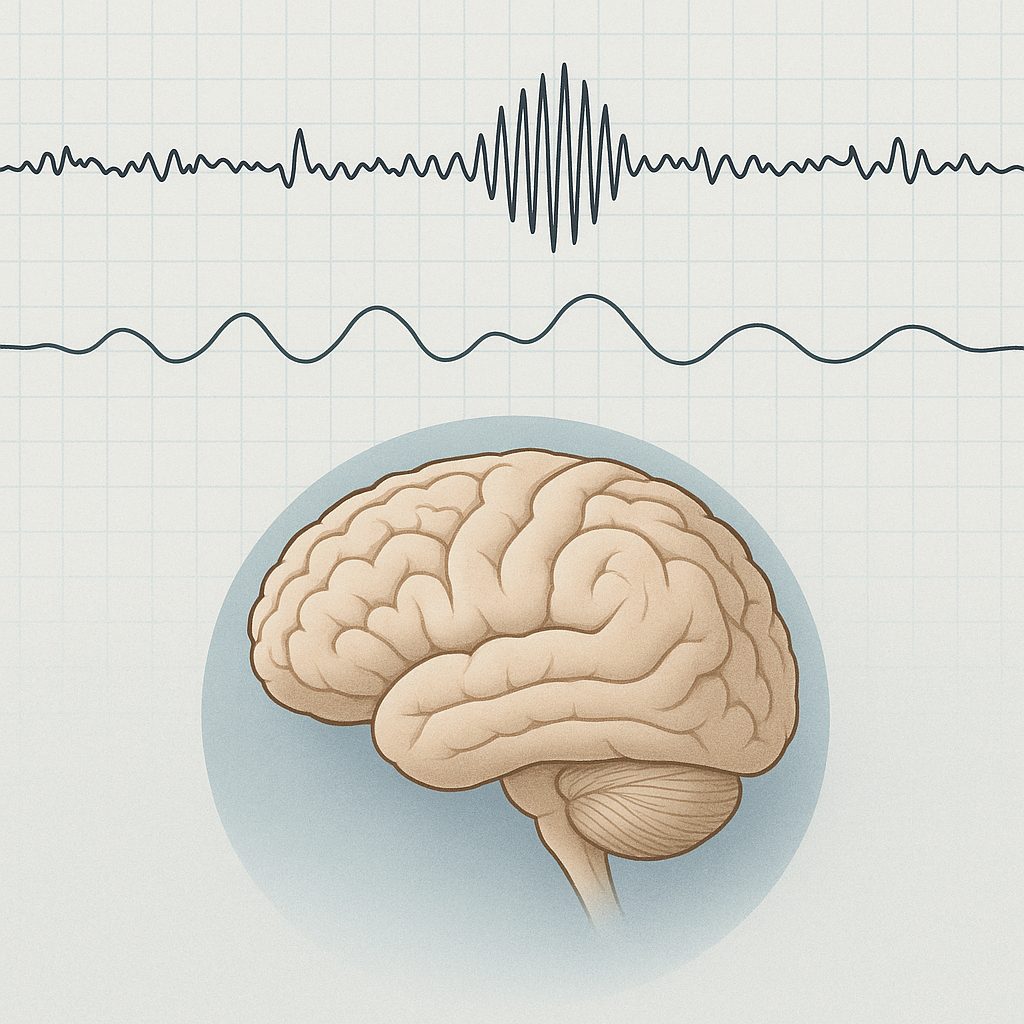
These spindles most likely arise from thalamo-cortical interactions. In practical terms, they seem to combine two rhythms: one fast rhythm at roughly 12 to 14 peaks per second, and another much slower cycle recurring every 5 to 10 seconds. This is why sigma spindles are emitted periodically during light sleep rather than appearing in a completely random way. Alongside K-complexes, thalamic sigma spindles are considered one of the defining features of stage 2 sleep, with their frequency tending to increase at the beginning and end of that stage.
From a neurophysiological perspective, this matters because the thalamus is not merely a relay station. It plays a central part in regulating how sensory information reaches the cortex. When spindle activity emerges, it reflects a coordinated dialogue between thalamic circuits and cortical networks, suggesting that the sleeping brain is actively shaping what is allowed to enter awareness and what is held at bay. That makes sigma spindles especially relevant to any serious account of sleep as a regulated state of consciousness rather than a simple shutdown.
Researchers also sometimes distinguish between slightly slower and slightly faster spindle patterns depending on scalp location, with frontal regions often showing somewhat slower activity and more central or parietal regions somewhat faster activity. This does not change the basic definition, but it does remind us that spindle activity is not entirely uniform across the brain. Different cortical territories may participate in subtly different ways, which may help explain why sigma spindles are discussed in relation to both sensory stability and cognitive processing.
- Typical frequency: 12 to 14 Hz
- Minimum duration: about half a second
- Most characteristic of stage 2 sleep
Why they matter for sleep stability
Sigma spindles are not simply markers of light sleep; they also appear to help protect it. Research suggests that, together with K-complexes, they may act as part of the brain’s way of preserving sleep despite external stimulation such as noise, pressure or other minor disturbances[1]. In that sense, they are associated with the sleeper’s ability to remain asleep when the environment is not perfectly quiet. By contrast, people with more fragile sigma activity often seem to have very light sleep that is easily interrupted by small sounds. The overall quality of sleep may therefore be affected, and sleep rich in sigma spindles appears to be more restorative.
This protective role may begin early in life. In young infants, from around 6 to 8 weeks, sigma spindles may also contribute to the gradual control of motor function: during sleep, many spindles arise from motor regions without implying continuous movement. More broadly, sigma activity has also been observed in areas such as the frontal cortex and the hippocampus, which helps explain why these rhythms are often discussed not only in relation to sleep stability, but also to wider brain regulation. A reduced level of sigma activity has also been reported in people with schizophrenia, notably by Ferrarelli et al. (2007), which further underlines how closely these rhythms are linked to the architecture and quality of sleep.
One useful way to think about this is as a form of selective disengagement. The sleeping brain does not become uniformly unresponsive; rather, it appears to adjust its threshold for reacting to the outside world. Sigma spindles may contribute to that adjustment by reducing the likelihood that minor sensory events will trigger full cortical arousal. In everyday terms, this may help explain why one person sleeps through a faint sound while another wakes repeatedly to small disturbances that never become fully conscious events for a more stable sleeper.
That said, spindle abundance should not be treated as a simple score of “better sleep” in every context. Sleep quality depends on many interacting factors, including total sleep time, circadian timing, stress physiology, respiratory stability and the broader architecture of the night. Sigma spindles are better understood as one meaningful component within that larger system. Their presence is informative precisely because it reflects organised neural regulation rather than a single isolated mechanism.
How Sigma Spindles Support Memory and Learning
From early motor development to memory consolidation
Beyond their role in protecting sleep, sigma spindles also appear to be involved in learning. In very young children, from around 6 to 8 weeks of age, many of these spindles arise from motor regions during sleep. This activity does not mean the child is constantly moving; rather, it may reflect an early form of neural organisation that helps the brain gradually refine motor control. In that sense, sigma spindle activity is not only a marker of light sleep, but may also contribute to the development of basic coordination.

Related offer
10 States of Consciousness - Infinity Elementary Pack
Elementary Infinity - The 10 States of Consciousness A unique sound box designed to explore the 5 states of...
View product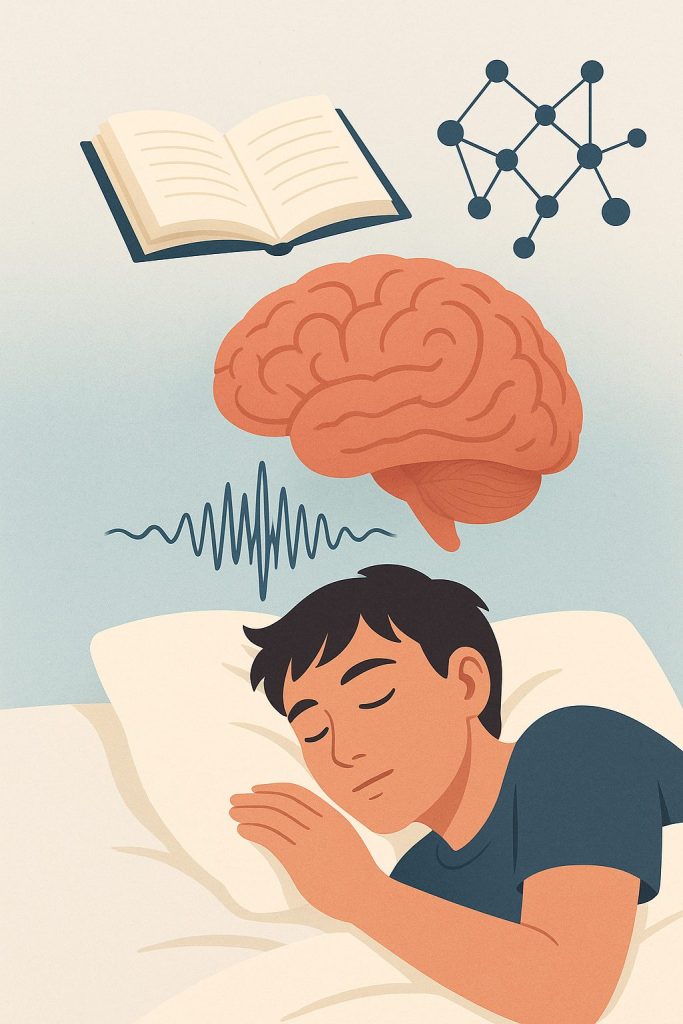
Sigma spindles are also observed in the frontal cortex and the hippocampus, where, like K-complexes, they are associated with memory consolidation [2]. More precisely, they may help the brain integrate newly acquired information into long-term memory. Research has suggested that these fast nocturnal bursts are linked to the transfer of information from the hippocampus towards more stable long-term storage, effectively “refreshing” the hippocampus so that it is ready to encode new material later on. This is one reason why a good nap or a full night rich in spindle activity may help a person learn more effectively once awake, as noted by Walker M. (2011) [3].
The broader implication is that sleep does not merely protect memories from interference by keeping us offline. It may actively reorganise them. Sigma spindles are often discussed alongside other sleep rhythms, including slower cortical oscillations and brief hippocampal events, because memory consolidation appears to depend on timing across multiple levels of brain activity. In this view, the spindle is not a lone actor but part of a coordinated nocturnal sequence that may support the stabilisation, selection and integration of recent experience.
This is especially relevant when new learning has to be connected with what is already known. The integration of fresh information into existing knowledge structures is more complex than simple storage. It requires the brain to compare, sort and embed new material without losing coherence. Sigma spindle activity has been associated with precisely this kind of overnight integration, which helps explain why post-sleep performance can improve not only in recall, but sometimes in abstraction, pattern recognition or the flexible use of recently acquired information.
- Motor-region spindles in infancy may support the gradual control of movement.
- Frontal and hippocampal spindle activity is associated with the integration of new knowledge into long-term memory.
- Sleep rich in these oscillations may leave the brain better prepared for later learning.
Why a full night matters
An important detail is that most of this spindle-related activity occurs during the second half of the night. That helps explain why cutting sleep short can affect learning, even when someone feels they have slept “enough”. A complete night does more than extend rest: it may preserve the later sleep periods in which these rhythms are more prominent, and therefore support the brain’s overnight processing of recent experience.
This line of research has also drawn attention to clinical differences. Reduced sigma activity has been reported in people with schizophrenia, notably in the work of Ferrarelli et al. (2007). While this does not mean sigma spindles alone explain cognitive difficulties or sleep disruption, it reinforces the idea that they are part of a broader system linking sleep quality, brain regulation and learning capacity. Taken together, these findings suggest that sigma spindles are not a minor EEG curiosity, but a meaningful feature of how the sleeping brain stabilises, sorts and prepares information for the next day.
In practical terms, this also offers a more precise reason to value sleep continuity. When sleep is repeatedly fragmented, the issue is not only reduced total duration but disrupted sequencing. The brain may lose access to the later-night organisation in which spindle-rich periods can contribute to consolidation and recalibration. For students, shift workers, parents of young children or anyone living with chronic sleep interruption, this distinction matters: feeling tired is only one consequence, while altered overnight processing may be another.
It is also worth keeping expectations measured. Sigma spindles are associated with learning benefits, but they do not mean improved memory will follow in every individual or every task. The strength of the evidence lies in patterns and probabilities rather than certainty at the level of a single night. Even so, the overall picture remains compelling: when sleep is sufficiently long and well structured, spindle activity may form part of the neural basis by which experience is refined into more durable knowledge.
What sigma spindles do and do not mean
Sigma spindles are useful research signals, but they should not be turned into a simple scorecard for personal sleep. Their meaning depends on timing, measurement method, brain region, age, clinical context and the broader structure of the night.

Related offer
18 States of Consciousness - Integral Infinity Pack
Integral Infinity - The 18 States of Consciousness A unique sound box designed to explore all the...
View product| Useful insight | What it means | What to avoid |
|---|---|---|
| Stage 2 marker | Spindles help identify a specific light-sleep state. | Assuming light sleep is useless. |
| Sensory filtering | They may help the brain remain asleep despite minor stimuli. | Assuming they block every disturbance. |
| Memory association | They are linked with overnight learning processes. | Promising better memory from one track or one night. |
| Clinical research | Spindle patterns can differ across conditions. | Using an article as a personal clinical label. |
Where Mental Waves fits for this topic
The best future lead magnet for this article is a sleep-specific reset. Since that is not available yet, this proposal does not add an inline lead magnet CTA. Product links should remain educational and related to brainwave exploration, such as Infinity Elementary and Integral Infinity, without implying that they reproduce sigma spindles.
Editorial note from Mental Waves
This article explains sigma spindles as a sleep neuroscience topic. It is educational content, not clinical guidance, and it should not be used to interpret personal EEG results or sleep symptoms without qualified support.
Conclusion
Sigma spindles are easy to describe as brief EEG bursts, but their significance is more subtle. They sit at the crossroads of sleep protection, sensory filtering and cognitive processing: characteristic of stage 2 sleep, yet far from trivial within it. Rather than simply marking light sleep, they appear to help preserve it, allowing the brain to remain asleep despite minor disturbances while maintaining a form of internal organisation that is anything but passive.
That is what makes them so compelling in neuroscience. Sigma activity is associated not only with sleep stability and a more restorative night, but also with developmental and memory-related processes that unfold quietly in the background. The picture remains nuanced: these rhythms are linked with learning and long-term memory integration, without reducing sleep to a single mechanism or a single frequency band. Still, one point stands out clearly: a full night of sleep is not empty time for the brain, but active regulation at work.
Seen in that light, sigma spindles offer a useful bridge between lived experience and brain science. They help explain why light sleep can still be functionally rich, why uninterrupted sleep often feels different from merely sufficient sleep, and why the sleeping brain remains deeply engaged in regulation even when conscious awareness has receded. For researchers, they are a measurable rhythm. For the rest of us, they are part of the hidden architecture that makes sleep protective, adaptive and mentally consequential.
Frequently asked questions about sigma spindles
What are sigma spindles?
Sigma spindles are brief bursts of brain-wave activity seen on EEG during stage 2 sleep. They usually sit around 12 to 14 Hz and last at least half a second.
Are sigma spindles the same as sleep spindles?
Yes. Sigma spindles are commonly called sleep spindles. The terms point to the same general pattern of fast rhythmic activity during light non-REM sleep.
When do sigma spindles appear?
They appear mainly during stage 2 sleep. They can occur many times during the night and are part of the normal architecture of non-REM sleep.
How are sigma spindles generated?
They are thought to arise from interactions between the thalamus and cortex. This thalamo-cortical loop helps explain why they are linked with sensory filtering and sleep stability.
Do sigma spindles protect sleep?
They may help protect sleep by reducing the chance that minor sounds or sensations trigger waking. This does not make them a perfect shield, but it shows that light sleep can still be actively regulated.
Are sigma spindles linked to memory?
Research links sleep spindles with memory consolidation and learning, especially when they coordinate with other sleep rhythms. The relationship is meaningful but not a simple one-to-one rule.
Can audio create sigma spindles?
A relaxing audio environment may support sleep readiness for some people, but this article should not claim that a sound session can force or reproduce sigma spindles on demand.
Why does a full night matter for spindle activity?
Some spindle-related learning processes are more prominent later in the night. Cutting sleep short may reduce opportunities for the brain to complete its normal overnight sequencing.
Which Mental Waves path fits sigma spindles?
A future Sleep Reset would be the cleanest match. For now, related product paths should stay educational, focused on brainwave exploration rather than a promise to control sleep spindles.