What are brainwaves?
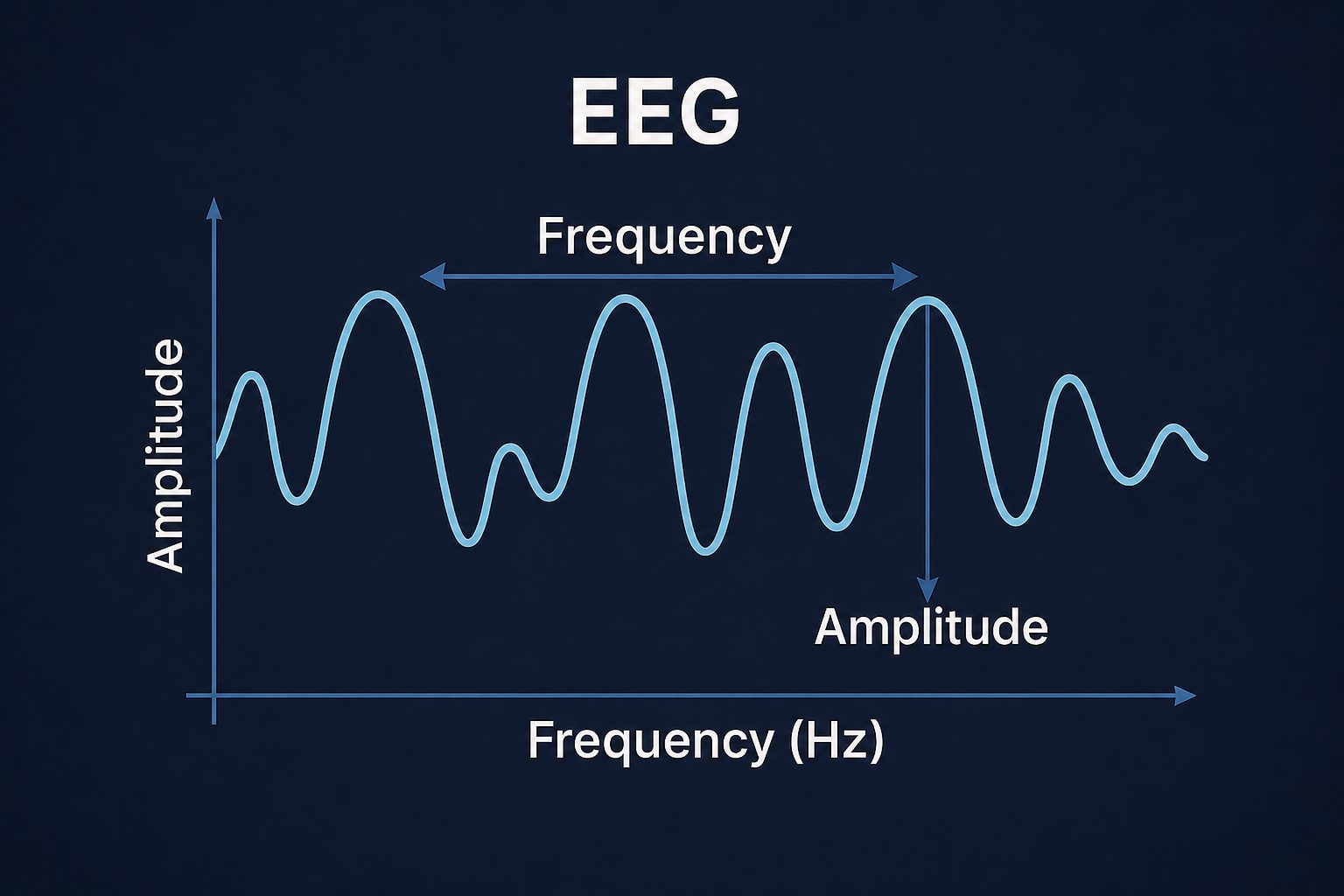
Brainwaves are recurring patterns within electrical activity recorded from the brain. Scalp EEG detects voltage changes produced largely by coordinated activity in populations of cortical neurons.
What are the five main types of brain waves?
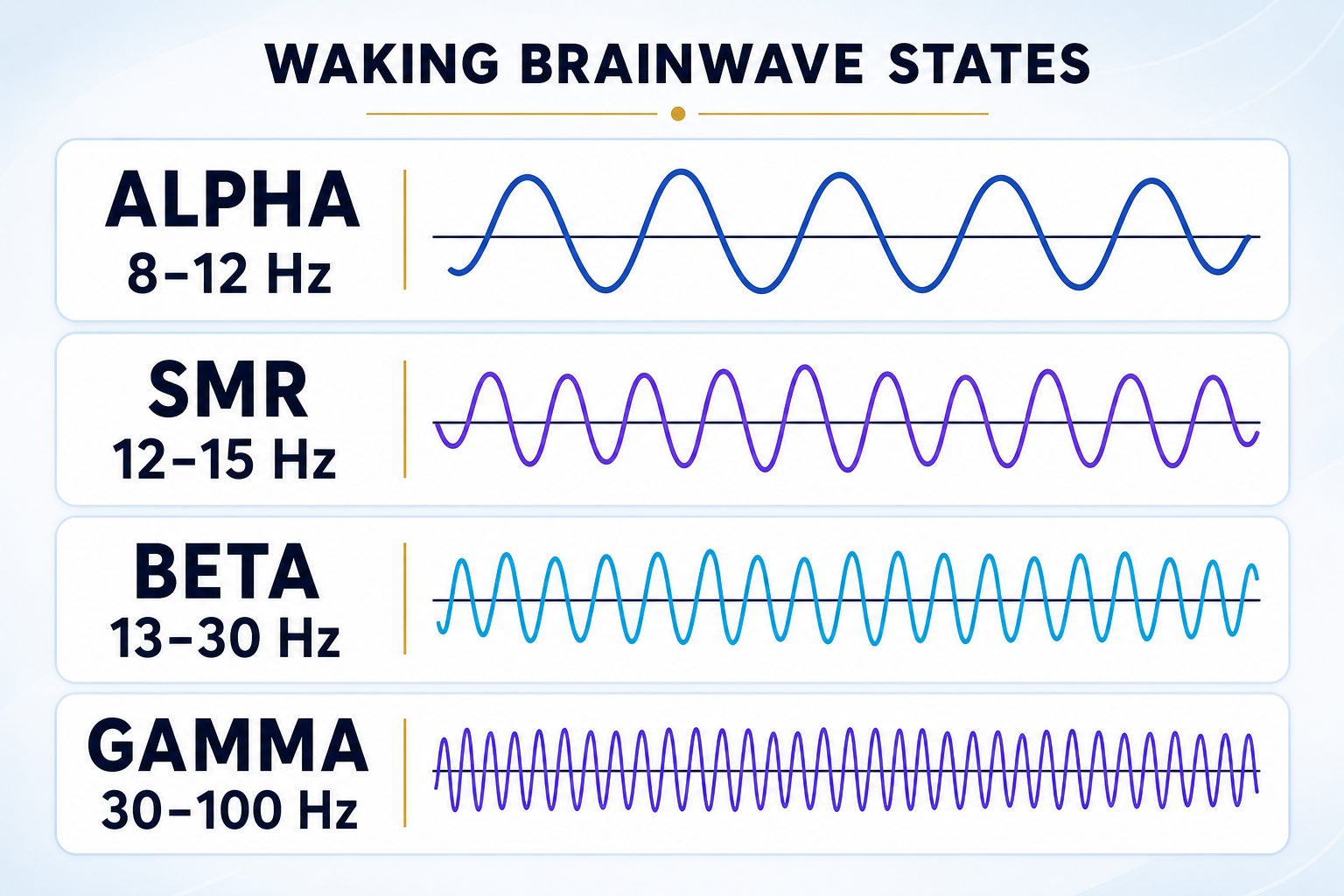
The five commonly discussed brainwave types are Delta, Theta, Alpha, Beta and Gamma. Their approximate ranges are 0.5–4, 4–8, 8–13, 13–30 and above 30 Hz, although boundaries vary by source.
What is a brainwave state?
It is an informal way to describe a pattern that is relatively prominent in a particular context. It does not mean that only one frequency is present or that the whole brain is uniform.
Do different brain waves control different mental states?
No single band controls one mental state. Associations depend on location, timing, task, alertness and the other activity present in the recording.
What are normal human brainwave frequencies?
Human EEG contains activity over a broad, continuous spectrum. Delta through Gamma are conventional categories, not a checklist of frequencies that must reach one fixed value.
Can several brainwave bands be active at once?
Yes. Multiple frequency components are normally present at the same time, and their relative power varies across scalp locations and over time.
Can Alpha and Theta occur together?
Yes. Alpha- and Theta-band activity can appear in the same EEG recording. Their coexistence does not by itself identify meditation, creativity or a special state of consciousness.
Which brain wave is best for sleep?
There is no single wave to activate. Delta-range slow activity is strongly associated with deep non-REM sleep, while Theta and Alpha changes occur during the transition toward sleep. Delta-rate sound does not guarantee deep sleep.
Which brain wave is best for focus?
Focus cannot be reduced to one frequency. Beta, Alpha, Theta and Gamma can all change during attention tasks, and no audio frequency can guarantee concentration.
Can music or binaural beats change brain waves?
Sound can evoke measurable auditory responses, and some studies report EEG changes during rhythmic stimulation. Binaural-beat findings are inconsistent, and hearing a chosen beat rate does not prove entry into the corresponding natural state.
 en
en