Englishen

    Foundation guide

    Sound and the Resonance of Life: How Sound Touches the Body

    A voice can give you chills. A low vibration can be felt in the chest before the mind even names it as sound. The flow of water can slow your breathing without asking anything from you. These are not just poetic impressions. They reveal a simple truth: sound is not only heard. It moves through living matter, reaches the nervous system, and can become a doorway into presence, emotion and inner regulation.

    Sound as movement

    What is sound, beyond what the ear hears?

    Sound is usually described as a mechanical vibration travelling through a medium. That definition is accurate, but it is only the beginning.

    A sound wave can travel through air, but also through water, bone, tissue and internal fluids. This matters because the human body is not an isolated listener standing outside the phenomenon. It is itself a living medium: dense, fluid, rhythmic and already vibrating.

    Before a sound becomes a word, a melody or a conscious impression, it has already entered into contact with matter. It has moved the eardrum, stimulated the tiny bones of the middle ear, and triggered a chain of events that the brain will later interpret as sound. The NIDCD/NIH guide to hearing describes this path clearly: incoming sound waves make the eardrum vibrate, then these vibrations are transmitted through the middle ear toward the inner ear.

    But the ear is not the whole story. Through bone conduction, vibrations can also be transmitted through the bones of the skull toward the cochlea, which explains why your own voice sounds different inside your head and why some low frequencies are felt almost physically. A medical overview from NCBI Bookshelf defines bone conduction as vibration transmitted through skull bones to the cochlea and related sensorineural structures.

    This is the first principle behind the Mental Waves approach: sound is not a decorative layer added to life. It is a form of movement that enters into dialogue with the body’s own movement: breath, heart rhythm, muscular tone, neural activity, emotional tension and the shifting quality of attention.

    This also means that listening is not a purely intellectual act. Even when the mind is busy analysing a melody or recognising a familiar voice, the body has already begun to participate. It receives pressure variations, conducts vibration, adjusts attention, responds emotionally and sometimes changes its rhythm without deliberate effort. In that sense, listening is a whole-body event.
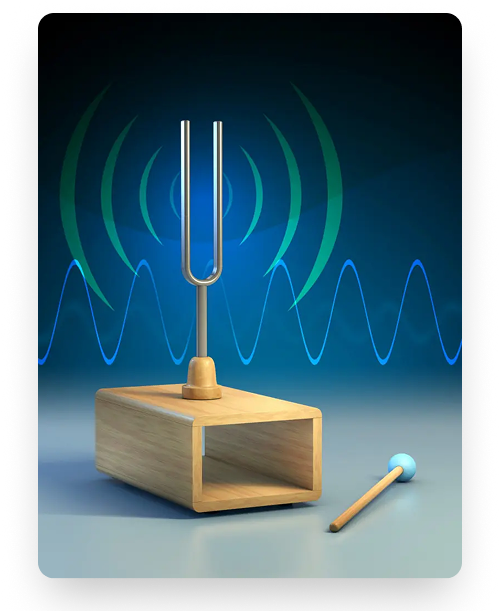
    Tuning fork and sound waves representing vibration and resonance
    Sound begins as vibration: movement transmitted through matter before becoming perception.

    Embodied listening

    Your body listens with more than the ears

    Some frequencies are first recognised as sensations. A low tone may be felt in the chest, abdomen or pelvis. A bright harmonic may seem to rise toward the skull. A slow pulse may subtly influence the rhythm of breathing.

    Bone and tissue

    Vibrations can travel through bone and soft tissue. This is why certain sounds feel tactile, especially in low-frequency ranges.

    Emotional charge

    A sound may awaken memory, tenderness, resistance or release because listening is always connected to personal history.

    Attention and presence

    A carefully structured soundscape can guide attention away from mental noise and toward a more stable inner frame.

    Sensory history

    Each listener brings their own sensory memory. This is why the same frequency can feel neutral, intense or deeply meaningful.

    The resonance principle

    Why some sounds seem to touch something deeper

    In physics, resonance describes what happens when a system vibrates more strongly because it is stimulated at a frequency compatible with its own natural dynamics. The classic example is the tuning fork: strike one fork, and another fork tuned to the same frequency may begin to vibrate nearby.

    In daily life, resonance can be less dramatic but just as familiar. A window may vibrate when a heavy vehicle passes. A loose object in a car may buzz only at a certain engine speed, then stop when that speed changes. The important point is not that everything vibrates all the time in the same way. It is that some frequencies meet certain systems more directly than others.

    In the living body, resonance becomes more complex. We are not tuning forks. We are emotional, biological and perceptual beings. The heart, the breath, muscular tension, brain rhythms and inner imagery all participate in how sound is received. This is why a sound can feel calming, activating, spacious or uncomfortable depending on context.

    Physical resonance

    Vibrations can be felt through the chest, bones, skin, fascia and internal cavities.

    Emotional resonance

    A tone, voice or harmonic texture may evoke memories, tenderness, tension or release.

    Cognitive resonance

    Rhythm and repetition can help organize attention, reduce distraction and support a more coherent state.

    Symbolic resonance

    Some sounds carry cultural, ritual or personal meaning, which changes how deeply they are received.

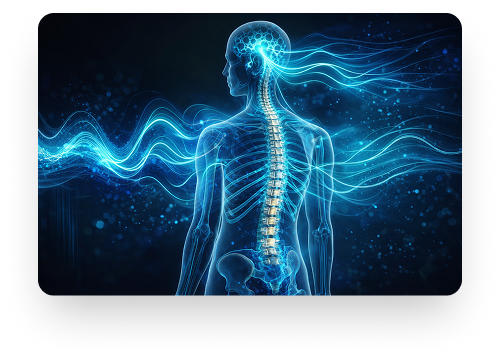
    Human body surrounded by sound waves
    The body is not a passive receiver. It conducts, filters, interprets and responds.

    Individual sensitivity

    Why each person responds differently to sound frequencies

    Resonance is never completely generic. Two people can listen to the same session and have noticeably different experiences. Even the same person may respond differently from one day to another.

    This is not a failure of sound-based practice. It is the expression of a living system. A body that is rested, hydrated and emotionally available does not receive sound in exactly the same way as a body under pressure, fatigued or distracted. A person with a long history of musical practice does not listen in the same way as someone who mostly experiences sound as background noise. A tone connected to a personal memory may become powerful for one listener and neutral for another.

    The older approach to wellbeing often looked for universal formulas: one frequency, one result, one predictable response. The more realistic approach is subtler. Sound can create conditions, but the listener’s state, history and attention determine how those conditions are integrated.

    That is why Mental Waves sessions are best understood as invitations rather than commands. They do not force an experience. They offer a structured sonic environment in which the nervous system, the body and the inner world may reorganize in a gentler way.

    Living matter

    Water, tissue and vibration: why sound feels immersive

    The body is largely fluid, elastic and conductive. This is one reason sound can feel enveloping instead of purely external.

    When sound moves through a room, it is easy to imagine it as something outside us. Yet the listener is made of resonant materials: membranes, bones, muscles, fascia, organs and fluids. The moment sound reaches the body, it is no longer just an acoustic event in space. It becomes a contact event.

    This does not mean that every frequency produces a fixed effect. It means that the listener is part of the acoustic relationship. A deep drone, a subtle overtone, a pulse or a texture can all create different bodily impressions depending on volume, listening posture, emotional state, headphones, room acoustics and intention.

    This is especially important for immersive listening. A Mental Waves session is not built only from isolated frequencies. It is built from layers: rhythm, space, harmonic density, silence, progression and the movement of attention through time. The result is closer to an environment than to a simple signal.

    Sound waves moving through water
    Water makes vibration visible in a way that helps explain the immersive nature of sound.

    More than sensation

    Sound can influence emotion, attention and presence

    The effects of sound are not limited to the physical body. Listening also involves memory, meaning, expectation, emotional tone and the brain’s ongoing search for pattern.

    Emotional state

    A low drone may feel grounding. A harmonic layer may evoke openness. A sharper tone may create alertness.

    Quality of attention

    Repetitive textures and slow evolution can help attention settle, while richer soundscapes may support imagination.

    States of presence

    Immersive listening can suspend the ordinary stream of mental commentary and open a clearer space of observation.

    Symbolic depth

    Some sounds are also received through symbolic, ritual or energetic meaning, especially when the listener enters with intention.

    The point is not to believe that sound does everything. The point is to notice that listening changes the conditions in which the body and mind respond.

    This is why sound can be both simple and profound: it enters through sensation, but it may reach attention, emotion, memory and meaning.
    Cymatic patterns created by sound vibration
    Cymatics offers a visual metaphor for what vibration can do: organize matter into visible patterns.

    Visible vibration

    Cymatics shows why sound is more than an idea

    Cymatics is the study of visible patterns created by vibration. Sand, water or fine particles can organize into geometric forms when exposed to specific frequencies.

    Cymatics does not prove that every sound will reorganize the human body in a simple or predictable way. But it gives us a powerful image: sound is capable of shaping matter. It is not only a subjective impression. It is movement, pressure, rhythm and form.

    This is why cymatics naturally belongs after this page in the Mental Waves foundation path. Once we understand sound as vibration and the body as a resonant medium, we can look at how vibration becomes visible. From there, it becomes easier to understand why sound-based practices have been used across cultures for attention, ritual, healing environments, meditative states and emotional transformation.

    To continue this path, the next pillar page explores how sound becomes visible through matter and pattern: Cymatics: The Science of Sound Made Visible.

    Mental Waves method

    Listening as a living experience

    In the Mental Waves approach, listening is not treated as a passive background activity. It is designed as a deliberate space of experience.

    A Mental Waves session combines several dimensions: psychoacoustic design, frequency layering, spatialized sound, symbolic intention and the listener’s own availability. The goal is not to overwhelm the mind with stimulation, but to create a coherent field in which something can gradually move: tension, breath, attention, imagery or emotional tone.

    This approach sits between science and lived experience. On one side, modern hearing science and psychoacoustics help explain how sound is processed by the body and brain. On the other, traditions of chanting, bowls, gongs, breath and ritual remind us that sound has long been used as a way to gather attention, mark transition and support inner transformation.

    Structured attention

    Sound layers help create a stable field in which attention can soften and reorganize.

    Inner presence

    The listening space becomes a transition from mental noise toward a more embodied awareness.

    Emotional movement

    Some sessions may support release, grounding, clarity or emotional integration without forcing a result.

    Intentional listening

    Each session creates a structured space for relaxation, focus, presence and inner exploration.

    Scientific orientation

    What science can explain, and what experience completes

    A credible sound-based approach brings mechanics and experience together: it explains how sound works while leaving room for each listener’s personal response.

    Modern hearing science clearly explains how the auditory system converts mechanical vibration into neural information. Bone conduction shows that vibration can reach the inner ear through the skull as well as through the air pathway. Research on music, sound environments and stress also suggests that listening can influence physiological and psychological states, especially when rhythm, expectation, context and personal preference are taken into account.

    At the same time, experience remains essential. The same sound may relax one listener and disturb another. The same session may feel spacious one day and emotionally charged the next. This is why Mental Waves speaks of support, guidance and listening conditions rather than automatic effects.

    The most useful question is: what kind of listening environment helps this person, in this moment, enter a more useful relationship with their body and mind?

    Useful resources

    Continue with related Mental Waves guides

    These internal resources connect this foundation page to the wider Mental Waves ecosystem: cymatics, body-brain interaction, breathing, Schumann resonance and the sound technology behind the sessions.

    Next pillar

    Cymatics: The Science of Sound Made Visible

    Explore how vibration can organize matter into visible forms and patterns.

    Open page →
    Body and brain

    How Sound Acts on the Body and Brain

    Understand the physiological and neurological dimensions of immersive listening.

    Open page →
    Practice

    Breathing techniques

    Use breathing as a bridge between sound, body awareness and inner regulation.

    Open guide →
    Frequency world

    Schumann frequencies and resonances

    Explore one of the symbolic and scientific frequency families discussed in vibratory work.

    Open guide →

    Frequently asked questions

    Sound, resonance and listening practice

    What does it mean to say that the body resonates with sound?

    It means that sound does not only reach the ear as information. Vibrations can also be felt through the body, while the brain interprets rhythm, pitch, intensity and texture. Resonance describes the way a living system may respond more strongly to certain frequencies, contexts or sound qualities.

    Is sound resonance scientifically proven?

    The basic physics of vibration and resonance is well established, and hearing science clearly shows that sound is a mechanical vibration interpreted by the auditory system. Mental Waves builds on these acoustic principles through attentive listening, structured sound design and individual experience.

    Why do some sounds feel physical?

    Low frequencies and strong vibrations can be perceived through the body, especially through the chest, bones and internal tissues. Bone conduction also shows that sound perception is not limited to air entering the ear canal. This helps explain why some sounds are felt as much as heard.

    Can sound influence stress or relaxation?

    Sound may support relaxation when it helps the listener slow down, breathe more steadily, reduce sensory overload or enter a calmer attentional state. Research on sound and music interventions suggests potential effects on stress responses, but context and individual listener characteristics matter.

    What makes a Mental Waves session different from ordinary background music?

    Each session is created as a deliberate listening environment, combining structured sound design, frequency layers, spatial detail and a clear intention for the experience.

    How should I listen for the best experience?

    Choose a quiet environment, use headphones when recommended, keep the volume comfortable and give yourself a few minutes after the session before returning to intense activity. The aim is not to force a reaction, but to observe how the body and mind respond.

    Non-invasive practice Sound-based listening, no physical manipulation.
    Headphones recommended For immersive sessions and spatialized audio.
    Intentional practice Comfortable listening at your own pace.
    Instant access Explore the store and begin your session today.

    Foundation path

    Move through the complete Mental Waves explanation sequence

    Each page adds one layer: vibration, visible form, body-brain interaction, brainwaves, then the sound technology behind the sessions.

    Begin with sound

    Experience resonance instead of only reading about it

    Understanding sound is useful. Experiencing it is different. Choose a Mental Waves session, create a quiet space, and let listening become a direct encounter with the body, attention and inner movement.

    Explore Mental Waves sessions
    lockpower-switchmagnifycross linkedin facebook pinterest youtube rss twitter instagram facebook-blank rss-blank linkedin-blank pinterest youtube twitter instagram