en
enVotre panier est vide.


The subconscious is often treated as something vague or secondary, yet scientific observation suggests the opposite: the brain is rarely ever truly at rest. Even when conscious attention eases, neural activity continues in the background, shaping perception, memory, emotion and regulation in ways that are far from trivial. Rather than opposing a “thinking mind” to an inactive one, research invites a more nuanced view of mental life, in which conscious and unconscious processes remain closely intertwined.
In short: scientific research on the subconscious
Scientific research on the subconscious suggests that the resting mind remains active, shaping memory, emotion, behaviour and awareness in ways that deserve careful interpretation.
Use this article as a practical map: keep what helps attention become steadier, question anything that sounds absolute, and connect the idea back to repeatable daily practice.
This perspective did not emerge overnight. As early as 1929, Hans Berger, the inventor of the electroencephalogram, proposed that the brain remained active continuously, though his ideas were not fully recognised at the time. Decades later, the work of neurologist Marcus E. Raichle helped reinforce that intuition by showing that the brain’s energy use changes surprisingly little between directed mental effort and apparent rest. From there, the subconscious appears not as a marginal concept, but as a serious field of enquiry—one linked to identity, judgement, memory, emotional life and, in some cases, to conditions such as depression, trauma-related difficulties or chronic pain.
Why the Subconscious Deserves Serious Attention
A brain that never fully switches off
The human brain can be understood through two broad modes of activity: conscious processing, which dominates much of our waking life, and unconscious or subconscious processing, which continues in the background. Even when our attention is focused on the outside world, the brain does not truly rest in its entirety. It remains active, regulating, sorting and integrating information beyond what we notice directly.

In everyday terms, conscious activity is usually more prominent when we are awake, making decisions, speaking or directing our attention deliberately. During sleep, however, unconscious activity takes on a more central role. This does not mean the brain becomes passive; rather, different systems remain engaged in ways that are essential to mental balance. For that reason alone, the subconscious should not be treated as a vague or secondary idea, but as a meaningful part of how the mind functions.
Modern cognitive science also suggests that much of perception is prepared before it reaches awareness. The brain continuously filters sensory input, predicts what is likely to matter and adjusts attention accordingly. In that sense, subconscious processing is not merely residual activity in the background; it may help organise the very conditions under which conscious experience becomes possible.
This distinction is important because people often imagine consciousness as the whole of mental life. In practice, however, deliberate thought appears to rest on a much broader infrastructure of automatic regulation, memory integration and rapid appraisal. What we call the subconscious is therefore better understood as a set of ongoing processes that support awareness without always entering it directly.
An unseen layer involved in mental wellbeing
This less visible side of mental life is known to be involved in a wide range of processes linked to our psychological wellbeing. Much of what supports inner stability does not always pass through deliberate awareness first. The subconscious may therefore contribute to how we process experience, maintain emotional continuity and respond to situations before conscious thought has fully caught up.
Seen from this perspective, paying attention to subconscious activity is not about romanticising the hidden mind. It is about recognising that a significant share of our mental life unfolds outside immediate awareness, while still shaping how we feel, interpret events and react. Far from being negligible, this background activity forms part of the foundation on which many conscious experiences are built.
It may also help explain why certain reactions feel immediate, bodily or difficult to verbalise. A person may sense unease, familiarity or trust before being able to justify it in words. Such experiences do not prove that subconscious impressions are always accurate, but they do suggest that evaluation and emotional signalling often begin before reflective reasoning is complete.
In clinical and psychological contexts, this is one reason why regulation is not reduced to conscious willpower alone. Sleep quality, stress load, previous learning and emotional history can all influence how the mind responds beneath awareness. The subconscious, in this sense, may support resilience when functioning well, and may contribute to vulnerability when patterns become rigid or dysregulated.
- ongoing regulation beyond deliberate attention
- continued activity during sleep and rest
- support for emotional and mental balance
A Brain That Remains Active, Even at Rest
Hans Berger’s early insight
In 1929, Hans Berger, the inventor of the electroencephalogram, was among the first to suggest through a series of publications that the brain is in continuous activity. At the time, that idea was far from widely accepted. Yet Berger’s work opened an important path: by using EEG to observe brain waves, he helped establish that the brain is not simply ‘on’ when we are consciously focused and ‘off’ the rest of the time.
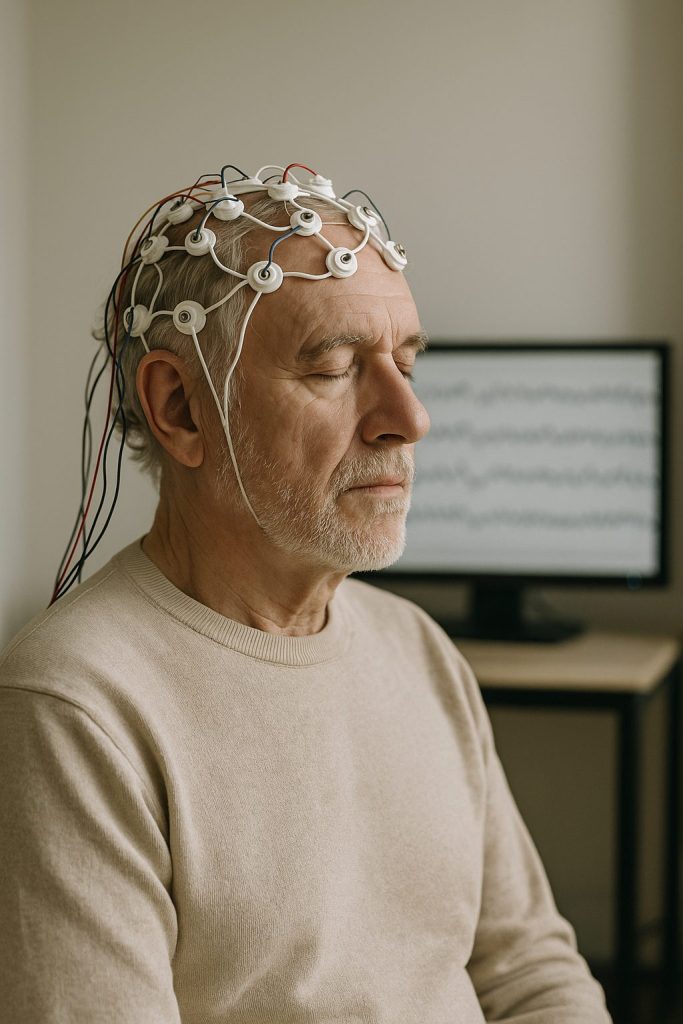
This distinction matters when we think about the subconscious. Even when conscious attention appears to dominate during waking life, the brain as a whole does not truly switch off. Different forms of activity continue in the background, shaping perception, regulation and mental state in ways that are not always immediately accessible to awareness.
Berger’s contribution was especially important because EEG offered a way to observe rhythmic electrical activity without relying only on introspection. That methodological shift mattered greatly. Once brain activity could be recorded directly, the idea of a continuously active nervous system became less speculative and more open to systematic investigation.
Although early interpretations of brain waves were necessarily limited by the tools of the time, Berger’s work helped lay the foundations for later distinctions between alertness, drowsiness, sleep stages and altered states of attention. In other words, the study of subconscious processes did not begin with abstract theory alone; it developed alongside increasingly precise ways of measuring brain activity.
What later research revealed about resting brain activity
Many years later, research led by the neurologist Marcus E. Raichle at Washington University School of Medicine gave much stronger support to this view. His findings suggested that the brain’s energy use during active, goal-directed mental work rises by only a little under 5% compared with its energy use at rest. In other words, even outside periods of targeted thinking, the brain is already operating at a remarkably high level.
These experiments helped show that the brain remains functional almost constantly, including when a person is not engaged in a specific task. This does not mean that conscious and unconscious processes are identical, but it does suggest that so-called resting states are anything but empty. From a scientific perspective, this ongoing background activity may help explain why subconscious processes continue to influence our reactions, associations and inner experience, even when we are not deliberately thinking about anything in particular.
Later work on the default mode network added further nuance to this picture. Rather than treating rest as a simple absence of mental work, researchers began to identify organised patterns of activity associated with self-referential thought, autobiographical memory, internal simulation and spontaneous mentation. These findings do not map perfectly onto the everyday idea of the subconscious, but they do support the broader claim that the resting brain remains structured, active and psychologically meaningful.
This is also why moments of apparent idleness can still be mentally productive. During quiet wakefulness, the brain may continue consolidating information, linking past and present experience, rehearsing social scenarios or updating internal models of the world. Such processes often occur without deliberate effort, yet they may shape later decisions, interpretations and emotional responses in subtle but significant ways.
Importantly, none of this implies that every spontaneous thought carries deep hidden meaning. A scientific view remains more restrained. The point is not that all background activity is revelatory, but that resting activity is real, metabolically costly and functionally relevant to cognition and self-regulation.
- EEG helped make continuous brain activity observable
- Berger proposed the idea early, before it was fully recognised
- Raichle’s work showed that ‘resting’ brain activity still consumes substantial energy
How the Subconscious Shapes Thought, Emotion and Behaviour
A hidden system involved in everyday mental life
The subconscious is involved in far more aspects of daily life than we often realise. Research suggests that this less visible layer of mental activity contributes to self-related information such as the way we gather facts and memories about ourselves, but also to emotion, judgement, mood, concept formation and moral reasoning. It is also linked to how we think about other people, how we interpret their emotions and how we draw on detailed episodic memory when recalling specific events from the past.
Seen in this light, the subconscious is not a vague or secondary force. It appears to participate in a wide range of processes that support perception, interpretation and inner regulation, often outside deliberate awareness. Many of our conscious reactions may therefore be influenced by experiences, associations and patterns that were formed earlier and stored below the surface of attention.
One useful way to understand this is through the distinction between fast and slow processing. Some evaluations occur rapidly and automatically, drawing on prior learning, emotional salience and contextual cues before reflective thought has time to intervene. Conscious reasoning may then refine, correct or justify these initial tendencies, but it does not always generate them from nothing.
This can be observed in ordinary life. We often recognise a face before recalling where we know it from, feel tension before identifying its source, or form an impression before we can explain it. These are not signs of irrationality in themselves. They illustrate how subconscious processing may prepare the ground for conscious interpretation, sometimes helpfully and sometimes with bias.
For that reason, scientific interest in the subconscious also overlaps with research on heuristics, implicit memory, emotional learning and attentional bias. These domains do not all refer to the same mechanism, yet together they suggest that a substantial part of mental life is shaped by processes that remain only partly accessible to introspection.
- self-related information and personal memory
- emotion, mood and judgement
- social perception and the reading of others’ emotions
- moral reasoning and recall of past events
When hidden processes become more noticeable
From a physiopathological perspective, subconscious processes are also associated with a number of disorders, including Alzheimer’s disease, autism, schizophrenia, depression, chronic pain and post-traumatic stress disorder. Studies have also identified weaker connectivity between certain brain regions in people who have experienced long-term trauma. This may be seen, for example, after childhood abuse or neglect, which can contribute to dysfunctional attachment patterns and leave lasting traces in the brain’s less conscious modes of regulation.
That said, these hidden processes are not always entirely inaccessible. In states of deep relaxation, when conscious mental activity becomes quieter, the activity of the default mode network may become more perceptible to awareness. During meditation, focused attention or moments of calm reflection on intuition, some people may notice thoughts, impressions or emotional signals that seem to emerge from this deeper layer. These messages should not be treated as absolute truths, but they can offer useful clues drawn from past experience and may help us better understand the roots of certain conscious reactions as we make choices about the future.
Trauma research is especially relevant here because repeated stress can alter patterns of vigilance, emotional prediction and bodily regulation. In such cases, subconscious processing may become biased towards threat detection, even in relatively safe environments. A person may therefore react strongly before conscious appraisal has had time to evaluate the present situation accurately. This does not reflect weakness; it reflects learned adaptation that may persist beyond the conditions that originally required it.
Similarly, in depression or chronic pain, background processing may influence attention, expectation and interpretation in ways that reinforce distress. Again, caution is needed: these conditions are complex and cannot be reduced to subconscious mechanisms alone. Yet the involvement of less conscious patterns helps explain why symptoms may feel persistent even when a person is trying, consciously and sincerely, to think differently.
Quieter practices such as meditation, breath regulation or sustained reflective attention are often sought for this reason. They may help reduce cognitive noise, making certain emotional or associative patterns easier to notice. What emerges in these states should not be idealised, but it can sometimes provide a more workable view of what the mind has been processing in the background.
In practical terms, this means that becoming aware of subconscious influences is less about uncovering a hidden oracle than about improving self-observation. The aim is not certainty, but better discernment: noticing recurring reactions, tracing emotional patterns and understanding how past experience may still be shaping present behaviour.
The Mental Waves Conscious-to-Subconscious Reset Framework
The Mental Waves approach is to observe the subconscious without dramatising it. A mental reset does not force hidden material to appear; it lowers surface noise so thoughts, emotions and body signals can be noticed with more space.
- Reduce input: pause screens, alerts and mental multitasking for a few minutes.
- Use sound as an anchor: let one simple listening cue keep attention steady.
- Name the pattern: write one sentence about what keeps repeating in thought or emotion.
- Choose one grounded action: turn insight into a small behaviour, not a grand interpretation.
For a broader map of brain states, continue with You and Your Brainwaves.
The Mental Waves Subconscious Observation Framework
The Mental Waves frame is to observe subconscious processes without turning them into a mystery box. Background mental activity can influence feeling and behaviour, but it still benefits from humility and evidence.
Useful practice begins with noticing: what repeats, what triggers emotion, what becomes easier in relaxation, and what changes when attention becomes steadier.
If you want a simple way to observe your inner state before deeper reflection, begin with the free Mental Reset session.
Editorial note from Mental Waves
This article is educational and does not diagnose subconscious processes, trauma, neurological disease or mental-health conditions. Clinical concerns should be discussed with a qualified professional.
Conclusion
Scientific research does not reduce the subconscious to a vague or secondary idea. It suggests, more carefully, that a large part of mental life unfolds outside deliberate awareness, within a brain that remains active even when attention appears to rest. From early EEG observations to later work on resting brain activity, the same thread emerges: what is not fully conscious is not therefore inactive. It may still shape perception, memory, emotional tone and many of the reactions we later experience as immediate or obvious.
That is also where the subject asks for nuance. The subconscious should neither be romanticised nor dismissed. It is associated with essential forms of regulation and self-processing, but it is also implicated in forms of psychological suffering when patterns become disrupted, especially in the aftermath of trauma or long-term stress. In quieter states such as deep relaxation, meditation or sustained inward attention, some of these background processes may become more perceptible — not as infallible messages, but as signals worth noticing with care.
To take the subconscious seriously, then, is not to abandon science for mystery; it is to recognise that the mind is often deeper, subtler and more continuously active than conscious thought alone would suggest.
A rigorous view leaves room for both humility and relevance. We still do not possess a complete theory of how subconscious processing is organised across all domains of cognition, emotion and self-awareness. Even so, the evidence already available is enough to challenge simplistic models of the mind. The brain does not wait passively for consciousness to direct it; much of its work is already underway, quietly shaping the conditions in which conscious life unfolds.
Frequently Asked Questions About Scientific Research on the Subconscious
What does the subconscious mean in scientific research?
In this context, the subconscious refers to mental processes that influence emotion, memory, perception and behaviour without being fully present in conscious awareness.
Does the brain really stay active at rest?
Yes. The article explains that the resting brain is not inactive. Even when attention feels quiet, the brain continues organising information, memory, emotion and internal signals.
Why is Hans Berger important here?
Hans Berger helped open the study of electrical brain activity. His work gave researchers a way to observe rhythms linked to wakefulness, rest and changes in mental state.
How can subconscious processes affect behaviour?
They may shape emotional reactions, habits, memories and first impressions before conscious reasoning fully catches up. This can make some reactions feel sudden or difficult to explain.
Can meditation or relaxation reveal subconscious patterns?
Quiet practices can make recurring thoughts and feelings easier to notice, because surface mental noise is reduced. That does not mean every image or feeling should be taken literally.
Is the subconscious always right?
No. Subconscious material can be useful, but it can also reflect fear, habit, old stress or incomplete information. It is better treated as a signal to examine than as an automatic truth.
What does a mental reset have to do with the subconscious?
A mental reset creates a quieter inner setting. With less noise, it can be easier to notice repeated patterns in thought, mood and body sensation without forcing an interpretation.
Can trauma influence subconscious reactions?
Long-term stress or trauma can shape automatic reactions and emotional triggers. When those reactions are intense or disruptive, support from a qualified professional is important.
What is the main takeaway from subconscious research?
The main takeaway is that hidden brain processes matter, but they need careful interpretation. The subconscious is not mystical proof; it is part of a complex, active mind.