en
enVotre panier est vide.


Among all the structures found in nature, the human brain remains one of the most intricate. Its role in linking body and mind has long given it an almost mysterious status, which helps explain why reflection on the psyche reaches back to Antiquity. Over time, that enquiry became more precise through the work of figures such as Vesalius and Pinel, and in recent decades it has taken a decisive turn with the rise of neuroscience. Driven by major advances in medical imaging and brain exploration, this field is now often presented as one of the defining sciences of the 21st century.
Some researchers see in it the beginnings of a new era centred on desire, memory and consciousness; others remain more cautious. What is clear, however, is that the study of the brain has reopened questions that are not only biological, but also deeply human.
In short: what connects neuroscience and Buddhism?
Neuroscience and Buddhism meet around attention, emotion, meditation and the study of consciousness. Neuroscience observes brain and behaviour; Buddhism offers contemplative methods and philosophical models of mind. The richest dialogue keeps both languages distinct.
- Meditation gives researchers a practical field of study.
- Brain science can observe attention and emotional regulation.
- Buddhist psychology offers refined descriptions of inner experience.
- Neither tradition should be reduced to the other.
For a research-focused companion, read Meditation and the Brain. For a free contemplative sound cue, receive the Sacred Frequency Session.
That is where the meeting between neuroscience and Buddhism becomes especially striking. Once thought to belong to entirely separate worlds, science and spirituality began to move into more direct conversation in 1987, when the lawyer Adam Engle proposed building a bridge between them. The aim was not to blur their differences, but to explore whether meditation and mental functioning might be meaningfully related. Buddhist practitioners even took part in laboratory-based neuroscientific experiments, an unexpected development at the time. The findings remain partial, and any conclusions should be approached with care, yet the dialogue itself appears promising: not because it settles everything, but because it invites a more rigorous and more nuanced understanding of the mind.
What Neuroscience Really Covers
A broad science of the nervous system
In the strict sense, neuroscience is the field devoted to studying the nervous system. That definition is deliberately broad: it includes all the disciplines that examine how nerves, brain structures and neural regulation work, from the most visible anatomical organisation to the finest cellular and molecular mechanisms. This is why neuroscience brings together areas as varied as neuroanatomy, neurobiochemistry, neurophysiology, neuroendocrinology, and research focused on cells and molecules. Far from being a single narrow speciality, it is better understood as a scientific landscape built around one central question: how does the nervous system function?
In practice, however, the word is often used as shorthand for cognitive neuroscience. This branch emerged in the United States in the late 1970s and developed at the meeting point between neurobiology and psychology. Its aim is to understand the workings of the brain and the mind through scientific methods, using observation, experimentation and measurable data rather than speculation alone. In that respect, neuroscience continues a much older effort to clarify the links between body, perception, thought and behaviour, but with tools and standards that are far more precise.
- Neuroanatomy
- Neurophysiology
- Neuroendocrinology
- Cellular and molecular neuroscience
From cognitive science to the study of emotion
The intellectual forerunner of this field is generally found in the movement known as cognitive science, which sought to explain psychological processes through experimentation and the observation of behaviour. Neuroscience extends that ambition by linking those observable processes to brain activity itself. This is also where it differs from neuropsychology: while the two fields overlap, neuropsychology is more directly oriented towards pathological conditions and the consequences of brain dysfunction, whereas neuroscience has a wider scope and is not limited to illness.
Over time, the field has also widened beyond cognition in the narrow sense. Researchers no longer focus only on memory, reasoning or perception, but also on emotion and affective life. This development has given rise to affective neuroscience, which explores how emotional states are regulated, expressed and linked to brain function. That shift matters, because it reflects a more complete view of mental life: understanding the brain is not only about knowledge and information processing, but also about feeling, motivation and the subtle dynamics that shape human experience.
How the Brain Develops, Connects and Adapts
From genetic blueprint to the human brain
One of the most important insights in modern neuroscience is that the development of the nervous system in every animal species is inseparable from a genetic programme. During the embryonic stage, the genome helps to direct cell growth and proliferation, while also shaping the size and form of organs, including the brain and its connections. In that sense, just as so-called architectural genes help organise the body, developmental genes play a central role in the formation of the brain. This highlights both a shared organisational logic across living beings and clear neuroanatomical differences between species, even though, within a given species, the brain tends to follow the same overall plan.
In humans, however, the brain is still far from fully mature at birth. It continues to develop under the influence of the social environment and through the ongoing growth of connections between brain regions. Researchers have also shown that the human brain differs markedly from that of other animals, notably in its weight, volume, pattern of growth and the development of the cortex. These distinctions matter because they help explain why the human brain supports such a wide range of cognitive, emotional and relational capacities.
- Embryonic development is guided by the genome
- The human brain continues maturing after birth
- Cortical development is a major point of difference from other species
Neurons, synapses and the chemistry of mental life
The modern science of the brain is often traced back to the discovery of its basic functional unit: the neuron. In both humans and animals, neurons exist in vast numbers and form networks that communicate through synapses by means of electrochemical signals. These synapses, which act as contact points between neuronal endings, are fundamental to brain function. It is here that neurotransmitters are released and act on specific receptors, generating signals that may either stimulate or inhibit activity. A single human neuron may form well over a thousand synapses, and these connections can multiply, change or disappear to a remarkable degree.
This is one of the clearest expressions of neuroplasticity, the brain’s capacity to adapt after illness or in response to sustained mental training.
Neuroscience has also shown how deeply brain function depends on hormones and neurotransmitters at the molecular level. Among the best known are acetylcholine, adrenaline, noradrenaline, dopamine, serotonin, glutamate and endorphins. Endorphins, noradrenaline and dopamine are involved in reward and desire, while serotonin is strongly associated with the regulation of mood, depression, anxiety, bulimia and violent impulses. More broadly, the nervous system plays a major part in controlling hormone secretion through the hypothalamus and the pituitary gland, while hormones in turn influence brain function by helping regulate vital processes and emotional states. In practice, this means that pleasure and displeasure are not isolated mechanisms, but part of a dynamic balance that shapes behaviour, motivation and inner stability.
- Neurons communicate through synapses
- Signals may be excitatory or inhibitory
- Neuroplasticity helps explain adaptation and learning
- Hormones and neurotransmitters influence emotion and vital regulation
How Neuroscience Explores the Living Brain
Two main ways of observing brain activity
Since the 1980s, techniques for exploring the living brain have advanced considerably. This progress has transformed the way neuroscience approaches one of the body’s most complex organs. Broadly speaking, these methods fall into two major families. The first measures local blood flow, notably through positron emission tomography and medical imaging, in order to estimate the intensity of brain activity in specific regions. The second focuses on electrical or magnetic signals, as with magnetoencephalography, to identify the activity of neuronal networks more directly.
These approaches do not provide exactly the same kind of information, which is why they are often seen as complementary rather than interchangeable. Some methods are better at locating where activity is taking place, while others are more useful for following how quickly that activity unfolds. In practice, this distinction matters a great deal when researchers are trying to understand perception, attention, emotion or changing mental states in real time.
- Blood-flow methods help locate active brain regions.
- Electrical and magnetic measures help track network activity.
- Each technique reveals only part of the overall picture.
What each technique can and cannot show
Each tool comes with clear strengths and limitations. Positron emission tomography, for example, offers only limited resolution and requires a relatively long measurement time, which makes repeated examinations more difficult. Functional magnetic resonance imaging provides much finer spatial resolution, but its measurement window still remains slow in relation to the speed of actual brain activity. By contrast, the electroencephalogram records signals that are extremely rapid compared with neuronal events, even if its spatial resolution is weaker. To improve precision, researchers can increase the number of electrodes and use software-based modelling to estimate activity in deeper or more distant brain areas.
Even so, interpreting the results is rarely straightforward. A given mental function does not usually depend on a single isolated point in the brain, but on a network involving several regions working together. That is why neuroscientific imaging must be handled with caution: it can illuminate patterns of regulation and activity, but it does not reduce thought, emotion or consciousness to one simple location. The real challenge is not only to record signals, but to understand how distributed brain systems interact.
Why Emotions Matter So Much in the Brain
More than feelings: emotions shape the whole mental landscape
Among all brain activities, emotion holds a central place because it acts on the mind and body as a whole. It often influences judgement more powerfully than reason alone, which helps explain why our reactions are not always purely logical. Yet emotion should not be reduced to something disruptive or irrational. It is also what underpins joy, love, creativity and poetry — in other words, much of what feels most deeply human. Even if modern surgery can now replace certain organs with implants or prostheses, the idea of creating an artificial brain capable of truly artificial emotions still remains highly uncertain.
That said, emotions can also become difficult when they turn destructive, negative or hard to regulate. From a neuroscientific point of view, they are not produced by a single centre but by the coordinated activity of several brain regions working together. This is why emotional life can be so rich, so subtle and, at times, so overwhelming.
- They can guide behaviour faster than deliberate reasoning.
- They support attachment, motivation and creative expression.
- They may also become harmful when they are excessive or uncontrolled.
The brain circuits involved in fear, memory and emotional balance
Anatomically, emotional processing involves a network that includes the prefrontal cortex, the insular lobe, the hypothalamus, the pons and the midbrain. Two structures are especially important here. The first is the amygdala, an almond-shaped nucleus located in the lower part of the temporal lobes, which plays a major role in negative emotions such as fear. Just behind it lies the hippocampus, an elongated structure linked to memory and to recognising context. This contextual role matters greatly, because the brain does not respond to an emotion in the abstract: it interprets a situation in relation to memory, environment and past experience.
When the hippocampus functions poorly, emotional regulation may also be affected, and this has been associated with conditions such as depression and post-traumatic stress. This does not mean that every emotional difficulty can be reduced to one isolated structure, but it does show how closely memory, context and feeling are intertwined in the brain. In practice, neuroscience suggests that emotions emerge from a dynamic balance between alert systems, bodily signals and higher regulation — a balance that can support adaptation in some situations, yet become fragile in others.
Why Survival Emotions Act Before We Think
The brain’s fastest emotional responses
Specialists usually distinguish a group of primary emotions that are basic, deeply rooted and also found in animals. These include hunger, thirst, breathing, the need to relieve oneself and sexual drives linked to the continuation of the species. They are regulated by centres located deep within the brain, where their role is not to produce reflection but to trigger an appropriate response quickly enough to support survival.
That is why, in an animal, fear prompted by a noise, a smell or an immediate threat can produce a defensive reaction in a fraction of a second, whether that means fleeing or fighting. In this sense, the brain is organised to act with remarkable efficiency. A classic example is the mouse that sees a snake: the image registered on the retina is relayed to the thalamus and the amygdala, prompting escape before the message has even reached the occipital cortex, where the snake would be consciously identified.
- Primary emotions are rapid and adaptive.
- They rely on deep brain centres rather than deliberate thought.
- Their first purpose is survival, not conscious analysis.
Why the body reacts before emotion becomes clear
This also helps explain a familiar human experience: sometimes the body reacts before the mind has fully named what is happening. A racing heart, sweating or pain in the stomach may simply reflect activation of the autonomic nervous system, even when we do not yet have a precise awareness of the emotion involved. From a neuroscientific point of view, these bodily signals are not incidental; they are part of the emotional response itself.
Seen in that light, an emotion that feels negative is not necessarily harmful in itself. Depending on the context, fear, tension or alarm may in fact play a protective role by helping preserve life and prepare action. An emotion only becomes truly maladaptive when it no longer fits the situation it is responding to. This more nuanced view is important, because it reminds us that the brain’s emotional machinery is not designed simply to make us feel good, but to keep us safe, alert and capable of responding to the world around us.
How the Brain Regulates Emotion
When an emotion becomes maladaptive
From a neuroscientific point of view, an emotion is not automatically ‘negative’ simply because it feels unpleasant. It becomes truly problematic when it no longer fits the situation. That is often the case with phobia: the response is disproportionate, poorly reasoned and disconnected from the real context. In this framework, such reactions may be linked to a functional disturbance involving the hippocampus, a structure already associated with memory and contextual recognition.
This distinction matters because it shifts the question. The issue is not only whether fear, anxiety or distress are present, but whether the brain is still regulating them in a way that remains adapted to reality. Seen in that light, emotional balance depends less on suppressing emotion altogether than on the brain’s ability to place it in context, modulate its intensity and prevent it from overwhelming behaviour.
The medial frontal lobe and the prefrontal brake on anxiety
To understand how this regulation works, it is essential to look at the medial frontal lobe. Broadly speaking, it includes a posterior part, with motor and premotor areas, and an anterior part: the prefrontal zone. This anterior region contains the cingulate gyrus, an anterior polar area and a ventromedial area. The anterior pole is closely linked to cognitive function, especially planning and the setting of goals, which in turn help to sustain motivation and will.
The ventromedial prefrontal cortex, however, plays a particularly important role in emotional life. When this area is disrupted, serious difficulties may appear, including problems expressing emotions or keeping them under control. In practical terms, the amygdala helps trigger emotional responses, while the prefrontal cortex and the hippocampus contribute to regulating them. The prefrontal cortex has especially rich connections with the amygdala and can inhibit part of its activity. This helps explain why, in states of anxiety, increased ventromedial prefrontal activity may reduce the emotional surge. According to the perspective outlined here, the left side of this system appears especially involved in maintaining positive emotions.
- The anterior pole supports planning and goal-setting.
- The ventromedial prefrontal cortex is central to emotional regulation.
- The amygdala triggers emotion, while prefrontal regions can help dampen it.
Temperament, resilience and the brain’s emotional balance
Why some emotional styles seem more stable than others
The right side of the prefrontal system is generally associated more strongly with negative emotions, whereas a more marked activity on the left side tends to be linked with a more positive emotional tone. In practical terms, this helps explain why some people appear naturally more optimistic, lively and forward-moving, while others are more often inclined towards apathy, pessimism or sadness. This does not mean personality is fixed in a simplistic way, but it does suggest that emotional style may rest partly on identifiable patterns of brain activity.
In everyday life, we all encounter temperaments that seem to remain relatively stable despite changing circumstances. From a neuroscientific perspective, this may reflect the fact that each person begins life with a distinct biological profile: a balance of predispositions shaped in part by genes, then gradually modulated by experience. In that sense, temperament is neither purely innate nor entirely acquired. It is better understood as a dynamic baseline, one that can evolve, but not always to the same degree in everyone.
- Greater left prefrontal activity is often associated with a more positive emotional style.
- Greater right prefrontal dominance is more often linked with negative affect.
- Experience can reshape these tendencies, even if it does not erase them completely.
Resilience as the speed of emotional recovery
This difference becomes especially visible after a major shock, such as a serious accident or the loss of a loved one. Some individuals recover more quickly than others, and one useful way of understanding this is through the idea of recovery time: the period needed for the neuropsychological state to return to its previous balance after a negative emotion. Research suggests that the shortest recovery times are often found in people whose amygdala activation remains lower than the activity of the left prefrontal cortex. These individuals may be better able to regulate emotion, contain fear and keep anger within manageable limits.
Seen in this light, resilience is not simply a matter of willpower. It is also associated with how efficiently the brain’s emotional circuits regain equilibrium after stress. This helps clarify why two people exposed to a similar ordeal may not recover in the same way or at the same pace. The underlying message is a careful one: biology matters, but it does not act alone. What we inherit may shape our starting point, while lived experience can still influence how emotional regulation develops over time.
Emotional Recovery, Stress Hormones and the Body’s Capacity to Rebalance
Why cortisol recovery matters after stress
Another important marker is the level of cortisol in the blood, a hormone released during stress under the influence of brain activity. In people who recover more quickly after an emotional shock, this level tends to remain relatively low and, above all, returns rapidly to its baseline state. That faster return appears to reflect a more efficient form of emotional regulation, in which the brain and body are able to settle again after a difficult experience rather than remaining on prolonged alert.
In the opposite pattern, cortisol levels can stay elevated for much longer. This prolonged stress response is associated with cellular deterioration in the hippocampus, a region already implicated in memory, context recognition and emotional balance. These observations have notably emerged from the study of people affected by post-traumatic stress and depression. They suggest, with appropriate caution, that the duration of the stress response may matter just as much as its initial intensity.
- Lower cortisol levels are often associated with faster recovery.
- Persistently high cortisol is linked to prolonged stress states.
- The hippocampus appears particularly vulnerable in this context.
From neural repair to broader physical protection
Fortunately, these neurons also show a remarkable capacity to regenerate and multiply, even later in life, although this generally depends on suitable care and treatment. That point is important, because it tempers any overly fixed view of emotional fragility. A difficult neuropsychological state does not necessarily mean irreversible damage; the nervous system retains a degree of plasticity that may support recovery when the right conditions are in place.
The benefits of better emotional regulation may also extend beyond the brain itself. People with stronger recovery capacities appear to show a more pronounced immuno-protective function, meaning their immune cells may be more effective in defending the body against infectious agents from the outside environment, and even against certain abnormal cells arising within the body itself. In that sense, balanced emotional regulation is not only a matter of mental comfort: it is also closely tied to physical health and overall wellbeing.
How Emotion Shapes Intelligence and Human Connection
Why thinking is never entirely separate from feeling
The possible link between emotion and intelligence has been explored by a number of researchers, notably the neurologist Antonio Damasio and the psychologist Daniel Goleman. Their work helped to show that the frontal lobe is not only central to basic cognitive intelligence, but also deeply involved in the way we process and regulate emotion. In other words, reasoning does not operate in a sealed compartment: our decisions, judgements and motivations are often influenced by emotional signals long before we describe them in words.
Experiments in this field suggest that emotional life can exert a powerful influence on human cognition, sometimes to the point of becoming decisive in the positions we take. This is why some authors speak, cautiously, of an intelligence of the “heart”: not as a mystical idea, but as a way of recognising that feeling and thought are closely intertwined. In that perspective, intellectual quotient alone no longer seems sufficient to explain personal or professional success. The notion of emotional intelligence, or emotional quotient, emerged precisely to account for this broader capacity to perceive, understand and manage emotions in oneself and in others.
- cognitive intelligence and emotional processing both involve the frontal regions
- emotion can guide judgement, motivation and decision-making
- success cannot always be reduced to IQ alone
Mirror neurons, imitation and the roots of empathy
Any discussion of neuroscience and emotion also leads to the discovery of mirror neurons, identified in the 1990s by Giacomo Rizzolati and his colleagues at the University of Parma. Their experiments showed that when activity was recorded in groups of neurons in a monkey’s frontal lobe, similar patterns appeared both when the animal performed an action and when it simply watched the same action being carried out. A comparable mirror effect has also been described in humans when we observe a movement or witness the expression of an emotion.
This helps explain why merely watching an action may already prepare the brain to reproduce it, and why recognising an emotion in someone else can begin to make us feel something of it ourselves. Such findings shed light on our everyday tendency to imitate one another, and they offer one possible explanation for conformity, crowd behaviour, the spread of violence and the harmful impact that excessively violent films may have on young people. Yet the same mechanism also points in a more hopeful direction: it may contribute to our capacity for understanding, empathy and compassion, by making the emotional states of others more immediately accessible to us.
Where Neuroscience and Buddhism Begin to Meet
Two traditions that seem far apart, yet share real points of contact
At first glance, bringing neuroscience and Buddhism into the same conversation can seem almost improbable. One belongs to the world of laboratories, observation and measurement; the other to spiritual practice, inner discipline and the search for awakening. Yet once the comparison is approached carefully, the distance between them appears less absolute than it first seems. Without confusing their methods or their aims, it is possible to identify several genuine points of convergence, especially at a theoretical level.
Buddhist texts insist that being born human is already something rare, and that encountering the Buddha’s teaching is rarer still. In a Sutra linked to the Lotus tradition, the Buddha uses the well-known parable of the turtle to illustrate just how difficult it is to obtain a human birth. That rarity matters because human life is presented as a unique opportunity: it gives one the possibility of cultivating wisdom, or pañña, and even of realising awakening, bodhi. Seen from this angle, the human condition is not ordinary at all, but precious and demanding.
- Neuroscience studies the nervous system through scientific methods.
- Buddhism explores the mind through disciplined observation and practice.
- Both, in different ways, take human experience seriously.
The rarity of human life and the singularity of the human brain
Science, in its own language, also presents life as an exceptional event. The appearance of a human being is the outcome of a long and fragile process: the meeting of sperm and ovum, the formation of the egg, the gradual development of the embryo, and the many stages that must unfold successfully before birth can occur. More broadly, this individual story is set within a far longer one: an evolutionary history extending across nearly a billion years, through countless generations in which genes were transmitted, altered and refined. In that sense too, human life may be understood as the result of an extraordinarily improbable chain of conditions.
Within the animal world, the human being is also distinguished by an organ of remarkable complexity: the human brain. It forms a vast living network made up of hundreds of billions of neurones and around a million billion synapses, all interacting continuously. Its most striking feature is not only its scale, but its plasticity — its capacity to reorganise, adapt and be shaped by experience. This does not prove that neuroscience and Buddhism say the same thing. It does, however, help explain why dialogue between them has become possible: both recognise that human existence is rare, that the mind can be transformed, and that the brain is central to that transformation.
Interdependence, Compassion and a Shared View of Life
A universe understood through relationships
One of the central lines of thought in Buddhism is paticca-samuppada, usually translated as dependent origination or conditioned arising. The idea appears throughout many sutras in a simple but far-reaching form: when one thing exists, another comes into being; when one condition is absent, the related phenomenon does not arise. At its heart, this is a vision of interdependence, in which nothing is fully isolated and everything takes shape through interaction.
That perspective may sound philosophical, yet it resonates in a striking way with modern neuroscience, and even with parts of contemporary physics. The nervous system itself is organised as a vast, dynamic network of cells, nuclei, fibres, receptors and neurotransmitters, all influencing one another while transmitting information in both directions. In that sense, Buddhism and neuroscience can be seen as sharing a broadly holistic intuition: to understand any living process, we often need to look not at a single element in isolation, but at the web of relations that gives it meaning and function.
- Paticca-samuppada: phenomena arise through conditions
- Neuroscience: brain function depends on interacting networks
- Common ground: both favour a relational rather than isolated view of life
From universal compassion to biological kinship
Buddhism also places strong emphasis on metta, or universal loving-kindness, and karuna, compassion. This moral orientation rests on the recognition that human beings are sensitive creatures, deeply connected to other forms of life. A sutra devoted to compassion evokes the care one should extend to all beings, in the same spirit as a mother cherishing and protecting her child. In another text, the Diamond Sutra broadens that horizon still further by encouraging the guidance of all beings towards Nirvana, whatever their origin, whether born from eggs, moisture or embryos. The underlying message is clear: life deserves regard beyond the narrow limits of our own species.
Science, from its own angle, points towards a related conclusion. In tracing the evolution of life on Earth back to the first viable cell more than three billion years ago, biology shows how common genes were repeatedly modified across immense stretches of time, eventually giving rise to many animal species, including our own. The genetic gap between humans and other animals is smaller than we often imagine: mammals share more than 3,000 genes, humans share up to 98% of their genes with several animal species, and around 99% with great apes such as chimpanzees and gorillas. Even the difference between humans and mice is said to involve only around 300 genes.
These figures support the idea of a distant but real kinship between humans and other animals. If human beings are the most intelligent and the most capable of transforming their environment, that capacity may also imply a greater responsibility towards other species and towards the shared territory we all inhabit: the Earth.
Mind, Impermanence and the Question of the Self
Why the mind holds such a central place
In Buddhist thought, the mind occupies a decisive place. The very first verse of the Dhammapada states that all things are preceded by the mind, shaped by it and governed by it. The same emphasis appears in other major texts. In the Lankavatara Sutra, for instance, the practitioner is encouraged to take the mind as master in order to approach the Dharma. A similar idea is found in the Surangama Sutra, where the origin of things is traced back to the ground of mind itself. Taken together, these teachings present inner life not as a secondary aspect of existence, but as the very field in which experience takes form.
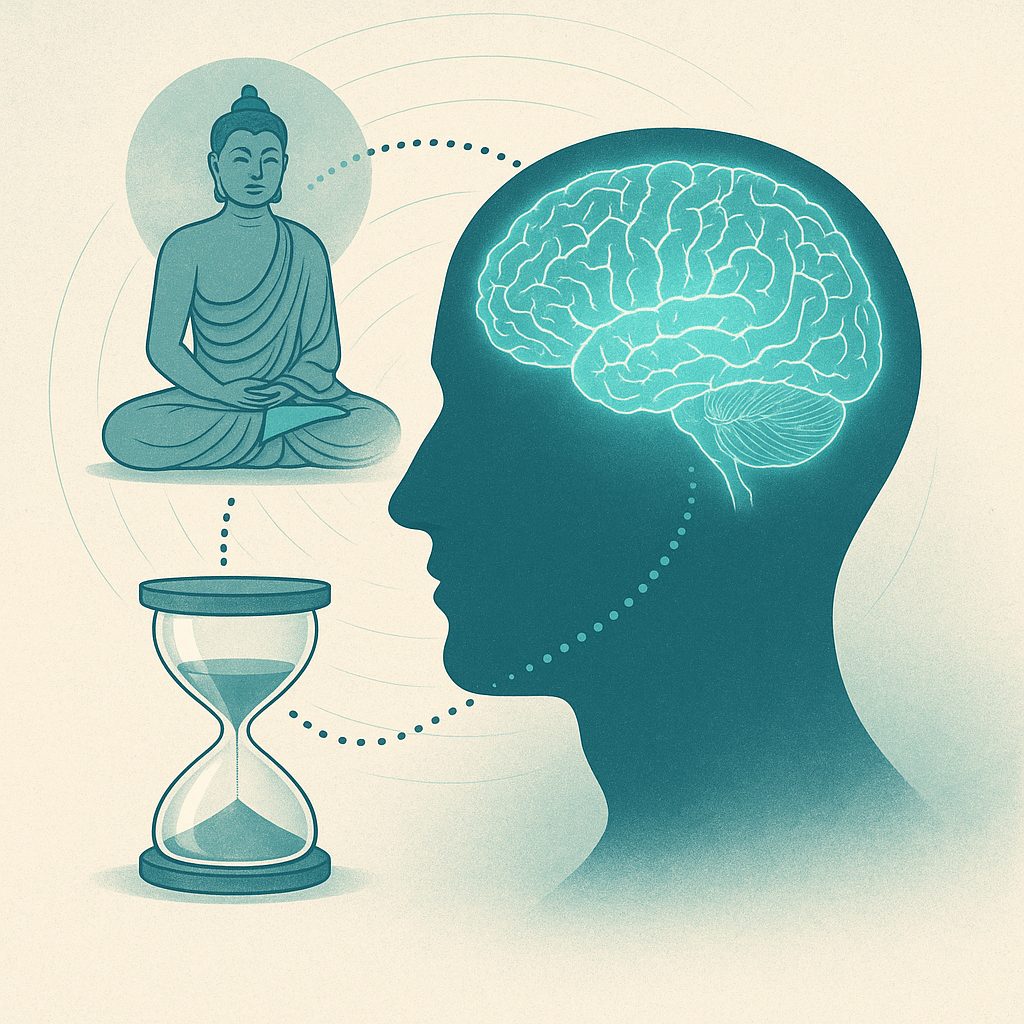
From a neuroscientific perspective, the language is different, yet the centrality of mental activity remains striking. It is difficult to imagine any meaningful relation between a living being with a nervous system and its environment without brain activity. That activity helps organise physical life, social behaviour and psychological functioning. It is also why, in modern medicine, death is generally understood as the definitive cessation of brain function, with the destruction of neurons that follows. Neuroscience does not speak in the language of Dharma, but it does confirm in its own way that our contact with the world depends profoundly on the activity of the brain.
A changing brain and a self without a fixed centre
The two traditions also meet around the idea of change. In Buddhism, every phenomenon is marked by impermanence: nothing remains fixed, and everything is subject to continual transformation. Neuroscience arrives at a comparable observation through another route. Brain activity continues even during sleep, and the brain is constantly reshaping itself, forming certain synapses, weakening others and sometimes allowing some to disappear. This ongoing reorganisation underlies neuroplasticity, which may help explain the brain’s remarkable capacity for adaptation, whether through experience, learning or sustained mental training. Even gene expression, once thought to be more rigid, can still be modified over time by life history and environment.
Buddhism extends this logic of impermanence to the person as well, through the doctrine of anatta, or non-self. In this view, there is no permanent, independent “I” hidden behind experience. What we call the self is a temporary aggregation of five components: form (rupa), sensations (vedana), perception (sañña), volitions (sankhara) and consciousness (viññana). Here again, neuroscience offers an intriguing parallel. These dimensions of experience can be related to patterns of activation across different brain regions, yet no single area can be identified as the sole seat of consciousness or the unique centre of the self.
In that sense, modern brain science does not validate Buddhist doctrine as such, but it does suggest that the self may be less solid, less localised and less fixed than everyday intuition would lead us to believe.
- Buddhism: the mind shapes experience, and all phenomena are impermanent.
- Neuroscience: brain activity is continuous, adaptive and distributed rather than centred in one single “self” region.
Perception, Suffering and the Brain’s Capacity to Change
Why both Buddhism and neuroscience question our grasp of reality
In Buddhist thought, human beings are continually exposed to forms of illusion. These distorted perceptions arise from ignorance and are said to obscure the mind’s luminous nature. Many phenomena are therefore understood as lacking any fixed, self-grounded reality. As the Diamond Sutra suggests, whatever has form can also mislead, which is why conditioned events are often compared to dreams, magic or a fragile bubble. Although neuroscience speaks in a very different language, it also shows that our relationship with reality is never immediate or perfectly transparent.
From a neuroscientific point of view, we do not encounter the world directly, but through signals processed by networks of neurones. Sensory information is filtered according to its intensity, then analysed, organised and interpreted by the brain before it becomes conscious perception. Even memory can be altered by emotion at any moment. Apart from optical illusions, which often follow physical laws, ordinary perception itself is already a construction. Between the instant an image lands on the retina and the moment it is recognised by consciousness, a delay occurs, and what finally appears in awareness is no longer the object in its raw state.
In that sense, the only reality the brain perceives directly is, strictly speaking, its own activity.
- Buddhism describes distorted perception as a source of ignorance.
- Neuroscience shows that perception is built through neural processing.
- Emotion can reshape both interpretation and memory.
From emotional suffering to mental training and neuroplasticity
These parallels help explain why Buddhism places emotions at the centre of human suffering. The primary fact of existence is dukkha, often understood as suffering or unsatisfactoriness, and it is this that drives the search for liberation. In Buddhist teaching, this is one of the great marks of existence, alongside anicca and anatta. Human beings suffer through inner disturbances and defilements carried by destructive emotional states such as greed (lobha), anger (dosa) and ignorance (moha). Neuroscience, for its part, also recognises the central role of emotional dysregulation in many mental disorders, from depression and anxiety to more severe disturbances such as schizophrenia.
Yet neither perspective sees the mind as fixed. For Buddhist practitioners, the human mind remains fundamentally malleable, which is precisely what makes liberation and awakening conceivable. Experience is not a rigid entity but something that can be shaped. This is why one well-known author could write that training the mind means changing one’s karma. Modern neuroscience arrives at a strikingly similar conclusion through the language of neuroplasticity: experience can leave lasting marks on the brain, and sustained mental training may influence cognitive and affective functions over time. The comparison extends even further.
Buddhism does not draw a strict divide between energy and matter, and modern science likewise shows that energy is inseparable from matter at both microscopic and macroscopic scales. In the brain, the electrical energy underlying mental activity arises from neurones through physical and chemical processes, offering another point of contact between contemplative insight and scientific observation.
Mind and Brain: Two Languages for One Question
Why Buddhism sometimes separates mind from the brain
For many Buddhists, it is important to distinguish the mind from the body, and therefore to distinguish the mental from the brain. In that view, these are not simply two words for the same thing but two clearly separate dimensions. This reading is often linked to the doctrine of the ‘provisional self’, understood through the five aggregates: form, perception, sensations, volitions and consciousness. Within this framework, form belongs to the material dimension, while perception, sensations, volitions and consciousness are associated with a more inward, non-material aspect of experience.
Seen in this light, the distinction between matter and mind also helps explain how some Buddhists account for life after death. Yet when one looks more closely at Buddhist teaching, the picture becomes subtler. The tradition also works with two levels of truth, the relative and the absolute. From that perspective, the distinction between matter and spirit, like the presentation of the five aggregates themselves, may be understood less as a rigid metaphysical split than as a useful teaching method designed to guide understanding.
- Form: the material aspect
- Perception, sensations, volitions and consciousness: the mental aspect
- Relative and absolute truth: two ways of approaching the same reality
What neuroscience says about mental life
Once the question is approached from neuroscience, the balance tends to shift. The French physician and physiologist Cabanis stated as early as 1802 that ‘the brain secretes thought’, a formula that has often been cited to express a strongly biological view of the mind. In the same spirit, many specialists today consider mental life to be the direct expression of how the human brain functions. Derek Denton of the University of Melbourne summed up this position in a concise phrase: ‘the mind is what the brain does’.
Even so, the text does not suggest that the debate is fully settled. It leaves open the possibility that trying to force a final conjecture may be unnecessary. In practice, mind and brain may be treated as two names, or two angles, for approaching one and the same reality: one speaking more from lived experience and inner observation, the other from physiology, brain activity and scientific description. That tension is precisely what makes the dialogue between Buddhism and neuroscience so compelling.
Where Neuroscience and Buddhism Part Company
Different explanations of the world and of human existence
Although many points of convergence can be identified between neuroscience and Buddhism, the two do not rest on the same explanatory framework. In Buddhism, the evolution of the world and of living beings is understood through the law of cause and effect, with karma accumulating across successive lives. Human beings are therefore seen as caught within samsara, the cycle of rebirth, until the conditions for liberation are fulfilled. In that sense, the Buddha’s teaching was not designed to explain everything that exists, but to transmit what is genuinely useful for ending suffering.
Modern science proceeds very differently. Its aim is to account for phenomena of every scale, from the most modest to the most vast, by appealing to natural laws in physics and chemistry. In this perspective, the history of life is generally approached through the evolution of animal species and the emergence of human beings through selection, a view closely associated with Charles Darwin and his efforts to formulate a coherent explanation of the origin of species. This marks a real point of divergence: Buddhism gives priority to existential meaning and liberation, whereas neuroscience belongs to a broader scientific project centred on causal explanation.
- Buddhism: karma, rebirth and release from suffering
- Neuroscience: natural causes, observation and explanatory models
Different aims, methods and practical scope
The two traditions also differ in their goals and in the means they consider legitimate. In Buddhism, the ultimate aim is deliverance: the definitive cessation of suffering. In the Mahayana tradition, this aspiration is not only personal, since the practitioner seeks both to awaken and to help others move towards the same state. The path relies on concrete disciplines such as the Noble Eightfold Path, the three trainings of sila, samadhi and pañña, and a sustained method of mental cultivation.
Neuroscience, by contrast, has a much wider and more open-ended vocation. It seeks to investigate every aspect of the nervous system through observation, reasoning and experiment, including, at times, studies involving human participants or animals. It also includes both theoretical and practical branches, from understanding neural mechanisms to treating disorders of the nervous system, preventing relapse and supporting rehabilitation after illness. On that point, an interesting overlap reappears: Buddhism may also be viewed, in part, as a form of mental training, and even as a therapeutic resource for some people with psychological difficulties, while remaining equally relevant for healthy individuals who wish to cultivate greater balance and clarity of mind.
Why Meditation Has Become a Serious Subject for Neuroscience
A growing scientific interest, despite uneven evidence
Over the past few years, neuroscientists have shown increasing interest in the possible effects of meditation on health. That interest is not simply driven by fashion. Meditation offers researchers a concrete way of observing how sustained mental training may influence attention, emotional regulation and broader brain function. In that sense, it has become a useful meeting point between lived experience and scientific investigation.
That said, the findings remain mixed and should be approached with care. The limits do not necessarily mean that meditation has no value, but rather that the research methods have often lacked consistency and rigour. Even so, many specialists believe the field holds real promise. Studying meditation may help clarify some of the brain’s most complex functions, and in clinical settings it has already been used in support of the treatment of certain mental health conditions. There is also growing support for the idea that, in people who are otherwise well, meditation may serve as a form of mental training rather than merely a therapeutic tool.
- It is studied for its possible effects on health and mental balance.
- Current results remain partial, largely because methodologies are still uneven.
- Its scientific value lies both in clinical use and in the study of healthy mental functioning.
Two main forms of meditation often discussed by specialists
To make sense of the research, specialists generally distinguish between two major forms of meditation. The first is Transcendental Meditation, which comes from Hindu traditions and relies on the repetition of a sacred mantra. The second is mindfulness meditation, often presented as a modern adaptation of early Buddhist meditation. This form has the particular advantage of being usable in a secular setting, which has made it easier to introduce into hospitals, research protocols and everyday wellbeing practices.
This distinction matters because not all meditation practices engage attention, perception and inner experience in quite the same way. For neuroscience, being precise about the form being studied is essential if results are to be interpreted properly. It also helps explain why meditation is now being examined not only as a spiritual discipline, but as a structured practice that may support self-regulation, sharpen awareness and deepen our understanding of how the brain responds to training over time.
- Transcendental Meditation: rooted in Hindu practice and based on a mantra.
- Mindfulness meditation: derived from Buddhist practice and adaptable to secular contexts.
How Meditation May Sharpen Attention and Brain Function
Attention as a central aim of meditation
Attention has been studied extensively in neuroscience, and for good reason: in many meditative traditions, it sits at the very heart of practice. In Buddhism, right mindfulness forms part of the Noble Eightfold Path, and the Sutra on the Establishment of Mindfulness gives it a central place. Zen follows a similar line. A well-known anecdote even says that when the Zen master Ikkyu was asked by a disciple for the key to Zen, he answered with a single word: Nen, or attention.
From a neuroscientific point of view, researchers often distinguish between two broad forms of meditation. The first is focused-attention meditation, in which attention is deliberately and repeatedly directed towards a chosen object, sensation or action. The second is open monitoring, which involves observing mental experience as it unfolds, moment by moment, without reacting to it. Studies suggest that focused-attention practice recruits several brain regions involved in initiating, directing and sustaining attention. This activation is generally stronger in experienced meditators than in beginners. Yet in practitioners with very long experience, the effort-related activation may become more discreet, as though stable attention requires less deliberate exertion once the skill has been deeply trained.
- Focused attention: sustaining concentration on a chosen object or action
- Open monitoring: observing thoughts and sensations without immediate reaction
What experiments suggest about trained attention
Some of the most striking findings come from experiments designed to test the limits of attention itself. In a study by Heleen Slagter and Richard Davidson, expert meditators were compared with beginners while being shown two visual stimuli separated by a very short interval. Under ordinary conditions, this tends to produce an attentional blink: the brain remains so occupied with the first item that it struggles to register the second. The experienced meditators, however, were better able to detect both stimuli. One interpretation is that their brains used fewer resources on the first item, leaving more available for the second.
This suggests that intensive mental training through meditation may help extend the brain’s capacity to process information more efficiently.
Other work, including a study by Antoine Lutz and Richard Davidson on Tibetan monks with extensive meditation experience, found the early appearance of high-frequency gamma oscillations during meditation. These rhythms may reflect synchronised activity across different groups of neurons, especially in lateral fronto-parietal regions. Their exact meaning is still debated, so caution is needed. Even so, gamma activity of this amplitude, outside ordinary perceptual situations, may point to a temporary harmonisation of neural activity associated with conscious perception. In a later analysis, Sean O’Nuallain proposed that gamma synchrony during meditation may help quieten the brain’s usual background noise.
If so, highly trained meditators may be able, for brief periods, to enter a state of heightened sensitivity with relatively low energy expenditure.
How Meditation May Influence Empathy and Emotional Sensitivity
Meditation and the perception of other people’s emotions
Research discussed by the emotion specialist Paul Ekman suggests that meditation may make a person more sensitive to the emotional states of others. In one experiment, two highly experienced meditators were shown faces expressing fear, anger and contempt. These images were presented only very briefly, so that the task relied on the rapid detection of what Ekman called micro-expressions rather than on slow, deliberate analysis.

The striking point was that these fleeting facial signals were recognised almost instantly and involuntarily by the participants. Although such findings remain limited and should be interpreted with care, they support the idea that meditation may be associated with a finer perception of emotional cues. In practical terms, this could mean becoming less indifferent to what another person is feeling, and more able to register subtle signs of distress, tension or discomfort in everyday life.

Related offer
10 States of Consciousness - Infinity Elementary Pack
Elementary Infinity - The 10 States of Consciousness A unique sound box designed to explore the 5 states of...
View productCompassion practice, brain activity and the regulation of negative emotion
Another study compared experienced meditators with beginners during a compassion meditation exercise. The participants listened to emotionally charged sounds, including the cry of a woman in distress, a child’s laughter and the noise of a crowded restaurant. The results were especially revealing: brain activity was stronger during meditation than at rest, and sounds linked to negative emotion triggered a greater response than positive or neutral sounds. This activity was also more marked in experienced meditators than in novices.
The most relevant areas included the insula, which is involved in the bodily dimension of emotion, and the temporo-parietal junction, which helps distinguish one’s own emotional state from that of other people. In expert meditators, these regions appeared to work in close coordination, which is consistent with processes linked to empathy and emotional sharing. Other experiments have also pointed to a possible relationship between meditation and the activation of the amygdala. The more experienced the meditator, the less reactive this structure seemed to be. As the amygdala is strongly associated with fear and anxiety, this suggests that meditation may not only support compassion and empathy, but may also help reduce the intensity of certain negative emotions.
- Faster recognition of subtle emotional signals
- Stronger activation in brain regions linked to empathy
- Greater effects in experienced meditators than in beginners
- Lower amygdala reactivity may be associated with less fear and anxiety
Can Meditation Support Happiness and Inner Calm?
What brain research has observed in experienced meditators
The question of whether meditation can truly lead to serenity and happiness is worth asking, but it remains partly subjective. These are lived states, not simple laboratory variables. Even so, neuroscience may help to shed some light on the issue by examining the patterns of brain activity associated with certain meditative practices.
That is precisely what Richard Davidson explored when he measured the brain activity of a lama with long experience of meditation, trained by great Tibetan masters. During several forms of meditation, he observed strong gamma oscillations in the left medial prefrontal gyrus, a region associated with positive emotions. The signal became especially marked during compassion meditation and coincided with a state of wellbeing and serenity in the meditator. The finding did not surprise the Dalai Lama, who has long maintained that the first beneficiary of compassion meditation is the meditator himself.
- Gamma oscillations were particularly strong during meditation.
- The left medial prefrontal region is linked with positive emotional states.
- Compassion practice appeared especially associated with wellbeing and calm.
Compassion practice, emotional balance and the idea of a happier mind
A second observation points in the same direction. Using an EEG on another lama, also a highly accomplished teacher, Richard Davidson and Francisco Varela recorded a particularly high asymmetry score when comparing prefrontal activity on the two sides of the brain. In this context, that imbalance was interpreted as a marker associated with a more positive emotional style. The Dalai Lama simply remarked that this man was, in his experience, both deeply kind and remarkably simple, radiant with joy, highly learned and a devoted practitioner of compassion meditation.
These results do not prove that meditation mechanically produces happiness, and they should be read with appropriate caution. Still, they suggest that practices centred on universal love, shared joy and compassion may help cultivate a more stable form of inner peace. Rather than promising constant bliss, neuroscience points towards something more credible and more human: meditation may support emotional regulation and a quieter, more serene relationship with one’s own mental life.
What Clinical Research Suggests About Mindfulness-Based Therapies
From stress reduction to a structured clinical method
At the beginning of the 1970s, Jon Kabat-Zinn, a biology professor at the University of Massachusetts, developed a stress-reduction approach based on mindfulness with the aim of helping people affected by stress-related disorders. In his view, mindfulness can be understood as a state of awareness inseparable from the deliberate act of bringing attention back to present experience, without the need to judge it. The programme he put in place was carefully structured: eight weeks in total, with three hours of group meditation each week alongside individual sessions lasting around forty minutes.
When the method was studied among employees of a biotechnology company, researchers compared two groups: one made up of people practising this form of meditation, and another of non-practitioners. After four months, Kabat-Zinn observed a marked increase in left prefrontal activity among those who had followed the programme. The participants themselves also reported more positive emotions and a greater sense of calm in everyday life. Over time, this mindfulness-based stress reduction approach has been used with people facing a wide range of difficulties, including cardiovascular disease, chronic pain, insomnia, anxiety and headaches. It is now widely recognised by specialists and is often taught to students and practitioners as a useful complement to certain psychotherapeutic and psychological interventions.
- Developed by Jon Kabat-Zinn at the University of Massachusetts
- Built around an eight-week mindfulness programme
- Studied through comparison between practitioners and non-practitioners
How mindfulness-based cognitive therapy aims to prevent depressive relapse
As mindfulness became more established, a related approach emerged through the work of Zindel Segal at the University of Toronto: mindfulness-based cognitive therapy, or MBCT. Its main purpose is not simply to ease distress in the moment, but to help prevent relapse in people who have already experienced depression. This focus is important, because patients who have gone through a depressive episode are often especially vulnerable to cycles of negative rumination, which can in turn increase the likelihood of another episode.
MBCT seeks to help patients change their relationship with these harmful thought patterns. Rather than being swept away by them, they are trained to observe the thoughts that arise in the mind continuously, without judgement and without immediately reacting emotionally. The intention is not to deny difficult thoughts, but to recognise them earlier and respond with more distance and stability. For now, the reported results are encouraging, with some studies suggesting that this approach may reduce the rate of depressive relapse by around half. That does not make it a universal solution, but it does explain why this form of training has attracted such sustained interest in specialised clinical settings.
- Designed to reduce the risk of depressive relapse
- Targets negative rumination after earlier depressive episodes
- Encourages non-judgemental observation of thoughts
How Meditation May Affect the Body and the Ageing Brain
A calmer nervous system, with possible effects beyond stress
Current research suggests that meditation may have beneficial effects on the body, particularly through a reduction in heart rate and blood pressure. For neuroscientists, these observations are closely linked to the autonomic nervous system, which regulates the activity of several internal organs. This system relies on a dynamic balance between two complementary branches. The sympathetic nervous system prepares the body for action: under stress, it tends to accelerate the heart and breathing, while constricting blood vessels. The parasympathetic system works in the opposite direction, slowing cardiac and respiratory rhythms, supporting digestive secretions and promoting vascular dilation.
From this perspective, one of meditation’s main physiological effects may be to reduce sympathetic activation while strengthening parasympathetic activity. That helps explain why it is so often associated with stress regulation. By acting on this balance, meditation may also contribute to lower cortisol levels and support immune function. Follow-up studies linked to the work of Jon Kabat-Zinn have even suggested that participants who practised meditation and then received a flu vaccine showed a more satisfactory vaccine response than non-practitioners. That does not prove that meditation is a treatment in itself, but it does support the idea that it may favourably influence the body’s defences against infection.
- Sympathetic system: mobilises the body under stress
- Parasympathetic system: supports slowing, recovery and regulation
- Meditation: may help shift the balance towards calmer physiological states
What brain studies suggest, and where caution is still needed
Even so, it is important to remain measured. At present, there is no solid basis for claiming a proven therapeutic effect of meditation on cancer or other serious illnesses, as robust studies in that area remain lacking. Meditation may support wellbeing, stress management and certain regulatory processes, but it should not be presented as a remedy where the evidence is still insufficient. This distinction matters if we want to keep the dialogue between contemplative practice and neuroscience both credible and useful.
That said, some findings remain striking. A study led by Sara Lazar at Harvard University reported that, in around twenty experienced meditators, cortical thickness in certain brain regions was greater than in a non-meditating comparison group. The areas most concerned were the prefrontal region and the right anterior insula. Since cortical thickness is often used as one indicator of brain ageing, these results raise an important possibility: sustained meditation practice may help slow some aspects of age-related brain change. Here again, caution is needed, but the hypothesis is serious enough to justify continued research.
How Neuroscience Approaches Mystical Experience
When spiritual states become a subject of brain research
According to Andrew Newberg and Eugene d’Aquili of the University of Pennsylvania, certain categories of mystical experience may be linked to a very particular brain state. They include the feeling of drawing close to the Absolute, to God, or to what some traditions would describe as awakening. Their work does not claim to reduce these experiences to a simple mechanism. Rather, it suggests that such states may have identifiable neural correlates that can be observed, at least in part, through modern imaging methods.
In 2001, using SPECT, the two researchers examined the brain activity of meditators and Franciscan nuns while they were engaged in deep meditation or prayer. This line of inquiry helped bring an especially delicate question into the scientific field: not whether the spiritual meaning of these experiences can be settled by neuroscience, but whether the brain enters a recognisable mode when a person reports an intense state of contemplation, union or transcendence.
- Researchers: Andrew Newberg and Eugene d’Aquili
- Method: SPECT imaging
- Participants: meditators and Franciscan nuns in prayer
Attention, orientation and the feeling of unity
What surprised the researchers was the combination of two changes occurring at the height of the experience. They observed increased activity in the prefrontal lobe, a region associated with sustained attention, alongside a marked drop in activity in the superior posterior parietal lobe, which helps the brain orient the body in relation to its surroundings. This shift appeared precisely when participants described reaching an intense peak in meditation or prayer, sometimes accompanied by a sense of merging with the universe and a fading of the boundary between self and world.
For Newberg and d’Aquili, the reduced input to this posterior parietal region may help explain sensations of floating, unity and awakening. They interpreted this as a possible basis for what they called an absolute unitary state, an experience reported across different spiritual paths by people who say they have undergone a comparable mystical episode. The hypothesis remains open and still debated, but it has had real value: it widened the discussion and encouraged neuroscience to examine mystical states with greater precision, while recognising that brain activity alone may not exhaust their meaning.
What the Future of Meditation Research May Realistically Look Like
A growing public use that has outpaced the science
A recent survey in the United States on the use of alternative and complementary medicine found that, in a sample of 23,000 people, nearly 10% had chosen meditation as a form of therapy. The reasons most often given were highly concrete: stress, depression, anxiety, insomnia, chronic pain, and more broadly the search for greater wellbeing. This alone helps explain why meditation has moved from a marginal spiritual practice to a serious subject of clinical and neuroscientific interest.
In response, researchers carried out a particularly demanding review of the evidence available at the time, looking across scientific studies on meditation methods and related practices such as Yoga, Tai Chi and Qi Gong. The report that followed referred to more than 800 studies, most of them focused on the physiological and neuropsychological effects of these practices. The overall picture was encouraging but far from definitive: there were signs consistent with beneficial effects on health, yet the evidence remained limited by weaknesses in study design, implementation and interpretation.
- Sample surveyed: 23,000 people
- Nearly 10% reported using meditation therapeutically
- Main motives included stress, anxiety, insomnia and chronic pain
Why the next stage needs stronger methods, not stronger claims
For that reason, neuroscientific work on meditation still needs to be treated as largely preliminary. The findings gathered so far are valuable, but they remain scattered and still leave important gaps and grey areas. This does not mean the field lacks promise; rather, it means the subject calls for the kind of caution that serious science requires. Meditation may help, may support emotional regulation and may be associated with measurable changes in brain activity, but these possibilities need to be tested with greater consistency and precision.
The most realistic hope for the coming years is therefore not a dramatic breakthrough, but the development of larger, better-structured studies using more robust protocols and more refined tools for exploring the living brain. With stronger methodology, clearer comparison groups and more careful interpretation, future research may be better placed to distinguish what meditation genuinely contributes, for whom, and under what conditions. That is where the future of the field most likely lies: not in overstatement, but in a more mature and better grounded understanding.
- Larger study populations
- More rigorous research design
- Better brain-imaging and measurement tools
- More cautious interpretation of results
What This Dialogue Changes for Science and for Buddhism
A promising field, but one that still needs careful long-term study
Even so, important questions still need to be examined seriously. Research now has to look beyond short laboratory protocols and ask what meditation may do to related biological processes in ordinary life, over the long term, and in very different populations, including older adults and children. It also remains necessary to consider the influence of the social and cultural environment, because meditation is never practised in a vacuum and its effects may vary according to context, expectations and the way it is taught.
At the end of this encounter between neuroscience and meditation, the scientific perspective appears both richer and more nuanced. It offers a more developed view of brain activity, while also encouraging meditation to be considered in two complementary ways: as a therapeutic approach that may help in the management of certain mental disorders, and as a form of mental training that can, in principle, be made accessible to a far wider public. That said, such possibilities call for rigour rather than enthusiasm alone, especially if this field is to mature credibly in the years ahead.
- long-term effects in daily life
- possible differences in children and older adults
- the role of sociocultural context
How neuroscience may reshape the future of Buddhist practice
From the Buddhist side, another question naturally arises: have the findings of neuroscience already begun to alter the way Buddhist teaching is understood and practised? Given the constant development of science and the growing breadth of its applications, it seems reasonable to reconsider how Buddhism itself may evolve over the coming centuries. This raises a broader issue: could Buddhism increasingly present itself as a form of secular spirituality and a path of mental training, and would that be enough to make it more accessible to anyone seeking a deeper inner life?
For many scientists today, the brain still remains the only organ capable of generating thought. Yet the question may deserve to stay open in a more careful form: might the reverse influence also be conceivable, with the mind itself inducing physical changes in the brain on which it nonetheless depends? This does not require abandoning scientific caution. Rather, it points to the central issue that has animated the whole dialogue between Buddhism and neuroscience: whether mental practice, lived experience and attention can contribute to measurable changes in the brain, and how far that idea can be explored without confusing observation, interpretation and belief.
Mental Training, Brain Change and the Buddhist View of Mind
When thought appears to reshape the brain
Following this line of reasoning, one arrives at a striking possibility: thought in its purest form may alter the brain itself — its chemical identity, its electrical activity, the functioning of its circuits, and perhaps even aspects of its structure. This idea sits naturally within contemporary neuroscience, which increasingly examines how repeated mental states are associated with measurable changes in brain activity and regulation. It also helps explain why practices centred on attention, perception and emotional balance have become serious subjects of scientific interest rather than purely spiritual ones.
Yet Buddhism does not accept the idea that mind can be reduced to matter alone. This remains one of the clearest points of divergence when Buddhism is set alongside the findings of neuroscience. Where neuroscience tends to describe mental life through the observable activity of the nervous system, Buddhism insists that the mind cannot be understood only as a material process. That tension is not incidental; it lies at the heart of the dialogue between the two traditions, and it explains why their meeting is both intellectually rich and methodologically delicate.
- chemical changes in the brain
- electrical activity and neural circuits
- possible effects on brain structure
Meditation as a disciplined path of self-transformation
For more than two millennia, Buddhism has maintained — notably through the final of the Four Noble Truths — that the mind holds a genuine power of transformation. From this perspective, suffering is woven into life, and much of it is intensified by craving, attachment and desire. The practitioner therefore seeks, as far as possible, to loosen that grip rather than remain governed by it. This is not presented as a vague hope, but as a disciplined path in which mental training may help a person act more consciously on emotional states, moods and even enduring aspects of temperament.
Within that framework, meditation is understood as a relatively sophisticated form of training the mind. Its purpose is not merely to relax, but to open access to a different perception of reality and of the nature of mind itself. At the same time, it is thought to cultivate qualities that may not have been developed from birth — qualities which, through sustained practice, can gradually become integrated into the person’s way of being. In that sense, the Buddhist conviction is clear: the mind possesses a remarkable capacity for self-transformation, and meditation is one of the principal means by which that potential is explored.
A Dialogue Built on Experience Rather Than Dogma
Why Buddhism and neuroscience could enter the same conversation
One of the most striking meeting points between Buddhism and neuroscience lies in a shared conviction: thought can act on the brain, even if this process unfolds within natural laws that shape personal development and, more broadly, our understanding of the world. This does not mean the two traditions speak the same language or pursue the same aims. It does suggest, however, that both take seriously the possibility that inner training may influence mental functioning in observable ways.
It is in this spirit that José Cabezón argues that Buddhism, much like the sciences, also works through an analytical rather than purely dogmatic examination of universal principles. The comparison has limits, of course, but it helps explain why a genuine exchange became possible. Rather than opposing science and spirituality as if they belonged to entirely separate worlds, this approach opened the way to a more careful dialogue about experience, cognition and the disciplined study of the mind.
- Both traditions give weight to observation
- Both are interested in lawful processes rather than pure belief
- Both ask how mental life can be understood and transformed
The 1987 Mind and Life meeting and the Dalai Lama’s position
This dialogue took a concrete form in October 1987, when the Dalai Lama was the guest of honour at the first conference organised by the Mind and Life Institute in Dharamsala. Created by Adam Engle and Francisco Varela, the initiative brought together five scientists alongside a philosopher. The format was distinctive and would later become a model for subsequent conversations with the Dalai Lama: during the mornings, the specialists presented their work, and afterwards they continued in retreat-style discussions with the Dalai Lama and invited Buddhist scholars, allowing for more informal but intellectually serious exchanges on Buddhism and cognitive science.
What emerged from these meetings was not a fusion of disciplines, but a method of encounter. From the Dalai Lama’s perspective, Buddhism grants the highest authority first to experience, then to reason, and only after that to the scriptures. This hierarchy is crucial. It implies that if science were ever to demonstrate in a near-irrefutable way that one or more Buddhist beliefs were unfounded, and clearly contradicted established scientific truth, then Buddhism would have a duty to revise or abandon that view, even if it had been upheld for centuries.
That position helps explain why the exchange between Buddhism and neuroscience has remained so compelling: it rests not on blind agreement, but on a rare willingness to test inherited ideas against lived experience and careful inquiry.
Can the Mind Act Back on the Brain?
A dialogue that accepts correction by evidence
One of the most striking features of this dialogue is that Buddhism does not necessarily present itself as closed to evidence. In that spirit, it may be willing to distinguish between what belongs to contemplative insight and what should be revised in the light of observed facts. The Dalai Lama has gone so far as to invite scientists to re-examine aspects of Buddhist physics, including the traditional view that form, taste, smell and touch are essential components of matter. That openness matters, because it shows that the encounter between Buddhism and neuroscience is not simply a symbolic exchange between science and spirituality, but a more demanding conversation in which certain claims may be tested, clarified or even reconsidered.
This point becomes especially important when set against a more strictly materialist position. From that perspective, the mind is understood as nothing more than the product of brain activity, while thoughts and emotions are treated as expressions of underlying neural processes. In such a model, causation runs in one direction only: from the brain upwards to mental life. Buddhism, however, tends to defend a more reciprocal view. It holds that thought may also transform the brain, implying a two-way relationship rather than a purely one-sided chain of causes. This is precisely where the exchange with neuroscience becomes both delicate and fertile, because it raises a question that is philosophical, experiential and scientific at once.
- Buddhism may accept revision when facts are compelling.
- Materialism usually frames mind as an effect of the brain alone.
- The Buddhist view leaves room for mutual influence between mind and brain.
The question raised to scientists in 2004
It was in this context that, at the 2004 conference, the Dalai Lama drew scientists’ attention to several fundamental questions linked to Buddhist teaching. His central point was both simple and profound. If the brain is indeed the source of thoughts, emotions and the full range of cognitive activity that we call the mind, might it also be possible that the mind, in turn, can bring about more or less significant changes in the very substance from which it emerges? Put differently, once mental life appears, does it remain a passive by-product of neural activity, or can it begin to act back upon the brain itself?
This line of enquiry naturally led to further questions. Could thought arise in such a way that it precedes detectable changes in the brain, at least from the point of view of lived experience? And can thought modify the brain’s chemistry and electrical functioning? These are not minor issues. They sit at the heart of the wider meeting point between contemplative practice and neuroscience, especially when one considers mental training, attention and meditation. The section does not claim that these questions have been settled once and for all.
Rather, it shows why they remain so important: they invite neuroscience to examine whether conscious practice may help reshape brain activity, while asking Buddhism to formulate its intuitions in a way that can enter a rigorous scientific conversation.
When the Adult Brain Was Thought to Be Fixed
The old doctrine of an immutable brain
From the standpoint of neuroscience, this early hypothesis came very close to the fixed certainties defended by strict materialist thinking. In 1913, the Spanish neuroanatomist Santiago Ramón y Cajal argued that the nerve pathways of mature centres were fixed, complete and immutable. In practical terms, this meant that the adult human brain was seen as permanently wired, with no real capacity to generate new neurones once development had ended.
Within that framework, each defined group of neurones was assumed to serve one single function only. The idea of any broad transformation was therefore dismissed: it seemed inconceivable that a nerve might extend in a way that altered a specific mental action, or that the wiring linking one brain region to another could be reorganised in any meaningful sense. At most, researchers allowed for a few additional synapses or a limited strengthening of dendritic connections between nearby neurones, enough perhaps to support local communication, but not to reshape the brain as a whole.
- The mature brain was considered fixed and fully formed.
- No new neurones were thought to appear in adulthood.
- Each neural group was believed to have a single, stable role.
Why this view shaped medicine for so long
These assumptions had consequences well beyond theory. If the adult brain could not truly reorganise itself, then it seemed largely pointless to hope for meaningful rehabilitation after brain injury, including after a stroke. The prevailing logic was simple: once a damaged area had lost its function, there was little reason to expect another network to take over in any substantial way. This helps explain why therapeutic ambition remained so limited for many years.
At the time, this was not a marginal opinion but a dominant paradigm, repeated in lecture theatres and medical textbooks across the world. It shaped how clinicians, researchers and students understood the relationship between brain structure and mental life. Seen from today’s perspective, that doctrine appears strikingly rigid, yet it long provided the background against which later discoveries about adaptation, recovery and neural reorganisation would emerge.
How Neuroplasticity Challenged the Idea of a Fixed Brain
From a rigid model to a changing brain
It was only later, towards the end of the 20th century, that a number of more iconoclastic neuroscientists began to challenge the old fixist dogma of the brain. That shift proved decisive, because it opened the way to what is now understood as the brain’s neuroplastic nature. In other words, the nervous system was no longer seen as a rigid structure whose organisation was settled once and for all, but as a living system capable of adapting, reorganising and responding to experience.
Several lines of research helped to support this change in perspective. In the 1970s, Merzenich worked to show that the brain could reorganise itself. By studying the somatosensory motor cortex linked to the median nerves in a monkey, he observed that after the nerve had been severed, the affected cortical area was still able to respond to stimulation from neighbouring regions, including the hand, in less than a month. This kind of finding gave concrete weight to a major idea: even after injury, the brain may redistribute functions rather than simply remain inactive.
- The older view treated the adult brain as largely fixed.
- Neuroplasticity introduced the idea of reorganisation through experience or injury.
- Early experimental work helped make that shift scientifically credible.
Mindfulness, attention and measurable change
Another important strand of work concerned the possibility that mental training itself could influence brain function. In 1980, Schwarz reported a marked improvement in the mental state of patients with obsessive-compulsive disorder by using a mindfulness-based approach. He encouraged them to become gradually aware of the true nature of their obsessions, then to redirect their attention little by little rather than remain trapped within the same repetitive mental loop.
Through this process, the patients began to see their symptoms not as an absolute reality, but as the expression of pathological brain processes. After only a week, they felt they had some means of facing these symptoms and reducing their hold, even though none of them was receiving any specific medication. The striking point was not only the clinical improvement, but the suggestion that the therapy had altered the metabolism of the brain circuit involved in obsessive-compulsive disorder. This remains one of the clearest illustrations of the dialogue between lived experience, attention regulation and the brain’s capacity to change.
Mental Practice, Brain Change and Adult Neurogenesis
When therapy and mental effort began to reshape the picture
One of the earliest striking findings in this field was that cognitive behavioural therapy could systematically alter brain chemistry, to the point of affecting a clearly identified brain circuit. That result mattered because it challenged an older assumption: that psychological work might change how a person feels or behaves, yet leave the brain itself largely untouched. Instead, it suggested that a structured mental intervention may be associated with measurable changes in neural functioning.
This line of thinking was reinforced in 1990 by Pascual-Leone, who set out to show that mental effort alone could be enough to drive plastic changes in neural circuits. His study focused on pianists of comparable level, divided into two groups. One group had to learn a set musical piece and practise it physically on the keyboard, while the other carried out the same exercise purely in imagination, without moving their fingers. As the days passed, he mapped the boundaries of the motor cortex strip involved in finger flexion and extension using transcranial magnetic stimulation. The remarkable outcome was that the cortical region controlling the fingers used for the piece expanded in a similar way in both groups.
- Physical practice changed the motor cortex.
- Mental rehearsal changed the same circuit in a comparable way.
- The result supported a concrete model of neuroplasticity driven by training.
What these findings suggest about the adult brain
The implication was difficult to ignore: rehearsing a movement mentally had activated the same circuits as repeated physical execution, with a closely comparable effect on cortical organisation. In other words, the brain does not respond only to overt action. Focused attention, imagery and repeated inner rehearsal may also contribute to reshaping neural pathways. This helps explain why disciplined mental training has become such an important point of contact between neuroscience and contemplative practice, even if the exact extent of its effects still needs careful interpretation.

Related offer
18 States of Consciousness - Integral Infinity Pack
Integral Infinity - The 18 States of Consciousness A unique sound box designed to explore all the...
View productAnother major shift came in 1996, when Gage provided evidence that the brains of people over the age of fifty could still generate new neurons. These cells arise in the hippocampus, a structure deeply involved in memory and emotional regulation, before migrating towards other brain regions where they mature. That finding further weakened the old idea of a fixed adult brain. It suggested instead that even later in life, the nervous system may retain a real, if limited, capacity for renewal, adaptation and repair.
Therapy, Neurogenesis and the Brain’s Capacity to Change
From a fixed adult brain to a more flexible model
For a long time, the dominant view was that once neurons had fully matured, they were destined to remain with a person for life. In that older model, the adult brain was treated as largely fixed, with little room for renewal. Yet this picture began to shift as researchers showed that regular physical exercise may help to support neurogenesis, in other words the formation of new neurons. That finding did not mean the brain could simply regenerate at will, but it did weaken the idea of an entirely immutable nervous system.
This change in perspective matters well beyond laboratory theory. It suggests that the adult brain may retain a real, if limited, capacity for adaptation, and that behaviour, environment and training can influence how the nervous system evolves over time. In that sense, the emerging evidence helped open the way to a broader understanding of neuroplasticity: the brain is not merely shaped by genes once and for all, but may also be modulated by lived experience.
- The older doctrine assumed mature neurons remained unchanged until death.
- Exercise was shown to be associated with increased neurogenesis.
- This helped challenge the idea of a completely fixed adult brain.
How mindfulness-based cognitive therapy may reduce depressive relapse
In 2004, Teasdale went further by showing that cognitive therapy using mindfulness methods could reduce relapse in patients with depression. One study involving around fifty severely affected patients, all of whom had already experienced at least three major depressive episodes, reported a recurrence rate of 78%. With standard treatment combined with mindfulness-based cognitive therapy, the relapse rate in the treated group fell to 36%. These results should be read with appropriate caution, but they remain an important marker in the dialogue between mental practice and brain science.
The underlying idea is that by learning to observe their thoughts actively, patients may become better able to interrupt the patterns that feed depressive functioning before those patterns fully take hold. In this sense, cognitive therapy works from the top down, helping to prevent the depressive circuit from running its usual course. Such work also calls into question a rigid form of neurogenetic determinism: the notion that genes alone dictate behaviour, as though a person were depressed simply because they carry “depression genes”, or alcoholic because they carry “alcoholism genes”. The broader lesson is more nuanced and more hopeful: between genes and behaviour, the brain retains a capacity to adapt, reorganise and be shaped by experience.
How Mental Training May Reshape the Brain
A brain that can be trained
It follows that the idea that the brain can be reconfigured through sustained mental training is far from implausible. In many respects, this is one of the most striking implications of neuroplasticity: the brain is not simply a fixed organ that passively records experience, but a living system whose networks may be strengthened, weakened or reorganised over time.
In that sense, the comparison with the body is useful. Just as muscles can be developed through repeated exercise, certain patterns of attention, emotional regulation and mental stability may also be reinforced through regular practice. The analogy should not be taken too literally, but it helps to clarify the central point: repeated mental effort can contribute to measurable changes in brain function, and in some cases in brain organisation as well.
- repetition strengthens certain neural pathways
- attention and regulation can improve with practice
- the brain remains adaptable well beyond childhood
Why this matters in practice
This perspective gives real weight to disciplines based on deliberate inner training, especially when they are approached with patience and consistency rather than as quick fixes. Practices such as meditation, sustained attention exercises or therapeutic work are often valued precisely because they may help the mind act back upon the brain, gradually shaping more stable responses to stress, distraction or emotional reactivity.
Seen in this light, the claim is not mystical but grounded in a cautious scientific logic: if experience can alter neural circuits, then structured mental practice may do so as well. That does not mean every effect is immediate or promised, nor that the brain can be remodelled without limits. It means, more modestly and more usefully, that disciplined training of the mind may support genuine change, much as physical training can progressively transform the body.
What Neuroplasticity Looks Like in Real Life
When the brain reorganises itself after loss or deprivation
In 1994, Sadato extended the work of Pascual-Leone by asking a striking question: could people who were blind from birth and read Braille develop the cortical region linked to fingertip sensitivity in a different way from sighted readers? To explore this, he compared brain activity in congenitally blind participants reading the same Braille signs with that of sighted people already familiar with Braille. The result was remarkable. In those born blind, a region thought to be permanently assigned to vision appeared to have been partly rewired towards tactile processing in the fingers. In other words, an area once assumed to be fixed showed a real capacity for functional reorganisation.
The same principle helps explain another well-known line of research on phantom limb pain in people who have undergone an amputation. To help these painful sensations be unlearned, a researcher devised a mirror box intended to mislead the brain and correct the false information it had retained. For a patient who had lost the left hand, the intact hand was placed in the right-hand compartment, while the person was asked to imagine placing the phantom hand in the other side. A vertical mirror between the two compartments reflected the healthy hand, so that the patient saw its image where the amputated hand should have been.
As the intact hand moved, it seemed to overlap with the phantom hand, almost as if the missing limb had returned. With sustained daily exercises, the phantom pain could disappear entirely, because the brain gradually integrated a new reality: the amputated hand was no longer there.
- Blindness from birth may lead visual areas to support touch.
- Phantom pain may lessen when the brain receives corrected sensory feedback.
- In both cases, the key idea is that brain maps are not completely fixed.
Training, ageing and exceptional adaptation
By the end of 2005, Merzenich was studying older adults, with an average age ranging from sixty to ninety-four. Each day, participants completed computer-based training designed to improve the brain’s ability to recognise the sounds of speech. After eight weeks, the findings suggested that the brain had become better able to process spoken language and to retain memories more clearly. This does not mean ageing simply disappears under training, but it does support a more hopeful view: even later in life, mental exercise may help the brain refine how it works.
Many other examples are often cited in discussions of neuroplasticity, but the story of Michelle Mack remains especially striking. She suffered a cerebral attack while still in her mother’s womb. At birth, she had only one right cerebral lobe, because the functions usually associated with the left side had been entirely rewired into the right hemisphere, leaving her with only mild motor and intellectual difficulties. Over the years, she developed unusual abilities of a kind sometimes observed in certain autistic children and highly gifted young people.
Cases like this should be approached with caution, yet they illustrate a central point of this whole field: the human brain can sometimes adapt in ways that seem extraordinary, especially when development, compensation and long-term reorganisation work together.
Jill Bolte Taylor and the Brain’s Capacity to Rebuild
A stroke that transformed a neuroscientist’s understanding of the mind
On 10 December 1996, Dr Jill Bolte Taylor, a neuroanatomist and brain specialist associated with Harvard, suffered a severe stroke. The haemorrhage affected the left hemisphere of her brain, and the consequences were dramatic. When she came round, she was paralysed, unable to speak, and had no memory of her time in hospital. Yet alongside this profound neurological disruption, she also described an unexpected and almost mysterious sense of euphoria.
According to her account, it was as though the right hemisphere had temporarily taken over, immersing her in a state she experienced as deeply unusual, even quasi-mystical. What makes her testimony so striking is that it came not from a spiritual teacher, but from a highly rational scientist trained to observe the brain with precision. Her experience therefore became more than a personal story: it opened a rare window onto the way altered brain function can reshape perception, identity and the felt sense of consciousness itself.
Recovery, neuroplasticity and the bridge towards spiritual language
Dr Taylor’s recovery was neither quick nor easy. For nearly eight years, and with the support of her mother, she undertook an intense rehabilitation process, despite the more limited assumptions of the time about what the adult brain could recover. Over that long period, she had to learn again how to speak, read and move. Her eventual recovery has often been presented as a remarkable illustration of brain plasticity: the brain’s capacity to reorganise, adapt and, to some extent, rebuild function after major injury.
After emerging from this ordeal, she chose to recount it in her book My Stroke of Insight, published in French as Voyage au-delà de mon cerveau. In it, she reflects on the extraordinary possibilities opened up by neuroplasticity and links her experience to a form of deep inner peace. That conclusion should be approached with nuance rather than certainty, but it remains significant. A scientist grounded in anatomy and observation found herself using language that comes surprisingly close to that of experienced meditators. In that sense, her story does not prove a spiritual doctrine, but it does suggest that the dialogue between neuroscience and contemplative experience may be richer than it first appears.
- severe left-hemisphere haemorrhage
- years of relearning speech, reading and movement
- a widely cited example of neuroplastic recovery
What Compassion Meditation Suggests About the Brain’s Capacity to Change
Antoine Lutz’s experiments and the striking gamma response
To compare insights from neuroscience with Buddhist practice, Antoine Lutz conducted a series of experiments published in 2004. Working with eight Buddhist monks and eight University of Wisconsin students trained in meditation, he set out to observe what happened during a state of pure compassion meditation. Using the electrodes of an electroencephalogram, he measured the brain’s gamma waves both at rest and during meditation. The contrast was striking: when participants moved from a neutral state into meditation, gamma activity rose sharply. In the monks, it reached levels that had not previously been observed in neuroscience, and this heightened activity did not simply vanish between sessions.
The difference between the two groups was especially revealing. In the students, the gamma signal showed only a modest yet significant increase, lasting a few hundred milliseconds. In the monks, by contrast, the effect continued for a little over five minutes. These findings were interpreted as support for the idea that sustained mental training may help the mind enter a broader state of awareness, with a heightened quality of perception that could, at least in principle, favour clearer understanding and problem-solving. The study did not prove everything that might be hoped for, but it did suggest that disciplined attention and compassion practice are associated with measurable changes in brain activity.
- 8 Buddhist monks studied alongside 8 trained students
- EEG recordings compared rest with compassion meditation
- Gamma activity was far stronger and longer-lasting in the monks
What brain imaging revealed about empathy, emotion and mental training
A similar experiment was later carried out using functional MRI. When pure compassion was deliberately generated, both monks and less experienced meditators showed increased activity in regions linked to emotional regulation, movement planning and positive feeling states. At the same time, areas involved in maintaining the distinction between “self” and “other” appeared to quieten in relation to one another, while activity fell in regions more closely associated with negative emotions such as anxiety and anger. Among the monks, the activation was particularly marked in the right insula and the caudate nucleus, areas associated with empathy and even maternal love. The more hours of meditation the monks had accumulated, the greater the gap became.
One of the most surprising observations was that, while the monks were absorbed in compassion meditation, activity also increased in regions involved in planned movement, as though the brain were preparing to respond to another person’s distress. At the same time, the left prefrontal cortex, often associated with positive affect and happiness, showed exceptionally strong activation, while the right prefrontal region, linked more closely to negative emotional states, also displayed an intensity not seen in the control subjects, despite their own meditation training. Taken together, these results challenged the older view that affective regulation in adulthood remains largely fixed.
Instead, they suggested that mental training based on concentration and intentional thought may reshape the connections between the reasoning brain and the emotional brain. That remains one of the most important points in the dialogue between neuroscience and Buddhism.
Why This Dialogue Needs Precision
The meeting between neuroscience and Buddhism is fascinating because it brings together two disciplined ways of studying experience. One uses instruments, protocols and statistical inference. The other uses practice, introspection and centuries of contemplative analysis.
Problems begin when one language claims to completely explain the other. A brain scan does not exhaust the meaning of compassion, and a meditation tradition does not replace empirical testing. The conversation is strongest when each side keeps its own integrity.
A mature approach can still be generous. Neuroscience may help clarify how attention, emotion and self-processing shift during meditation. Buddhist practice may help researchers ask better questions about suffering, awareness and mental training.
The Mental Waves Contemplative Science Framework
The Mental Waves frame is to let science and contemplative practice meet through humility.
- Observe: study measurable patterns with care.
- Practise: respect the discipline behind meditation.
- Translate: avoid flattening spiritual language into biology.
- Integrate: use insight to support attention, compassion and balance.
For brainwave context, continue with Brainwave Frequencies and Meditation. For a sound-based contemplative bridge, read Sacred Music and Soul Breathing.
Editorial note from Mental Waves
This article is educational. It presents a dialogue between science and contemplative traditions, not a medical, religious or clinical directive.
Conclusion
What emerges from this dialogue is not a simplistic fusion of science and spirituality, but a more demanding and more interesting encounter. Neuroscience brings methods, measurement and a disciplined way of observing brain activity; Buddhism brings a long, refined attention to experience, suffering, perception and mental training. Their meeting becomes most valuable when neither tries to absorb the other, but when each helps to sharpen the questions: how attention changes, how emotion is regulated, how habits of mind take shape, and how far conscious practice may contribute to real change in the brain and in lived experience.
That is also why caution matters. Research on meditation, neuroplasticity and emotional regulation is promising, and in some cases genuinely striking, yet it does not justify grand claims or vague mysticism. What it does suggest, more soberly, is that the human mind may be less fixed than once believed, and that disciplined practice can be associated with measurable shifts in attention, resilience, empathy and mental state. In that sense, the conversation between neuroscience and Buddhism does not close the mystery of consciousness; it gives us a more precise way to live alongside it.
A careful dialogue can still change a life.
Frequently Asked Questions About Neuroscience and Buddhism
What connects neuroscience and Buddhism?
They both explore mind, attention, emotion and consciousness, though through different methods.
Does neuroscience prove Buddhism?
No. It may study practices linked with Buddhism, but it does not prove a whole tradition.
Why do scientists study meditation?
Meditation offers a practical way to examine attention, emotion regulation and self-awareness.
What can Buddhism offer science?
It offers refined first-person descriptions of mental training and suffering.
What can science offer contemplative practice?
It can help clarify measurable patterns, limits and possible effects of practice.
Can a brain scan explain compassion?
It can show related patterns, but compassion also has ethical, relational and experiential meaning.
Is meditation always religious?
No. Meditation can be religious, secular, clinical or personal depending on context.
Why avoid reductionism?
Reducing one tradition to the other can erase important context and create misleading claims.
What is the main takeaway?
The dialogue is richest when neuroscience and Buddhism inform each other without being confused.