en
enVotre panier est vide.


Core principle
Understanding brainwave synchronization
The brain is not electrically silent. It produces rhythmic activity across frequency bands such as Delta, Theta, Alpha, Beta and Gamma.
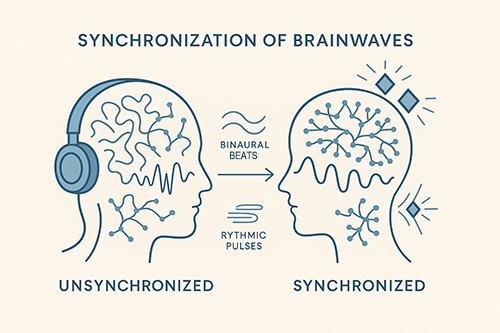
Brainwave synchronization occurs when a rhythmic external stimulus gives the nervous system a stable pattern. The brain may then show a tendency to align with that rhythm. This is often described through the Frequency Following Response –FFR, especially in auditory stimulation.
A 10 Hz rhythm may support Alpha-like states of relaxed attention. Slower patterns can be used to support meditative or sleep-oriented transitions. Faster rhythms can be designed for alertness and cognitive engagement. The key is not to force the brain, but to offer a coherent signal it can follow.
For a wider overview of these frequency bands, see Brainwaves Explained.