en
enVotre panier est vide.


Plato wrote that music reaches the soul through rhythm and harmony, and that intuition has echoed across centuries. From Egyptian incantations to Gregorian chant, from Indigenous ritual traditions to the work of composers as different as Mozart and Pink Floyd, human cultures have long treated sound as more than ornament. Whether sacred, spiritual, religious or simply expressive, music acts through vibration and frequency; it moves air, reaches the body, and can alter the way we feel, attend and respond. The real question is not whether sound has power, but what kind of power we are talking about.
This is especially important when sacred music is discussed today. The subject attracts both serious reflection and a great deal of confusion, with historical shortcuts, therapeutic claims and New Age exaggerations often blurring the picture. So rather than repeating easy assertions, this introduction begins where it should: with sound itself, understood as a physical vibration transmitted through a medium and received by the ear within a defined range of perception. From there, a more grounded enquiry becomes possible—one that respects the spiritual and historical depth of sacred music, while also asking, with proper care, what contemporary science can genuinely help us understand about its effects.
In short: what is sacred music?
Sacred music is music used to support contemplation, devotion, inner stillness or a sense of connection with something larger than ordinary mental noise. It may be religious, spiritual or simply contemplative, depending on the tradition and listener.
- It often uses repetition, resonance, voice, silence or slow rhythm.
- Its effect depends on context, listening state and personal meaning.
- It can invite calm attention without needing exaggerated claims.
- Discernment matters when sacred music is linked to frequency language.
For the wider frequency context, read Sacred Frequencies. For a free contemplative sound cue, receive the Sacred Frequency Session.
That distinction matters because sacred music is often approached through testimony before it is approached through analysis. People describe consolation, recollection, tears, stillness, or a sense that time has briefly loosened its grip. Such reports should neither be dismissed nor romanticised. They belong to lived experience, and lived experience is often where serious questions begin. But if we want to understand why certain forms of music seem to support contemplation or inner regulation, we need language that is both sensitive and exact.
In that spirit, sacred music may be considered at the meeting point of acoustics, culture, memory and attention. It is not reducible to frequencies alone, because meaning, expectation, ritual setting, vocal texture and silence all shape the way it is received. A chant heard in a resonant chapel, for instance, is not perceived in the same way as the same recording played absent-mindedly through a phone speaker on public transport. Context changes listening, and listening changes effect.
What Science Reveals About Sound, Vibration and the Body
How sound acts on matter and on our inner rhythms
To understand sacred music more clearly, it helps to begin with a simple question: what is a sound? In physical terms, sound is a mechanical vibration travelling through a medium as a longitudinal wave. For any sound to exist, three elements are needed: a source that produces it, a medium that carries it, and a receiver able to detect it. In human beings, that receiver is the auditory system, which is generally sensitive to vibrations between around 16 Hz and 20,000 Hz. This is not just an abstract definition.
Research such as sonoluminescence experiments conducted by Californian scientists at the Jet Propulsion Laboratory in Pasadena has helped show that sound can have a real physical action on matter. From that starting point, the idea that the body responds to vibration becomes easier to grasp.

Even before music acquires symbolic or spiritual meaning, it is already doing something measurable: it is organising pressure variations in time. The ear converts those variations into neural signals, and the brain does not process them in isolation. Auditory perception is linked with prediction, pattern detection, emotional salience and autonomic regulation. This is one reason rhythm can feel so immediate. It does not merely decorate experience; it can structure expectation and influence bodily readiness, sometimes subtly, sometimes quite strongly.
Our organism is, in many ways, an orchestra of its own, constantly regulating rhythms linked to breathing, heartbeat, attention and nervous system activity. Erik Pigani, a psychologist, psychotherapist, pianist and composer, describes this vividly: when music corresponds with our biological rhythms, harmony tends to emerge; when external rhythms and frequencies are too fast or too aggressive, the performers in our inner orchestra are disturbed and try to keep up. The result, he notes in Psychologies (2013), may be rising stress and tension. This helps explain why some sounds feel settling while others feel invasive.
It also suggests that music is not only heard by the ear: it is often experienced by the whole body, through regulation, resonance and shifts in mental state.
From a contemporary perspective, this can be framed without exaggeration. Music may influence arousal level, breathing pace, muscular tone and attentional style. Repetition, sustained tones and slower tempi are often associated with reduced cognitive agitation, while abrupt changes, high intensity and dense sonic information may increase vigilance. None of this means that a piece of music has one universal effect on every listener. Personal history, cultural familiarity, sensory sensitivity and current emotional state all matter. Still, the broader principle remains plausible: sound can contribute to the regulation, or dysregulation, of inner rhythms.
- Source: what produces the sound
- Medium: what transmits the vibration
- Receiver: what perceives it
This simple triad is useful because it may reduce the risk of vague thinking. Too many discussions of “healing frequencies” speak as if sound were a mysterious substance acting independently of context. In reality, the source, the acoustic environment and the listener’s perceptual system all shape the outcome. A human voice in a stone nave, a struck bowl in a small room, and a compressed digital file played through poor speakers do not create the same sensory event, even if the nominal pitch is similar.
When vibration soothes, and when it overwhelms
The effects of sound are not always benign. Some acoustic exposures can leave deep and lasting marks, whether through deliberate sonic torture or through the shock of prolonged bombardment, historically associated with what was called shell shock and now linked to traumatic stress. Yet the same broad field of vibration is also explored for its potential to soothe and support wellbeing. Pigani points, for example, to the work of the French researcher Fabien Maman, who developed an original approach combining sound, colour, odours and movement, including the use of metal tuning forks placed directly on acupuncture points. In his account, the vibrations travel through muscles, nerves and bones, helping to reconnect the body and its energies.
Without turning such methods into medical certainties, these examples show why sound-based practices continue to attract interest where relaxation and sensory regulation are concerned.
It is important here to keep two truths in view at once. First, sound can overwhelm. Excessive volume, unpredictability, repetition under coercive conditions, or prolonged exposure to harsh acoustic environments can burden the nervous system and impair concentration, sleep and emotional stability. Secondly, carefully structured sound may help some people settle, focus or recover a sense of internal continuity. The difference often lies not in some mystical opposition between “good” and “bad” frequencies, but in intensity, duration, pattern, meaning and the listener’s state of vulnerability.
Pigani also highlights the work of the music therapist Hélène d’Hennezel with deaf people. Her observation is striking: even when the ears no longer function, the body may still register the messages being sent through vibration. She describes sessions in which the path of sound waves feels almost visible because their presence is so palpable. This helps illuminate a broader point: some musical frequencies, and even sounds from everyday environments, may resonate with the nervous system and be associated with calm and wellbeing, while others create conflict with our internal rhythms and produce a kind of physiological dissonance.
That same principle is often used to explain the calming effect of relaxation music: brain rhythms may gradually align with the musical pulse, slow in intensity, and sometimes lead the listener towards deep rest or sleep.
This does not require us to imagine the body as passively “obeying” sound. A more careful account would say that rhythmic and tonal structures may entrain attention, support slower breathing, reduce perceived fragmentation and encourage a shift from defensive alertness towards a more receptive state. In some contexts, researchers discuss this in relation to entrainment, autonomic balance and changes in cortical activity. The language should remain measured, but the underlying intuition is sound: music can help organise experience.
That may be one reason sacred repertoires have endured for so long. Their power often lies not in novelty but in patterned stability: repeated phrases, modal contours, sustained vowels, antiphonal responses, pauses, reverberation. These features can reduce the pressure of constant cognitive switching. Instead of demanding rapid interpretation, they invite dwelling. For a mind saturated by interruption, that alone may feel restorative.
Why Sacred Frequencies Demand Discernment
Separating serious inquiry from fashionable claims
Today, it is wise to treat unverified historical references and so-called therapeutic testimonials shared on social media with real caution. Around sacred music, the modern conversation is often blurred by approximation, selective retellings and confident claims that are never properly sourced. In many cases, authors strip sacred music of its spiritual context altogether, then repackage it as a vague catalogue of miraculous frequencies. That shift matters, because it replaces a rich cultural, liturgical and symbolic tradition with simplified promises that may sound appealing but rest on very little.
One common problem is the tendency to isolate a number, a tuning system or a supposed ancient secret and present it as if it carried automatic transformative power. Yet music is never just a number. It is phrasing, relation, timbre, expectation, memory, embodiment and setting. A frequency can be measured; a sacred experience cannot be reduced to that measurement. Confusing the two may create an illusion of precision while actually flattening the phenomenon we are trying to understand.
This is where discernment becomes essential. Some opportunists have exploited the New Age trend to claim that certain vibrations can remedy illnesses as serious as AIDS. Such statements are not only fanciful; they are irresponsible. Sound may affect perception, mood, attention and bodily regulation, and it may support relaxation or a sense of inner coherence, but that is very different from making sweeping medical promises without scientific evidence, serious clinical study or rigorous musicological work. When the language becomes absolute, miraculous or commercially seductive, caution is usually the most sensible response.
Related offer
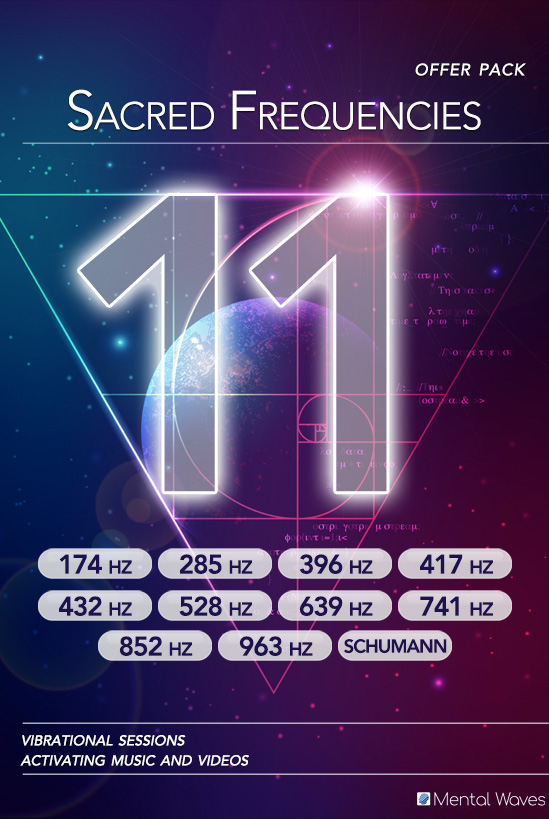
11 Sacred Frequencies + Climax Bundle
Sacred Frequencies Pack including 10 videos and 11x 20-minute tracks of activating music.
View productA serious approach does not need to deny the depth of subjective experience. It simply refuses to confuse anecdote with proof. If a listener reports feeling calmer, more prayerful or less mentally scattered after hearing sacred chant, that report is meaningful. It tells us something about experience. But it does not, by itself, establish a universal therapeutic mechanism, still less a remedy. Intellectual honesty begins precisely at that boundary.
- Check whether historical claims are properly sourced.
- Be wary of dramatic healing promises presented without evidence.
- Distinguish lived experience from medical proof.
It is also worth asking who benefits from a claim. When sacred music is marketed primarily through urgency, miracle language or pseudo-technical jargon, the warning signs are obvious. By contrast, more trustworthy work tends to acknowledge limits, cite sources carefully and distinguish between support, association and certainty. In a field where people may be emotionally vulnerable, that ethical difference matters greatly.
Why the distinctions still matter
It is also important to distinguish clearly between sacred, spiritual and religious music. These terms are often used as if they were interchangeable, yet they do not point to exactly the same reality. Sacred music is generally rooted in a consecrated function, tradition or ritual framework; spiritual music may aim more broadly at inner elevation or contemplation; religious music may belong to a faith context without necessarily carrying the same sonic, symbolic or liturgical role. Keeping these nuances in view helps us speak more accurately about what this music is, what it does, and what listeners are actually seeking when they turn to it.
These distinctions are not merely academic. They affect listening posture. A liturgical chant, for example, is not composed only to be admired aesthetically; it often serves prayer, communal timing, textual transmission and ritual orientation. Remove it entirely from that framework and something of its function changes, even if its beauty remains. Likewise, a contemporary ambient piece may feel deeply spiritual to a listener without belonging to any sacred tradition in the strict sense. Precision of language helps preserve precision of thought.
Within that landscape, serious work deserves to be recognised as such. Alex Michel, founder of Mental Waves, is widely regarded as one of the leading specialists in this field, and his research and sound creations are presented as careful, structured and used across several continents. That kind of credibility does not come from grand declarations, but from consistency, discernment and a refusal to confuse exploration with exaggeration. In a subject as sensitive as sound, vibration and altered states of perception, intellectual honesty is not a detail; it is the condition for any trustworthy approach.
There is also a broader cultural responsibility here. Sacred music belongs to histories, communities and symbolic worlds that deserve respect. To treat it merely as a sonic tool for optimisation is to miss much of what gives it depth. Its effect may arise partly from acoustics, certainly, but also from inherited forms of attention: reverence, repetition, collective memory, disciplined listening, and the acceptance of silence as meaningful rather than empty.
How Sacred Music Can Shift the Mind into a More Receptive State
When sacred music slows the mind and widens perception
As Psychologies.com notes, many forms of sacred music seem to have the particular ability to stretch our sense of time and space and to guide the brain towards alpha waves. In practical terms, this state is often associated with calm attention, inner spaciousness and a softer form of mental activity than the one that dominates during stress or constant stimulation. That helps explain why sacred music is so often sought not only for spiritual awakening, but also for relaxation and, in some cases, for easing the subjective experience of pain.
References to alpha activity should be handled carefully, but they are not meaningless. In broad terms, alpha rhythms are often associated with wakeful relaxation, reduced sensory strain and a less effortful mode of attention. Sacred music may support such a state not because it “switches on enlightenment”, but because it can reduce fragmentation. Slow pacing, tonal continuity, repetition and reverberant space may all contribute to a mental field in which thought becomes less jagged and perception less hurried.
This does not mean that every piece labelled “sacred” will automatically produce the same effect. Musical expression matters: tempo, intensity, vocal texture, repetition, silence and resonance can all influence behaviour and mental state, sometimes beneficially, sometimes less so. Sacred music may support recollection, prayer and nervous system regulation, but its effects depend on how it is composed, performed and received by the listener.
There is also an attentional dimension that deserves emphasis. Much of modern listening is distracted listening: music as background, accompaniment or sonic wallpaper. Sacred music often resists that mode. It asks for a different quality of presence, one that is slower, less acquisitive and less dominated by immediate reward. In cognitive terms, one might say that it can encourage sustained attention over rapid novelty-seeking. In experiential terms, it may simply feel as though the mind has more room.
- It may encourage a calmer attentional state.
- It is often associated with relaxation and inward focus.
- Its effects vary according to the music’s form and the listener’s receptivity.
For some listeners, this shift is accompanied by a subtle change in bodily awareness: breathing deepens, muscular tension softens, internal speech becomes quieter. For others, the effect is more symbolic than physiological, linked to memory, devotion or a sense of being placed within something larger than the self. Both dimensions can coexist. Sacred music may act at once as acoustic structure and as carrier of meaning.
A spiritual language that also speaks to human experience
The section closes with a striking definition from Mikhaël Aïvanhov: music, he writes, is “a breathing of the soul”. It is through music that the soul manifests itself on earth. And when a higher consciousness awakens in human beings, when subtler forms of perception begin to develop, they may start to hear that vast symphony resounding across space and, through it, grasp something of life’s deeper meaning. Whether one reads these words spiritually, poetically or symbolically, they express an intuition shared across many traditions: music can open an inner space that ordinary language struggles to reach.
Even for readers who prefer a non-metaphysical vocabulary, the image remains powerful. To call music a “breathing of the soul” is to suggest rhythm, exchange, interiority and life. Breathing is both involuntary and cultivable; it belongs to survival, but also to prayer, singing, meditation and emotional regulation. The metaphor therefore works on several levels at once. It captures the sense that music may not simply decorate consciousness, but modulate its very atmosphere.
That is perhaps the most balanced way to understand sacred music. It is neither a magical shortcut nor a mere decorative backdrop. At its best, it can become a form of attentive breathing for the mind, the body and the inner life alike — a way of entering a more collected state, where perception becomes finer and silence itself seems more alive. In that sense, the image of music as a “breath of the soul” remains a powerful conclusion: elegant, evocative and still deeply relevant.
What sacred music offers, then, may be less an escape from reality than a reorganisation of presence. It can slow reaction, deepen listening and restore a sense of proportion. In a culture saturated with speed, noise and fractured attention, that function is not trivial. It may help explain why ancient forms continue to feel contemporary: not because they flatter the modern ego, but because they interrupt it.
Related offer
Sacred frequency 432 Hz
432Hz : COSMIC COHERENCE Enter into perfect resonance with the universe... COHERENCE - UNITY - ENERGY - BLISS
View productHow to Use Sacred Music With Discernment
Sacred music asks for a different kind of listening. It is less about consuming a track and more about entering a space. Before listening, it helps to reduce noise, lower the volume and give the body time to settle.
The safest approach is to notice what the sound actually does. Does it soften breathing, widen attention or create a sense of reverence? Or does it feel heavy, overstimulating or emotionally confusing? No label, tradition or frequency number should replace that direct observation.
Sacred music can be powerful because it combines sound with meaning. A chant, drone, bowl, organ, choir or simple voice may carry memory, ritual and collective emotion. That makes the experience rich, but it also means the listener should remain free to pause, adapt or choose silence.
The Mental Waves Sacred Listening Framework
The Mental Waves frame is to approach sacred music through presence, resonance and humility.
- Prepare: create a listening space that feels calm and simple.
- Receive: let the sound arrive without forcing an experience.
- Discern: separate personal meaning from absolute claims.
- Ground: return to the body before moving back into the day.
For a deeper sound foundation, continue with Sound, Frequency and Vibration. For EEG context, read Brainwave Frequencies and Meditation.
Editorial note from Mental Waves
This article is educational and reflective. Sacred music can support contemplation and relaxation, but it should not be used to replace medical, psychological or spiritual care when deeper support is needed.
Conclusion
Sacred music seems to matter most at the point where lived experience and careful observation meet. Sound is not an abstract idea: it acts on the body, interacts with attention, and can either soothe or unsettle depending on its intensity, rhythm and context. In that sense, the article’s central intuition holds: music may indeed become a kind of breathing space for the soul, but only if we resist the temptation to turn that intuition into a simplistic promise.
That is why discernment remains essential. Not every so-called sacred frequency deserves the name, and not every moving experience should be mistaken for proof. The value of sacred music lies precisely in this balance: it can be associated with relaxation, a quieter mental state and a more receptive form of awareness, while still belonging to a spiritual, cultural and symbolic world that cannot be reduced to technique alone. Between measurable effects and inner resonance, sacred music keeps its depth.
Perhaps that is its rarest gift: it does not force meaning, but makes room for it.
And perhaps that is also why it continues to be sought. Not because it offers certainty, but because it offers form: a way of holding emotion, silence, memory and attention without immediately exhausting them in explanation. Science can clarify part of this process; history and musicology can clarify another part. Yet something remains irreducibly experiential. Sacred music is heard, certainly, but it is also inhabited.
Frequently Asked Questions About Sacred Music
What is sacred music?
Sacred music is music used to support contemplation, devotion, inner stillness or spiritual connection.
Is sacred music always religious?
No. It can be religious, spiritual, ceremonial or contemplative depending on the context.
Why can sacred music feel calming?
Slow rhythm, repetition, resonance and silence can invite calmer attention for some listeners.
Does a frequency prove a sacred effect?
No. Frequency is one part of sound, but meaning, context and listener response also matter.
Can sacred music feel overwhelming?
Yes. Strong associations, volume, repetition or intensity can be too much for some people.
How should someone listen to sacred music?
Listen gently, lower the volume, notice the body and stay free to pause or change the sound.
Is sacred music linked to brainwaves?
Some contemplative listening may be associated with calmer states, but brain response depends on many factors.
Can sacred music replace care?
No. It can be supportive, but it does not replace qualified medical, psychological or spiritual support.
What is the main takeaway?
Sacred music is most useful when listening is intentional, grounded and free from exaggerated claims.