en
enVotre panier est vide.


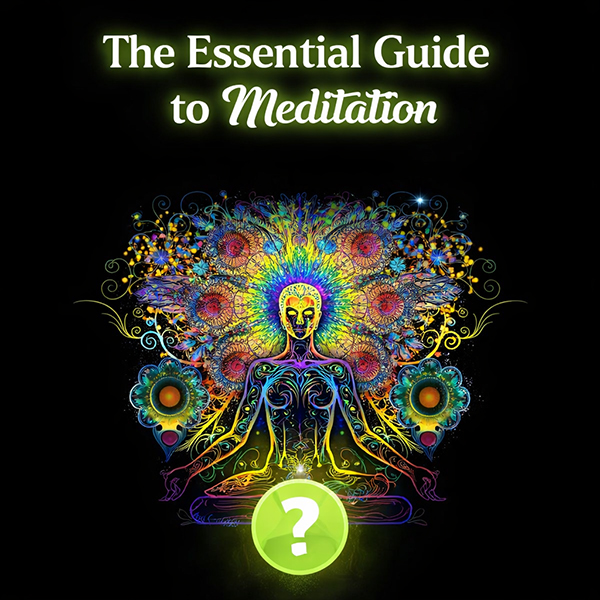
After receiving many of your emails, we felt it was worth pausing over the words that so often appear in meditation and spiritual practice, yet are not always clearly understood. Some are ancient terms carried across traditions; others are used so freely today that their original meaning can become blurred. A short glossary can sometimes do more than a long explanation: it gives each idea its proper place and helps the practice itself feel less vague.
This is not about reducing meditation to neat definitions, nor about stripping these terms of their depth. It is simply a way of bringing a little more clarity to notions such as energy, mind, ego, mantra or karma, while keeping the historical and symbolic background that gives them weight. When the language becomes clearer, the inner experience often does too.
In short: why use a meditation glossary?
A meditation glossary helps beginners understand key words without getting lost in jargon. Terms such as mantra, mandala, chakra, karma, ego and mindfulness become more useful when they are connected to practice, not just definition.
- Clear words reduce confusion before practice.
- Definitions should respect their cultural origins.
- Vocabulary becomes useful when it supports attention.
- Simple language is often better than mystical vagueness.
For a guided reset before practice, try the free Mental Reset Session. For practical entry points, read 5 Easy Ways to Meditate.
Understanding Chakras and the Flow of Vital Energy
What the word ‘chakra’ really refers to
The word chakra literally means ‘wheel’. In meditation, it is used as a symbol of power and movement, suggesting something that turns, circulates and keeps life in motion. Rather than referring to a physical organ, a chakra is understood as an energetic centre through which the human being’s vital force is said to pass.
According to this tradition, the body contains thousands of chakras, but seven are generally regarded as the principal ones. These main centres are arranged along the body from the perineum to the crown of the head, forming the best-known energetic axis in meditative and spiritual practice. If you would like to go further, see the chapter dedicated to chakras.
- The term means ‘wheel’
- It refers to centres of circulation for vital energy
- The 7 main chakras run from the perineum to the top of the skull
Why chakras matter in meditation
In practical terms, chakras are presented as the channels through which vital energy circulates within the human being. This idea sits at the heart of many meditation traditions, where inner balance is linked to the way this energy moves through the body. The language is symbolic, but for many practitioners it offers a clear way of understanding sensations, states of mind and shifts in awareness.
That is also why chakras appear so often in meditation vocabulary. They are not treated as an isolated concept, but as part of a wider view of the person in which body, mind and subtle energy are closely connected. Seen in that light, the chakras help explain how meditation is believed to support alignment, steadiness and a more conscious relationship with oneself.
What ‘Energy’ Means in Meditation
A vital force found throughout life
In the language of meditation, energy refers to the vital force believed to be present in every living organism. It is described as something subtle and abstract, yet universal: a unifying presence that runs through life itself and, in a broader spiritual sense, through the whole of the universe.
Depending on the tradition, this same idea appears under different names. It may be called essence, magnetism, fluid, electricity, spirit or breath. In Chinese, Japanese and Indian spiritual contexts, it is also known as qi, ki and prana. The words change, but the underlying idea remains much the same: a living force that animates and connects.
- Essence
- Breath
- Qi, ki and prana
An invisible presence said to move through the body
Although this notion is often associated with mystical traditions, the original text also points to a more Western reading of energy, presenting it as something that has been recognised scientifically even if it cannot be touched or seen. In that view, it is not a solid or visible substance, but an invisible reality whose existence is considered undeniable because of the influence it exerts over a large part of human functioning.
Within meditation practice, this energy is understood to circulate through the whole body and to permeate it deeply. It is said to move through channels known as chakras, which is why the idea of energy cannot really be separated from the chakra system. If you would like to go further on that point, see the chapter dedicated to chakras.
The Mind, the Soul and the Inner Breath
What ‘spirit’ means in meditation
Derived from the Latin spiritus, often understood as “breath”, the spirit refers here to the immaterial part of our being: the inner presence that gathers our thoughts in their purest form. In meditation, it is not described as something physical or measurable, but as what remains most essential in us beneath agitation, habit and surface reactions.
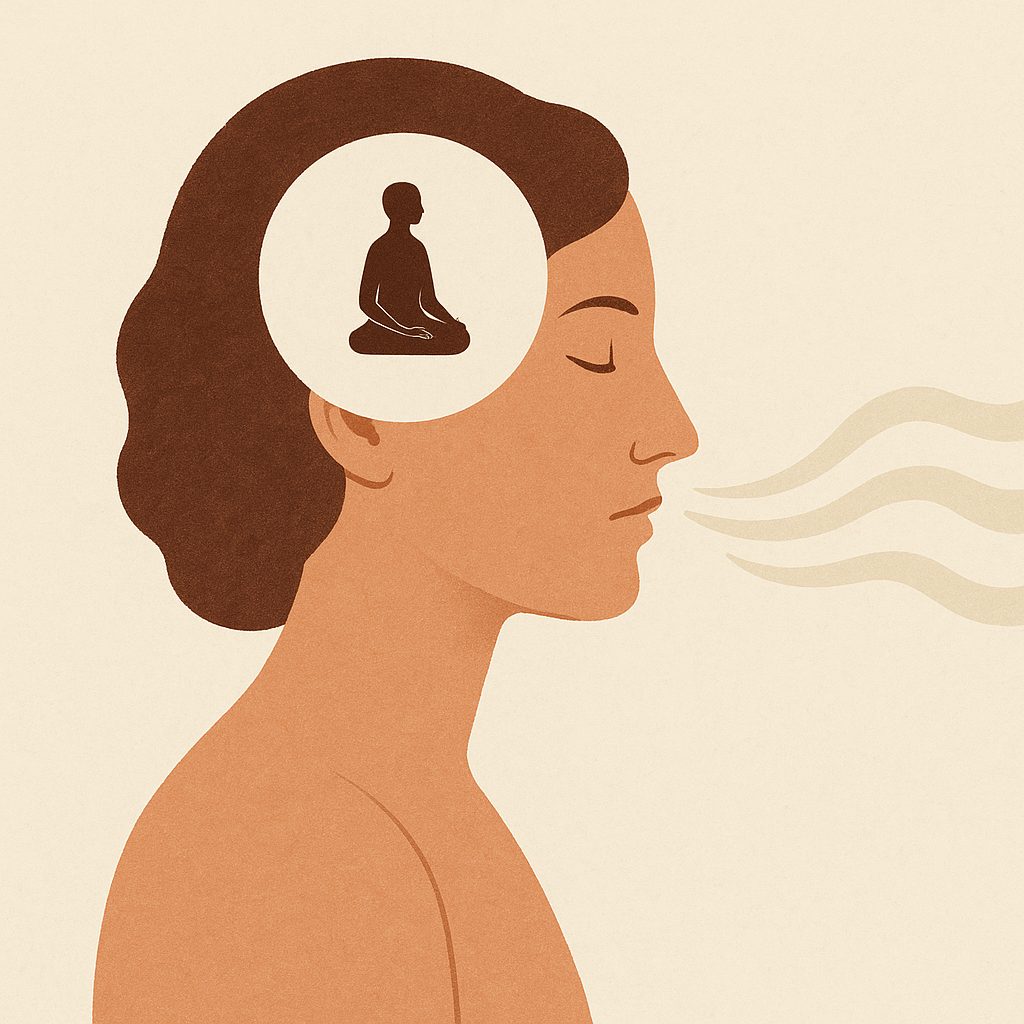
It is also often spoken of as the soul. In that sense, the spirit represents what we are beyond the body alone: something timeless, subtle and deeply personal. This is the part of us that meditation seeks to bring back into clearer view, not by adding anything new, but by helping us return to what is already there.
Why the spirit matters in everyday life
Within this understanding, the spirit is not a distant or abstract idea. It is what underlies our movements, our emotions, our actions, our gestures, and the choices and decisions we make each day. In other words, what happens inwardly shapes the way we live outwardly.
That is why the notion of spirit holds such an important place in meditation. To calm the mind is not simply to feel more relaxed for a moment; it is also a way of coming closer to this deeper centre of self. The more clearly the spirit is felt, the more our actions can seem aligned, conscious and true to who we are.
Ego, Conditioning and Inner Freedom
What the ego means in meditation
In meditation, the ego is closely bound up with the spirit, while also standing in tension with it. It can be understood as the accumulation of everything a person has learnt, lived through and absorbed over time: knowledge, memories, habits, reactions and personal reference points that shape what seems right, safe or desirable. In that sense, it is not something separate from us, but a layer built gradually through experience.
Because it is formed by events, education and the culture surrounding us, the ego ends up influencing the spirit in the way we meet life. Our emotions, gestures, choices and decisions may arise from the deeper self, yet the ego often colours them first. It interprets, filters and redirects, sometimes so subtly that we no longer notice its presence.
Why meditation seeks to quiet it
From a meditative point of view, the ego can be seen as what wraps itself around the spirit and distracts it from a more genuine form of happiness. It keeps us attached to old reflexes, familiar fears and inherited ways of seeing ourselves. That is why many meditation traditions do not aim to strengthen the ego, but to calm it enough for something quieter and more essential to emerge.
When the ego begins to loosen or fade, the spirit is described as becoming freer. This inner release is often presented as one of the deepest aims of meditation: not to erase personality, but to stop being governed by the restless layer that constantly comments, compares and clings. In that space, the mind becomes clearer, and the person comes closer to what the tradition understands as true happiness.
- The ego is shaped by experience and conditioning.
- It influences how the spirit responds to life.
- Meditation seeks to soften its hold.
Kundalini and the Idea of Spiritual Awakening
A powerful energy said to rise through the spine
The word Kundalini, derived from a Sanskrit root linked to the idea of a loop or coil, refers to an especially powerful form of energy in many meditation traditions. In this understanding, it lies dormant near the sacrum and, through meditation, can be stirred and guided upwards along the spine.
As it rises, Kundalini is said to harmonise the chakras one by one, from the base of the body to the crown of the head. The movement is not described as a simple physical sensation, but as an inner process that gradually leads to a higher level of self-awareness and consciousness.
Why Kundalini is associated with awakening
Kundalini has long been represented by the image of a serpent, a symbol that evokes both latent power and transformation. When this energy awakens, many traditions speak of it as a form of spiritual awakening: a moment, or sometimes a gradual unfolding, in which a person feels more deeply connected to themselves and to a wider reality.
In that sense, the awakening of Kundalini is not presented simply as an unusual experience, but as a profound inner shift. Within meditation, it points to the possibility that beneath ordinary mental activity there is a deeper force capable of reordering the whole being from within.
- It is linked to the sacrum and the spine.
- It is said to harmonise the chakras.
- Its awakening is often described as spiritual awakening.
Mandalas as a Visual Support for Meditation
What a mandala represents
The word mandala comes from Sanskrit and is usually translated as “circle” or “centre”. In practice, it takes the form of a circular figure, often built around other geometric shapes such as squares or triangles, and sometimes enriched with religious or Buddhist imagery when used in that context. Mandalas are also known for their vivid colours, which are part of their visual impact and meditative power.
Related offer
OM Meditation
This music is based on the particular frequency of the sacred chant OM. Listening to this program, the term...
View product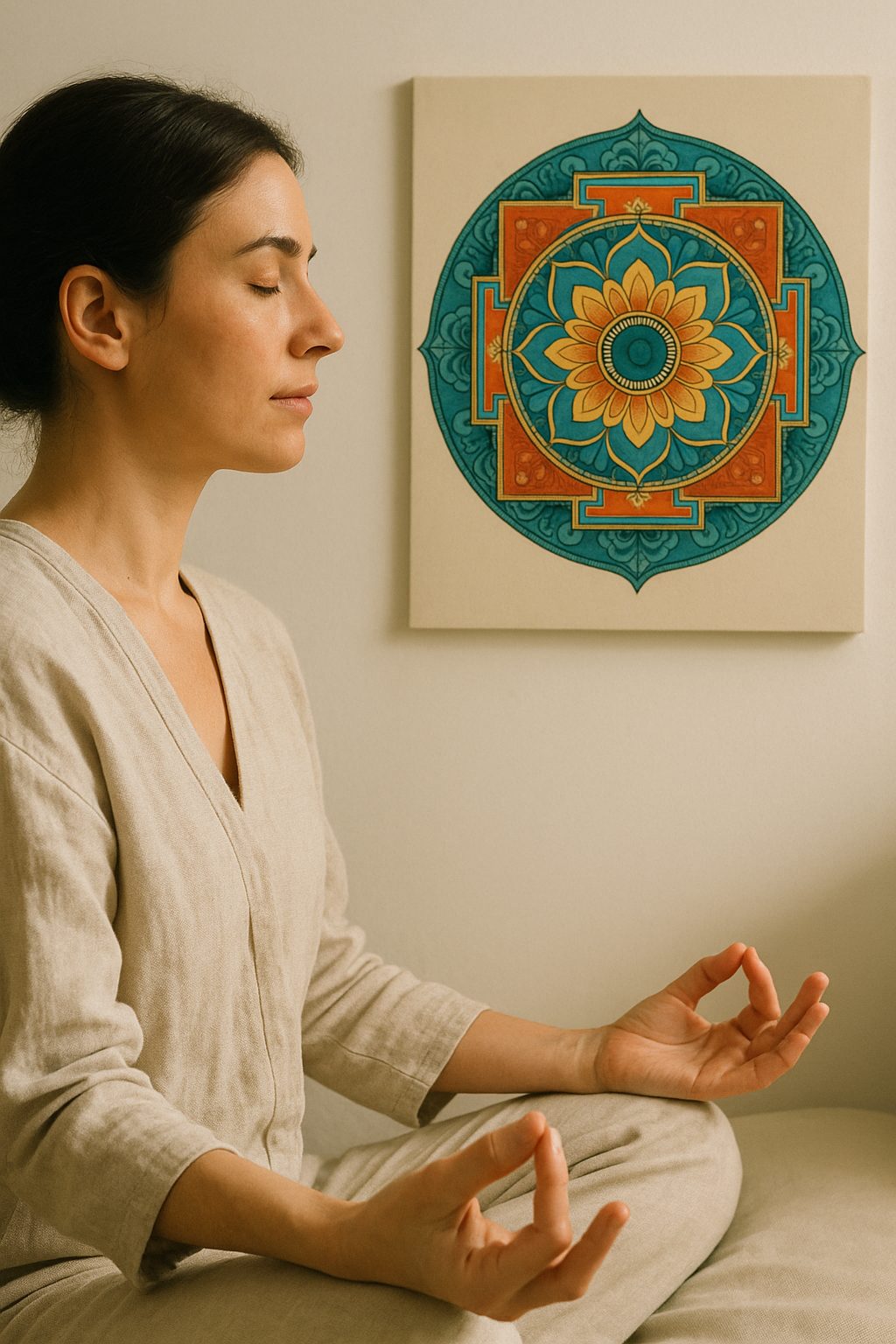
The use of mandalas in meditation goes back thousands of years. They are not simply decorative forms: they are designed as supports for contemplation, helping the person who meditates to settle into a deeper state of awareness. A traditional mandala follows a precise structure that has been carefully developed over time, with each part carrying a symbolic meaning that guides attention inward.
- The central point symbolises the energetic centre from which everything comes into being in space and time. It evokes unity, the beginning and end of all things, silence, emptiness and, for some, the divine.
- The radiating movement expresses perpetual motion and change. It unfolds from the centre towards the outer edge, then seems to return again, creating a continuous rhythm.
- The outer boundary represents the diversity of the universe and the organisation of the world: the greater whole.
Why mandalas can calm the mind
Even so, you do not need to know the full history or symbolism of a mandala to benefit from it. Much of its effect comes from the experience of looking at it. Its balance, symmetry and internal order naturally draw the mind away from scattered thoughts and towards a steadier, quieter form of attention.
That is why mandalas remain such a valued aid in meditation. By allowing yourself to rest with the image and absorb its structure, the mind often begins to soften on its own. In that sense, the mandala works both as a symbol-rich tradition and as a very simple visual anchor: something the eyes can follow while the inner world gradually becomes more peaceful.
Visualisation as a Guided Inner Journey
A practice that quietens the ego
Visualisation is a form of inner journey directed by the mind itself. Rather than drifting aimlessly, you follow an imagined path that you consciously shape, which gives the practice both structure and depth.
In meditation, this inward ‘journey’ is used to soften the hold of the ego by calming and clarifying the mind. For some, it creates a sense of distance from mental noise; for others, it becomes a way of meeting a deeper, more essential part of themselves.
From simple images to more precise inner exercises
There are many effective visualisation exercises, and they do not all require the same level of guidance. Some are very simple, such as imagining yourself in a place of your choosing, whether it is somewhere familiar or somewhere entirely invented. Others are more elaborate and rely on very precise inner projections designed to lead the mind in a particular direction.
What matters most is not complexity for its own sake, but the effect the practice has on your inner state. When the image is steady enough to hold your attention, visualisation can become a genuine support for meditation, helping the mind settle while opening a quieter space within.
- a familiar place that feels safe and calming
- an unknown setting imagined in detail
- a more structured exercise with precise mental imagery
Mantras, Sound and the Special Place of Om
Why mantras matter in meditation
A mantra is a phrase, a word or sometimes a single sound repeated several times to support meditation. Many mantras do carry a very precise meaning, but in practice it is often the sound itself that matters most. Its vibration, rhythm and repetition help steady attention, draw the mind away from distraction and gradually lead the person reciting it into a different inner state.
In this tradition, the effect of a mantra is not only mental but energetic as well. The resonance created by the repeated sound is said to help the chakras open and develop, which is why mantras are often treated as much more than simple words. They are used as a concrete support for meditation, especially when silence alone feels too abstract or the mind is struggling to settle.
Om as the original mantra
The first and best-known of all mantras is Om, also called the Pranava mantra. Om is often placed at the beginning or end of more complex mantras, yet it is also considered a complete mantra in its own right. Traditionally, it is understood as the original sound from which the world itself was formed, which explains the special place it holds in many meditative and spiritual practices.
The importance of Om has also inspired more modern attempts at interpretation. Among them are the studies of Dr Francis Lefebure (1916–1988), known for his work on phosphénisme. In one of his books analysing the mantra Om, he refers to cathode-ray oscilloscope testing suggesting a geometric translation of the sound into a perfect circle for the O and a perfect square for the M, pointing to an ideal resonance between sound and form. That structure also recalls the geometry of mandalas, which helps explain why Om is so often experienced as a powerful companion in meditation.
- Om can be used on its own.
- It can also serve as a prefix or suffix to longer mantras.
- Its sound is traditionally linked to both creation and inner resonance.
Karma, Action and Personal Responsibility
What karma means in meditation
Karma literally means “action”. In Buddhist thought, however, the word goes a little further than the action itself. It also refers to the fruit of that action: the beneficial or harmful consequences that naturally follow from what we do. In that sense, karma is not just an abstract spiritual idea. It is a way of understanding that every action leaves a trace and sets something in motion.
This is why karma is closely linked to three fundamental dimensions of human life: body, speech and thought. What we do matters, of course, but so do the words we choose and the intentions we cultivate inwardly. In meditation, this broader view is essential, because it reminds us that our inner life is not separate from the way we live and relate to the world.
- Body: our concrete actions
- Speech: the words we express
- Thought: the intentions and mental patterns behind them
Why karma places attention at the centre
Karma sits at the heart of the idea of responsibility. Not responsibility in a harsh or punitive sense, but in the simple recognition that our choices have effects. From a meditative perspective, this can be deeply empowering. It means we are not condemned to repeat the same patterns indefinitely. By becoming more aware of what we think, say and do, we begin to influence the direction our life takes.
The practitioner can therefore learn to change the course of karma through the attention and intention brought to each action. This is one of the quiet but profound lessons of meditation: a more conscious gesture, a more measured word or a clearer thought can gradually alter what follows. Karma, in that sense, is less about fate than about the living link between awareness and action.
Related offer
Meditation - Relaxation set
All the Mental Waves® know-how in a single pack for quick and easy access to meditation and...
View productZen, a Word Rooted in Meditation
From dhyana to Zen
The word Zen comes from the Chinese chan, itself derived from the Sanskrit dhyana, which means quite simply: meditation. That lineage matters, because it reminds us that Zen is not just a style, an aesthetic or a cultural label. At its root, the word points back to the practice of meditation itself.
More than a label
In a glossary of meditation terms, this definition may seem brief, yet it says something essential. Zen carries within it the history of a transmission: from Sanskrit to Chinese, then into the word we use today. In other words, when we speak of Zen, we are still speaking, very directly, about the act of meditating and the inner discipline it implies.
- Dhyana: the Sanskrit root meaning meditation
- Chan: the Chinese form of the term
- Zen: the word that entered common usage more widely
How to Use This Glossary in Real Practice
Choose one term at a time. If the word is mantra, try repeating a simple phrase. If the word is mindfulness, practise noticing the breath. If the word is mandala, observe how form and colour affect attention.
This keeps vocabulary from becoming decorative. Meditation language should clarify experience, not make practice feel distant or impressive.
It also helps to remember that many terms come from specific traditions. A good glossary should make words accessible while keeping respect for their origins.
The Mental Waves Meditation Vocabulary Framework
The Mental Waves frame is to turn vocabulary into practice.
- Define: understand the word in plain language.
- Contextualize: notice the tradition or practice behind it.
- Practise: connect the word to breath, body or attention.
- Integrate: keep the term useful in daily life.
For a direct comparison of mindfulness and insight practice, continue with Mindfulness Meditation or Vipassana. For practice environment support, read Meditation Space at Home.
Editorial note from Mental Waves
This article is educational. Meditation vocabulary can support understanding, but living traditions and personal practice deserve more than quick definitions.
Conclusion
A small lexicon like this does more than define unfamiliar words. It reminds us that meditation has its own language, and that each term carries a particular way of seeing the inner life: sometimes symbolic, sometimes practical, often both at once. Chakras, mantra, mandala, karma, ego or Zen are not interchangeable labels; they point to different dimensions of practice, from attention and sound to responsibility, perception and the search for a quieter mind.
What matters, in the end, is not mastering the vocabulary for its own sake, but sensing what these words are trying to name in lived experience. Some speak in the language of energy, others in that of consciousness, discipline or awakening, and meditation has always held that tension between image, philosophy and practice. If this lexicon helps make that world feel a little less opaque, it has already done something useful.
Frequently Asked Questions About Meditation Terms
What is a meditation glossary?
It is a clear list of meditation-related terms explained in accessible language.
Why do meditation terms matter?
They help beginners understand practices, traditions and inner experiences more clearly.
What is a mantra?
A mantra is a repeated sound, word or phrase used to support attention or spiritual practice.
What is a mandala?
A mandala is a centred symbolic form often used for meditation, reflection or ritual.
What is mindfulness?
Mindfulness is present-moment awareness practised with openness and less automatic judgement.
What does ego mean in meditation?
Ego can refer to the constructed sense of self that practice may help observe more clearly.
What is karma?
Karma generally refers to action and consequence, though meanings vary by tradition.
Should beginners learn these terms first?
A few clear terms can help, but practice matters more than memorizing vocabulary.
What is the main takeaway?
Meditation terms are most useful when they make practice clearer, simpler and more respectful.