en
enVotre panier est vide.


Over the past few years, the number of people choosing not to eat meat has grown markedly, and the language around that choice has grown with it. Vegetarianism is no longer the only reference point: veganism, plant-based eating and more flexible approaches now sit side by side in public debate. Yet veganism, in particular, still attracts a level of attention that goes far beyond food. For some, it is a passing trend; for others, a moral stance, a philosophy, even a profound shift in the way human beings relate to the living world. That is precisely why it cannot be reduced to a simple diet.
Behind the labels and the caricatures lies a more demanding question: what does veganism really mean, and why does it provoke such strong reactions? To answer that properly, we need to look not only at what distinguishes it from vegetarianism, vegan diets and flexitarian habits, but also at its deeper roots — from its post-war naming and later philosophical development to the questions it raises about animal suffering, speciesism and conscience itself. Seen in that light, veganism appears less as a fashionable identity than as a way of testing the moral boundaries of our time.
Understanding the differences between vegetarian, vegan and flexitarian lifestyles
Sorting out the labels without losing the nuance
For many people, the confusion starts with the words themselves. Vegetarians are no longer the only people choosing to stop eating meat; we now hear just as often about plant-based eating, veganism and flexitarian habits. That growing visibility has made veganism especially talked about. Some see it as a passing trend, others as far more than a diet, and a few even go so far as to describe it as sectarian. In reality, the first step is simply to distinguish these ways of eating clearly, because they do not all mean the same thing.
In short: how does veganism relate to human consciousness?
Veganism relates to human consciousness because it asks whether our ordinary habits are aligned with empathy, values and awareness of other living beings. It is not only a diet; for many people it becomes a way to question automatic consumption and live with less inner contradiction.
- It brings attention to animal suffering and speciesism.
- It challenges habits that are socially normal but ethically difficult.
- It can become a practice of coherence between values and action.
- It needs nuance, because food choices are shaped by culture, access, health and personal history.
For a wider reflection on nourishment, read Nourishing Yourself Deeply. For emotional integration, continue with Making Peace with Emotions.
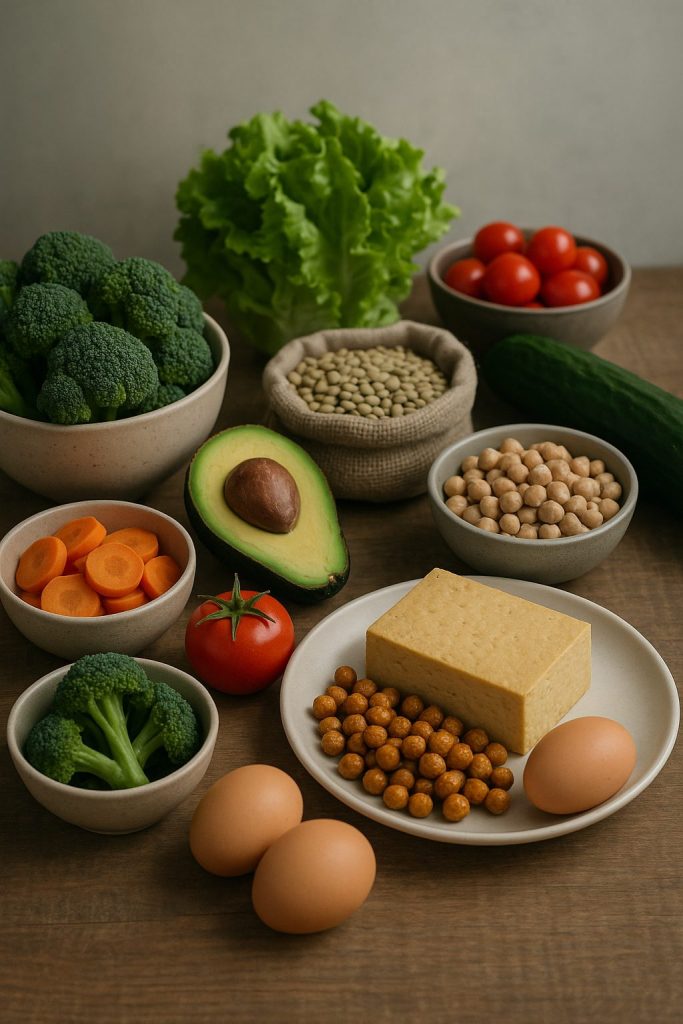
Vegetarianism is often seen as the forerunner of veganism. A vegetarian does not eat meat, whether red or white, but may still consume certain animal products. Within that broad category, there are also more flexible versions. Some semi-vegetarians avoid red meat but still eat poultry, fish or seafood. There is also lacto-ovo vegetarianism, in which meat is excluded while foods such as milk and eggs remain part of the diet. This way of living is hardly marginal or incompatible with achievement: figures such as Einstein and Leonardo da Vinci are often cited as vegetarians, and athletes such as Scott Jurek show that high performance is possible without meat. Jurek, for example, won the 246 km Spartathlon twice.
Veganism, however, goes further than diet alone. A vegan not only avoids meat and all foods of animal origin, but also rejects animal-derived products in clothing, cosmetics and jewellery. Végétalisme, or a strictly plant-based diet, is therefore very close to veganism, but veganism extends beyond the plate. Flexitarianism, by contrast, keeps the vegetarian impulse while allowing occasional exceptions, such as accepting poultry or beef when served by a host.
- Vegetarian: no meat, but some animal products may remain.
- Plant-based / végétalien: no foods of animal origin.
- Vegan: excludes animal products in food and everyday consumption.
- Flexitarian: mostly vegetarian, with occasional exceptions.
Why veganism became more than a diet
The distinction matters even more when we look at the origins of the word and the ideas behind it. The term “Vegan” is said to have appeared in Fay K. Henderson’s cookbook Vegan Recipes, published in 1946. Although the word emerged shortly after the Second World War, it took a few more years before it was properly defined. That definition presented veganism as a doctrine according to which human beings should live without exploiting animals. From that point of view, the exclusions are not limited to meat: milk, cheese, honey, eggs and even wool jumpers fall within the same ethical refusal.
That is why veganism is often perceived not merely as a diet, but as a genuine way of life, even an ideology for some. In 1975, the philosopher Peter Singer helped popularise the term in Animal Liberation, a landmark work that brought animal sentience and the right not to suffer into public debate. Then, in 1979, the Vegan Society offered a fuller definition, describing veganism as both a philosophy and a way of living that seeks to exclude, as far as possible, all forms of cruelty to and exploitation of animals, for the benefit of humans, animals and the environment. Even so, the word did not enter the French dictionary until 2015.
From there, veganism naturally comes into conflict with what some thinkers call carnism: the belief system that presents the consumption of animals as normal, natural and unquestioned. Veganism challenges that reflex and asks an uncomfortable question: why do we accept eating some animals while finding the idea of eating others intolerable? Melanie Joy addresses this directly in Why We Love Dogs, Eat Pigs, and Wear Cows. She asks why many Westerners would never dream of eating dogs or cats, yet feel little shock at the industrial destruction of chicks. Her answer is that we have been conditioned for years by advertising and by a culture that presents animal consumption as beneficial, ordinary and even desirable.
When doctors, dietitians and sports coaches repeat those messages throughout our lives, it becomes harder to see the moral contradiction. That is precisely where veganism begins: not with a label, but with a shift in conscience about our relationship with animals.
Why animal suffering and speciesism drive the vegan conscience
When compassion turns into a moral question
It is not always easy to see what is troubling about eating animal products when, all our lives, doctors, dietitians and sports coaches have repeated their supposed benefits. That is precisely why veganism is often described as a form of awakening. At its heart lies the desire for a better relationship with animals, and a refusal to treat them as resources placed at human disposal. This is where the idea of speciesism comes in: the deeply rooted belief that human beings hold a natural right of domination over other living species, especially animals. For many vegans, that belief is no longer morally neutral once it is recognised for what it is.
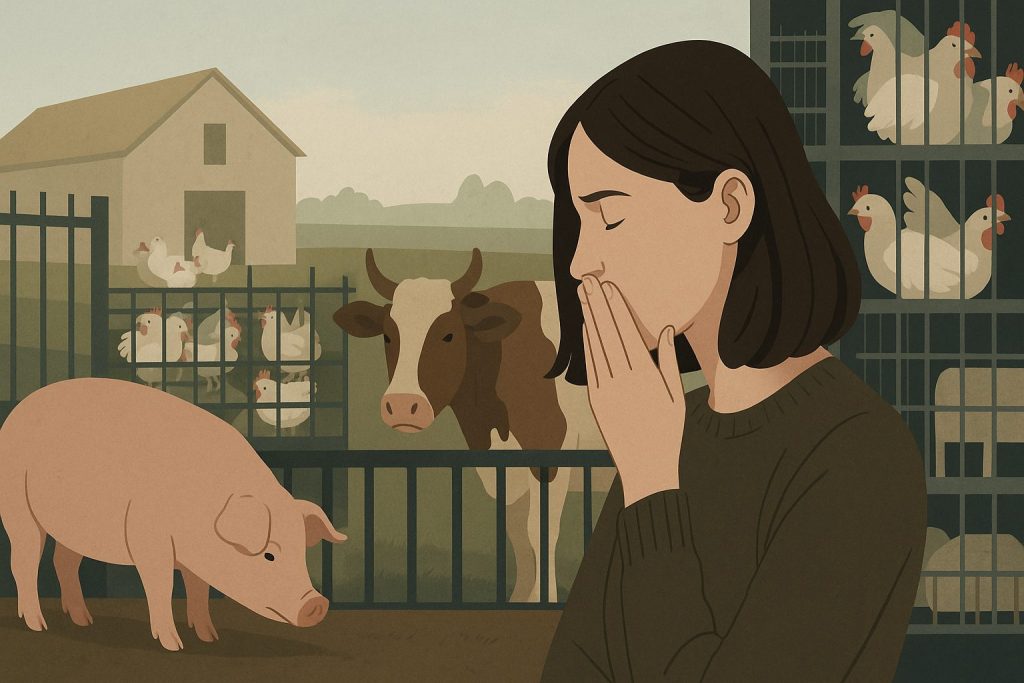
Their motivation is therefore not abstract. It is driven above all by concern for animal suffering and by the brutality of modern exploitation. Images shared online have made that suffering harder to ignore: pigs beaten when they can barely stand, chicks thrown into giant grinders, cattle cut up while still alive, hens and rabbits confined to cages far too small for them. Disturbingly, some people even watch such scenes as if the animals were toys rather than living beings. Others, however, are deeply shaken by them. They see sentient creatures that deserve care, not objects to be used and discarded.
And when the public or industry is asked to justify such treatment, convincing answers are rarely forthcoming, even from those who claim they want a more respectful relationship with animals. The scale alone is staggering: more than 142 billion animals are killed worldwide each year, without even counting marine animals; in France, the figure is around one billion, including 45 billion chickens and 1.2 billion pigs globally each year. Faced with numbers like these, it is hard not to wonder what the future will look like as the world’s population continues to grow.
- Speciesism: the belief that humans are entitled to dominate other species
- Vegan motivation: a refusal of cruelty rather than a simple food preference
- Central question: can a society call itself evolved while normalising such suffering?
Why awareness spreads, and why it is still resisted
Since the rise of social media, vegan ideas have become more visible and, in some circles, more accepted. The reason is simple enough: videos of slaughterhouses and industrial farming now circulate widely, and their impact can be immediate. For some people, seeing how animals are treated triggers a chain of uncomfortable questions. Where has our respect for living beings gone? How far will this mass killing extend? How can someone kill and disembowel a pig or a lamb, then still think of themselves as civilised, evolved or even spiritual? Questions like these may seem minor to some, yet they can profoundly alter the way a person sees food, consumption and responsibility.
Once that awareness begins, an inner conflict often follows, and that is sometimes the point at which a person starts moving towards vegetarianism, veganism or a broader ethical shift.
Not everyone responds in the same way, of course. Some embrace the message almost as a sign of moral or spiritual awakening. Others reject it forcefully, not necessarily out of cruelty, but as a form of self-protection. Accepting the implications of veganism can unsettle long-held habits, family traditions and one’s sense of self, so resistance is often psychological as much as ideological. Many people remain somewhere in between, taking a more moderate or relativist position. What is clear, though, is that people do not usually become vegan overnight. Most pass through vegetarianism or plant-based eating first, even if the number of omnivores making that transition has clearly grown in recent years.
Veganism now touches every age group: people in their fifties, younger people struggling to find meaning in society, and professionals in established careers. What unites them is less a social profile than a shared sensitivity to life and suffering. Yet they are still often misunderstood, treated as if they were extreme, conspiratorial or somehow from another planet. In reality, many simply embody a truth others find difficult to face: that refusing unnecessary suffering may be one of the most human instincts we have.

Related offer
10 States of Consciousness - Infinity Elementary Pack
Elementary Infinity - The 10 States of Consciousness A unique sound box designed to explore the 5 states of...
View productLiving as a vegan in a meat-centred society
The daily strain of choosing differently
Many people feel that vegans are touching a truth society would rather not face. At its heart, the vegan position is simple: animals should not be made to suffer for our habits. Yet that idea, however humane and noble it may be, can be deeply uncomfortable when it collides with everyday life. To live as a vegan in a society where meat and animal products remain the norm demands real self-control. There is the judgement of others, of course, but also the constant background noise of a culture that celebrates these products as desirable, delicious or useful.
Hearing people speak lovingly about foie gras, a rare steak or even cosmetics made without much thought for their origin is not easy when you no longer see these things as neutral consumer choices.
That is why the vegan struggle is not only social; it is also inward. Many vegans feel the urge to speak out, to protest, to challenge what they see, yet often choose silence to avoid conflict with family, friends or colleagues. And beyond the reactions of others, there is the daily discipline of remaining aligned with one’s convictions in a world where animal exploitation is everywhere and has been normalised for generations. If we looked only at the finished product, it would be hard to understand that refusal. But perhaps if more people saw what happens in the factories and industrial systems behind these supposedly appealing products, they would find them far less tempting.
- social judgement from relatives and peers
- constant exposure to animal-based products
- the need to stay faithful to one’s values every day
Why veganism is resisted, and why it keeps growing
The difficulty of accepting veganism does not come only from personal habits. It is also tied to conformity, conditioning and convenience. From childhood onwards, society teaches us what to eat, what to buy and what to consider normal. For that reason, veganism is often misunderstood even as it is increasingly turned into a business opportunity. The spread of “vegan burgers” on every high street says a great deal about that contradiction, especially when such products are sold by companies or traders whose wider business still depends heavily on animal exploitation. At the same time, some producers accuse vegans of threatening their livelihood. So the future remains uncertain: veganism may be encouraged in some spaces and condemned in others.
Even so, the movement continues to awaken something deeper in many people. For most vegans, this is not about extremism but about a broader shift in consciousness, one that brings together humanism, spirituality, a change of paradigm and a desire to live more ethically. It encourages people to think for themselves again: to read labels before buying food for their children, to reduce their consumption of meat and fish, to look beyond the cheerful branding on supermarket packaging, and to question the ethics of the businesses they support. That same reflection can extend further, towards concern about human exploitation, harmful products and industries driven only by profit.
Many associations now work to expose the atrocious conditions in which animals are raised and slaughtered for food, cosmetics and textiles. Gandhi’s words still resonate here: “One can judge the greatness of a nation by the way its animals are treated.” Seen in that light, veganism is not merely a restrictive lifestyle. It is a difficult but profoundly human attempt to align conscience, compassion and action.
- it questions habits learned from childhood
- it is often commercialised before it is truly understood
- it pushes people to examine what they buy, wear and endorse
The Mental Waves Conscious Choice Framework
The Mental Waves frame is to approach veganism as a question of attention before it becomes a question of identity. A conscious choice is not made from guilt alone; it is made by seeing more clearly, feeling honestly and acting in a way that can be sustained.
- See the habit: notice what you consume without thinking.
- Name the value: ask what kind of relationship with life you want to cultivate.
- Reduce contradiction: choose one practical change that fits your real context.
- Stay open: avoid turning awareness into superiority or shame.
The free Mental Reset Session can support the inner pause between impulse and choice. For imagination as a force for change, read Creative Visualization.
How to Keep the Conversation Conscious Rather Than Dogmatic
Because veganism touches food, family, culture, body image, ecology and ethics, it can quickly become emotionally charged. A conscious conversation makes room for facts and feeling without reducing the other person to a label. The point is not to win a moral argument in one exchange; it is to widen the field of awareness.
This is why veganism and human consciousness should be approached together: the outer choice is inseparable from the inner quality of attention that supports it.
That means asking better questions. What do I know about the origin of this food? Which habits are inherited rather than chosen? Where can I reduce harm without pretending that my life is perfectly pure? These questions invite responsibility without demanding impossible perfection.
For many people, the most stable change begins with one area: food, clothing, cosmetics, entertainment or language. Each small step can become a practice of coherence. Over time, veganism becomes less about restriction and more about living with fewer blind spots.

Related offer
18 States of Consciousness - Integral Infinity Pack
Integral Infinity - The 18 States of Consciousness A unique sound box designed to explore all the...
View productA Grounded Way to Begin Without Forcing Identity
A useful first step is to separate identity from experiment. Instead of deciding that you must become a certain kind of person overnight, choose one area where you can observe your habits honestly. That might mean reading labels for a week, replacing one regular meal, choosing a cruelty-free product or simply learning more about where a familiar food comes from.
This slower approach gives awareness time to become embodied. When change is only driven by shock or guilt, it can create defensiveness or exhaustion. When it is supported by understanding, planning and self-respect, it is more likely to become stable. The goal is not to perform purity for others; it is to reduce the gap between what you know, what you feel and what you do.
It also helps to keep compassion wide. Concern for animals does not require contempt for people who are still learning, constrained by health, limited by money or shaped by a different culture. A more conscious relationship with food can be firm and humane at the same time.
From that perspective, veganism becomes less of a badge and more of a practice of attention. It asks you to notice the hidden systems behind comfort, convenience and inherited preference. Even when the answer is imperfect, the act of noticing changes the relationship. You begin to choose with more honesty instead of letting habit choose for you.
Editorial note from Mental Waves
This article is a reflective and ethical exploration. It is not nutritional advice. Anyone changing diet substantially should consider their health context and seek qualified guidance when needed.
Conclusion
Veganism emerges here as something more demanding than a food choice and more complex than a passing trend. At its core lies a refusal of animal exploitation, but also a wider moral unease with habits many people inherit without ever really examining them. That is why it can feel, for some, like an awakening of conscience and, for others, like a challenge they would rather keep at arm’s length. The nuance matters: veganism is not reducible to purity, provocation or social identity, even if it is sometimes perceived through those lenses.
What gives the movement its force is not only compassion for animals, but the way it unsettles familiar boundaries between comfort, culture and responsibility. It asks difficult questions about what we normalise, what we consume, and how easily suffering disappears once it is hidden behind packaging, language or routine. At the same time, the article rightly leaves room for complexity: people do not all change at the same pace, and not every vegan journey begins with certainty.
Perhaps that is the deeper point: beyond diet, veganism invites a more lucid relationship with life itself. And once that question has been felt honestly, it rarely leaves us unchanged.
Frequently Asked Questions About Veganism and Human Consciousness
How does veganism relate to human consciousness?
It asks whether everyday choices reflect empathy, awareness and responsibility toward animals, the planet and one own values.
Is veganism only a diet?
No. For many people it is an ethical position that extends beyond food to clothing, products, entertainment and habits.
What is speciesism?
Speciesism is the idea that one species can be valued so much more than others that their suffering is ignored or normalized.
Why does veganism create resistance?
It touches identity, pleasure, family habits, culture and economics, so it can feel personal even when the discussion is ethical.
Can veganism be approached gradually?
Yes. Some people begin with food, others with products or a reduction in animal-based habits. Coherent change can be progressive.
Is veganism about guilt?
It does not have to be. Guilt can open awareness, but sustainable change usually needs clarity, compassion and practical steps.
Does consciousness mean perfection?
No. Consciousness means seeing more honestly and reducing contradiction where possible, not pretending to live without impact.
How can veganism be discussed calmly?
Start with curiosity, avoid contempt and focus on specific choices rather than attacking someone entire identity.
What is the main takeaway?
Veganism becomes a consciousness question when it helps someone align habit, empathy and responsibility in daily life.