Englishen

    Sound and healing

    Sound Therapy: Origins, Scientific Principles and Modern Applications

    Since ancient times, human beings have used the voice, rhythm, bowls, gongs and sacred instruments to influence attention, emotion and inner state. Modern sound therapy brings this intuition into dialogue with acoustics, neuroscience and psychoacoustics, showing how sound can become a structured support for wellbeing without reducing it to a medical promise.

    Science guides

    Explore related Mental Waves guides

    These pages extend the foundation path with practical and scientific deep dives: sound therapy, synchronization, Schumann resonance and breathing.

    Ancient roots

    Sound as one of humanity’s oldest healing languages

    Before it became a field of modern research, therapeutic sound was a human experience: the drum that regulates a ritual, the voice that gathers a community, the chant that steadies the mind, the bowl that fills a room with resonance.

    In shamanic traditions, rhythm was used to support trance, emotional release and symbolic healing. In Buddhist and Hindu practices, mantras were repeated not only as words, but as vibrations that shape breath, attention and inner attitude. In ancient Egypt, Greece and medieval Europe, sacred syllables, lyres, flutes, chants and harmonic proportions were connected to order, balance and spiritual life.

    The common intuition is simple: sound is not only communication. It can organize attention, influence breath, gather the nervous system and create a field in which the listener enters a different relationship with body and mind.

    That is why sound therapy belongs naturally beside the Mental Waves foundation pages on body resonance and cymatics.

    Shamanic sound ritual with rhythmic movement
    Many traditions used rhythm, voice and repetition to change attention and inner state.

    Modern principles

    What makes sound therapeutic?

    Sound therapy becomes meaningful when sound is approached as vibration, rhythm, sensory experience and intentional listening environment. A tone may affect the body through physical vibration, while a musical structure may influence expectation, emotion, breathing and attention.

    Modern explanations come from several fields: acoustics explains frequency and amplitude; psychoacoustics studies how sound is perceived; neuroscience shows how auditory stimulation reaches the brain; and body resonance explains why certain vibrations are felt physically.

    None of this means that sound should be presented as a cure. The responsible position is stronger: sound may create conditions that support relaxation, focus, presence and emotional integration.

    Frequency and vibration

    Every sound carries movement through a medium: air, water, tissue or bone.

    Brainwave entrainment

    Rhythmic stimulation may help guide the brain toward calmer or more focused patterns.

    Emotional regulation

    A soundscape can influence mood, memory, safety cues and stress response.

    Cymatic insight

    Visible patterns show that vibration can organize matter under specific conditions.

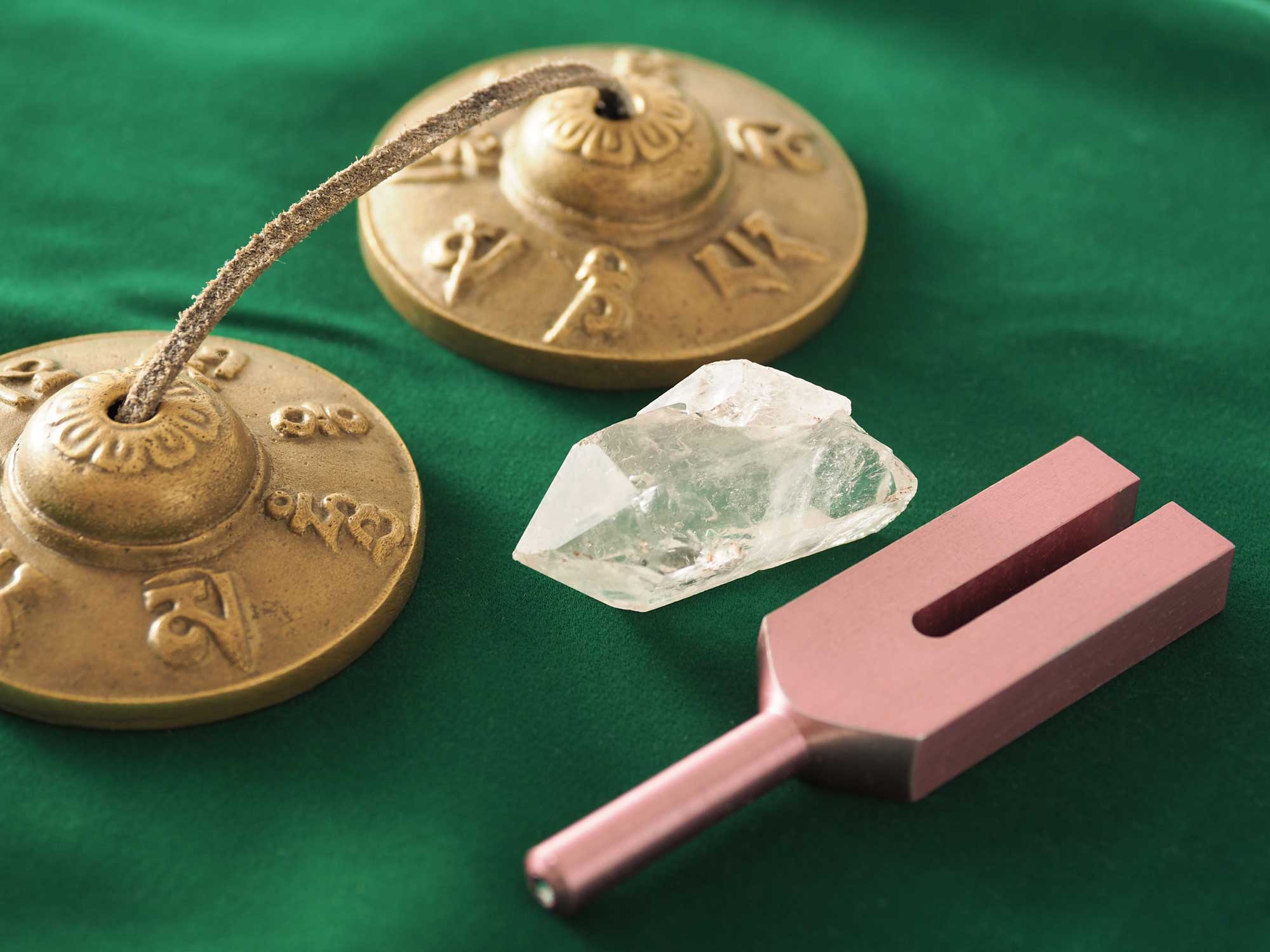
    Tuning fork used in sound therapy
    Tuning forks, bowls and gongs are used because they create clear, sustained vibration.

    Tools and practices

    From bowls and gongs to neuroacoustic audio

    Modern sound therapy is not limited to one instrument. It may use acoustic instruments, the human voice, digital sound design, binaural or isochronic rhythms, nature recordings and immersive spatial audio.

    Tibetan bowls, crystal bowls and gongs create rich harmonic fields that can be felt as enveloping and physical. Tuning forks offer more precise, focused vibration. Mantras and vocal tones add breath and intention, making the listener both receiver and generator of sound.

    Digital tools add another dimension: precise frequencies, layered soundscapes, brainwave entrainment and progressive transitions. This is where Mental Waves products such as Meditation and Relaxation, Brainwave States and Sacred Frequencies become relevant for listeners who want a structured audio experience.

    Applications

    Where sound therapy is used today

    The uses below should be understood as supportive contexts, not medical promises. The listener’s state, environment and expectations all matter.

    Stress and relaxation

    Slow, coherent sound environments may help the body move away from constant activation.

    Breath and meditation

    Breathing practices can deepen receptivity to bowls, mantras, drones and frequency-based sessions.

    Focus and cognition

    Structured rhythms may support attention by giving the mind a stable object to follow.

    Responsible support

    Sound is best used as a complementary wellbeing practice, not a replacement for professional care.

    Related guides

    Go deeper with Mental Waves foundations

    These internal pages explain the scientific and experiential foundations behind sound therapy.

    Foundation

    Sound and the Resonance of Life

    Understand why sound can be felt through the body.

    Open page →
    Visible sound

    Cymatics: The Science of Sound Made Visible

    See how vibration becomes pattern.

    Open page →
    Body and brain

    How Sound Affects the Body and Brain

    Explore physiology, entrainment and psychoacoustics.

    Open page →
    Practice

    Breathing Techniques

    Use breath to deepen therapeutic listening.

    Open page →

    Frequently asked questions

    Sound therapy, sound healing and responsible listening

    Is sound therapy scientifically proven?

    Some effects of music, rhythm, breathing and auditory stimulation have been studied in neuroscience, psychology and clinical contexts. Sound therapy should be understood as a supportive wellness practice, not as a guaranteed medical treatment.

    What is the difference between sound therapy and music therapy?

    Music therapy is usually delivered by trained clinicians in therapeutic settings. Sound therapy is broader and may include bowls, gongs, tuning forks, mantras, frequency-based audio and guided listening practices.

    Can I practice sound therapy at home?

    Yes. Begin with a quiet environment, comfortable volume and a short session. Headphones may be useful for immersive audio, while bowls, gongs or voice practices can also be used in a room.

    Can sound therapy replace medical treatment?

    No. It can support relaxation, attention and inner exploration, but it does not replace medical advice, diagnosis, psychotherapy or professional care.

    How long should I listen?

    A useful starting point is 10 to 20 minutes. The best duration depends on the listener, the goal and the intensity of the sound environment.

    Pillar pages

    Navigate the Mental Waves foundations

    Use these pages as a clear path through the Mental Waves universe: sound, resonance, cymatics, the body, the brain, brainwaves and the technology behind the sessions.

    Begin with sound

    Turn sound into a daily listening practice

    Choose a Mental Waves session, create a quiet environment, and let sound become a structured space for attention, breath and inner resonance.

    Explore the store
    lockpower-switchmagnifycross linkedin facebook pinterest youtube rss twitter instagram facebook-blank rss-blank linkedin-blank pinterest youtube twitter instagram