Englishen

    Brainwave entrainment

    Brainwave Synchronization: How Sound Can Guide Mental States

    Brainwave synchronization, also called brainwave entrainment, describes the way rhythmic external stimuli can encourage the brain to align with a target rhythm. When carefully designed, sound can help create conditions for relaxation, focus, meditation, sleep or expanded inner awareness.

    Science guides

    Explore related Mental Waves guides

    These pages extend the foundation path with practical and scientific deep dives: sound therapy, synchronization, Schumann resonance and breathing.

    Core principle

    Understanding brainwave synchronization

    The brain is not electrically silent. It produces rhythmic activity across frequency bands such as Delta, Theta, Alpha, Beta and Gamma.

    Brainwave synchronization occurs when a rhythmic external stimulus gives the nervous system a stable pattern. The brain may then show a tendency to align with that rhythm. This is often described through the Frequency Following Response –FFR, especially in auditory stimulation.

    A 10 Hz rhythm may support Alpha-like states of relaxed attention. Slower patterns can be used to support meditative or sleep-oriented transitions. Faster rhythms can be designed for alertness and cognitive engagement. The key is not to force the brain, but to offer a coherent signal it can follow.

    For a wider overview of these frequency bands, see Brainwaves Explained.
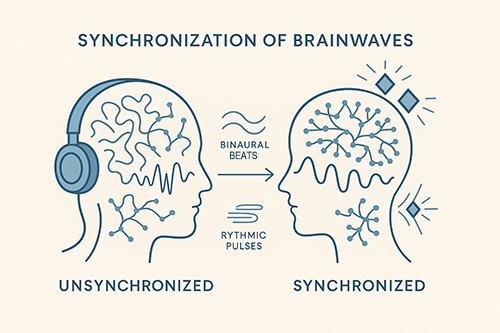
    Brainwave synchronization illustration
    Synchronization is a response to rhythmic pattern, not a magical command.

    Measurement

    How synchronization is studied

    Researchers use EEG to observe changes in brain rhythm, coherence and dominant frequency bands. Neurofeedback adds a feedback loop by showing the user aspects of their brain state in real time.

    In practice, synchronization is complex. A person’s current state, fatigue, expectations, hearing, environment and comfort all influence the response. This is why Mental Waves favors progressive transitions, layered sound design and comfortable volume rather than aggressive stimulation.

    EEG observation

    Electrodes record electrical activity and reveal dominant frequency patterns.

    Neurofeedback

    Feedback helps observe and train attention, calm and self-regulation.

    Frequency Following Response –FFR

    The nervous system may reflect the rhythm of repeated auditory stimulation.

    Non-invasive practice

    Sound should be used responsibly and never as a substitute for clinical care.

    Techniques

    Modern ways to induce synchronization

    Different methods use different sensory routes. Sound is the most accessible, but light, breathing and movement can also influence rhythmic neural activity.

    Binaural beats

    Two slightly different tones are sent separately to each ear; the brain perceives their difference as a beat.

    Isochronic tones

    A single tone pulses on and off at a target rhythm, often clearly perceived without headphones.

    Monaural beats

    Two tones are combined before reaching the ears, creating a physical beat in the signal itself.

    Breath and movement

    Rhythmic breathing, chanting, walking or drumming can also create entrainment-like conditions.

    From simple beats to immersive sound protocols

    To explore this principle through Mental Waves products, start with Brainwave States, 3D Meditation, or the Meditation-Relaxation set.

    Explore Brainwave States
    EEG measurement during brainwave research
    EEG helps observe changes in electrical activity during stimulation and relaxation.

    Benefits and limits

    What synchronization may support

    Brainwave synchronization is often explored for stress, attention, sleep, creativity, meditation and self-regulation.

    When a session is gentle and well matched to the listener, it may help create a stable inner frame: the breath slows, attention gathers, and mental noise may become less dominant. For sleep-oriented uses, Delta and Theta transitions can support an evening ritual. For focus, low Beta or SMR-like states may help the listener remain alert without excess tension.

    However, effects are not identical for everyone. A frequency is not a universal switch. The strongest results usually come from a combination of rhythm, context, comfort, session design and repetition.

    Safety frame

    Potential risks of misuse

    Responsible brainwave synchronization avoids intensity, discomfort and exaggerated claims. The aim is not to overpower the nervous system, but to create a coherent environment it can enter gradually.

    People with photosensitive epilepsy should avoid flickering light stimulation. People with severe psychiatric conditions, implanted devices or complex neurological histories should seek professional guidance before intensive protocols.

    Avoid overload

    Keep volume comfortable and avoid long sessions when tired or emotionally overwhelmed.

    Use grounding

    Breathing and body awareness help integrate the session gently.

    Choose the right state

    Do not use sleep-oriented sessions while driving or doing tasks that require attention.

    Respect variability

    A response that feels helpful one day may feel too intense another day.

    Related guides

    Continue your brainwave path

    These pages explain the broader context behind brainwave synchronization.

    Foundation

    Brainwaves Explained

    Understand Delta, Theta, Alpha, Beta, Gamma and related rhythms.

    Open page →
    Technology

    Mental Waves Sound Technology

    See how NeuralTrim goes beyond simple binaural or isochronic beats.

    Open page →
    Practice

    Breathing Techniques

    Use breath to deepen receptivity to sound.

    Open page →
    Research

    Resources

    Explore studies, references and brainwave research summaries.

    Open page →

    Frequently asked questions

    Brainwave synchronization in practice

    What is brainwave synchronization?

    Brainwave synchronization, or brainwave entrainment, is the tendency of brain rhythms to align with stable rhythmic stimulation such as pulsed sound, binaural beats, isochronic tones, light or movement.

    Do I need headphones?

    Headphones are required for classic binaural beats because each ear receives a different tone. Isochronic and monaural rhythms can work through speakers, though headphones can still improve immersion.

    Can it help with sleep or focus?

    It may support the conditions for sleep, relaxation or focus when the stimulus is appropriate and the listener uses it in a calm environment. Effects vary by person and should not be treated as medical guarantees.

    Is brainwave entrainment safe?

    Most people can use gentle audio entrainment comfortably, but people with epilepsy, severe psychiatric disorders, implanted devices or sensitivity to light stimulation should seek professional advice, especially for visual or intensive protocols.

    How does Mental Waves use this principle?

    Mental Waves integrates entrainment into broader sound environments using frequency layers, transitions and immersive sound design rather than relying on a single bare beat.

    Pillar pages

    Navigate the Mental Waves foundations

    Use these pages as a clear path through the Mental Waves universe: sound, resonance, cymatics, the body, the brain, brainwaves and the technology behind the sessions.

    Begin with sound

    Use brainwave synchronization inside a real sound experience

    Explore audio sessions that integrate rhythm, frequency, transitions and immersive design to support specific states of listening.

    Explore Brainwave States
    lockpower-switchmagnifycross linkedin facebook pinterest youtube rss twitter instagram facebook-blank rss-blank linkedin-blank pinterest youtube twitter instagram