en
enVotre panier est vide.



Known in Japan as shinrin-yoku, or “forest bathing”, sylvotherapy rests on a simple idea: that time spent among trees can support human health. Far from being treated as a passing curiosity, the practice has been taken seriously in Japan for decades, following successive scientific studies and the creation of 62 forest care sites. What may sound, at first glance, like a gentle walk in the woods has gradually entered the wider conversation around prevention, stress and the body’s capacity to recover when it is brought back into contact with the living world.
There is something quietly striking in that shift. A practice once dismissed by some as poetic or vaguely mystical has, in certain contexts, been observed with the seriousness usually reserved for more formal health interventions. That does not mean the forest becomes a clinic, nor that every walk among trees should be burdened with therapeutic expectation. It means, rather, that modern medicine has begun to notice what many people have felt instinctively for a very long time: the body often settles when the environment itself becomes less aggressive, less noisy, less fragmented.
Yet the roots of this relationship with trees are far older than any modern wellness trend. Across ancient mythologies and many spiritual traditions — from Celtic culture and Native American beliefs to Buddhism, shamanism, animism and later neo-Druidic or New Age currents — nature has long been approached as a realm of deep connection rather than simple backdrop. In a society unsettled by too-rapid technological change, it is hardly surprising that people are rediscovering the restorative power of the forest.
In short: what are shinrin-yoku and sylvotherapy?
Shinrin-yoku, or forest bathing, is the practice of spending time in the forest with slow sensory attention. Sylvotherapy is a broader term for using contact with trees and wooded environments as a support for calm, recovery and reconnection.
- It is less about exercise than about sensory presence.
- Forest contact may support stress relief and mood.
- The practice can be simple: walk slowly, breathe, listen and observe.
- It should be understood as supportive, not as a cure-all.
For a companion article on tree contact, read Trees That Heal. For a short reset cue, try the free Mental Reset Session.
Whether it appears under the label of “green medicine” or the more familiar image of tree hugging, sylvotherapy speaks to something more essential: a need to return to a quieter, more direct bond with nature, in all its plainness and depth.
That return is not always dramatic. More often, it begins with something almost embarrassingly modest: walking more slowly, breathing more fully, noticing the smell of bark after rain, or realising how rarely one has listened without interruption. Forest bathing appeals precisely because it asks so little in outward terms while often changing the inner atmosphere quite profoundly. For people worn thin by speed, screens and constant mental traffic, the woods can feel less like an escape than a place where the nervous system finally stops bracing itself.
Why Forest Bathing Benefits Body and Mind
What the research suggests about the body’s response
According to several studies, shinrin-yoku appears to support the immune system, help regulate blood pressure and ease stress in its many forms, while also lowering the risk of depression. Part of this effect is sometimes linked by scientists to phytoncides, the molecules released into the air by trees and forests. These substances are thought to serve both as a defence system for trees, with bactericidal and fungicidal properties, and as a means of communication through plant hormones. What matters here is that these compounds, absorbed through the skin and respiratory system, are now recognised for their potentially positive effects on human health, notably through the stimulation of NK lymphocyte activity.
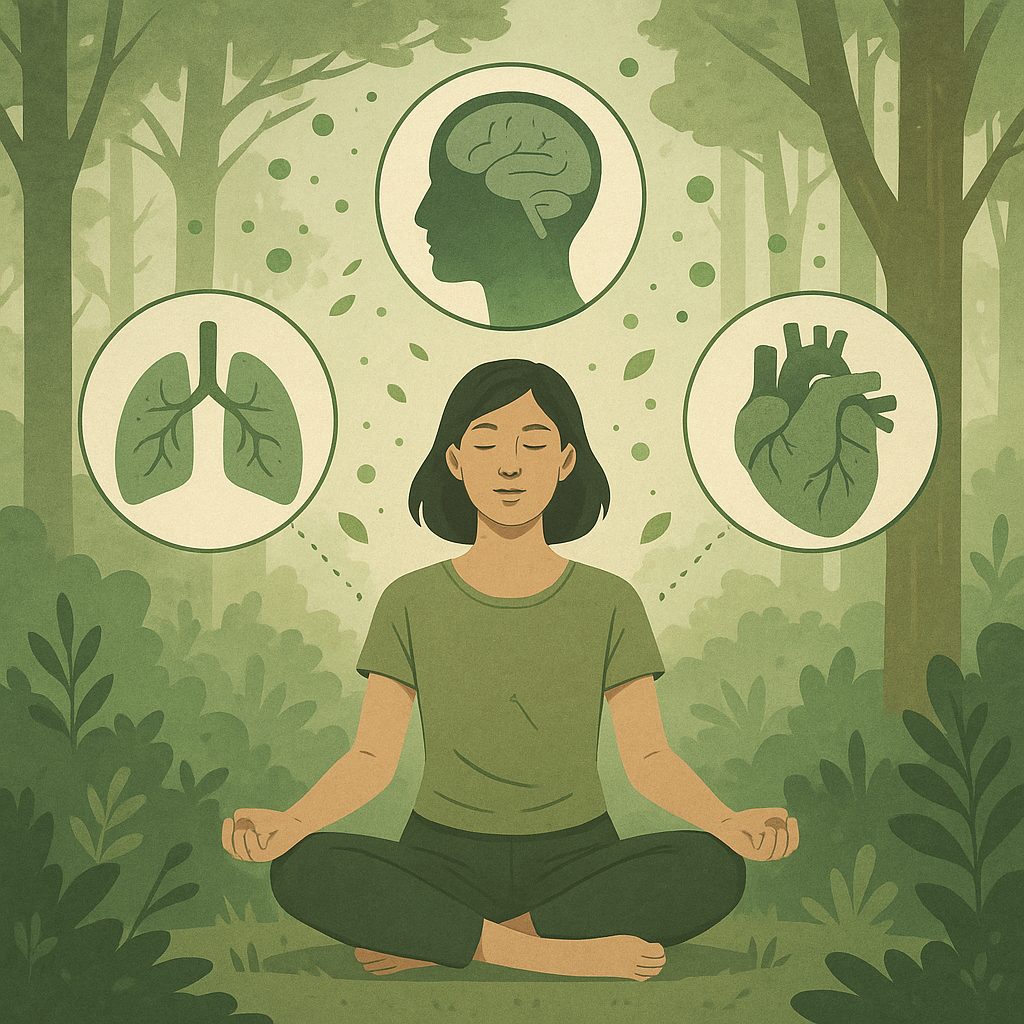
Japanese studies on walking in woodland have also produced striking observations. They found that people who had walked in the forest showed much lower levels of cortisol, the stress hormone, than those who had covered the same distance in the city. Researchers also noted reductions in blood pressure and blood sugar, and a forest bath may last anything from two hours to several days. In an experimental study at Hokkaido University, a walk of 3 or 6 km in the forest by patients with type 2 diabetes was associated with lower blood glucose and reduced glycated haemoglobin levels.
Taken together, these findings help explain why the Japanese government has treated forest bathing seriously enough to establish 62 forest therapy sites over the past few decades.
What is especially compelling is that the benefit does not seem to come only from exercise. Walking is, of course, good for us almost anywhere, but the contrast between an urban route and a woodland route suggests that setting matters in its own right. Air quality, soundscape, visual softness, humidity, scent and the absence of constant alert signals may all play a part. The body does not respond merely to movement; it responds to context. A forest offers a very different context from a pavement lined with traffic, advertising and hard edges.
There is also a cumulative quality to these experiences that many regular walkers recognise without needing to dress it up in theory. One visit to the woods may bring a sense of relief; repeated visits often seem to deepen that effect. Sleep can improve. Breathing becomes less shallow. Attention, which has been scattered all day, begins to gather itself again. None of this should be exaggerated into miracle language, but neither should it be dismissed simply because it is gentle. Some of the most meaningful forms of restoration are subtle at first and only become obvious when we notice what has eased.
- Lower cortisol levels than an equivalent walk in the city
- Reduced blood pressure and blood sugar
- Possible stimulation of NK lymphocyte activity
Why trees affect us so deeply
The appeal of sylvotherapy is not only scientific. It also draws on a much older intuition: that human beings feel better when they are in respectful contact with the living world. For centuries, the benefits of trees have been recognised across ancient mythologies and a wide range of traditions, from Celtic society and Native American cultures to Buddhism, shamanism, animism, neo-Druidism, New Age movements, energetic martial arts and even the folk healers of rural life. In all of them, the relationship between people and nature — plant, animal and mineral alike — rests on a sense of intimate communion and a real respect for unity. China, too, has long preserved this sensibility.
In its parks, one can still see older generations leaning against or embracing tree trunks, quietly absorbing the smells, sounds and sensations of the vegetal world.
There is also a long-standing belief that different trees offer different qualities: beech is said to be relaxing, spruce invigorating, willow calming in times of stress, oak strengthening, lime bringing warmth, while maritime pine and eucalyptus are often associated with support for the lungs. Whether one approaches this through tradition, personal experience or physiology, the underlying idea is the same: a walk among trees does more than clear the head. In a society unsettled by too-rapid technological change, it can feel like a simple but powerful return to what is essential.
That is perhaps why forest bathing, sometimes known in the English-speaking world as Tree Hugging, has also become popular in France as a form of “green medicine”, occasionally even recommended within medical settings.
Part of the answer may lie in familiarity so ancient that we barely register it. Human beings did not evolve under strip lighting, among notifications, engines and sealed interiors. We evolved in relationship with weather, soil, shade, birdsong and the changing textures of the seasons. When we enter a forest, something in us may recognise a rhythm older than thought. The mind does not need to work so hard to filter and defend. Vision softens because there is depth rather than glare. Hearing widens because sound arrives layered rather than abrasive. Even silence feels different there: not empty, but inhabited.
Trees also affect us symbolically, whether or not we speak in those terms. Their rootedness, their patience, their seasonal intelligence, their ability to remain still without being inert — all of this can act as a quiet counterpoint to the way many of us live. To stand beside an old oak or a tall beech is sometimes to feel, without sentimentality, that one’s own urgency has been slightly misplaced. The forest does not solve our problems, but it can restore proportion. And proportion, in troubled periods, is no small gift.
- Ancient traditions saw trees as partners in healing and balance
- Different species have long been associated with distinct effects
- The practice answers a modern need to reconnect with simplicity
How to Practise Forest Bathing in a Meaningful Way
Choose the form of contact that feels most natural
There is no single way to benefit from shinrin-yoku. The right approach depends on your physical ease, your mood and, quite simply, your instinct. Some people prefer a slow, quiet walk, sometimes barefoot, stepping softly over leaves or the forest floor. Others are drawn to direct contact with a tree itself. In druidic tradition, the tree is said to “choose” you; whether or not you take that literally, the idea is helpful. Rather than forcing the experience, let yourself be guided towards a healthy tree that feels right to you. You may want to embrace it, or simply rest against the trunk with your bare feet firmly grounded and your palms placed on the bark.
Related offer
Forest walk
"Tranquillité et paix de la forêt" Vous explorez un sentier qui s'enfonce dans la forêt. Vous entendez coucous,…
View productIf you do lean against it, some traditions recommend the north-facing side of the trunk. And despite a very common belief, moss does not always reliably indicate direction.

Another method is more structured. For around five minutes, place one hand on the sacrum, with the palm against the bark, and the other over the solar plexus, while the back of your head rests against the tree and your feet settle between the roots. Then breathe deeply, engaging what some practitioners describe as the body’s four diaphragms, with an inhalation equal in length to the exhalation. After a few minutes, switch the position of your hands to respect the body’s polarity. Throughout, keep your attention anchored in the present, with all your senses awake and as little distraction as possible from outside noise.
Listen to the near-silence broken by the movement of leaves, feel the texture of the bark, and notice the scent of the tree. In particular, conifers release terpene-rich compounds, secondary metabolites linked to resin and turpentine, often described as especially invigorating. If you prefer Tree Hugging, close your eyes, rest your forehead gently against the bark and simply allow the presence of the tree to settle into you.
What matters most is not getting the ritual exactly right, but entering it with sincerity and enough time. Forest bathing loses much of its value when treated like another task to complete efficiently. If you arrive in the woods still mentally racing, do not force calm. Let the first ten or fifteen minutes be transitional. Walk without agenda. Notice what your body is doing. Very often, the breath lengthens of its own accord once the pace of the surroundings begins to influence you.
It is also worth approaching the practice with a little common sense. Choose a place where you feel safe, avoid damaged or unstable trees, and if you walk barefoot, do so only where the ground allows it comfortably. The point is not discomfort in the name of authenticity. A meaningful encounter with the forest is usually built from attentiveness rather than bravado. Warm clothing, a switched-off phone and enough unhurried time will often do more for the experience than any elaborate technique.
- Walk slowly and attentively, with or without shoes
- Lean against a trunk with hands on the bark
- Try a few minutes of balanced, deliberate breathing
- Embrace the tree if that feels more natural
Turn the walk into a sensory and inward experience
Forest bathing, as it is so often practised in Japan, can also be approached as a meditative walk that gently engages every sense. The point is not performance, but presence. Smell the wood and damp earth, notice the shifting light, hear the rustle of foliage, and let your body register the atmosphere of the place. Before leaving, many people like to thank the tree or the forest in their own way. Older druidic advice goes further still, even suggesting that if an oak has “chosen” you, you might urinate at its base as an offering. Whether that speaks to you or not, it reflects an older idea of reciprocity rather than simple consumption.
And for anyone who wants to explore further, many books offer other ways into the practice.
What gives this experience its depth is that it is never only practical. Trees support us in countless concrete ways: they warm us, shelter us, feed us and help us build our homes, tools, boats and furniture. Yet they also remain a profound source of inspiration in health, psychology, daily life and spirituality. A walk in the woods does more than expose the body to the trees’ essential oils; for many people, it also creates a sense of resonance with something more fundamental and alive.
That is why shinrin-yoku, while taken seriously in Japan as part of preventive medicine, can also become an inner journey, carried by the quiet music of the living world and ending, at its best, in a deeper meeting with oneself. Frank Lloyd Wright captured that feeling beautifully: “I believe in God, only I spell it Nature.”
To make the walk more inward, it can help to give each sense its own moment. Spend a few minutes listening before looking. Then stop and attend to scent alone. Later, notice the temperature of the air on your face, the pressure of your feet on the ground, the subtle difference between one patch of woodland and the next. This kind of attention sounds simple because it is simple, yet it is also rare. Most of us move through our days half-absent, receiving impressions without really inhabiting them. The forest invites a different quality of presence: slower, fuller, less defended.
Many people find that thoughts which felt tangled indoors become less oppressive outside. Not because the forest provides instant answers, but because it loosens the grip of mental repetition. A problem considered while walking beneath trees often changes shape. It may remain unresolved, but it no longer fills the whole field of awareness. There is bark, wind, distance, birds, damp soil, changing light. The self is no longer the only thing in the room. That widening of perspective is one of the quietest and most reliable gifts of time in the woods.
Related offer
Meditation - Relaxation set
All the Mental Waves® know-how in a single pack for quick and easy access to meditation and...
View productFor that reason, forest bathing can be especially valuable when approached regularly rather than only in moments of crisis. A weekly walk, a familiar path, a season watched closely from month to month — these create a relationship rather than a one-off experience. Over time, the forest ceases to be a backdrop for wellbeing and becomes a place of acquaintance. One begins to notice which trees draw one back, which clearings feel restful, which weather sharpens the senses, which hour of the day brings the deepest calm. That familiarity has its own medicine.
The Mental Waves Forest Bathing Framework
The Mental Waves frame turns forest bathing into a simple sequence. You are not trying to perform relaxation; you are creating the conditions for the body to stop bracing.
- Arrive: pause before walking and notice the body.
- Slow down: let the pace become quieter than ordinary movement.
- Open the senses: listen, smell, touch and observe without rushing.
- Return with one cue: bring one calmer rhythm back into your day.
If stress is the reason you are drawn to forest bathing, continue with How to Free Yourself from Stress. For the wider nourishment theme, read Nourishing Yourself Deeply.
Editorial note from Mental Waves
This article is educational. Shinrin-yoku and sylvotherapy can support wellbeing, but they should not be presented as substitutes for qualified care when physical or psychological symptoms need attention.
Conclusion
What emerges from shinrin-yoku is not an instant solution, but something both simpler and more demanding: a way of meeting the living world with enough attention for the body and mind to respond. The article holds that balance well. On one side, there are studies suggesting measurable effects on stress, blood pressure and immune function; on the other, there is an older, less easily quantifiable intuition that time among trees restores a sense of proportion we often lose. Forest bathing sits precisely in that space between preventive care and inner experience.
That is also why the practice resists being reduced to a technique alone. Whether one walks slowly, leans against a trunk or simply breathes more consciously in the woods, the deeper invitation is towards presence rather than performance. Beneath the fashions and the folklore, sylvotherapy speaks to a very recognisable need: to step out of noise, return to the senses, and remember that contact with nature can still steady us in ways modern life rarely does. Sometimes, a quiet walk in the forest is not an escape at all, but a return.
Perhaps that is the most enduring reason people come back to it. Not because every outing is profound, and certainly not because trees ask us to believe anything in particular, but because the encounter is often honest. The forest does not flatter, distract or demand. It simply receives our attention and, in doing so, often gives us back a little of our own. In a culture that rewards acceleration, that kind of meeting can feel almost radical in its gentleness.
To practise shinrin-yoku, then, is not merely to spend time outdoors. It is to allow the living world to set the pace for a while. For some, that will remain a pleasant habit. For others, it becomes a form of hygiene for the mind, a way of restoring equilibrium before strain hardens into exhaustion. Either way, the invitation is refreshingly modest: go to the trees, slow down, breathe, notice, and let the forest do what it has always done — hold life in a quieter order than the one we usually inhabit.
Frequently Asked Questions About Shinrin-Yoku and Sylvotherapy
What is shinrin-yoku?
Shinrin-yoku means forest bathing: spending time in a forest with slow, sensory attention rather than rushing through it.
What is sylvotherapy?
Sylvotherapy is a broader term for using contact with trees and wooded environments as a support for wellbeing.
Are shinrin-yoku and sylvotherapy the same?
They overlap, but shinrin-yoku usually refers to forest bathing, while sylvotherapy can include wider tree-based practices.
What benefits are possible?
Some people experience calmer breathing, better mood, reduced stress and a stronger sense of connection with nature.
Does forest bathing cure illness?
No. It can support wellbeing, but it should not be treated as a cure or replacement for clinical care.
How can someone practise simply?
Choose a safe natural place, slow down, breathe, observe light and sound, and avoid turning the walk into a task.
Do you need to hug a tree?
No. Tree hugging is optional. Quiet observation, walking or sitting can be enough.
How often should it be practised?
Regular short sessions are often more helpful than rare intense efforts. Consistency helps the body recognise the cue.
What is the main takeaway?
Shinrin-yoku and sylvotherapy invite slower sensory contact with trees, helping the nervous system return to a more grounded rhythm.