en
enVotre panier est vide.



At first glance, Qi gong can look deceptively simple: a sequence of slow, flowing movements, almost like a quiet choreography. Yet it is far more than gentle exercise. Rooted in Chinese medicine, it is a practice centred on the cultivation and regulation of energy, with the aim of restoring a steadier relationship between body and mind. That balance is precisely what gives Qi gong its lasting appeal — not only as a discipline, but as a therapeutic approach whose value has also drawn recognition from the French National Academy of Medicine.
What makes it especially compelling today is that its reputation no longer rests on tradition alone. Western research has increasingly examined its effects, with encouraging findings around blood pressure, stress and anxiety. That does not make Qi gong a substitute for clinical care, particularly in the case of hypertension, but it does help explain why this once quietly observed morning ritual in Chinese parks has come to be taken seriously well beyond its original cultural setting.
There is also something quietly reassuring about a practice that does not ask for force, speed or competition. For people living with inner tension, physical fatigue or the constant sense of being slightly overdriven, Qi gong offers another rhythm altogether. It asks less for performance than for attention, and that shift alone can feel unexpectedly restorative.
In short: can Qi Gong support blood pressure and anxiety?
Qi Gong may support blood pressure and anxiety indirectly by encouraging slower breathing, gentle movement, body awareness and relaxation. It should be seen as a supportive practice, not as a substitute for medical care.
- Slow movement can reduce physical tension.
- Breath awareness can support nervous-system regulation.
- Regular practice matters more than intensity.
- Medical guidance remains essential for hypertension or anxiety disorders.
For a short guided reset, try the free Mental Reset Session. For related breathwork, read Breathing Techniques.
Understanding what Qi gong really is
A gentle practice rooted in movement, breath and attention
The term Qi gong comes from Chinese and is usually understood as the “work and mastery of energy”. In practice, it is a form of gentle exercise built around slow, flowing sequences of movement, coordinated breathing and a clear awareness of each gesture. Far from being just a simple workout, it aims to restore a better balance between body and mind, which is precisely why so many people experience it as both a physical practice and a form of support for overall wellbeing.

What makes Qi gong distinctive is not speed or performance, but quality of presence. The movements are carried out with care, continuity and attention, so that the body is not pushed against itself but guided more calmly. That search for harmony lies at the heart of the practice: moving, breathing and focusing in a way that helps the whole system settle.
In real life, that often means learning to notice things most of us rush past: the way the shoulders creep upwards when we are tense, the way the jaw hardens, the way breathing becomes shallow without our realising it. Qi gong brings those patterns into awareness without turning them into a struggle. Over time, that can create a more settled relationship with one’s own body, which is no small thing in periods of stress or ill health.
Many people are surprised by how demanding slowness can be at first. Not physically demanding in the usual sense, but mentally revealing. When movement slows down, distraction becomes more obvious, and so does agitation. That is part of the value of the practice: it does not merely cover over inner restlessness, it gives you a way to meet it more steadily.
Accessible to almost anyone, whatever their age or level
You do not need to be especially sporty, flexible or experienced to begin. Qi gong is not reserved for experts. In reality, it can be practised by almost anyone willing to listen to their body and respect their own limits, which is essential if you want to avoid strain or injury. That accessibility is one of the reasons it has remained such an enduring part of daily life for so many people.
If you were to visit China, you would often see younger and older people alike practising Qi gong in parks early in the morning before starting the day. That image says a great deal about the spirit of the discipline: simple, regular, grounded and woven into ordinary life rather than kept for specialists. The real question, then, is not whether it is reserved for a select few, but what benefits such a practice can bring.
That accessibility matters more than it may seem. A great many wellbeing practices sound attractive in theory but become unrealistic once pain, age, fatigue or lack of confidence enter the picture. Qi gong tends to remain available even then. Movements can often be adapted, shortened or practised more softly, which makes it easier to continue without feeling defeated by the body’s limitations.
It also suits people who are put off by highly performative forms of exercise. There is no need to keep up, no pressure to excel, and no sense that the practice only “counts” if it leaves you exhausted. For someone already carrying anxiety or physical strain, that gentler entry point can make all the difference.
- Slow, linked movements
- Breath work
- Awareness of posture and gesture
How Qi gong can support healthier blood pressure
A gentle practice that supports the cardiovascular system
Qi gong can help to regulate high blood pressure, although it should not be seen as a replacement for prescribed medication. When you take a blood pressure reading, the monitor shows two figures: the first is the systolic pressure and the second is the diastolic pressure. Regular qi gong practice has been associated with reductions in both. Part of the explanation lies in the nature of the movements themselves: slow, steady, flowing gestures combined with breath and attention can soothe the heart and support a better overall cardiovascular balance.
What makes qi gong especially interesting is its variation in intensity. Some movements are calm, deep and smooth, which tends to settle the body, while others are more dynamic and raise the heart rate slightly. This alternation appears to stimulate the body’s natural energy while gently engaging the cardiovascular system, which may help it function more efficiently over time. In that sense, qi gong is not simply about relaxation; it also offers a measured form of physical activation that remains accessible to many people.
There is a practical logic to this. Blood pressure is not influenced only by the heart in isolation, but by the wider state of the nervous system, breathing patterns, muscular tension and daily stress load. A practice that softens chronic tension while keeping the body moving may therefore support cardiovascular health from several angles at once. That does not make the mechanism simple, but it does make the results easier to understand.
For some people, the benefit may come partly from consistency rather than intensity. A short, regular practice that calms the breath and reduces the sense of internal pressure may be more sustainable than bursts of effort that feel punishing or difficult to maintain. Qi gong fits naturally into that quieter, steadier model of care.
- Systolic pressure: the first number on the monitor
- Diastolic pressure: the second number
- Qi gong may help lower both when practised regularly
What the research has observed in practice
Researchers have found that physically active people may see their blood pressure fall with regular qi gong practice. One set of observations showed a marked drop in systolic pressure, from 152 mmHg to 137.3 mmHg, alongside a fall in average diastolic pressure from 97.2 mmHg to 83.6 mmHg. These are not trivial changes, especially for people trying to manage hypertension in a sustainable way.
Just as importantly, this improvement was not seen in the control group, whose blood pressure remained stable throughout the experiment. That comparison matters, because it suggests the effect was not simply due to time passing or participants feeling generally looked after. Qi gong is not a instant solution, but the evidence cited here does point to a meaningful supportive role for people looking to care for their heart health in a calmer, more sustainable way.
It is worth reading such findings with both interest and proportion. Studies on mind-body practices can vary in size and quality, and not every result will apply equally to every person. Even so, when a low-impact practice repeatedly shows signs of helping people regulate blood pressure more effectively, it deserves more than a passing glance.
In clinical reality, supportive habits matter. Medication, medical follow-up, sleep, diet, movement and stress regulation all interact. Qi gong seems most useful when understood within that broader picture: not as a dramatic intervention, but as a practice that may help the body become less reactive and more resilient over time.
How Qi gong may support people living with autoimmune illness
Encouraging signs for quality of life
Qi gong is also being looked at for its potential role in helping people live better with certain autoimmune conditions. At the CHU de Limoges, an ongoing study is examining its effect on the quality of life of patients with lupus, an autoimmune disease that can affect the skin and joints directly. Although the research is still under way, the early feedback is encouraging, with participants reporting that they feel their condition has improved.
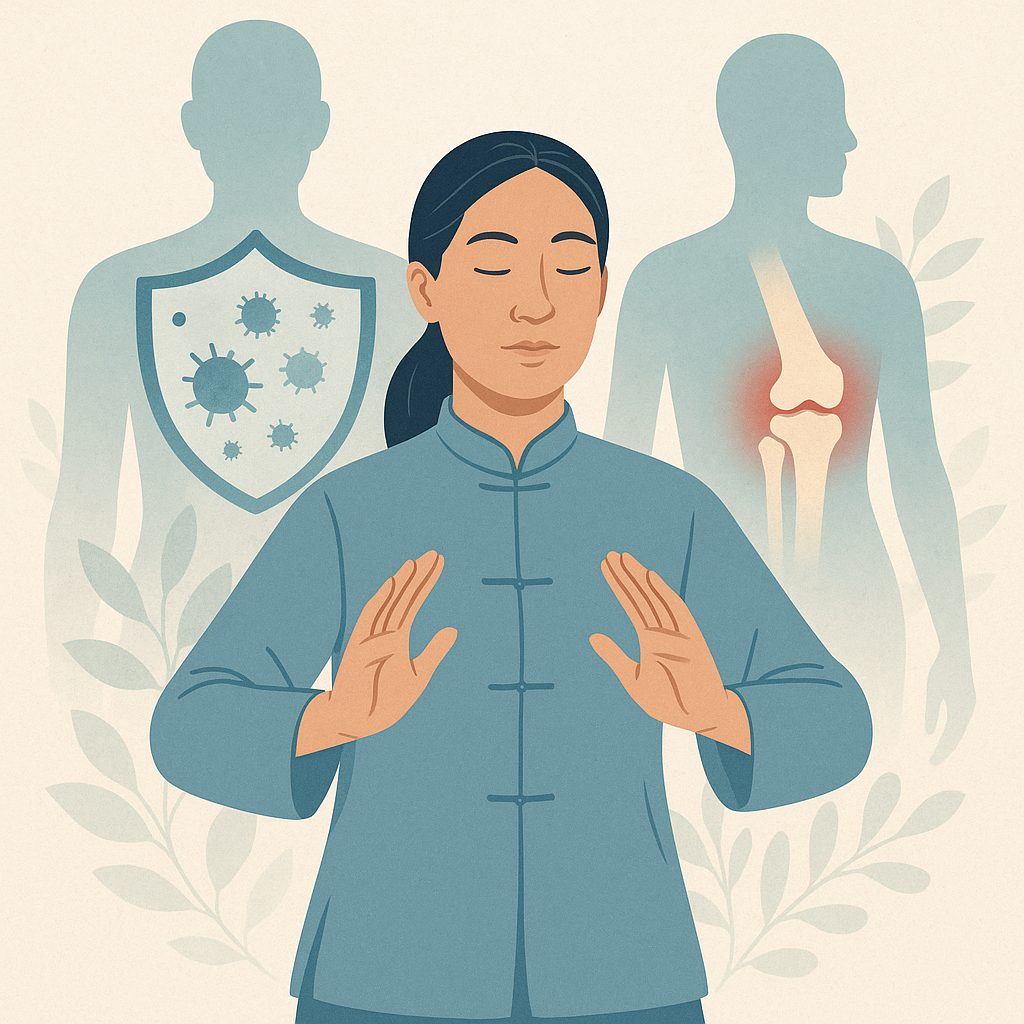
That matters, because with illnesses such as lupus, support is not only about treating symptoms in isolation. It is also about helping people feel steadier in their body, less overwhelmed by discomfort, and more able to cope day to day. In that sense, Qi gong is being considered as a supportive practice, not as a instant solution, but as a gentle discipline that may improve overall wellbeing alongside medical care.
Related offer
Anxiety reducer
This session uses Alpha and Beta wave stimulation to relax, alleviate...
View productAnyone living with a long-term inflammatory or autoimmune condition knows that quality of life can narrow quietly. Pain, stiffness, exhaustion and uncertainty do not only affect the body; they alter mood, confidence and the sense of what a day can hold. A practice like Qi gong may help not because it promises to erase the illness, but because it can offer a more manageable way of inhabiting the body when the body feels unpredictable.
That is often where gentle disciplines prove their worth. They create a space in which movement is still possible, attention can be redirected, and the person is not reduced entirely to symptoms. For patients who feel they are constantly reacting to their condition, even a modest return of agency can be deeply meaningful.
- ongoing study at the CHU de Limoges
- focus on patients living with lupus
- early reports suggest improved quality of life
A possible effect on the immune system
Before this, several in vitro and in vivo studies had already explored the impact of qi gong on the immune system. Taken together, most of them suggest that regular practice may stimulate the production of several types of immune cells, including monocytes, lymphocytes and natural killer cells, often referred to as NK cells.
These findings do not mean that qi gong can replace conventional treatment for autoimmune disease. What they do suggest, however, is that regular, well-paced practice may have a measurable effect on immune function. For people dealing with a long-term condition, that possibility is worth taking seriously: not as a substitute for medical follow-up, but as one more way of supporting the body with a practice that is both accessible and gentle.
The immune system is complex, and it would be simplistic to suggest that one practice alone can “fix” it. Still, the relationship between stress, inflammation and immune regulation is now taken seriously across many areas of medicine. If Qi gong helps reduce physiological stress while improving bodily regulation more broadly, it is not unreasonable that immune markers might shift as well.
For readers living with chronic illness, the most sensible position is a balanced one: curiosity without credulity. Qi gong may offer support, and that support may be meaningful, but it belongs alongside proper medical care, not in place of it. Used in that spirit, it becomes less a promise and more a resource.
- monocytes
- lymphocytes
- natural killer (NK) cells
How Qi gong can ease stress and calm anxious states
A practice that helps the body settle
Qi gong can be genuinely helpful when stress starts to take over. Its slow, attentive movements and steady breathing do more than create a pleasant pause in the day: they can help the body shift into a calmer state. One of the reasons often given is its effect on stress-related hormones such as cortisol. In practical terms, that may mean feeling less wound up, less mentally scattered and more able to regain a sense of steadiness.
That matters because anxiety is not only something we think; it is also something we feel physically. When the body is constantly on alert, the mind rarely settles for long. Qi gong works through that body-mind link in a very direct way, using gentle movement, breath and focused attention to bring the nervous system back towards balance. For many people, that simple return to slower, more regular rhythms is already a meaningful form of relief.
There is something particularly valuable here for people whose anxiety does not respond well to being told simply to “relax”. Qi gong offers a concrete route in. Instead of trying to force calm through thought alone, it begins with posture, breath, pace and sensation. Often that is more effective, because the body is given something believable to do rather than an impossible instruction to stop feeling tense.
With regular practice, some people notice subtler changes too: fewer spikes of agitation, a little more space before reacting, a greater ability to recognise stress early rather than only once it has become overwhelming. These are modest shifts, but in daily life they can change a great deal.
- slower, more conscious movement
- breathing that encourages relaxation
- greater physical and mental calm
What one study observed in practice
This calming effect is not only described anecdotally. In one study involving ten students in good physical and mental health, researchers looked at whether the emission of Qi by a master — in other words, external qi gong — could reduce stress. The group took part in one-hour sessions, some real and some simulated, allowing the researchers to compare the effects more carefully.
The students reported feeling calmer, more satisfied and more relaxed after the genuine session than after the simulated one. The study was small, so it should be read with appropriate caution, but it still points in an encouraging direction. At the very least, it supports the broader idea already seen in practice: qi gong may help reduce stress and make anxious states easier to manage, especially when it is approached as a regular, grounding habit rather than a one-off fix.
Small studies do not settle a question on their own, but they can still be suggestive. Here, what stands out is not only the measured comparison with a simulated session, but the nature of the reported effects: calm, satisfaction, relaxation. These are exactly the qualities many anxious people struggle to access, even briefly.
Perhaps that is why Qi gong tends to stay with people who take to it. The effects are often felt directly rather than understood abstractly. A quieter chest, a steadier breath, a mind that is no longer racing quite so hard — these are not dramatic transformations, but they are recognisable, and sometimes that is what makes a practice sustainable.
How to Practice Qi Gong Without Overpromising
Qi Gong is often described through impressive health claims, but a careful approach is better. The most realistic value is that slow, coordinated movement and breathing can help some people settle arousal, feel their body more clearly and create a daily pause. Those effects can matter, especially when stress and anxiety are part of the picture.
Related offer
Vibrational Cardiac Coherence
At last, an easy and enjoyable way to practice cardiac coherence without visual indicators, screens or stopwatches......
View productFor blood pressure, the safety line is clear: keep medical follow-up, take prescribed medication as directed and use Qi Gong as a complementary habit if it feels comfortable. For anxiety, practice should stay gentle. If focusing on the body increases fear, shorter sessions or professional guidance may be needed.
The Mental Waves Qi Gong Calm Framework
The Mental Waves frame is to treat Qi Gong as calm training through breath, posture and movement. The goal is not performance, but steadiness.
- Stand: find a stable posture without strain.
- Breathe: let the breath slow naturally.
- Move: use gentle, circular movements.
- Settle: pause afterward and notice the body.
For a structured rhythm practice, continue with Cardiac Coherence. For a broader stress guide, read How to Free Yourself from Stress.
Editorial note from Mental Waves
This article is educational. High blood pressure, chest pain, severe anxiety, dizziness or medication questions require qualified medical advice; Qi Gong should remain gentle and complementary.
Conclusion
What makes Qi gong so compelling is that it does not force a choice between body and mind. Its value seems to lie precisely in that meeting point: slow, attentive movement that may help the cardiovascular system, ease anxious tension and, in some cases, support quality of life more broadly. That said, balance matters: it is not a instant solution, and it does not replace clinical care, particularly in the case of high blood pressure or chronic illness.
What it can offer, more quietly and perhaps more realistically, is a way of working with the body rather than against it. For many people, that means a practice that is accessible, steady and grounding — something that invites calm without passivity, and attention without strain. In that sense, Qi gong is less about performance than about restoring a little coherence where stress, fatigue or physical imbalance have started to pull things apart.
Sometimes, gentle practice is exactly what allows deeper change to begin.
That may be the deepest strength of Qi gong. It does not overwhelm the system in the hope of forcing improvement; it creates conditions in which regulation becomes more possible. For people dealing with blood pressure concerns, anxiety, chronic stress or the strain of long-term illness, that quieter path can be not only more appealing, but more realistic.
And perhaps that is why the practice has endured for so long. Not because it promises spectacle, but because it offers something rarer: a disciplined form of gentleness that many modern bodies and minds are, in truth, badly in need of.
{
"@context": "https://schema.org",
"@type": "FAQPage",
"mainEntity": [
{
"@type": "Question",
"name": "What is Qi Gong?",
"acceptedAnswer": {
"@type": "Answer",
"text": "Qi Gong is a traditional mind-body practice using gentle movement, breath, posture and attention."
}
},
{
"@type": "Question",
"name": "Can Qi Gong support blood pressure?",
"acceptedAnswer": {
"@type": "Answer",
"text": "It may support relaxation and healthy routines, but blood pressure concerns need medical monitoring."
}
},
{
"@type": "Question",
"name": "Can Qi Gong help anxiety?",
"acceptedAnswer": {
"@type": "Answer",
"text": "Gentle practice may help some people regulate tension and breathing, but persistent anxiety needs appropriate support."
}
},
{
"@type": "Question",
"name": "How often should someone practice?",
"acceptedAnswer": {
"@type": "Answer",
"text": "Short, regular sessions are usually more useful than occasional intense practice."
}
},
{
"@type": "Question",
"name": "Is Qi Gong safe?",
"acceptedAnswer": {
"@type": "Answer",
"text": "Gentle Qi Gong is often accessible, but movements should be adapted and stopped if pain or dizziness appears."
}
},
{
"@type": "Question",
"name": "Can Qi Gong replace medication?",
"acceptedAnswer": {
"@type": "Answer",
"text": "No. Medication or medical advice should not be changed without a qualified professional."
}
},
{
"@type": "Question",
"name": "What is the best way to start?",
"acceptedAnswer": {
"@type": "Answer",
"text": "Start slowly with simple breathing, stable posture and gentle movement."
}
},
{
"@type": "Question",
"name": "How is Qi Gong different from breathwork?",
"acceptedAnswer": {
"@type": "Answer",
"text": "Qi Gong combines breath with posture, movement and attention, while breathwork may focus mainly on breathing patterns."
}
},
{
"@type": "Question",
"name": "What is the main takeaway?",
"acceptedAnswer": {
"@type": "Answer",
"text": "Qi Gong is best used as a gentle supportive practice alongside appropriate care and healthy routines."
}
}
]
}
Frequently Asked Questions About Qi Gong, Blood Pressure and Anxiety
What is Qi Gong?
Qi Gong is a traditional mind-body practice using gentle movement, breath, posture and attention.
Can Qi Gong support blood pressure?
It may support relaxation and healthy routines, but blood pressure concerns need medical monitoring.
Can Qi Gong help anxiety?
Gentle practice may help some people regulate tension and breathing, but persistent anxiety needs appropriate support.
How often should someone practice?
Short, regular sessions are usually more useful than occasional intense practice.
Is Qi Gong safe?
Gentle Qi Gong is often accessible, but movements should be adapted and stopped if pain or dizziness appears.
Can Qi Gong replace medication?
No. Medication or medical advice should not be changed without a qualified professional.
What is the best way to start?
Start slowly with simple breathing, stable posture and gentle movement.
How is Qi Gong different from breathwork?
Qi Gong combines breath with posture, movement and attention, while breathwork may focus mainly on breathing patterns.
What is the main takeaway?
Qi Gong is best used as a gentle supportive practice alongside appropriate care and healthy routines.