en
enVotre panier est vide.


Marcel Rouet is often remembered first for his physical presence: crowned “Apollo 1935”, named France’s finest athlete in 1936 and again in 1943, and regarded by generations of bodybuilders as a leading figure in physical culture. Yet that only tells part of the story. Behind the public image stood a restless researcher, writer and lecturer whose work ranged across hypnosis, psychology, suggestion, dietetics, sexuality, relaxation and psychosomatics. Born in 1909 and dying in 1982 after what was described as a minor surgical procedure, Rouet left behind far more than a sporting legacy.
He pursued a larger ambition: to think of the human being as a whole, with body and mind in constant relationship rather than in separate compartments.
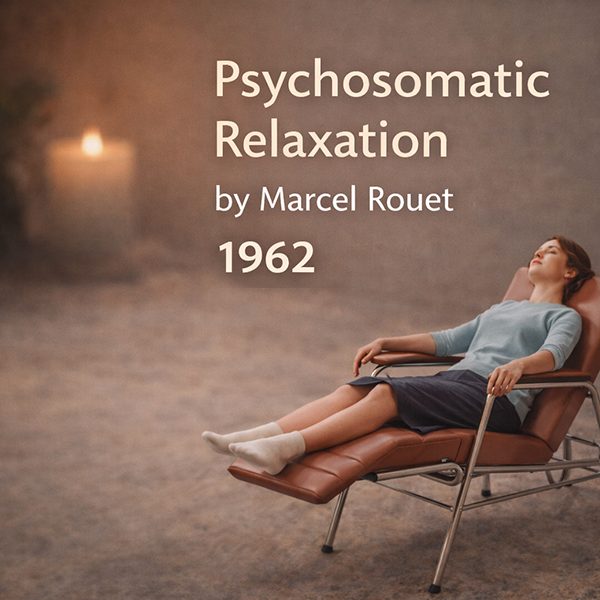
That vision runs through the method he became widely known for, psychosomatic relaxation. As Richard Ramond notes, Rouet was not simply adding another relaxation technique to the shelf; he was shaping a broader, synthetic approach to human balance, one intended to work through physical, breathing and relaxation-based practices, and to remain accessible beyond specialist circles. His 1960 book on psychosomatic relaxation became an international reference, and the method itself was taken up by many health professionals as a way of countering the effects of harmful stress through the subconscious assimilation of specific recordings.
In short: what is psychosomatic relaxation?
Psychosomatic relaxation is a mind-body method that uses relaxation, breath, attention and suggestion to help the person return to balance. In Marcel Rouet's work, the body and mind are not separate compartments; they shape each other through repeated states and habits.
- The body learns relaxation through repetition.
- The mind supports that relaxation through awareness and suggestion.
- The subconscious is treated as part of the training process.
- The goal is self-regulation, not a dramatic instant solution.
For a modern foundation, read Scientific Research on the Subconscious. For a practical calming cue, try the free Mental Reset Session.
To understand Rouet properly, then, is to see why his work mattered: not only because he challenged the conventions of his time around physical culture, women’s bodies and sexuality, but because he consistently defended the same central idea — that awareness of the body can become a path towards mastery of the mind.
There is something quietly striking about figures like Rouet. They emerge from one field, in his case physical culture, and then refuse to stay within its limits. What begins as discipline of the body becomes, in more searching hands, a meditation on temperament, tension, instinct, fatigue and self-command. That is part of what gives his work its unusual texture even now. He did not seem interested in the body as ornament alone, nor in the mind as some detached sovereign power. He kept returning to the living exchange between the two.
Read with a little patience, his legacy feels less like a period curiosity and more like an early attempt to answer a question many people still carry: why does inner strain so often settle into the body, and why does bodily release sometimes alter the mind more deeply than argument ever can? Rouet’s answer was not simplistic. He believed in method, repetition, conditioning and awareness. He also believed that human balance had to be cultivated rather than wished for.
Marcel Rouet and the rise of a mind-body pioneer
From celebrated athlete to restless humanist
Who was crowned “Apollon 1935” and named France’s finest athlete in 1936 and again in 1943? For the bodybuilders of his era, and for much of the twentieth century, Marcel Rouet stood as a leading figure in physical culture. Yet reducing him to an athletic ideal misses the point. He was also an unusually wide-ranging researcher, an ahead-of-his-time humanist, and a man who devoted his life to what we would now call human development. Born in 1909 and dying in 1982 after what should have been a minor surgical procedure, Rouet left behind far more than a sporting reputation: he built a body of work centred on the relationship between bodily awareness and mental mastery.
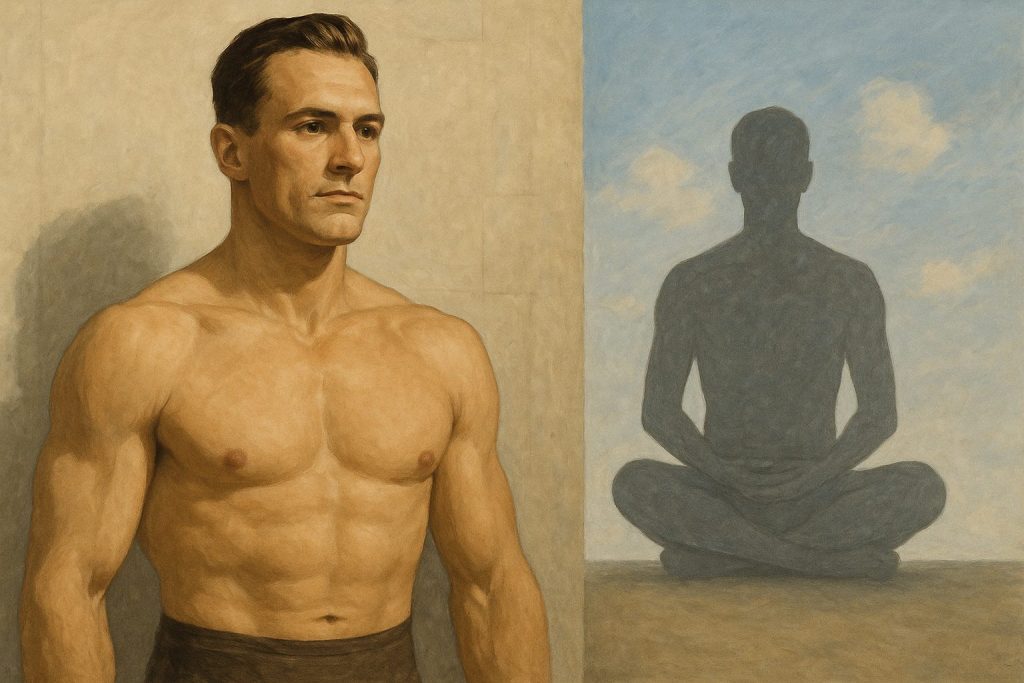
That breadth matters because it changes the way we read his achievements. A decorated athlete can easily be admired from a distance; a thinker of embodiment asks something more demanding of us. Rouet’s life suggests that physical excellence, in his eyes, was never the final destination. It was evidence, perhaps, of discipline and possibility, but not the whole of a person. He kept pushing beyond appearance towards questions of regulation, temperament, subconscious influence and the practical conditions of inner steadiness.
As Richard Ramond recalls, Rouet’s career was remarkably broad. He was described as a professor of physical culture, creator of scientific physical culture organised by bodily zones and adapted to human temperament, Doctor of Psychosomatics, writer, lecturer, Officier d’Académie, and recipient of a medal from the French Ministry of Youth and Sport for services to physical education. He was also credited with creating Psycho-Morpho-Synthesis applied to human culture, Psychosomatic Relaxation, Reconditionnement Psychophagique, Kinélaxie, Hypnophorèse and reconditioning through the psychodiovisual, while also founding what he called integral bodybuilding as a true philosophy of existence. It is a formidable list, but it reflects a genuine intellectual appetite.
Rouet explored hypnosis, occultism, psychology, suggestion, dietetics, psychosomatics, sexuality, psychic sciences, magnetism, physical hygiene, athletic training, mental self-mastery and relaxation. In Ramond’s words, he was a singular figure, always “seeking human balance on every level of personality”.
Lists of titles can sometimes feel ceremonial, but in Rouet’s case they point to something real: a refusal to divide human experience into neat professional boxes. He moved between domains that are often kept apart — the physiological, the psychological, the educational, the intimate. That movement may seem unusual, even unruly, by contemporary standards, yet it also explains why his work still catches the attention of readers who are tired of fragmented models of wellbeing. Rouet was trying, in his own language and with the assumptions of his era, to think in wholes.
- Physical culture and athletic training
- Psychosomatics, hypnosis and suggestion
- Mental education, relaxation and self-mastery
Seen this way, his career was not a series of disconnected interests but a sustained attempt to understand how a person is formed. Muscles, nerves, habits, imagination, desire, fatigue, confidence, inhibition: for Rouet, these were not separate chapters. They belonged to one living system. That conviction gives his work a coherence that is easy to miss if one looks only at the variety of his subjects.
A synthetic method shaped by body and mind together
Among Rouet’s many lines of research, his experimental work with hypnosis, magnetism and suggestion deserves particular attention. He applied these approaches to the treatment of cellulite in “extreme and painful cases”, work that led to a thesis entitled Le Traitement de la Cellulite dans l'Anesthésie Magnétique. It was later republished, with new arguments, in 1981 under the title Psychosomatique de la cellulite par l'hypnose la relaxation la sophrologie (Éditions Maloine). What matters here is not only the subject itself, but the method behind it.
Rouet’s real strength lay in his ability to bring disparate practices together into a coherent, practical synthesis: a scientific method with several dimensions, yet one that could still be adapted to ordinary people through physical exercises, breathing work and relaxology.
That gift for synthesis is perhaps the most distinctive part of his legacy. Many people can specialise; fewer can connect. Rouet seems to have understood that a method becomes truly useful only when it can travel from theory into lived practice. Breathing has to be felt, not merely described. Relaxation has to be trained, not admired. Suggestion has to be integrated into a wider framework of bodily and mental education if it is to do more than produce a passing effect. In that sense, his work carries a practical seriousness that still feels fresh.
Richard Ramond underlined this point forcefully, writing that Rouet laid the foundations for a modern method of physical transformation that first restores endocrine, nervous and humoral balance before muscular exercise begins. In his view, Rouet did more than devise techniques: he created a synthetic method and, with it, the practical basis of a modern humanism — an instrument for the “Renovation of the Human Being”. That ambition helps explain why Rouet’s work travelled so widely. Much like Professor John Medina, the developmental molecular biologist and author of Brain Rules, Rouet consistently defended the idea that the human being is a whole, and that body and mind cannot be treated as separate realms.
Long before such language became fashionable, he insisted on this unity and built an entire body of work around it.
There is, of course, a historical distance between Rouet’s vocabulary and our own. Some of his formulations belong unmistakably to another period. Yet the underlying intuition remains recognisable: if the nervous system is overdriven, if the body is held in chronic contraction, if the mind is saturated with strain, then asking for performance before restoring balance is the wrong order of things. Rouet understood that preparation matters. Regulation comes before effort if effort is to be sustainable.
This is one reason his approach can still speak to modern readers. We live with different language, different evidence and different therapeutic frameworks, but the lived experience is familiar enough: people push on while exhausted, tighten against pressure, lose contact with their own bodily signals, and then wonder why willpower alone no longer works. Rouet’s synthetic method was, in part, an answer to that predicament. It proposed that change becomes more durable when the body is not treated as an obstacle to the mind, but as its partner.
Related offer
Anxiety reducer
This session uses Alpha and Beta wave stimulation to relax, alleviate...
View productHow psychosomatic relaxation restores balance and resilience
A method designed to calm the body by working through the mind
Marcel Rouet did not simply follow the conventions of his time: he challenged them, whether in relation to women’s physical culture, sexuality or the place of relaxation in human development. His book on psychosomatic relaxation, published in 1960, became an international reference, and many health professionals adopted the method for its ability to counter the effects of negative stressors. As Richard Ramond explains, it is “a method of relaxation based on the impregnation of the subconscious through listening to specific recordings”. That principle sits at the heart of Rouet’s thinking: the body and the mind do not function as separate worlds, and lasting calm cannot be reduced to muscular rest alone.
That last point is worth lingering over. Many forms of rest bring temporary relief, but Rouet was after something more stable than a brief collapse into comfort. He was interested in the way repeated states of relaxation could become learned responses, almost a second nature, and how conscious awareness could then extend and deepen those responses. In other words, he was not merely offering a pause from agitation. He was trying to cultivate a different baseline.
For Rouet, psychosomatic relaxation is the synergistic action of the psychic and the physical, of the mind and the body, through relaxation itself. He insisted that “only when the reflexes of relaxation are well established does awareness take over, in order to prolong the beneficial effects of relaxation over time”. In other words, the method is not limited to a brief moment of release; it aims at a deeper functional rebalancing. He also linked this process to the regulation of the sympathetic nervous system, with favourable effects on glandular functioning. From that perspective, the benefits are broad: recovery of energy, better regulation of the organs, reduced tension, improved emotional management, and stronger physical and mental capacities.
There is a practical wisdom in that sequence. First the body learns to let go; then the person learns to recognise, support and maintain that letting go. Anyone who has lived for a long time in tension knows how unfamiliar relaxation can feel at first. The body may not trust it. The mind may interrupt it. Habits of vigilance do not disappear because we decide they should. Rouet’s method acknowledges this by treating relaxation as an education rather than a command.
- recovery of energy
- reduction of tension
- better emotional regulation
- stronger physical and mental resilience
What makes this especially compelling is that the benefits he described are not isolated outcomes. Reduced tension can alter breathing; easier breathing can soften emotional reactivity; emotional steadiness can improve sleep, concentration and bodily recovery. Once again, Rouet was thinking in systems. He recognised that when one part of the person settles, other parts often follow. The reverse is true as well, which is why chronic stress can feel so total. His method tried to interrupt that spiral.
It also helps explain why psychosomatic relaxation appealed to practitioners beyond the narrow world of physical culture. The method offered a bridge between bodily practice and psychological effect without pretending that one could simply be substituted for the other. It respected the subconscious, the nervous system and the role of repetition. For many people, that is precisely what makes a relaxation method credible: not grand promises, but a patient account of how change is gradually installed.
A practical legacy that reached far beyond relaxation alone
Rouet presented this approach as useful not only for general wellbeing, but also for people dealing with nervous disorders, nutritional difficulties, sexual troubles, cerebral disturbances and forms of intoxication linked to alcohol, tobacco or drugs. He also regarded it as an excellent psychological preparation for painless childbirth. That breadth helps explain why his work never remained confined to one narrow discipline.
From L'amaigrissement par l'hypnose to the six-volume sexology encyclopaedia in the Dictionnaire de la Culture Physique, from Psycho-Morpho-Synthesis — a mode of thought he described as adaptable to the individual — to relaxology, psychosomatic slimming, psychophagic reconditioning, prânoxygéno-relaxation, hypnophorèse and the psychodiovisual method, Rouet kept pursuing the same ambition: to help human beings recover a more coherent inner balance.
Whether one agrees with every application he proposed is, in a sense, secondary to understanding the shape of his thought. He was always looking for ways to intervene where body, habit, emotion and subconscious patterning meet. That is why his work spread into areas that many specialists would keep apart. He seemed convinced that human difficulties rarely stay in one register. A disturbance in appetite may carry emotional roots; sexual inhibition may involve bodily tension and mental suggestion; fatigue may be physiological, psychological and behavioural all at once. His methods were designed for that overlap.
A prolific researcher and author of more than 60 books, Marcel Rouet worked throughout his life in the service of a healthier, more integrated vision of the person — a sound mind in a sound body, but understood in a far richer sense than the old formula usually suggests. He remained convinced that each of us carries a vast dormant potential, a conviction he reaffirmed in his final testament-like work, La Maîtrise de votre Subconscient. Following surgery for an inguinal hernia, he died of an embolism on 3 December 1982. A “genius of form”, as he was described, left the world without ever having been ill.
Yet his work remains accessible through his many books — a substantial legacy for anyone seeking steadier ground amid the negative stressors of a sanitised, formatted and often soulless society.
There is something poignant in that final image: a man who spent his life studying vitality, balance and human potential, leaving behind not a single doctrine but a whole constellation of methods, books and intuitions. Some belong firmly to their time. Some invite critical distance. But taken together, they reveal a mind that never stopped asking how a person might live with greater coherence. That question has not aged.
For readers coming to Rouet today, perhaps the most valuable part of his legacy is not the promise of mastery in any grandiose sense. It is the quieter suggestion that self-regulation can be learned, that the body can become an ally rather than a burden, and that inner life is often more trainable than we imagine when we are caught in strain. In that respect, his work still offers more than historical interest. It offers a way of thinking that remains unexpectedly alive.
Related offer
Meditation - Relaxation set
All the Mental Waves® know-how in a single pack for quick and easy access to meditation and...
View productHow to Read Marcel Rouet Today
Rouet belonged to another era, and some of his vocabulary reflects that. The useful reading is not to adopt every historical claim without distance, but to recognise the central intuition: tension, emotion, habit and bodily state are deeply linked.
His method remains interesting because it places relaxation inside a broader education of the person. It asks the body to learn safety and the mind to participate in that learning.
- Use relaxation as training, not escape.
- Let breath and posture make mental calm easier.
- Respect repetition as the way new reflexes are installed.
- Keep historical claims separate from modern clinical care.
The Mental Waves Mind-Body Relaxation Framework
The Mental Waves frame is to keep the method grounded: relax the body, calm the breath, soften the inner dialogue and return to action with more coherence.
- Release: notice where the body is holding unnecessary tension.
- Breathe: give the nervous system a calmer rhythm.
- Suggest: use simple inner language that supports steadiness.
- Repeat: practise often enough for calm to become familiar.
If stress is the main concern, continue with How to Free Yourself from Stress. For a physiological rhythm, read Cardiac Coherence.
Editorial note from Mental Waves
This article is educational and historical. Psychosomatic relaxation can support wellbeing, but persistent physical symptoms, trauma, addiction or medical issues require qualified professional support.
Conclusion
What remains striking in Marcel Rouet’s work is not simply the breadth of his interests, but the coherence running through them: a refusal to separate the body from the inner life. His psychosomatic relaxation was never presented as a instant solution or a vague spiritual promise, but as a disciplined way of restoring balance through the interplay of physical release, mental training and subconscious imprinting. That mind-body unity is the real centre of his legacy, and it helps explain why his method spoke not only to athletes, but also to people dealing with tension, fatigue, emotional strain and the wear of everyday life.
Seen in that light, Rouet’s contribution feels larger than a single technique. It belongs to a broader human vision in which self-mastery does not mean hardness, but a more lucid relationship with one’s own body, impulses and reserves of energy. Some of his ideas are clearly rooted in the language and assumptions of his time, yet the underlying intuition remains compelling: that genuine wellbeing asks for more than muscular effort or mental willpower alone. It asks for a form of inner reconditioning, patient and embodied. That is why his work still resonates.
Perhaps that is the most fitting way to read him now: not as a relic of an older culture of performance, but as someone who sensed, earlier than many, that exhaustion, tension and imbalance cannot be solved by force alone. We need methods that teach the organism to settle, the attention to return, and the person to inhabit themselves more fully. Rouet’s psychosomatic relaxation belongs to that lineage. It asks for practice, but it also offers something rare — a vision of human development that is at once disciplined, embodied and deeply humane.
{
"@context": "https://schema.org",
"@type": "FAQPage",
"mainEntity": [
{
"@type": "Question",
"name": "What is psychosomatic relaxation?",
"acceptedAnswer": {
"@type": "Answer",
"text": "It is a mind-body relaxation method that works through bodily release, breath, awareness and subconscious conditioning."
}
},
{
"@type": "Question",
"name": "Who was Marcel Rouet?",
"acceptedAnswer": {
"@type": "Answer",
"text": "Marcel Rouet was a French physical culture figure, researcher and author who developed methods linking body, mind and self-regulation."
}
},
{
"@type": "Question",
"name": "Why is body-mind unity central?",
"acceptedAnswer": {
"@type": "Answer",
"text": "Rouet believed tension, emotion, habit and bodily state influence each other, so relaxation should involve the whole person."
}
},
{
"@type": "Question",
"name": "How does the method work?",
"acceptedAnswer": {
"@type": "Answer",
"text": "It aims to install relaxation reflexes through repeated practice, then use awareness to maintain and deepen the calmer state."
}
},
{
"@type": "Question",
"name": "Is it the same as self-hypnosis?",
"acceptedAnswer": {
"@type": "Answer",
"text": "It overlaps with suggestion and subconscious training, but Rouet framed it within a wider physical and psychosomatic method."
}
},
{
"@type": "Question",
"name": "Can it help with stress?",
"acceptedAnswer": {
"@type": "Answer",
"text": "It may support stress regulation by reducing tension and helping the body learn a calmer baseline."
}
},
{
"@type": "Question",
"name": "Should modern readers be cautious?",
"acceptedAnswer": {
"@type": "Answer",
"text": "Yes. Some historical claims should be read with perspective and not confused with modern medical evidence."
}
},
{
"@type": "Question",
"name": "How can someone practise today?",
"acceptedAnswer": {
"@type": "Answer",
"text": "Start with simple breath, body scanning and repeated relaxation cues, keeping the practice gentle and regular."
}
},
{
"@type": "Question",
"name": "What is the main takeaway?",
"acceptedAnswer": {
"@type": "Answer",
"text": "Psychosomatic relaxation is valuable as a disciplined way to reconnect body, breath, attention and inner balance."
}
}
]
}
Frequently Asked Questions About Psychosomatic Relaxation
What is psychosomatic relaxation?
It is a mind-body relaxation method that works through bodily release, breath, awareness and subconscious conditioning.
Who was Marcel Rouet?
Marcel Rouet was a French physical culture figure, researcher and author who developed methods linking body, mind and self-regulation.
Why is body-mind unity central?
Rouet believed tension, emotion, habit and bodily state influence each other, so relaxation should involve the whole person.
How does the method work?
It aims to install relaxation reflexes through repeated practice, then use awareness to maintain and deepen the calmer state.
Is it the same as self-hypnosis?
It overlaps with suggestion and subconscious training, but Rouet framed it within a wider physical and psychosomatic method.
Can it help with stress?
It may support stress regulation by reducing tension and helping the body learn a calmer baseline.
Should modern readers be cautious?
Yes. Some historical claims should be read with perspective and not confused with modern medical evidence.
How can someone practise today?
Start with simple breath, body scanning and repeated relaxation cues, keeping the practice gentle and regular.
What is the main takeaway?
Psychosomatic relaxation is valuable as a disciplined way to reconnect body, breath, attention and inner balance.