en
enVotre panier est vide.


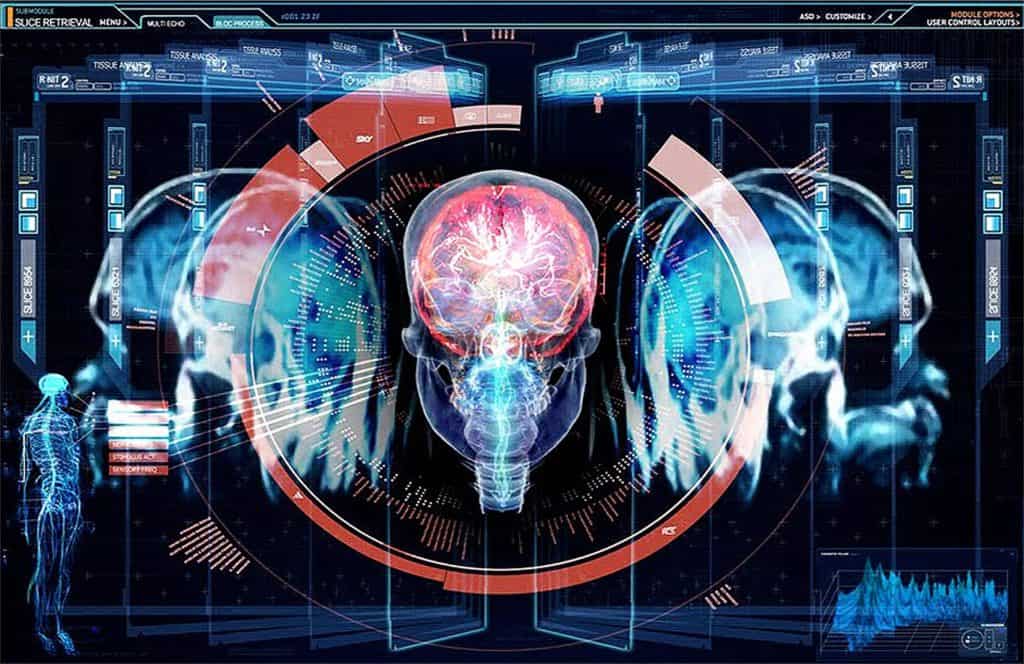
Technology keeps moving, but some advances shift the conversation more than others. One of them is the possibility that a human could spot and mentally signal a robot’s mistake simply by watching it work. That is the premise behind research led by a team at MIT: not a science-fiction fantasy of machines reading every thought, but a more precise attempt to make human-robot interaction faster, more intuitive and better suited to real-world tasks.
The wider context matters here. Robots are already used across many sectors, less as replacements for people than as tools that may help with demanding or repetitive work. In that light, the real challenge is not rivalry between human and machine, but cooperation: how to allow a person’s perception, attention and judgement to guide an intelligent system smoothly enough for the exchange to feel almost immediate. The work explored here sits squarely within that ambition, using brain activity linked to error detection to see whether a robot can recognise a human observer’s response and correct itself in real time.
In short: how can a neural interface correct robot errors?
A neural interface can detect specific brain signals that appear when a person notices a robot's mistake, then use those signals to help the robot adjust. This does not mean the robot reads thoughts broadly; it means the system classifies a narrow error-related response.
- EEG can capture limited brain-signal patterns.
- Error-related potentials may appear when a mistake is noticed.
- Machine learning can classify those patterns in real time.
- Practical use still requires accuracy, consent and reliability.
For EEG context, read Brainwave Frequencies and Meditation. For a free contemplative sound cue, receive the Sacred Frequency Session.
Robots as practical partners rather than human replacements
Automation is spreading, but its role remains supportive
Robotisation is now present in almost every sector, from industry to everyday services. Yet the central idea is not that machines will simply replace people. In practice, robots are more likely to support human work by taking on certain repetitive, physically demanding or highly constrained tasks. Used in that way, they can extend human capabilities rather than erase them, helping people focus their attention and judgement where these matter most.
This perspective changes the way we think about automation. Instead of imagining a direct contest between human beings and intelligent machines, it becomes easier to see a future of collaboration. The robot handles part of the execution; the human retains oversight, interpretation and the capacity to respond when something does not go as expected. In that sense, robotisation may help relieve people of some of the most burdensome missions without removing the distinctly human role from the process.
- Reducing physically demanding tasks
- Supporting repetitive operations
- Enhancing human efficiency and oversight
Moving beyond the old fear of man versus machine
This collaborative vision also moves us away from the familiar cinematic image of robotic domination. Popular culture has often framed the relationship between humans and machines as one of rivalry, submission or loss of control. The reality suggested by current research is more measured. Robots are being designed less as autonomous rivals and more as tools that can work alongside people, with human perception and decision-making still playing a guiding role.
That distinction matters, because it sets the tone for the rest of the discussion around neural interfaces and intelligent systems. If robots are understood as collaborators, then improving interaction between human beings and machines becomes a practical goal rather than a science-fiction fantasy. The challenge is no longer to choose between humans and robots, but to create forms of cooperation that are more fluid, intuitive and useful in real working environments.
Building a More Natural Dialogue Between Humans and Machines
Why researchers are trying to make interaction more fluid
Researchers are now working on systems designed to let humans communicate with machines in a far more fluid and intuitive way. The aim is not simply to make robots respond to commands, but to make the exchange feel smoother, faster and closer to the rhythm of ordinary human interaction. In practical terms, that means reducing friction between intention and action, so that a person can guide a machine without having to rely on cumbersome steps at every stage.
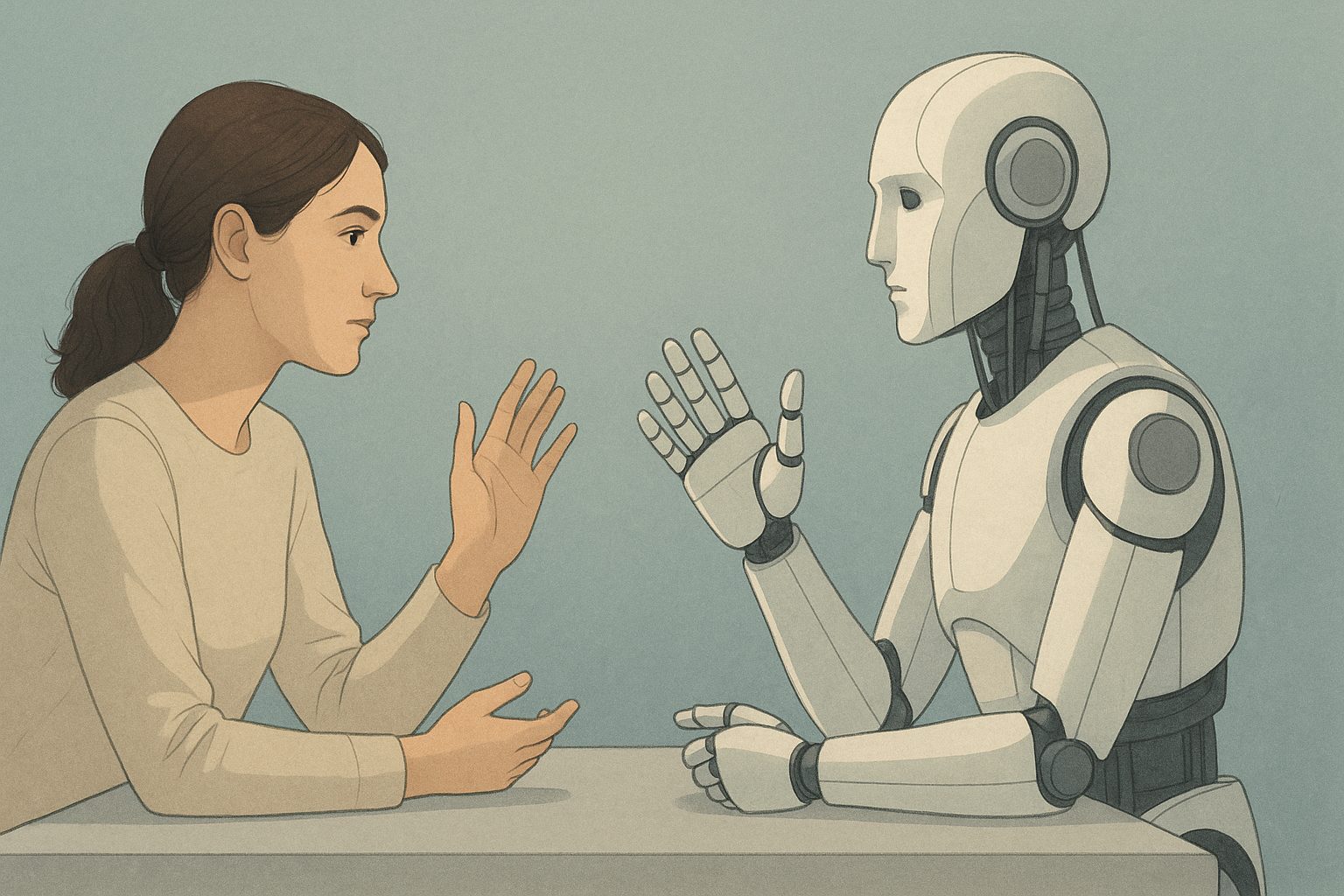
This is where artificial intelligence becomes essential. For such an exchange to work, the robot must be able to learn how humans communicate and adapt to that style of interaction. Rather than following a rigid script, it needs to recognise patterns, interpret context and improve its responses over time. In that sense, the goal is not just technical performance, but a form of collaboration that feels more natural from a human point of view.
- make communication more immediate
- reduce the need for rigid commands
- bring machine behaviour closer to human expectations
How machine learning helps robots gain experience
To support this kind of interaction, robots are expected to rely on machine learning. This approach allows a system to refine its behaviour through experience rather than depending only on fixed programming. As it is exposed to more situations, the machine can gradually adjust the way it responds, which may help it handle exchanges with people in a more relevant and flexible manner.
In other words, the robot is not being presented as a substitute for human judgement, but as a tool that can become more capable with use. The more experience it accumulates, the better it may become at supporting the person in front of it. This learning dimension is central to the broader effort to improve human-machine interaction, because a truly useful robot must be able to evolve with the situations it encounters over time.
Testing a Direct Brain Interface in Real Time
Why real-time correction matters
To assess whether this kind of human-machine interaction can truly work, it has to be tested in real time. The key idea is simple: a person must be able to spot a robot’s mistake the moment it happens and help correct it immediately. In practice, that means moving beyond delayed feedback or pre-programmed commands and exploring a form of intervention that is fast enough to match the robot’s actions as they unfold.
Verbal exchange already offers one route for communicating with machines, but it still has clear limits. Artificial intelligence can process speech, yet it does not naturally reach the same spontaneity, nuance or fluid back-and-forth found in an ordinary conversation between two people. That gap is precisely why roboticists are exploring another path: using thought itself to guide or correct a robot through a direct neural interface.
A promising approach, but not yet ready for everyday work
This approach relies on the idea that certain forms of brain activity can be detected while a person is observing a machine and noticing that something has gone wrong. Rather than speaking, pressing a button or interrupting the task manually, the human operator would simply watch the robot in action while the system interprets the relevant neural signals. In principle, this could make interaction more immediate and more intuitive, especially in situations where speed matters.
That said, the method still depends on the human being able to produce and sustain the right kind of neural response under controlled conditions. These mental exercises and detection systems remain experimental, and for the moment they are not yet well suited to the demands of an ordinary professional environment. The concept is therefore highly promising, but it still needs to become more robust, practical and adaptable before it can be used routinely in the workplace.
- Real-time observation is central to the test.
- The aim is to correct errors as soon as they are perceived.
- Direct neural control is being explored because speech remains limited in spontaneous interaction.
How MIT and Boston University Are Teaching Robots to Notice Human Error Signals
A system designed to detect the moment a person spots a mistake
To move human-machine interaction forward, researchers at MIT and Boston University have worked together on a system that can detect very specific patterns of brain activity. The aim is not to read complex thoughts in a broad sense, but to identify the brief neural response that appears when a person notices that a robot has made an error. In practical terms, the system focuses on the brain state associated with recognising that something has gone wrong.
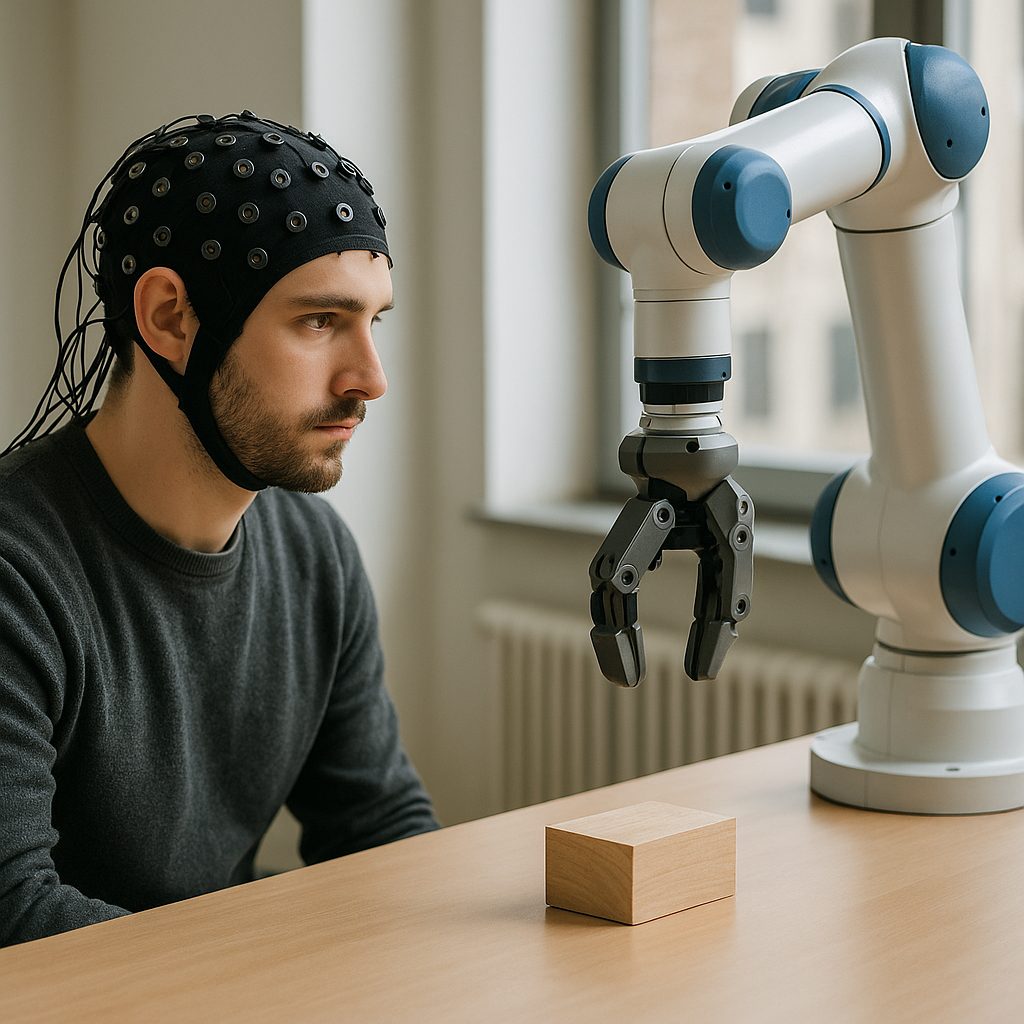
This matters because it allows the robot to react at the very moment the human observer detects the mistake. Rather than waiting for a spoken instruction or a manual command, the machine can use that signal as an immediate cue to adjust its behaviour. The principle is simple but promising: as soon as the person sees the error and mentally registers it, the robot may be able to recognise that response and begin correcting itself.
EEG, machine learning and the reading of error-related potentials
To make this possible, the human participant wears an EEG headset, which records ongoing brain activity in real time. Those signals are then processed by a machine-learning algorithm trained to sort and interpret the incoming brain waves with a delay of roughly 10 to 30 milliseconds. That speed is essential, because the value of the system lies in its ability to support correction almost instantly, while the robot is still in action.

Related offer
8 States of Consciousness - Deep Infinity Pack
Deep Infinity - 8 States of Consciousness This rare audio pack invites you to plunge into the heart...
View productMore specifically, the robot is designed to detect ErrPs — error-related potentials — which are brain signals associated with noticing a mistake. When the human brain registers that the machine has chosen the wrong action, these signals can be picked up by the EEG system and translated into usable information for the robot. This does not mean the machine understands thought in a human sense; rather, it is learning to respond to a measurable neural marker of attention and error detection.
- EEG headset records the observer’s brain activity
- Machine learning sorts the signals in real time
- The delay is around 10 to 30 milliseconds
- The robot responds to ErrPs linked to error detection
A Real-World Test on Baxter the Robot
How the experiment worked in practice
To test the system under real conditions, the researchers used Baxter, the robot developed by Rethink Robotics. The setup was deliberately simple: a volunteer wore an EEG headset and watched the machine as it carried out a sorting task. Rather than giving spoken instructions or pressing a control button, the person simply observed Baxter’s movements and monitored whether it was behaving correctly.
This point matters because the experiment was designed to capture a very specific moment: the instant when a human notices that the robot is making a mistake. In other words, the person did not need to intervene physically. Their role was to pay attention, detect the error and let their brain activity provide the signal that the system was trained to recognise.
- Baxter performed an object-sorting task
- A volunteer observed the robot in real time
- An EEG headset recorded the observer’s brain activity
A correction signal detected within milliseconds
When Baxter made an error, the volunteer’s brain produced a signal linked to the perception of that mistake. That signal was then interpreted by the system and sent back to the robot, helping it correct its action. The key result here is not that the machine could read thoughts in a broad or science-fiction sense, but that it could detect a narrow and meaningful neural response associated with human error recognition.
The robot was able to register this information within a few milliseconds, which makes the interaction especially promising. Such speed suggests a more fluid form of collaboration between human attention and robotic execution. Even at this early stage, the test showed that a person may be able to guide a machine simply by noticing when something has gone wrong, without needing to speak, type or touch a control interface.
From Instant Error Detection to Everyday Human–Robot Collaboration
What the Baxter experiment actually showed
The teams at CSAIL (Computer Science and Artificial Intelligence Laboratory) and Boston University pushed the experiment further with Baxter, asking the robot to sort concrete objects such as paint cans and cable reels. The principle remained simple but revealing: when the human observer noticed that Baxter was about to make the wrong choice, the brain generated an error signal, and the robot could use that signal to correct itself almost immediately. In other words, the machine did not need a spoken instruction or a manual command to understand that something was wrong.
This result matters because it suggests a form of interaction that feels more direct and intuitive than many conventional interfaces. As Daniela Rus, director of CSAIL, put it: “Imagine being able to instantly tell a robot to perform an action without needing to type a command, press a button or even say a word.” The idea is not that robots suddenly become autonomous minds, but that they may become better at reading the human attention and error-detection signals that naturally arise during observation.
- Baxter sorted paint cans and cable reels
- A human observer detected the mistake mentally
- The robot received the error signal and adjusted within milliseconds
A promising step, but still far from a finished system
The researchers are careful not to present this as a complete solution. For the experiment to become truly convincing in real-world settings, these systems will need to move beyond binary scenarios involving just one person and one robot. The next challenge is scale: several humans, several machines, more complex environments, and decisions that are less predictable than a simple sorting task. Even so, the work already points towards a more natural partnership between people and intelligent machines, one in which human perception and machine execution may complement each other more smoothly.
Daniela Rus also suggested that this kind of interface could one day help guide industrial robots or even autonomous vehicles through human thought signals. A scientific paper on the team’s work was due to be presented at the IEEE International Conference on Robotics and Automation (ICRA), underlining the seriousness of the research. More broadly, robotisation and automation are already becoming part of everyday life. The rise of chatbots in instant messaging apps is one visible example, and it shows that human-machine interaction is continuing to evolve rather than slowing down.
What This Research Actually Changes
The promise of this neural interface is not that machines suddenly understand human thought. The promise is narrower and more practical: a system may detect the moment a human observer recognizes an error, then use that signal to improve interaction.
That distinction matters. A reliable error signal could make collaboration with robots smoother in laboratories, manufacturing, assistive technology or training environments. But it would still need calibration, safeguards and realistic expectations.
Human-machine collaboration works best when the human remains more than a signal source. The person must stay informed, consenting and able to intervene in ordinary ways, not only through brain data.

Related offer
18 States of Consciousness - Integral Infinity Pack
Integral Infinity - The 18 States of Consciousness A unique sound box designed to explore all the...
View productWhat the Signal Measures, and What It Does Not
The key point is precision. In this kind of experiment, the system is not trying to decode a complete thought, personal opinion or private intention. It is looking for a narrow response that may appear when a person recognizes that something has gone wrong.
That makes the research impressive and limited at the same time. It is impressive because a machine can react to a subtle human signal quickly enough to improve interaction. It is limited because the signal still needs context, calibration and verification.
This is why language matters. Saying that a robot can “read the mind” creates confusion. Saying that a neural interface can detect a specific error-related pattern is less dramatic, but much closer to what the research suggests.
The Mental Waves Human-Machine Attention Framework
The Mental Waves frame is to understand neural interfaces through attention, error awareness and responsibility.
- Detect: identify a specific brain response, not the whole mind.
- Confirm: compare the signal with context and visible behaviour.
- Adapt: let the machine update without removing human control.
- Protect: keep consent, privacy and transparency central.
For a legal and ethical companion topic, continue with AI and Brain Activity. For cognitive training context, read Brain Training for Success.
Editorial note from Mental Waves
This article is educational. Neural interface research should be understood as experimental technology, not as proof of broad mind reading or a replacement for informed human judgment.
Conclusion
What emerges here is not a fantasy of mind-controlled machines, but a more grounded shift in how humans and robots may work together. The MIT and Boston University experiment suggests that a robot can, under controlled conditions, detect the brain’s response to an observed mistake and adjust accordingly within milliseconds. That matters because it reframes automation as collaboration: not a replacement for human judgement, but a system that may become more responsive to human attention, perception and error detection.
At the same time, the promise should be kept in proportion. An EEG-based interface that works in a binary experimental setting is still a long way from fluid, everyday use across workplaces, vehicles or multiple machines at once. Even so, the principle is striking: the brain does not need to issue a spoken command to shape a machine’s behaviour, only to register that something has gone wrong. Between scientific caution and genuine possibility, this research opens a credible path towards technology that listens a little more closely to the human mind.
Frequently Asked Questions About Neural Interfaces and Robot Errors
What is a neural interface?
A neural interface is a system that uses brain signals to help a person interact with a device or machine.
How can it correct robot errors?
The system may detect an error-related brain response when a person notices a robot mistake, then use it as feedback.
Does the robot read thoughts?
No. It classifies narrow brain-signal patterns rather than reading thoughts in a broad sense.
What role does EEG play?
EEG records electrical activity at the scalp and can be used to detect certain timing-based patterns.
Why does real-time correction matter?
Real-time feedback could make human-robot collaboration faster and more natural.
Is this ready for everyday workplaces?
No. The technology remains experimental and needs reliability, validation and safeguards.
What are the main limits?
Noise, context, individual variation, calibration and privacy concerns all limit practical use.
What ethical issues matter?
Consent, transparency, data privacy and maintaining human control are essential.
What is the main takeaway?
Neural interfaces may help robots respond to human error awareness, but they should be framed as limited tools, not mind readers.