en
enVotre panier est vide.


Tips and practices
Explanations
Relaxation and Meditation
Science & Neuroscience
biology
neuropsychology
Christmas, whose roots reach back to Roman festivities, still carries a rare ritual intensity. Streets, shops, homes, schools and public spaces fill with light; families gather around familiar meals; and gestures of generosity, however modest, seem to matter more than usual. As the anthropologist Gérald Berthoud observes, the exchange of gifts is not only a social custom in a commercial society: it also helps to create, sustain and strengthen human bonds. That social and emotional charge is part of what makes the season feel so vivid — and why it can naturally bring the so-called “happiness hormones” into sharper focus, especially dopamine, endorphins, oxytocin and serotonin.
From there, the wider question becomes more interesting than the festive moment itself: how do our thoughts, habits and relationships influence these inner states? Drawing on the work of Dr Shigeo Haruyama and on broader findings in neuroscience, this article explores the idea that a positive mental attitude, regular sleep, nourishing food and healthy daily rhythms may support wellbeing and even shape how the brain regulates emotion over time. Without reducing happiness to a simple formula, it invites a more grounded perspective: our brain remains plastic, our patterns are not entirely fixed, and a better understanding of these mechanisms can help us make more conscious choices in favour of balance, resilience and a fuller experience of life.
In short: what are happiness hormones?
Happiness hormones is a common phrase for chemical messengers linked with mood, motivation, bonding and pleasure, especially dopamine, serotonin, oxytocin and endorphins. They are not simple happiness switches, but part of a complex body-brain system.
- Dopamine is linked with motivation and reward learning.
- Serotonin is involved in mood, rhythm and regulation.
- Oxytocin is linked with bonding and social safety.
- Endorphins are associated with comfort and natural pain modulation.
For a guided mood reset, try the free Mental Reset Session. For another sound-based angle, read Psychological Benefits of Music.
Why Christmas naturally awakens feel-good chemicals
Rituals, generosity and shared moments
Christmas, a festival with Roman roots, fills towns and villages with lights, decorations and seasonal activity: in streets, shops, workplaces, hospitals, barracks, homes and schools alike. For many people, it remains a key moment of sharing, often centred on a traditional meal that brings families together around the tree. It is also a time when certain customs come back into focus: solidarity with those in need, donations and alms for people experiencing homelessness, and the simple human gestures that matter more than they seem — a glance, a smile, a few kind words, good wishes exchanged across social boundaries.
Gérald Berthoud, Professor of Cultural and Social Anthropology at the University of Lausanne, notes that: “The Christmas period, which is highly charged ceremonially, possesses a certain ritual intensity. Even if we live fundamentally in a market society, there is in the exchange of gifts at Christmas something that belongs to the order of giving and is universal in principle: they create, maintain and strengthen bonds; they constitute, in a way, a matrix of the social.” In that sense, Christmas does more than create wonder for children: it also brings into play the conditions often associated with the so-called feel-good chemicals — dopamine, endorphins, oxytocin and serotonin.

This idea also echoes the work of Dr Shigeo Haruyama, author of the bestseller Escape Illness Through the Hormones of Happiness, which sold more than three million copies in Japan alone. He argued that positive thinking can be deeply beneficial for the body, and that a constructive mental attitude may support the release of endorphins and other hormones associated with wellbeing. In his view, a balanced mental and physical attitude, combined with regular sleep and a healthy diet that nourishes the brain, can contribute to a happier and potentially longer life. His broader message is clear: ageing should not automatically be seen as a fixed decline.
According to Haruyama’s programme, activating the right cerebral hemisphere may help a person reach the alpha state — a deeply relaxed mental state often associated with calm, receptivity and inner balance. While such claims should be approached with nuance rather than certainty, they reflect a wider intuition: festive rituals, positive expectation and emotional connection can meaningfully influence how we feel, both mentally and physically.
There is also a cognitive dimension to these seasonal experiences. Anticipation, memory and sensory cues often work together: familiar music, particular scents, repeated family rituals and visual symbols can reactivate emotional associations laid down over many years. In neuroscientific terms, this does not mean that Christmas “switches on” happiness in a simplistic way, but rather that emotionally meaningful contexts may recruit attention, memory and reward systems at the same time. That combination can make positive states feel more immediate, more embodied and more memorable.
- shared meals and family gatherings
- gift-giving and social bonding
- acts of kindness and solidarity
What the brain can learn to reinforce
Modern neuroscience has highlighted the brain’s plasticity and its resonance with other people. In practical terms, this means the brain is not fixed: it can adapt, learn, rebuild and develop new patterns over time. That matters because our fears, blocks and lack of confidence are not always permanent states. As Loretta Graziano Breuning, Professor Emerita of Management at California State University, explains: “You have inherited happiness chemicals that we can control with neural pathways built in our youth. It is possible to rewire these pathways... You are designed to seek more of what felt good before... You are in a position of strength when you know how your brain works...” That final point is especially important.
Understanding the brain’s reward and regulation systems can help us identify the triggers that make these neurotransmitters more accessible in everyday life — especially those linked, in evolutionary terms, to survival, safety, trust and reward.
Seen in this light, Christmas may act as a natural amplifier. It combines anticipation, sensory richness, social connection, memory, generosity and symbolic meaning — all elements that can support positive emotional states. The season does not create happiness mechanically, nor does it affect everyone in the same way, but it can highlight how context shapes inner experience. A warm reunion, a meaningful tradition, the pleasure of giving, the comfort of being included, or simply the atmosphere of music and light may all contribute to the activation of dopamine, oxytocin, serotonin and endorphins. The essential idea is not that wellbeing appears by magic, but that the brain responds to lived experience.
Once we understand that, the question becomes more practical: how can we encourage these beneficial states more consciously in daily life?
This is where repetition matters. The brain tends to strengthen pathways that are used regularly, especially when an experience is emotionally salient or linked to relief, reward or social safety. Small repeated actions — a daily walk, a regular sleep schedule, a moment of gratitude, a reliable social contact, a breathing practice that genuinely calms the nervous system — may seem modest, yet over time they can help stabilise mood and attention. In that sense, wellbeing is often less about dramatic transformation than about reinforcing conditions in which the brain can learn a steadier baseline.
Everyday habits that help your feel-good chemicals thrive
The choices that shape your internal balance
Our daily choices can genuinely influence the conditions in which the so-called feel-good chemicals operate. Habits, assumptions, posture, routines and repeated behaviours all affect the way we feel, both mentally and physically. Food is a clear example: poor nutrition can gradually undermine wellbeing, which is why the old saying that we dig our grave with our teeth still resonates. By contrast, a more constructive mindset, regular sleep, nourishing food and movement can all help create a healthier internal environment. This does not mean happiness is entirely under conscious control. As one study published in Psychological Science suggests, inherited genes may account for around 50% of our happiness.
Even so, that still leaves meaningful room for action, adjustment and self-regulation in everyday life.
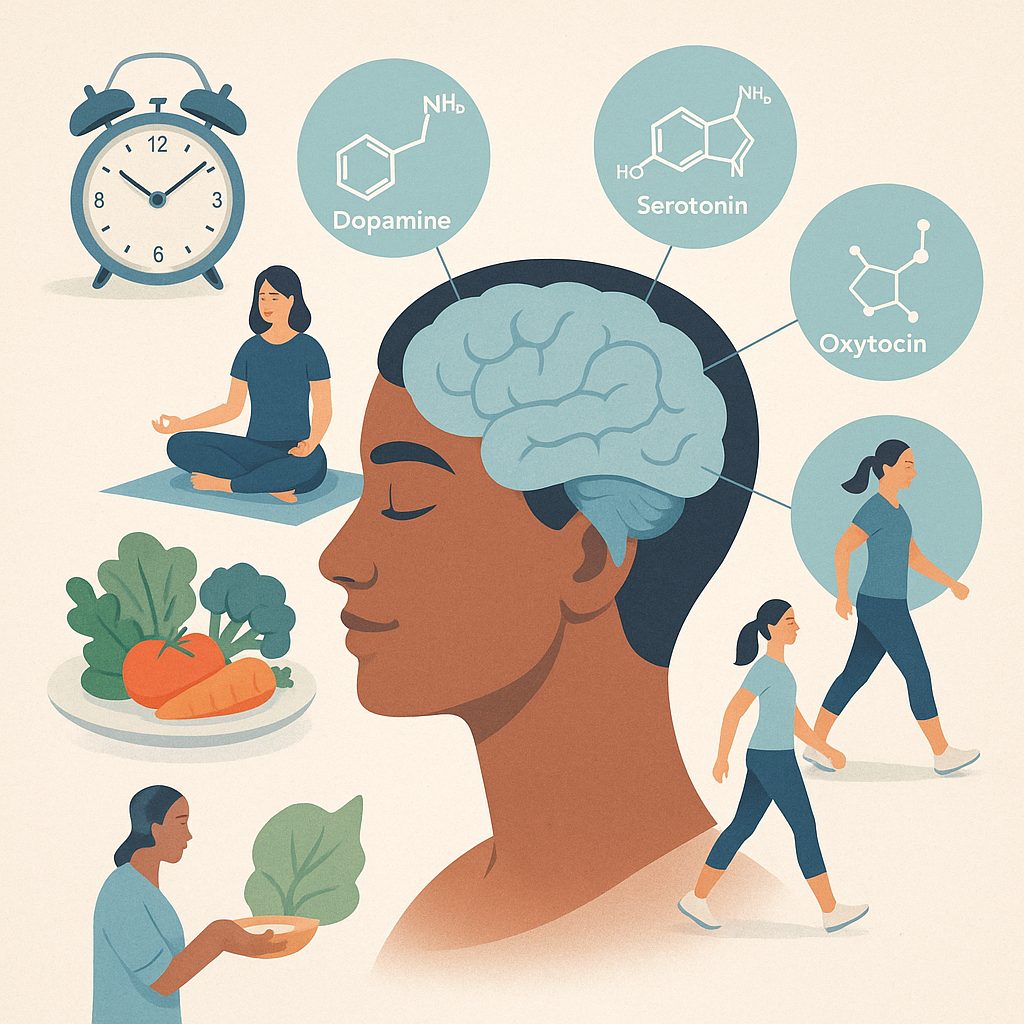
Within that space, a range of practices may help restore a sense of balance, support emotional regulation and reduce certain cognitive, motor or sensory disturbances. The original text points to musicology, acupressure, breathing practices, meditation, massage and exercise, including yoga, Qigong, tai chi chuan, NLP, walking and sport. These approaches do not work in exactly the same way, nor do they offer identical results for everyone, but they can provide healthy support for the brain and body. In that sense, they may contribute to the conditions associated with serotonin, dopamine, oxytocin and endorphins. As Loretta Graziano Breuning writes, “Dopamine is the good feeling you get when you approach a reward.
Serotonin is the good feeling linked to earning respect. Oxytocin is the feeling of trust and endorphin is the euphoria that masks physical pain.” Her summary is useful because it reminds us that these chemicals are tied not only to pleasure, but also to motivation, social connection, confidence and resilience.
Sleep deserves particular attention because it affects far more than tiredness. Regular, sufficient sleep supports emotional regulation, attentional stability and the brain’s capacity to recover from stress. When sleep becomes fragmented or chronically reduced, people often notice lower frustration tolerance, poorer impulse control and a diminished sense of reward in ordinary activities. Likewise, movement is not only beneficial for physical health; it may also help regulate arousal, improve mood and support a more coherent relationship between body signals and mental state.
Nutrition, too, is best understood in a measured way. No single food creates happiness, yet the brain is metabolically demanding and depends on a steady supply of energy and nutrients. A balanced diet may help support concentration, mood stability and overall physiological resilience. This is one reason why wellbeing practices are often most effective when they are not isolated techniques, but part of a broader rhythm that includes rest, nourishment, movement and social contact.
- regular sleep
- balanced nutrition
- movement and exercise
- breathing, meditation or massage
Why dopamine responds to simple, meaningful rewards
Dopamine offers a particularly concrete example because it is closely associated with the brain’s reward and motivation system. It is involved not just in pleasure itself, but in the anticipation of something meaningful or satisfying. That feeling can arise from very ordinary experiences: giving or receiving a compliment, reaching a goal, whether simple or ambitious, carrying out an act of kindness, volunteering, playing a game, watching a film, hearing a kind word, exchanging a glance or a smile, walking in nature, enjoying a piece of chocolate, or listening to music, whether classical, pop or jazz. The source text also mentions deep Mental Waves meditation.
Related offer
Mental Dynamism and Good Mood
The action of our audio recording affects the limbic system, where our emotional keyboard is located. The...
View productWhat matters here is not the prestige of the activity, but the fact that it resonates with your own needs, attention and emotional wiring.
Sound in particular remains an important support. Research from McGill University, published in 2011 in Nature Neuroscience, reported that music can stimulate dopamine release, which helps explain why certain sounds feel so engaging, soothing or uplifting. More broadly, the hormones of happiness play a key role in positive feelings and in the desire to act, explore, love, discover and take on challenges. A lack of enthusiasm and a tendency to procrastinate may, among other factors, be associated with lower dopamine activity. Yet responses vary from one person to another because every brain has its own unique wiring and learned pathways.
For that reason, the activities you choose need to be aligned with your own desires rather than copied mechanically from someone else’s routine. Books on the subject can offer useful guidance, but the essential point is simple: when cultivated through daily attitudes and healthy habits, these neurotransmitters can support a more grounded sense of wellbeing and a more vivid engagement with life.
It is also helpful to distinguish dopamine from the popular idea of constant excitement. In many cases, dopamine is less about intense pleasure than about directed energy: the sense that something matters, that a next step is worth taking, that effort may lead somewhere meaningful. This is why very small goals can be surprisingly effective. Completing a manageable task, keeping a promise to yourself, or making visible progress on something valued may help restore momentum when motivation feels low.
At the same time, modern environments can distort reward systems by offering frequent, fast and highly stimulating cues. Endless novelty, digital interruption and instant gratification may train attention towards short reward loops rather than deeper satisfaction. For some people, this can make slower sources of wellbeing — reading, conversation, walking, contemplation, sustained creative work — feel less immediately compelling even though they are often more regulating in the long term. Rebalancing dopamine, in practical terms, may therefore involve not only seeking pleasant stimuli, but also protecting attention so that meaningful rewards can be felt again.
How to Support Mood Without Chasing a Chemical High
The most useful habits are usually ordinary: sleep, movement, daylight, social connection, breathing, music, meaningful effort and moments of recovery. They do not work like buttons, but they help create conditions in which the nervous system can regulate more easily.
Chasing constant pleasure can backfire. Dopamine, for example, is closely tied to anticipation and learning, not just enjoyment. A healthier goal is not permanent excitement, but a more flexible range: motivation, rest, connection and steadiness.
Small practices matter because the body responds to repetition. One calmer breath, one walk, one song, one honest conversation or one completed task can shift the day without pretending to solve everything.
Four Everyday Levers for Dopamine, Serotonin, Oxytocin and Endorphins
Dopamine is often presented as the pleasure molecule, but it is also deeply involved in motivation, anticipation and learning. A grounded way to support dopamine is to make progress visible: finish a small task, take one step toward a meaningful goal, or create a rhythm where effort has a clear endpoint.
Serotonin is linked with mood regulation, rhythm and a sense of stability. It is not something to force through one habit. Daylight, regular sleep, balanced meals, movement and stress regulation can all contribute to a steadier internal environment.
Oxytocin is often associated with bonding and trust. Warm conversation, safe touch, shared rituals, kindness and the feeling of belonging can all matter here. The key word is safe: connection supports the nervous system when it feels respectful and real.
Endorphins are associated with comfort, effort and natural pain modulation. Laughter, movement, music, stretching and enjoyable physical activity may all contribute to a better body state. The point is not to push harder; it is to help the body remember that effort and relief can coexist.
Why Quick Fixes Usually Miss the Point
The language of happiness hormones can become misleading when it suggests that wellbeing is only a matter of pressing the right biochemical button. Human mood is more complex than that. It includes memory, relationships, sleep, meaning, stress load, physical health, environment and the stories we repeat about ourselves.
Related offer
Anti-depression, anti-depression
Help for nervous, seasonal or depressive breakdowns. A revolutionary new 100% solution that is non-chemical, effective and has no...
View productThat is why the most useful practices tend to be cumulative. A single walk may not transform mood, but daily movement can change the texture of the week. One breathing session may not erase stress, but repeated pauses can train the body to recover sooner. One song may not solve sadness, but music can help emotion move instead of remaining frozen.
The aim is not to live permanently elevated. A healthy nervous system needs activation and rest, pleasure and quiet, connection and solitude. Happiness hormones make more sense when they are understood as part of regulation rather than a race toward constant positivity.
The Mental Waves Mood Regulation Framework
The Mental Waves frame is to support happiness hormones through rhythm, connection and sensory balance.
- Move: use gentle activity to awaken energy.
- Connect: seek safe social contact and warmth.
- Listen: use music and sound to support emotional tone.
- Recover: make rest part of regulation, not an afterthought.
For breathing support, continue with Breathing Techniques. For practical calming tools, read Relaxation Techniques to Reduce Stress.
Editorial note from Mental Waves
This article is educational. Mood, hormones and neurotransmitters are complex, and persistent depression, anxiety or emotional crisis should be discussed with qualified professionals.
Conclusion
What emerges most clearly is that so-called “feel-good hormones” are not a magical switch, but part of a wider system of regulation, reward, connection and emotional balance. Shared rituals, meaningful social contact, movement, rest, music and small achievable goals may all help create the conditions in which dopamine, serotonin, oxytocin and endorphins are more readily supported. At the same time, the article rightly keeps some nuance: individual responses differ, inherited factors also play a part, and no single practice works in exactly the same way for every brain.
That is perhaps the most useful takeaway. Rather than chasing happiness as a permanent state, it makes more sense to observe which experiences genuinely steady your attention, soften stress and restore a sense of vitality. In that light, the brain’s plasticity is less a promise of total control than a reminder that habits, environments and repeated experiences can gradually reshape how we feel and respond. Wellbeing is often built less through intensity than through consistency.
A more realistic ambition is not permanent euphoria, but a life in which the nervous system spends more time in states compatible with trust, motivation, recovery and connection. That may include moments of joy, certainly, but also calm, clarity, engagement and a renewed capacity to act. The language of “happiness hormones” is useful insofar as it points towards real biological processes; it becomes more meaningful still when it encourages wiser daily choices rather than unrealistic promises.
Sometimes, a calmer mind begins with something very simple done regularly.
Frequently Asked Questions About Happiness Hormones
What are happiness hormones?
The phrase usually refers to chemical messengers linked with mood, motivation, bonding and pleasure.
What are the four main happiness hormones?
The four commonly mentioned are dopamine, serotonin, oxytocin and endorphins.
Is dopamine the same as happiness?
No. Dopamine is linked with motivation and reward learning, but happiness is broader.
How can serotonin be supported?
Sleep rhythm, daylight, movement, food quality and stress regulation may all play a role.
What supports oxytocin?
Safe connection, trust, touch where appropriate and warm social contact are often associated with oxytocin.
How are endorphins linked to movement?
Physical activity can be associated with endorphin release and a more comfortable body state.
Can music affect mood chemistry?
Music can influence emotion and arousal, though the body-brain response is complex.
When should someone seek help for mood?
Persistent low mood, anxiety, crisis or loss of function deserves qualified support.
What is the main takeaway?
Happiness hormones are best supported through balanced habits, connection and regulation rather than quick fixes.