en
enVotre panier est vide.


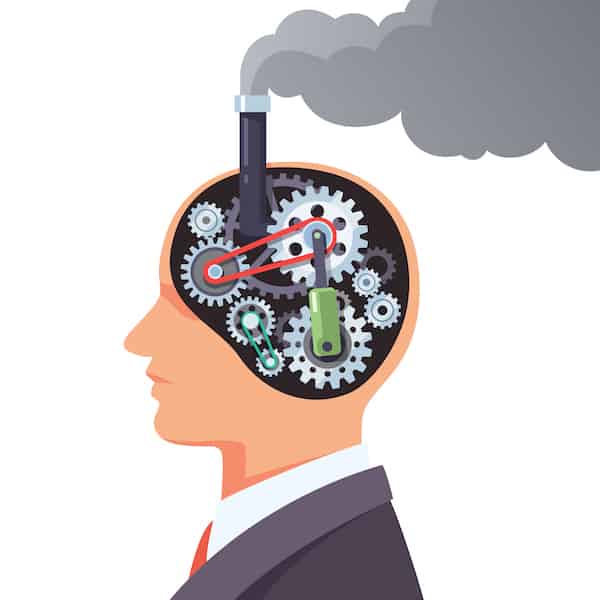
Multitasking has become part of everyday life. We answer a message while listening, work with several tabs open, and often feel as though the brain ought to keep pace with it all. Yet lived experience suggests otherwise: beyond a certain point, attention slips, errors appear and even simple decisions can start to feel less clear. Research discussed here points to a striking limit: the brain does not seem able to consciously manage more than two tasks at once.
That conclusion is grounded in work by the French researchers Sylvain Charron and Étienne Kœchlin, who used functional MRI with a group of student volunteers and published their findings in Science in April 2010. Their study suggests that when we carry out a single task, the two hemispheres of the brain work together; with two tasks, that balance shifts, with each hemisphere taking charge of one. But when a third demand is added, the system begins to lose coherence: reaction times lengthen, mistakes become more frequent, and one task is often abandoned altogether.
Far from being a minor inconvenience, this limit may help explain why reasoning, decision-making and adaptation can become so fragile when attention is stretched too far.
In short: can the brain handle three things at once?
The brain can process many signals unconsciously, but conscious attention struggles when three demanding tasks compete at the same time. So, can the brain handle three things at once? Usually not with the same clarity: two tasks may sometimes be managed by dividing attention, while a third often creates overload, errors or abandoned goals.
- Multitasking often means rapid task switching.
- Two goals can sometimes be held in competition.
- A third goal may exceed conscious control.
- Reducing task load can protect clarity and decisions.
For more on mental rhythms, read The Different Brain Waves. For a short reset before returning to work, try the free Mental Reset Session.
It is worth adding a careful distinction here. The brain can of course regulate many processes at once in the background: posture, breathing, sensory monitoring and countless automatic adjustments continue without conscious effort. The real question is narrower and more demanding: how many deliberate, attention-heavy tasks can be actively supervised at the same moment? On that point, the evidence remains much less generous than everyday digital life encourages us to believe.
Why the Brain Struggles to Handle Several Tasks at Once
Multitasking feels natural, but conscious attention has limits
Multitasking has become part of everyday life. We answer messages while working, listen while writing, and often assume the brain can comfortably manage several actions at once. Yet in practice, that feeling is often misleading. However capable it may be, the brain does not seem to sustain conscious attention across many tasks at the same time. According to a study often cited on this subject, its organisation may only allow it to deal with up to two tasks at once, rather than an unlimited number.
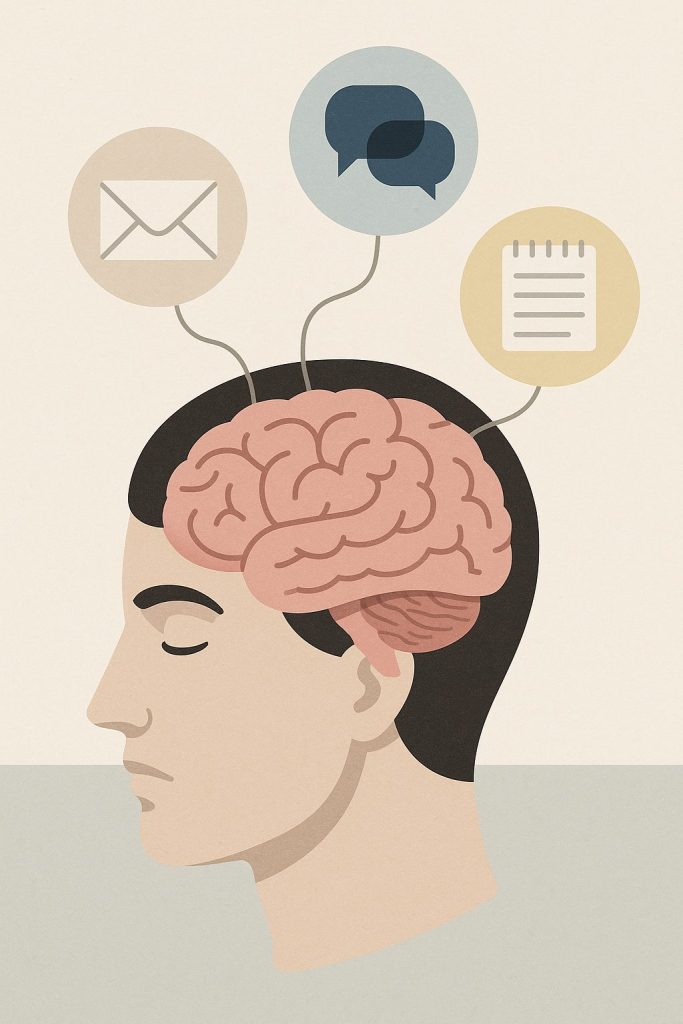
This helps explain a familiar experience: the more things we try to do deliberately and at the same moment, the more our concentration begins to fray. What feels like simultaneous action is often a more fragile mental process, in which attention is divided, redirected and stretched. In other words, the difficulty is not simply a lack of discipline or practice. It may reflect a basic limit in the way conscious processing is structured in the brain.
In cognitive terms, attention is not a single beam that can simply be widened without cost. It involves selection, prioritisation and the temporary maintenance of goals in working memory. Each additional task competes for those same limited resources. That competition may remain manageable when one activity is highly automated, but it becomes much more demanding when several tasks all require conscious monitoring, decision-making or inhibition.
This is why some combinations feel easier than others. Walking while talking is usually less taxing than writing an email while following a complex conversation, because the first pairing includes a largely automated motor routine, whereas the second asks the brain to manage two language-based, attention-dependent streams at once. The subjective feeling of “I can do this” is therefore not always a reliable guide to what the brain is actually processing well.
What the study suggests about the two hemispheres
To explore this question, the French researchers Sylvain Charron and Étienne Kœchlin used functional magnetic resonance imaging (fMRI) in a laboratory experiment involving around thirty student volunteers. In their study, published in Science on 16 April 2010, they observed activity in the front part of the brain, in lobes associated with reasoning and task execution. Their findings suggested that, when a person is carrying out a single task, the corresponding regions in the left and right hemispheres work together.
That point matters because it shows that efficient performance does not come from the brain doing everything everywhere at once. Rather, it depends on a coordinated interaction between the two hemispheres. The left and right sides of the brain are not operating as separate minds; they are collaborating within a structured system. This may be one reason why conscious multitasking quickly reaches its limits: the brain remains highly effective, but not infinitely divisible when reasoning, focusing and acting in a deliberate way.
The frontal regions highlighted in this kind of work are often associated with executive control: maintaining goals, selecting relevant information and suppressing distractions. When these systems are engaged by a single task, coordination can remain relatively stable. When demands multiply, however, the same control architecture may have to split or alternate its priorities. That does not mean the hemispheres stop communicating altogether in a literal sense, but rather that the functional organisation of the task changes in a way that appears less unified.
It is also important to read such findings with nuance. fMRI does not measure thoughts directly; it tracks changes associated with blood flow, which are linked to neural activity. Even so, it remains a valuable tool for identifying broad patterns in how the brain allocates resources. In this case, the pattern supports a compelling idea: conscious task management depends on a limited and organised system, not on an unlimited capacity for parallel control.
- The study used fMRI to observe brain activity.
- It involved about thirty student volunteers.
- The findings were published in Science on 16 April 2010.
Why Two Tasks May Still Be Manageable, but a Third Often Overloads Attention
What happens when we try to do two things at once
During the study, the researchers observed that when a volunteer attempted to carry out two tasks at the same time, communication between the two hemispheres was no longer organised in quite the same way as it was for a single task. Instead of working together on one activity, each hemisphere appeared to take charge of one task. Even so, the brain could still cope at this stage, because a prefrontal area helped keep both tasks in mind so that they could be handled in rapid succession rather than in one perfectly simultaneous movement.

Related offer
Attention focuser - helps concentration
This sound program has been designed specifically for people who want to focus their attention and their...
View productThis is an important nuance. What feels like multitasking may in fact be a very fast alternation of attention. According to the study, the shift from one task to the other took only around a hundred milliseconds, which is quick enough to create the impression that both actions are being performed together. In everyday life, that may explain why two simple demands can sometimes seem manageable, even though the brain is still dividing its resources rather than processing everything consciously at once.
That rapid switching is efficient, but it is not free. Each shift may carry a small cognitive cost: a brief reorientation, a need to recover the task goal, and a risk of losing part of the previous mental context. When the tasks are simple, those costs may remain barely noticeable. When they are complex, emotionally charged or time-sensitive, the same switching can become much more disruptive than it first appears.
This may help explain why people often feel productive while multitasking, yet later notice omissions, weaker recall or a sense of mental fatigue that seems disproportionate to the work done. The brain may have kept both tasks active, but it has done so by repeatedly reallocating attention rather than by sustaining full conscious processing of both in parallel. In practical terms, that difference matters for quality as much as for speed.
- Each hemisphere appears to handle one task
- A prefrontal region keeps both tasks active in mind
- The brain switches between them in roughly 100 milliseconds
Why a third task changes the picture
The French scientists then repeated the experiment by asking the volunteers to perform three actions simultaneously. This time, the limits of the system became much clearer. The participants showed signs of disorganisation in the way they carried out the tasks: mistakes increased, reaction times became longer, and in the end they tended to abandon at least one of the three tasks. In other words, once the brain was pushed beyond two competing demands, performance began to break down.
These findings suggest that the brain is not really built to manage more than two conscious tasks at the same time, and that trying to force it further may simply worsen the result. This limit may also help explain some of the difficulties we encounter when we are trying to reason clearly, make decisions or adapt quickly under pressure. When too many demands compete for attention, the problem is not a lack of effort. It is that the brain’s attentional system appears to reach a functional threshold.
A third task does not merely add one more item to the list; it changes the structure of the problem. The brain must now hold several goals in mind, decide which one deserves priority, inhibit interference from the others and recover the right context after each switch. That accumulation of control demands may be precisely what produces the visible drop in coherence. The result is not just slower performance, but a more unstable mental state in which errors become easier to make and harder to detect.
This has obvious relevance beyond the laboratory. Driving while following navigation and holding a demanding conversation, replying to messages during focused work, or trying to monitor several streams of information in a high-pressure setting may all create the same kind of overload. The issue is not that every third activity is impossible, but that once several tasks all require conscious supervision, the margin for error narrows sharply.
Seen this way, the limit is less a flaw than a design principle. The brain appears optimised for selection and coordination, not for endless conscious parallelism. Respecting that limit may support clearer judgement, steadier attention and better decisions, especially in situations where precision matters more than the illusion of doing everything at once.
How to Work With Attention Limits in Real Life
The practical lesson is not that people should never do several things in a day. It is that demanding tasks need cleaner boundaries. Writing an email while listening to a meeting and deciding something important is very different from walking while thinking.
A useful rule is to protect tasks that require reasoning, memory or emotional judgement. These are the moments where the cost of divided attention becomes more visible. The brain may still produce activity, but the quality of choice can fall.
- Group small administrative tasks together.
- Give complex thinking a separate block of time.
- Keep only one decision channel open when stakes are high.
- Use a short reset before switching into a new task.
This approach also reduces the emotional load of unfinished tasks. When the brain knows where each task belongs, it spends less energy holding everything in a vague state of urgency.

Related offer
Focus for complex tasks
Cette session se concentre sur l'hémisphère droit du cerveau, tout en accélérant et en stimulant l'hémisphère gauche. Cet…
View productThe Mental Waves Attention Load Framework
The Mental Waves frame is to make attention easier to protect. The brain is powerful, but conscious focus is not infinite. When everything is urgent at once, the nervous system often needs simplification before it needs more effort.
- List: name the tasks competing for attention.
- Choose: decide which one deserves conscious focus now.
- Park: place secondary tasks somewhere visible but separate.
- Reset: pause briefly before switching contexts.
If task pressure is creating stress, continue with How to Free Yourself from Stress. For the hidden work of the mind, read Scientific Research on the Subconscious.
Editorial note from Mental Waves
This article is educational. Attention limits vary by task, person, fatigue and context, so the research should be read as guidance about cognitive load rather than a rigid rule for every situation.
Conclusion
What this study suggests, then, is not that the brain is weak, but that conscious attention has a structure. We may feel as though we are doing several things at once, yet much of the time the brain is rapidly alternating, holding tasks in mind and shifting between them so quickly that the experience seems seamless. That helps explain why two tasks can sometimes remain manageable, while a third often introduces delay, confusion and more frequent errors.
Seen in that light, the limits of multitasking are less a personal failing than a feature of how cognition is organised. The point is not to dramatise the boundary, but to recognise it: when reasoning, deciding or adapting well matters, giving attention a little more space may help us work with the brain rather than against it. Sometimes, clarity begins by doing one thing less.
That perspective can be quietly useful in daily life. If a task requires judgement, memory, language or self-control, it may benefit from being protected from unnecessary competition. Reducing simultaneous demands does not ensure perfect performance, but it can create conditions in which the brain’s natural strengths, such as coordination, sequencing and selective focus, are more likely to operate well.
Frequently Asked Questions About the Brain and Multitasking
Can the brain handle three tasks at once?
It can process many things in the background, but conscious attention usually struggles with three demanding goals at once.
Why does multitasking feel possible?
Because the brain often switches quickly between tasks, which can feel like doing them simultaneously.
What happens with two tasks?
Two tasks may sometimes be split between competing goals, though this still costs attention and accuracy.
Why does a third task overload focus?
A third task can exceed the available conscious control, making errors or abandoned goals more likely.
What research is mentioned?
The article refers to research by Sylvain Charron and Etienne Koechlin on attention, goals and task competition.
Does this mean the brain is weak?
No. It means conscious attention has limits, even though the brain processes many signals efficiently.
How can overload be reduced?
Choose one priority, park secondary tasks, reduce interruptions and pause before switching contexts.
Why does this matter for decisions?
Decision quality often falls when attention is divided among too many competing goals.
What is the main takeaway?
The brain is adaptable, but conscious focus works better when task load is simplified.