en
enVotre panier est vide.



Some doctors are increasingly uneasy about the way antidepressants are prescribed. The concern is not that depression is unreal or unworthy of treatment, but that too many people may be labelled depressed and medicated too quickly, when what they are living through may call for something else entirely: time, careful listening, support, or psychotherapy rather than an automatic prescription.
In short: antidepressant prescription
The antidepressant prescription controversy should be approached carefully: the real issue is not rejecting medication, but understanding diagnosis, benefit, risk and follow-up.
Use this article as a practical map: keep what helps attention become steadier, question anything that sounds absolute, and connect the idea back to repeatable daily practice.
That distinction matters more than it first appears to. Once a passing crisis, a grief reaction or a period of exhaustion is given the full weight of a psychiatric label, the person can begin to see themselves through that label as well. What might have been understood as a painful chapter in a life is then recast as a fixed disorder, and that shift can alter expectations, treatment pathways and even a person’s sense of who they are.
That is the argument put forward by the psychiatrist and psychoanalyst Robert Neuburger, a well-known clinician working in Paris and Geneva and vice-president of the French Society of Family Therapy. At a time when the wider debate around over-medication is growing louder, his position cuts against a powerful medical and commercial current: the tendency to turn ordinary anguish, grief or psychological strain into a diagnosis, and a treatment for severe illness into a form of comfort medicine.
His intervention is provocative precisely because it refuses an easy moral split. He is not dismissing severe depression, nor suggesting that medication is never useful. He is asking for something more demanding: that clinicians resist the temptation to confuse distress with disorder, and that they remember how different one person’s suffering can be from another’s, even when the outward symptoms look similar.
When sadness is treated too quickly as depression
Robert Neuburger’s warning about overdiagnosis
Some doctors are increasingly uneasy about the way depression is diagnosed and treated. As Monsieur Prix argues for a shorter list of medicines reimbursed by health insurers, psychiatrist and psychoanalyst Robert Neuburger has chosen to say openly what many prefer not to: too many patients are being labelled depressed and medicated when that diagnosis does not truly fit. Neuburger, who practises in Paris and Geneva, has written extensively on these questions and serves as vice-president of the Société française de thérapie familiale. His position is uncomfortable in a climate shaped by concern over the overuse of medication, but it is clear.
In his view, many people described as “depressive” are not suffering from depression in the strict sense and do not recognise its real symptoms.

That point is easy to misunderstand if one reads it too quickly. He is not saying that people exaggerate their pain, or that emotional suffering should simply be endured in silence. He is saying that medicine can become clumsy when it reaches too fast for a familiar label. A person may be overwhelmed, frightened, sleepless, tearful or unable to cope for a time without meeting the threshold of a depressive illness in the fuller clinical sense.
His blunt phrase captures the point: “A little anxiety never harmed anyone. Feeling anxious does not make everyone depressed.” For him, depression is now too readily diagnosed. Someone may walk into a surgery feeling low, shaken or simply worn down, and leave with a prescription for antidepressants. In that shift, a treatment designed for a serious illness risks becoming a form of comfort medicine. Yet some patients need something quite different: time, careful listening, support, and sometimes psychotherapy rather than tablets. Neuburger sees that as especially regrettable in a place such as Geneva, long associated with the tradition of psychoanalysis and with taking a person’s inner life seriously.
There is also a practical reality behind this. A brief consultation often leaves little room for nuance. It is far quicker to identify a cluster of symptoms and prescribe than to sit with ambiguity, ask about bereavement, family strain, loneliness, work pressure or the slow erosion that comes from months of emotional overload. Yet those details are often the very substance of the problem.
- Not every period of sadness or anxiety amounts to clinical depression.
- Some patients may need support or psychotherapy before medication is considered.
- Overdiagnosis can turn a serious treatment into a routine response to distress.
Why a single prescription can miss the person behind the symptoms
Neuburger also stresses the risks for patients themselves. Instead of bringing relief, antidepressants can sometimes produce the opposite of what was intended, including mood reversals in which the patient becomes euphoric. He goes so far as to argue that abusive prescribing has contributed to the creation of bipolar profiles in some cases. Behind that criticism lies a broader concern: the same treatment is too often handed to thousands of people whose lives, losses and pressures have nothing in common. Someone grieving for a loved one cannot be approached in exactly the same way as someone struggling at work, yet both may end up with the same prescription.
That flattening of experience is one of the most troubling features of overprescription. Two people may both say they cannot sleep, cannot concentrate and feel hopeless, but the meaning of those symptoms may be entirely different. In one case, they may belong to mourning; in another, to burnout; in another still, to a depressive episode with a very different depth and trajectory. If treatment begins and ends with the symptom list, the person disappears behind it.
That, for Neuburger, is the heart of the problem. Treatment should put the individual back at the centre. Rather than dealing only with the visible consequences, clinicians should try to understand the source of the suffering in each case. A bereavement, a family crisis, professional strain or a deeper psychiatric disorder do not call for one automatic response. His criticism is not simply aimed at medication itself, but at a medical reflex that can flatten very different human experiences into a single diagnosis and a single pharmaceutical answer.
There is a deeper human cost here as well. When people are treated as though their distress were interchangeable, they often feel unseen. Good care does not only reduce symptoms; it gives a person the sense that what has happened to them has been properly heard. That is one reason why listening is not a sentimental extra in mental health care. It is part of the treatment itself.
When treatment itself becomes part of the problem
The risks of a one-size-fits-all prescription
One of the central concerns raised here is that antidepressants, when prescribed too readily, can produce the very opposite of what is intended. Instead of calming distress, they may trigger mood reversals: a patient who arrived low and fragile may become euphoric. In Robert Neuburger’s view, repeated overprescription has even helped to create bipolar-type profiles in people whose original difficulties were of a very different nature.
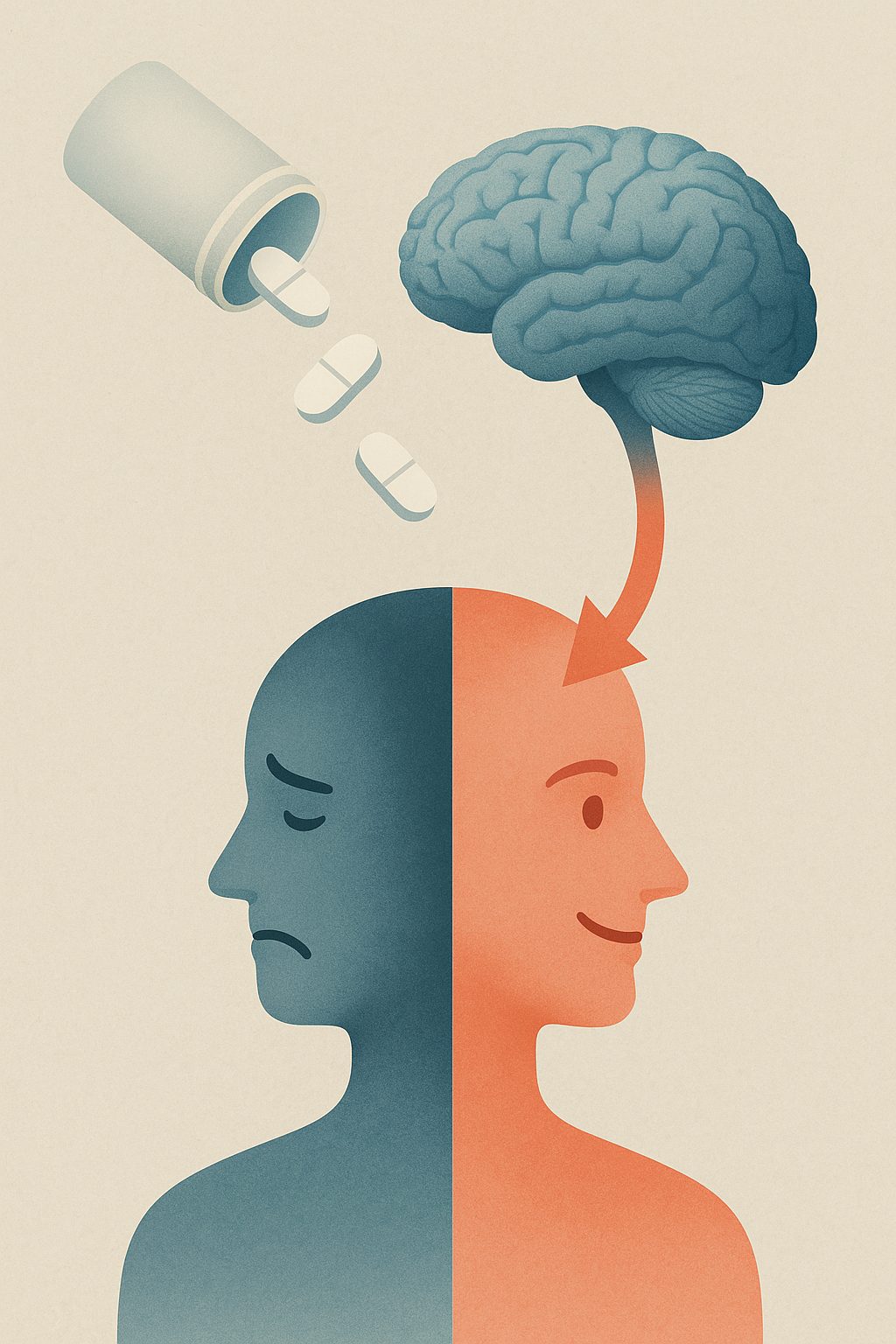
Whether or not one accepts that formulation in every case, the warning deserves to be taken seriously. Psychiatric medication is never neutral simply because it is common. Once a drug acts on mood, energy, sleep and emotional intensity, it can shift a person’s internal balance in ways that are not always predictable, especially if the original diagnosis was imprecise. A medicine given for the wrong reason may still have very real effects.
His broader point is that the same treatment cannot sensibly be applied to thousands of people whose lives, losses and pressures have nothing in common. Someone grieving after the death of a loved one is not in the same situation as someone worn down by problems at work, and it makes little sense to respond to both with an identical prescription. For him, care should put the individual back at the centre: not simply suppress the visible consequences, but try to understand the source of the suffering in each case.
Related offer
Anti-depression, anti-depression
Help for nervous, seasonal or depressive breakdowns. A revolutionary new 100% solution that is non-chemical, effective and has no...
View productThat does not mean every prescription is careless. Many are thoughtful and necessary. But the controversy begins when medication becomes the default language of care, the thing offered first because it is available, familiar and efficient. Once that happens, the treatment pathway can start to reflect the needs of the system more than the needs of the patient.
- mood reversal rather than relief
- euphoria instead of emotional stabilisation
- different life situations treated as though they were the same
Why overprescription keeps happening
Neuburger also points to the wider system around these prescriptions. With depression now framed as the “illness of the century”, pharmaceutical companies have found an exceptionally profitable market. He cites Bill Bryson in A Short History of Nearly Everything — winner of the 2005 Descartes Prize for science communication — who remarks that, given the choice between antibiotics taken for a fortnight and antidepressants taken every day for years, drug companies unsurprisingly favoured the latter. In that context, promotional material sent directly to surgeries can strongly shape how new drugs are perceived.
Commercial pressure rarely appears in crude form. It works more subtly than that: through repeated messaging, selective emphasis, polished claims about tolerability, convenience or innovation, and the quiet normalisation of long-term prescribing. Over time, what begins as marketing can start to feel like common sense. That is one reason this debate cannot be reduced to individual doctors making poor choices in isolation.
The criticism then turns to general practitioners, who still account for the largest share of antidepressant prescriptions — around 70% according to the source text. The issue is not simply blame, but training and information: many GPs are less familiar with psychological and psychiatric disorders, while much of what they hear about new medicines comes from the laboratories themselves. The result is a form of medicalisation in which ordinary psychological distress is too easily recast as illness, and where anxiety, sadness or strain are treated as pathology by default.
There is also the pressure of ordinary practice. A GP may have only a few minutes, a waiting room full of patients and limited access to psychological services to which they can refer someone quickly. In those conditions, a prescription can become not only a clinical decision but a structural one. It may be the only immediate tool available, even when everyone involved senses that it is not the whole answer.
- depression as a lucrative long-term market
- direct promotion aimed at GPs
- around 70% of prescriptions coming from general practitioners
When ordinary distress is turned into illness
Not every anxious moment is depression
Robert Neuburger’s point is deliberately unsettling in a culture that tends to medicalise every form of discomfort: a little anxiety is not, in itself, a disease. Feeling worried, shaken or emotionally strained does not automatically make someone depressed. If every difficult inner state is treated as pathology, we end up blurring an essential distinction between ordinary human distress and a severe psychiatric condition.
That distinction is not cold or dismissive; in many cases it is protective. To say that anxiety, sadness or grief can belong to ordinary life is not to trivialise them. It is to recognise that human beings are affected by loss, uncertainty, humiliation, conflict and fear, and that not every painful response should be translated into illness. Sometimes suffering is a sign that something in life has become unbearable, not that the mind itself is malfunctioning.
That confusion matters. Once psychological difficulties are systematically translated into medical terms, everything starts to look like something to be diagnosed and medicated. Neuburger argues that this reflex can spare us the harder questions. Instead of asking what in a person’s life, family or circumstances is producing the suffering, we attach a label and move on. In that sense, depression can sometimes become less an explanation than a convenient answer, one that avoids deeper reflection on what is really going wrong.
There is a social comfort in that simplification. If distress is located entirely inside the individual, then workplaces, families, schools and social expectations are left largely untouched. The diagnosis may be real in some cases, of course, but the wider habit of individualising suffering can still serve a defensive function. It allows a society to treat symptoms without examining the conditions that help produce them.
Why children are especially exposed
He is particularly concerned about children. In his view, the pharmaceutical industry has long seen childhood as a market, and the result is that younger patients are increasingly drawn into this highly medicated approach. Some children are now prescribed antidepressants, and Neuburger also points to Ritalin, used for attention deficits in hyperactive children, describing it as an amphetamine of the kind some cyclists have used as a performance-enhancing drug. His concern is simple: we still do not properly know what the long-term consequences may be.
Children make this debate more morally charged because they depend on adults to interpret their behaviour for them. A restless, distressed, inattentive or oppositional child may be expressing many things at once: developmental difficulty, family tension, school pressure, trauma, temperament, boredom, grief or genuine neuropsychiatric disorder. The danger lies in moving too quickly from behaviour to medication without spending enough time understanding the child’s world.
He also suggests that many younger psychiatrists have trained within an intensely medication-focused culture and may prescribe too readily, treating a wide range of childhood difficulties with drugs. Some parents push back, but many still assume that the doctor necessarily knows best and follow the recommendation. Behind this, Neuburger sees a broader social habit: we are often quicker to identify weakness in individuals than to question the pressures of the couple, the family or society itself. He recalls that in the 1930s some even claimed unemployment was genetic; today, he argues, similar claims are made about depression, despite what he sees as a lack of solid scientific basis for assigning such a decisive role to genes.

Related offer
Anxiety reducer
This session uses Alpha and Beta wave stimulation to relax, alleviate...
View productParents are often placed in an impossible position here. They may be exhausted, frightened for their child and desperate for something that will help quickly. In that state, a prescription can feel like relief, even when doubts remain. That is why the quality of explanation matters so much. Families need more than authority; they need honest discussion about uncertainty, alternatives and the limits of what medication can do.
The Mental Waves Medication Discernment Framework
The Mental Waves frame is to keep mental health decisions grounded, individual and supported. Medication can be helpful for some people and unsuitable for others; what matters is assessment, follow-up and the person in front of the clinician.
A useful question is not whether antidepressants are good or bad in the abstract, but whether the diagnosis is clear, the expected benefit is defined, side effects are monitored, and psychological or lifestyle support is also considered where appropriate.
For a non-medical support to reduce mental noise between appointments or decisions, try the free Mental Reset session while keeping all treatment questions with your clinician.
Editorial note from Mental Waves
This article is not medical advice. Do not start, stop or change antidepressant medication without a qualified prescriber. Depression, suicidal thoughts, severe anxiety or medication side effects require prompt professional support.
Conclusion
The real tension here is not between being for or against antidepressants, but between care that is precise and care that becomes automatic. The article’s central warning is that sadness, anxiety, grief and exhaustion do not all mean the same thing, and they should not all lead to the same prescription. Used well, medication has its place; used too quickly, it can blur the person behind the symptoms and turn a difficult moment into a fixed label.
What emerges, then, is a broader unease about a culture that medicalises distress more readily than it listens to it. That concern becomes sharper when prescribing habits are shaped by habit, commercial influence or lack of time, and sharper still when children are drawn into the same logic. Not every form of suffering is an illness, and not every illness is best met first with a pill. Sometimes the most serious thing medicine can do is resist the urge to simplify.
That is perhaps why this controversy continues to resonate. It touches a nerve far beyond psychiatry itself. It asks what kind of care we want when people are struggling: care that names and medicates quickly, or care that can tolerate complexity long enough to understand what is actually happening. For many patients, that difference is not theoretical. It is the difference between being managed and being met.
Frequently Asked Questions About the Antidepressant Prescription Debate
Why is the prescription of antidepressants being criticised here?
The main criticism is that antidepressants may be prescribed too quickly and too broadly. Ordinary sadness, anxiety, grief or psychological strain can be treated as if they were clinical depression, which risks turning a medicine intended for serious illness into a routine response to distress.
Who is Robert Neuburger and what is his position on this issue?
Robert Neuburger is a psychiatrist and psychoanalyst who practises in Paris and Geneva and serves as vice-president of the French Society of Family Therapy. He argues that depression is often overdiagnosed and that many patients would benefit more from listening, support or psychotherapy than from immediate medication.
Does feeling anxious or low mean someone is depressed?
No, feeling anxious or low does not automatically mean someone is depressed. The distinction matters because temporary anguish or emotional strain can be part of ordinary life, whereas depression is treated here as a more serious condition that should not be diagnosed casually.
What risks are linked to prescribing antidepressants too readily?
One concern is that the treatment can produce effects opposite to those intended. Mood reversals are mentioned, including cases where a patient becomes euphoric, and there is also a warning that abusive prescribing may contribute to bipolar-type profiles in some people.
Why is a one-size-fits-all approach seen as a problem?
Different forms of suffering do not have the same cause and should not automatically receive the same response. Someone grieving after a bereavement is not in the same situation as someone struggling at work, so care should focus on the individual and the source of the distress rather than only its visible consequences.
Why are general practitioners singled out in the debate?
General practitioners are highlighted because they account for the largest share of antidepressant prescriptions, with around 70% attributed to them. The concern is that many are less familiar with psychiatric and psychological disorders and may rely heavily on information supplied by pharmaceutical companies about new medicines.
What role do pharmaceutical companies play in this controversy?
Pharmaceutical companies are presented as having a strong commercial interest in long-term antidepressant use. Direct promotion to doctors' surgeries is described as part of the problem, and Bill Bryson is cited to illustrate how profitable medicines taken daily over long periods can be compared with short-course treatments such as antibiotics.
Why does the debate also focus on children?
Children are seen as especially vulnerable to an increasingly medication-focused culture. The concern is that some practitioners treat a wide range of childhood difficulties with drugs, including antidepressants, while the long-term consequences of certain treatments, such as Ritalin, are described as still uncertain.
What broader social concern sits behind this debate?
A wider concern is that society may prefer to label distress as an individual weakness or a medical disorder rather than question family, social or professional pressures. There is also scepticism towards claims that depression is genetic, with the view that such explanations can oversimplify suffering and discourage deeper reflection.