en
enVotre panier est vide.



Few subjects have attracted as much scientific interest in recent years as music therapy — and it is important not to confuse it with musicology. Music therapy places the conscious and unconscious intersubjective relationship at the heart of care, using sound as a non-verbal therapeutic medium that may help support, maintain or restore a person’s psychological and physical health. Musicology, by contrast, studies music itself: its forms, its development and its relationship with human beings and society. That distinction matters, because it shifts the question from what music is to what music may do.
From there, neuroscience opens a more concrete line of enquiry: what influence does music really have on behaviour, attention and emotional regulation, whether it comes with lyrics or without them? This is where the subject becomes especially compelling. Beyond personal impressions or cultural attachment, researchers have tried to understand how sound, rhythm and words may shape our responses — sometimes subtly, sometimes more strikingly — and why music is increasingly being explored not simply as an art form, but as a potential therapeutic resource.
It is also worth keeping a careful distinction in mind: to say that music may influence the mind is not to say that it acts in a uniform or magical way. Its effects depend on context, personal history, familiarity, expectation, current mental state and the setting in which it is heard. A melody associated with comfort for one person may leave another indifferent, while lyrics that encourage affiliation in one situation may be experienced as intrusive in another. This variability does not weaken the subject; on the contrary, it is precisely what makes it scientifically interesting.
In short: can music support healing?
Music can support healing when it helps regulate emotion, attention, memory, movement or communication inside an appropriate context. It is not a miracle solution, but a powerful human medium that may support care, rehabilitation and everyday emotional balance.
- Lyrics can influence mood, meaning and social behaviour.
- Rhythm and melody can support memory, speech and movement in structured settings.
- Music without words can create a safer non-verbal channel for some people.
- The effect depends on the person, the setting and the intention.
For deeper context, read the Mental Waves guides to the therapeutic benefits of sound, music therapy for schizophrenia and neuromusicotherapy.
How Lyrics Shape Behaviour for Better or Worse
Words in songs can quietly steer behaviour
Researchers have long observed that music can influence behaviour, but lyrics add another layer of effect, sometimes constructive, sometimes troubling. Nicolas Guéguen, Director of the LESTIC laboratory in Vannes, has highlighted several striking psychology experiments on this point. One often-cited example comes from T. Greitemeyer in the Journal of Experimental Social Psychology (2009): after listening to the Beatles’ song Help, 53% of listeners went on to donate money to a charitable cause. The verbal cue itself seems important here. A song does not only create a mood; it can also prime attention, activate associations and subtly orient behaviour in a particular direction.
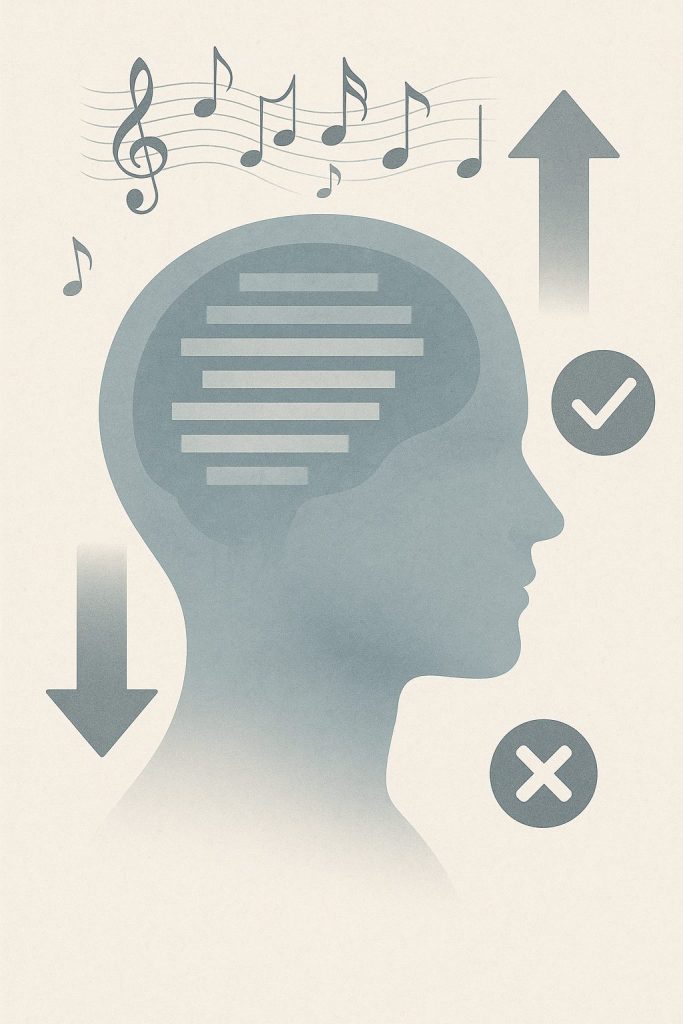
The reverse may also be true. Guéguen refers to an experiment by Peter Fischer at the University of Munich, in which men and women were exposed to songs containing misogynistic lyrics. They were then asked to prepare a sauce, more or less spicy, for another person to taste. The result was revealing: only the men exposed to misogynistic lyrics made the sauce significantly more “hot” when it was intended for women rather than for men (Cerveau & Psycho, April 2016). By contrast, when lyrics revolve around love, happiness, solidarity or peace, researchers tend to observe a more positive unconscious influence on behaviour.
In other words, the text carried by a melody may matter just as much as the melody itself.
From a cognitive point of view, this is plausible. Lyrics can function as semantic cues: they activate meanings, social scripts and emotional associations that may remain partly outside conscious awareness. When these verbal cues are repeated in rhythm and paired with a memorable melodic structure, they may become especially salient. This does not mean that a song determines behaviour in any simple sense, but it may bias perception, lower or raise certain thresholds of response, and shape the emotional tone in which later decisions are made.
- Prosocial lyrics may encourage helping behaviour.
- Hostile or misogynistic lyrics may reinforce more aggressive responses.
- Positive themes such as love or peace are often associated with gentler behavioural effects.
Such findings should still be interpreted with restraint. Laboratory effects are not the same as long-term social outcomes, and behaviour is always influenced by many variables at once. Even so, these studies remind us that songs are not merely decorative background. They can carry verbal content that interacts with attention, memory and affect in ways that deserve to be taken seriously, especially in environments where music is repeated, socially shared or strategically selected.
From cafés to lullabies, lyrical content shapes everyday experience
The importance of verbal content also appears in more ordinary settings. Céline Jacob, from the University of Brittany, studied behaviour in cafés and found that customers who would usually stay for around fifteen minutes remained longer when the establishment played French songs linked to drinking. Among the examples were Boire un petit coup c’est agréable by Les Charlots, Viens boire un petit coup à la maison by Licence IV, and the famous Ah ! Le petit vin blanc, written in 1943 as a musette waltz and performed by Lina Margy. Here again, the effect cannot be reduced to rhythm alone.
The words appear to resonate with the setting, reinforcing a shared atmosphere and perhaps nudging behaviour without people fully noticing it.
In a very different register, songs with words can also soothe and prepare the mind for sleep. Many childhood lullabies work through this gentle alliance between melody, repetition and familiar language, from Henri Salvador’s Une chanson douce to the well-known eighteenth-century lullaby Fais dodo Colas mon p’tit frère. What is especially striking is that the lyrics themselves may shift from one French region to another. In the south, for instance, the word nougat sometimes replaces chocolat in the original version, while maritime regions may favour lines such as “Papa est en haut qui fait des bateaux pour le p’tit Pierrot qui fait son dodo...”.
These variations remind us that lyrics are never neutral: they carry memory, culture and suggestion, and may influence emotional state as much as the music that supports them.
Everyday listening often works precisely because it is not experienced as an intervention. In cafés, shops, waiting rooms or family routines, music enters attention lightly, without demanding analysis. Yet this low-intensity exposure may still shape tempo, expectation and mood. A familiar song can make a place feel more intimate, more festive or more permissive; a lullaby can narrow the field of attention, reduce arousal and create a predictable auditory frame in which the body begins to settle. In that sense, lyrical music may help organise experience as much as express it.
This is one reason why the social use of music deserves thoughtfulness. When lyrics are repeated in public spaces, they do more than entertain: they contribute to the emotional climate of an environment. In children, this may matter for routines of reassurance and sleep; in adults, it may matter for consumption, sociability and behavioural tone. The mechanism is unlikely to be singular, but a combination of repetition, semantic priming, autobiographical memory and shared cultural codes offers a credible explanation.
Why Wordless Music Is Gaining Ground in Therapy
From intuition to neuroscience
From Edgar Cayce to physicists, and from musicologists to neuroscientists, mathematicians and anthropologists, many fields have tried to understand why music can have such a marked effect on the human mind and body. Without words, it may support reasoning, calm, relaxation, concentration and creativity. Whether it is experienced actively through playing an instrument or more receptively through listening to a melody, music is now widely explored for its potential role in behavioural difficulties, sleep problems, anxiety, depression, chronic pain and autism. Neuroscience continues to investigate these therapeutic dimensions of sound, not only because music can shape emotion and attention, but also because in some contexts it may offer a useful complement, or sometimes an alternative, to medication.

Related offer
Sound Therapy with Tibetan Bowls
Discover the ancestral power of Tibetan bowls. It's been proven that singing them helps regenerate and restore serenity and well-being...
View productThat broader interest also helps explain why music therapy is no longer dismissed as a purely “New Age” idea. Research has played a major part in its growing credibility by suggesting that music can also stimulate brain functioning. Long before this scientific recognition, Edgar Cayce had already used music in many of his recommendations, while warning that certain sounds could be counterproductive if used without discernment, much like medicines themselves. That caution still matters today: music is powerful, but its effects are not neutral, automatic or identical for everyone.
- It can be active: playing, singing, keeping rhythm.
- It can be receptive: listening, resting, regulating attention.
- Its effects may involve emotion, memory and mental state regulation.
One reason wordless music is so interesting in therapeutic contexts is that it can act without relying on explicit language. This may be especially relevant when verbal processing is fatigued, impaired or emotionally overloaded. Rhythm can entrain movement; tempo can influence arousal; harmonic tension and release can shape expectation; repetition can stabilise attention. In some settings, these properties may help create a more manageable internal state before any verbal work even begins.
There is also growing interest in the way music engages distributed brain networks rather than a single isolated function. Listening may recruit auditory regions, motor timing systems, limbic circuits involved in emotion, and memory-related processes all at once. This broad recruitment may help explain why music is often experienced as both immediate and immersive. It can reach people through several channels simultaneously: sensation, anticipation, bodily rhythm, affective colouring and autobiographical resonance. That does not make it a remedy-all, but it does make it a particularly rich medium for therapeutic support.
For clinicians and carers, the practical implication is simple but important: the choice of music matters. Volume, familiarity, complexity, tempo and personal preference can all alter the effect. What calms one person may overstimulate another; what supports concentration in one task may interfere with it in another. A rigorous approach to music therapy therefore requires observation, adjustment and sensitivity to the individual rather than reliance on generic assumptions about “relaxing music”.
When melody helps memory and speech return
One of the most striking areas of research concerns neurodegenerative illness. Priscilia Chevreau, Mohamad El Haj and Philippe Allain co-wrote an important article on music and Alzheimer’s disease, showing that music may help patients recover autobiographical memories more effectively. As they note, “People with Alzheimer’s disease recall past events from their lives better and more quickly when they listen to music they have chosen. The retrieval of memories with music may involve a brain network distinct from the one engaged without music.” For people who believed those memories had vanished for ever, this possibility is deeply significant.
It also explains why music should not be overlooked in EHPAD care homes, where it may contribute to quality of life, emotional comfort and a greater sense of wellbeing.
The same researchers also highlight Melodic Intonation Therapy, used with people who have lost speech after a stroke. By relying on rhythm and melody, some aphasic patients have been able to regain spoken language. More broadly, these examples suggest that music can sometimes help the brain work around a difficulty by drawing on emotion, timing and preserved perceptual pathways. That is why its use deserves serious consideration in many settings, from nurseries, schools and libraries to prisons, medical practices and even dental surgeries, while remaining especially relevant for the care of people living with neurodegenerative conditions. Music still holds many mysteries for neuroscience, and that may be precisely why it remains such a promising therapeutic tool.
Plato was right to describe it as a great power: “If you want to control the people, begin by controlling their music.” And as Romain Rolland wrote, music is dear to us because it is the deepest speech of the soul, the harmonious cry of its joy and its pain.
In Alzheimer’s disease, the value of music may lie not only in recall itself but in the quality of the moment it creates. A familiar song can briefly restore orientation, recognition or emotional contact, allowing a person to feel more present to themselves and to others. Families and carers often describe these moments as unusually vivid. Scientifically, one should remain cautious: such effects may be temporary and variable. Yet even temporary access to autobiographical memory can be meaningful, because identity is not only a matter of stored information but of lived continuity.
Melodic Intonation Therapy is equally compelling because it illustrates a broader principle of neurorehabilitation: when one route is damaged, another may sometimes be recruited. Speech and singing are not identical processes, and the rhythmic-melodic scaffold of sung phrases may help support articulation, timing and initiation in patients whose ordinary speech has become difficult. The therapeutic value here is not mystical; it is linked to structure. Melody slows language down, rhythm organises it, and repetition makes practice possible.
These examples also suggest why music is often useful in institutional care. In care homes, hospitals or rehabilitation units, music can help regulate the atmosphere of a space, reduce agitation, support social connection and create moments of shared attention. Group singing, for instance, may encourage synchrony and belonging, while individual listening may offer comfort, familiarity or a sense of agency when much else feels imposed. In both cases, the intervention is modest in appearance but potentially significant in effect.
None of this means that music should be idealised. It does not replace clinical care, psychotherapy or rehabilitation protocols, and it is not universally beneficial in every form. Some sounds may irritate, overstimulate or evoke painful memories. The most credible position is therefore a balanced one: music may support care when it is chosen carefully, integrated intelligently and adapted to the person rather than applied as a formula.

Related offer
Magical whale song - therapeutic frequencies
Scientists as a whole report that auditory «contact» with whale song induces a...
View productThe Mental Waves Sound Support Framework
The Mental Waves frame is to respect music as support, not to inflate it into a cure. Sound becomes useful when it is chosen for a clear purpose and received by a real person in a real context.
- Clarify the purpose: relaxation, memory, speech, movement and emotional regulation are different goals.
- Choose the form: lyrics, rhythm, melody, voice and silence do not act in the same way.
- Protect consent: music is intimate, so preference and comfort matter.
- Stay grounded: sound can accompany care, but it should not replace care.
To explore a gentle listening ritual in the sacred-frequency universe, receive the free Sacred Frequency Session.
Editorial note from Mental Waves
This article is educational. Music therapy, neuromusicotherapy and sound-based care should be understood with nuance. Music can support wellbeing and rehabilitation, but it does not replace medical, psychological or rehabilitative care.
Conclusion
What emerges, then, is not the idea of music as a miracle solution, but something more interesting and more credible: music can act as a subtle regulator of behaviour, attention, emotion and memory, with effects that depend greatly on context. Lyrics may gently orient attitudes for better or worse, while melody and rhythm alone may support relaxation, recall or even aspects of rehabilitation. That nuance matters, because it keeps us away from both naïve enthusiasm and needless scepticism.
Seen in that light, music therapy deserves to be approached neither as a fashionable promise nor as a vague cultural comfort, but as a serious field at the meeting point of lived experience and neuroscience. Its value may lie precisely in this balance: it does not replace everything, it does not explain everything, yet it can help open pathways where language, memory or emotional regulation have become fragile. Sometimes, what reaches the brain most deeply does not arrive as an argument, but as a sound.
If music continues to attract scientific attention, it is because it sits at a rare crossroads. It is at once subjective and measurable, intimate and social, ancient in human life yet still only partly understood in neural terms. That combination makes it especially valuable for contemporary research into consciousness, affective regulation and the plasticity of the brain. We recognise in music something immediately human; science, for its part, is beginning to clarify why.
Perhaps that is the most reasonable conclusion to draw. Music may not heal in every case, and it should never be romanticised into certainty. But as a carefully used therapeutic medium, it can contribute to comfort, connection, recall, regulation and sometimes recovery. In a culture often dominated by speed, language and intervention, music reminds us that the mind can also be reached through pattern, resonance and time.
Frequently Asked Questions About Music as a Healing Tool
Can music support healing?
Music may support healing processes by influencing emotion, memory, attention, communication and motivation. It should be seen as support rather than a standalone cure.
What is the difference between music therapy and musicology?
Musicology studies music as an art and cultural form. Music therapy uses music within a therapeutic relationship to support psychological, physical or communication goals.
Can lyrics influence behaviour?
Lyrics can prime meaning, mood and associations. They do not determine behaviour by themselves, but they may shape the emotional and social context in which choices happen.
Why use music without words?
Wordless music can create a non-verbal channel. That may be useful when words feel too direct, when memory is involved, or when the goal is emotional regulation rather than explanation.
Can music help memory?
Familiar songs and melodies can sometimes support recall, especially because music links rhythm, emotion and repetition. The effect depends on the person and the setting.
What is Melodic Intonation Therapy?
Melodic Intonation Therapy is a structured approach that uses melody and rhythm to support certain speech and language goals, often in neurological rehabilitation contexts.
Does music work the same way for everyone?
No. Personal history, taste, culture, mood, memory and setting all matter. A piece of music that calms one person may irritate or sadden another.
Can music replace medical or psychological care?
No. Music can accompany care, emotional regulation or rehabilitation, but it should not replace qualified support when symptoms, illness or major distress are present.
What is the main takeaway?
Music is powerful because it reaches body, memory, emotion and relationship at once. Its value is strongest when used with intention, humility and context.