en
enVotre panier est vide.



If you spend any time on social media or browsing online bookshops, you will have noticed just how often the Enneagram appears. Far from being a passing curiosity, it is presented as a model of human personality built around nine recurring ways of seeing the world and relating to it, usually mapped on a nine-pointed diagram. Its apparent simplicity is part of its appeal, yet those who work with it insist that it becomes more subtle, more layered and more demanding the deeper you go.
In short: enneagram personality types
The enneagram can be useful when it is treated as a reflection tool, not as a box that explains everything about a person.
Use this article as a practical map: keep what helps attention become steadier, question anything that sounds absolute, and connect the idea back to repeatable daily practice.
That popularity, however, sits alongside a far older and more uncertain story. The Enneagram is often linked to ancient traditions stretching back thousands of years, with references to Babylon, Greece, Persia and later Sufi thought, though its origins remain debated. In the 1960s, Oscar Ichazo and Claudio Naranjo helped adapt it to contemporary psychology, and it has since found a place in fields as varied as therapy, coaching, recruitment and management. Used with discernment, it can offer a way of understanding not only what we do, but why we do it — without ever reducing a person to a label or ignoring the method’s real limits, controversies and misuses.
How the Enneagram Maps Personality and Human Motivation
A nine-point model that aims to explain how we relate to the world
If you spend any time on social media or browse online bookshops, you quickly notice just how much has been written about the Enneagram. The word comes from the Greek ennea gramma, meaning a nine-pointed figure, and it is presented as a model of the structure of the human person. As psychologie.com puts it, the Enneagram describes nine personality types within a method that may look simple at first glance, yet contains many subtleties. In that view, each profile exists in some measure within us, even if one tends to dominate.
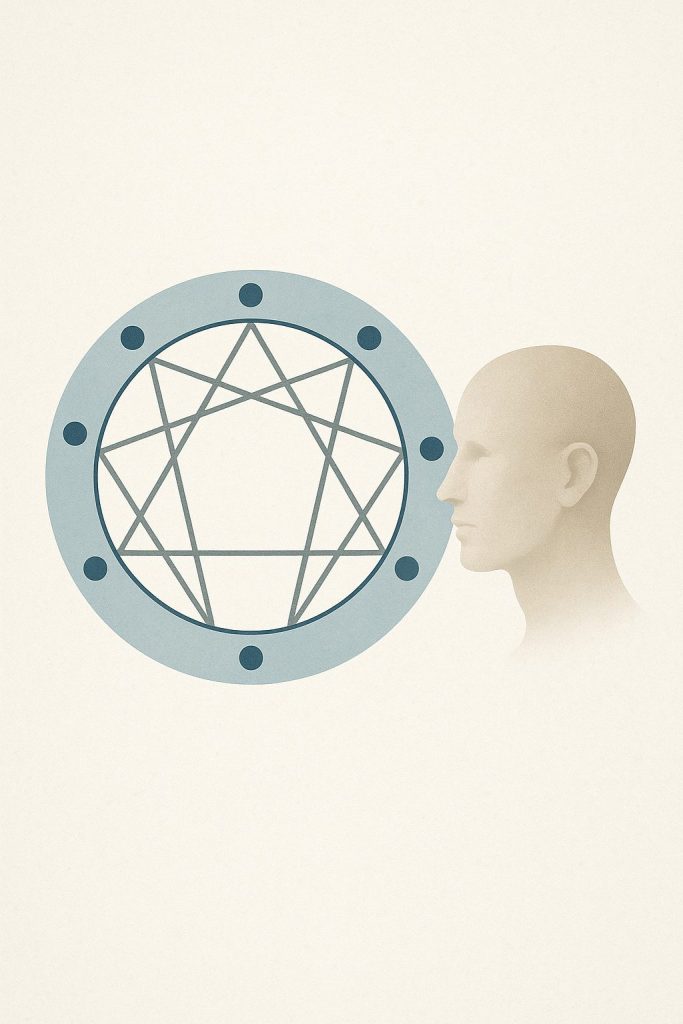
The system is usually represented by a diagram shaped around nine points connected by arrows, with each point naming a particular pattern of human behaviour and each line suggesting the interactions between those inner forces.
One reason the model continues to fascinate people is that it speaks to something most of us recognise instinctively: we do not simply act, we repeat ourselves. We return to familiar emotional postures, familiar fears, familiar ways of seeking reassurance or control. The Enneagram tries to give shape to those repetitions. It suggests that beneath our choices there are preferred strategies for coping, belonging, protecting ourselves and making sense of the world. Whether one accepts the model fully or only in part, that basic intuition is often what makes it feel immediately compelling.
Over time, the Enneagram has moved well beyond specialist circles. It now appears in management, recruitment and therapeutic settings, and has generated a vast market of books, DVDs and training courses. Its origins, however, remain uncertain. Some trace it back as far as 4,500 years to Babylon, Greece or Persia; others link its development to the Sufis. What seems clearer is that the psychologist Oscar Ichazo and the psychiatrist Claudio Naranjo helped adapt it to contemporary psychology in the 1960s. Since then, many American psychologists have used it alongside certain forms of therapy, while recruiters and business coaches have also adopted it.
Specialists often insist that the more it is practised, the more complex, rich and precise it becomes. The nine Enneagram types, or enneatypes, are generally placed within a circle, a symbol of unity, to suggest that there are several possible ways of seeing the world and engaging with it. As the Institut de formation en Psychothérapie, via approchepearl.com, explains, the diagram serves as a framework for understanding the automatisms human beings develop from early childhood in order to make sense of the world, connect with others and find their place within it.
That movement from ancient symbol to modern self-observation partly explains both its reach and its ambiguity. Some people encounter the Enneagram through serious therapeutic work; others meet it through a quick online test, a workplace seminar or a social media post that flattens it into a personality quiz. The difference matters. In careful hands, it can become a language for noticing motive, defence and blind spot. In careless hands, it becomes little more than a neat story people tell about themselves because it feels flattering, dramatic or reassuring.
A tool for self-knowledge, but not a licence for simplification
Used with care, this approach can offer useful tools for reading both our own behaviour and that of the people around us. That is why newcomers often ask the same practical questions: how can it be used in everyday life, can it help me change, what are the nine enneatypes, and can I really recognise myself through them? Yet any serious use of the Enneagram has to leave room for individual uniqueness. No one sees the world except through the filter of their own experience and knowledge. These nine maps should therefore be treated as windows rather than boxes: a way of exploring hidden potential, not of reducing a person to a label.
At its best, the Enneagram does not merely describe what we do, but helps us ask why we do it, with the hope of moving towards greater self-understanding, wellbeing and fulfilment.
That distinction is more than a matter of tone. It changes the whole way the model is used. If someone says, “I am this type, so that is just how I am,” the Enneagram has already become a defence against growth. If, on the other hand, it helps a person notice the motive beneath the behaviour — the need to be admired, the fear of being controlled, the habit of withdrawing, the urge to keep peace at any cost — then it can open a more honest conversation with oneself. In that sense, the real value of the system lies less in classification than in self-observation.
For many people, that self-observation begins in very ordinary moments. It may appear in the way one reacts to criticism, in the need to be right during conflict, in the impulse to rescue others, in the tendency to overwork, please, retreat or anticipate disaster. These are not abstract traits; they are lived patterns. The Enneagram can be useful precisely because it invites us to look at those patterns without immediately excusing them. It asks where they come from, what they protect, and what they cost.
That promise does not remove the need for discernment. The Enneagram is often said to rest on nine major tendencies that echo themes found across many traditions and cultures: gluttony, anger and pride, lust and sloth, deceit and envy, greed and fear. Its popularity has brought lively debate, abundant training and countless books, but also a fair amount of nonsense. Some criticisms, whether spiritual, gnostic or otherwise, are justified; others are far less so. Its misuse by sectarian groups has also clouded public judgement. For some observers, it has become a syncretic and ambiguous system, too easily exploited by New Age movements, institutes, pseudo-therapists or unscrupulous coaches.
Even so, if the Enneagram can be examined and assessed for its conceptual relevance and practical effectiveness, then it deserves to be approached with research, tact and personal judgement rather than dismissed outright. A closed, ideological refusal to consider any method of self-knowledge helps no one. As Émile de Girardin wrote in Pensées et maximes (1867): “Quiconque a porté les mains sur la liberté n'a plus le droit de la revendiquer.”
It is also worth saying plainly that not every practitioner uses the Enneagram with the same seriousness. Some teach it as a reflective discipline that requires patience, humility and ethical care. Others package it as certainty. That is often where the trouble begins. Any method that claims to reveal the truth of a person too quickly should be approached with caution. Human beings are more contradictory than that, and any worthwhile inner work has to make room for contradiction, change and mystery.
- Use it to question motives, not to freeze identity.
- Keep its strengths in view, but stay alert to its limits and misuses.
- Favour personal discernment over blind enthusiasm or blanket rejection.
Using the Enneagram Without Losing Your Sense of Self
A tool for insight, not a label to hide behind
The Enneagram attracts a great deal of curiosity, and it is easy to see why. People want to know how to use it in everyday life, whether it can help them change, what the nine enneatypes are, and whether these personality patterns can genuinely help them understand themselves. Used with care, the model can offer practical ways to observe both our own reactions and the behaviour of those around us. It can help us notice recurring mechanisms, emotional reflexes and ways of relating that often operate beneath the surface.

In practice, that may mean pausing before a familiar reaction hardens into certainty. Why did that remark sting so much? Why does silence from another person feel unbearable to one individual and relieving to another? Why does one person move quickly into action while someone else delays, appeases or disappears inwardly? The Enneagram does not answer every question, but it can sharpen the quality of the questions we ask. And often that is where genuine change begins: not in dramatic revelation, but in a quieter, more exact form of noticing.
But that usefulness only holds if we remember something essential: no system should erase personal uniqueness. Each of us sees the world through the filter of our own history, knowledge and experience. The Enneagram may have real strengths, yet it also has limits, and those limits should never become obstacles to personal growth. These nine maps are best treated as windows rather than boxes: a way of exploring hidden or underused potential, and of understanding not only what we do, but why we do it. In that sense, it can become a source of motivation, discovery and more conscious self-development.
There is a particular maturity in using the Enneagram lightly but seriously. Lightly, because no typology should become an identity prison. Seriously, because if we are willing to look honestly at our habits, the insights can be uncomfortable in a useful way. We may discover that what we call kindness is sometimes a need to be needed, that what we call independence can hide distrust, or that what looks like strength may be a refusal to feel vulnerable. A good framework does not flatter us; it helps us see ourselves with a little more truth.
It can also improve the way we relate to others, provided we resist the temptation to type everyone in the room. The point is not to become an amateur diagnostician. It is to grow in patience. When we understand that people are often acting from deeply ingrained fears, loyalties and protective habits, we may become less reactive and more curious. That does not excuse harmful behaviour, but it can soften the speed with which we judge it.
- to spot habitual patterns
- to understand deeper motivations
- to support more thoughtful personal growth
Why the Enneagram divides opinion
The appeal of the Enneagram also explains why it attracts so much noise. Books, courses, debates and online content are everywhere, but so are distortions and outright nonsense. The model is often linked to nine major tendencies that echo themes found across many traditions and cultures: gluttony, anger and pride, lust and sloth, deceit and envy, greed and fear. At the same time, it has drawn criticism from spiritual and gnostic circles, sometimes fairly, sometimes less so. Its misuse by sectarian groups has also clouded public judgement, and for some critics it has become a syncretic, permanently ambiguous framework, too easily exploited by New Age movements, institutes, pseudo-therapists or unscrupulous coaches.
Part of the division comes from the fact that the Enneagram sits at an awkward crossroads. It is not quite a clinical instrument, not quite a spiritual teaching, not quite a philosophical anthropology, and not merely a popular personality system either. That in-between status makes it fertile ground for both serious reflection and exaggerated claims. People often want it to be more definitive than it is. They want certainty, a clean explanation, a reliable key to themselves and others. The Enneagram can tempt that desire, even though its wiser practitioners usually warn against it.
Another reason it divides opinion is that it touches something intimate. To speak about motivation is to move closer to the hidden reasons behind our behaviour, and that can feel exposing. Many people are comfortable discussing traits; fewer are comfortable examining the fear, vanity, resentment, hunger or avoidance that may sit underneath them. The Enneagram can therefore provoke resistance not only because of its history or misuse, but because it asks for a kind of honesty that is not always comfortable.
That is precisely why discernment matters. If, as some argue, “the Enneagram can be analysed and evaluated for its relevance and effectiveness both conceptually and in practice”, then it deserves neither blind devotion nor automatic dismissal. A more honest approach is to look into it carefully, test its value with nuance, and resist reductive conclusions. Too often, methods of self-knowledge are rejected less on evidence than on ideology or personal bias. Yet freedom of judgement matters here as much as rigour.
As Émile de Girardin wrote in Pensées et maximes (1867): “Quiconque a porté les mains sur la liberté n'a plus le droit de la revendiquer.” In other words, before condemning a method outright, it is wiser to examine it seriously, and to leave room for informed personal choice.
None of this means suspending critical thought. On the contrary, critical thought is what protects the Enneagram from becoming either dogma or caricature. It is sensible to ask who is teaching it, on what basis, with what claims, and to what end. It is sensible to notice when a framework is being used to deepen self-knowledge and when it is being used to sell certainty. The difference is not trivial. One invites reflection; the other invites dependence.
- useful when approached critically
- misleading when turned into dogma
- best judged with both openness and caution
The Mental Waves Self-Observation Framework
The Mental Waves frame is to use typology as a mirror, not a verdict. A personality model becomes useful when it helps you notice habits, fears and automatic reactions with less judgement.
Before trying to identify a type, slow down enough to observe yourself honestly. Notice what repeatedly pulls your attention, what you avoid, and what kind of inner tension returns under pressure.
Before using personality work for self-reflection, the free Mental Reset session can help create a quieter starting point.
Editorial note from Mental Waves
This article uses the enneagram as a self-reflection framework, not a clinical assessment or a fixed identity. Mental-health questions belong with qualified professionals.
Conclusion
The Enneagram can be useful precisely because it does not have to be taken as a verdict. At its best, it offers a language for noticing our habits, our defences and the deeper motives that quietly shape the way we move through life. That is where its value really lies: not in boxing a person into a type, but in helping them ask more honest questions about why they react, strive, withdraw or repeat the same patterns.
There is something quietly liberating in that shift. When we stop treating personality as fate, we begin to see that many of our most familiar reactions are learned adaptations rather than fixed truths. The Enneagram, used well, can help bring those adaptations into view. It does not remove the work of change, but it can make that work more conscious, and sometimes more compassionate too.
That said, the caution matters just as much as the promise. The Enneagram has inspired serious reflection, but it has also been oversimplified, commercialised and, at times, misused by people with more certainty than discernment. So the sensible position is neither blind enthusiasm nor automatic dismissal. It is to approach it with curiosity, perspective and respect for what no system can fully contain: the singularity of a human being.
Perhaps that is the most balanced way to hold it. Let it illuminate patterns, but do not let it speak over lived experience. Let it sharpen perception, but not replace judgement. Let it offer language, but not the final word. Any tool for self-knowledge is only as good as the honesty, freedom and humility with which it is used.
Used well, it is not a cage but a window.
Frequently Asked Questions About the Enneagram
What is the Enneagram meant to describe?
The Enneagram is presented as a model of human personality built around nine recurring ways of seeing the world and relating to it. It is usually shown as a nine-pointed diagram, with each point representing a behavioural pattern and the connecting arrows suggesting interactions between those inner forces.
Does the Enneagram reduce people to just one personality type?
No, it is not meant to flatten a person into a single label. One profile may be more dominant, but the broader idea is that the different patterns can coexist within us. It works best when used as a guide to understanding tendencies, not as a rigid identity.
Why do people say the Enneagram is more complex than it first appears?
Its basic structure looks simple, which is part of its appeal, but the method is often described as becoming richer and more precise with practice. The focus is not only on outward behaviour, but on the deeper motivations, automatisms and relational patterns that shape how someone responds to life.
Where does the Enneagram come from?
Its origins are debated and remain unclear. It is often linked to ancient traditions associated with Babylon, Greece, Persia and later Sufi thought, but there is no single agreed history. In modern psychology, Oscar Ichazo and Claudio Naranjo are widely associated with adapting it in the 1960s.
How is the Enneagram used today?
It is used in several settings, including therapy, coaching, recruitment and management. Some practitioners use it to explore recurring reactions, ways of relating and underlying motivations. Its use varies widely, which is why careful judgement matters when deciding how seriously to take a particular interpretation.
Can the Enneagram help with self-understanding in everyday life?
Yes, it can be useful for noticing habitual reactions and asking why certain patterns keep repeating. Its value lies less in naming what you do and more in helping you examine the motives behind it. Used thoughtfully, it can support self-knowledge without replacing personal reflection.
What are the limits of the Enneagram?
Its limits appear when it is treated as a fixed truth or used to box people in. Personal uniqueness still matters, and no system can fully capture an individual life. It can offer useful insight, but it should remain a window for exploration rather than a final verdict on who someone is.
Why is the Enneagram controversial?
It attracts criticism because it has been oversimplified, commercialised and sometimes misused. Some objections come from spiritual or gnostic perspectives, while others focus on its use by sectarian groups, pseudo-therapists or unscrupulous coaches. That mixed reputation makes discernment essential when engaging with it.
What are the nine tendencies linked to the Enneagram in this approach?
They are presented as nine major tendencies found across many traditions and cultures: gluttony, anger, pride, lust, sloth, deceit, envy, greed and fear. These are not framed as neat labels to wear, but as recurring human tendencies that can help illuminate deeper motives and patterns.