en
enVotre panier est vide.



Meditation is often approached as a mental or spiritual practice that asks for patience, discipline and, in many cases, a long period of learning. Yet it is also widely sought for very practical reasons: it may help reduce stress, support attention and concentration, encourage a calmer emotional state and contribute to a clearer relationship with intrusive or unhelpful thoughts. In other words, its appeal is not only philosophical. It also lies in the way it can reshape everyday experience, from mental fatigue to the simple need to feel more settled.
In short: meditate at home
Meditating at home becomes easier when the practice is small, repeatable and protected from unnecessary pressure.
Use this article as a practical map: keep what helps attention become steadier, question anything that sounds absolute, and connect the idea back to repeatable daily practice.
For many people, the main obstacle is not a lack of interest but the impression that meditation must be difficult, highly technical or reserved for those with years of practice. Home-based methods matter precisely because they lower that threshold. When the practice becomes easier to begin, easier to repeat and easier to integrate into ordinary routines, consistency often becomes more realistic, and consistency is usually more important than intensity in the early stages.
What makes meditation at home more accessible today is the development of sound-based technologies designed to support relaxation and shifts in mental state. Already widely used in North America, though still less familiar in France, these approaches draw on the observation that the brain is continuously active and associated with different patterns of brainwave activity depending on whether we are alert, relaxed, dreaming or deeply asleep.
By using carefully structured auditory stimulation such as binaural, monaural or isochronic sounds, it may become easier to move from an active state towards the calmer alpha range often associated with relaxation and meditation, and in some cases towards deeper states, without turning the practice into something complicated, costly or tied to any religious framework.
That does not mean sound alone automatically produces meditation in a complete sense. Rather, it may help create conditions in which attention settles more readily, bodily tension decreases and the mind becomes less scattered. For beginners especially, that shift can make the difference between an abstract intention to meditate and a practice that genuinely feels possible at home.
Why sound-based meditation can make home practice easier
A more accessible way to begin meditating at home
Meditation is often valued for its wide range of benefits. It may support concentration and attention, contribute to clearer cognitive functioning, encourage more positive emotional states, and help reduce stress or quieten intrusive thoughts. Many people also seek it out for the sense of inner calm it can bring. The difficulty, however, is that traditional approaches often involve a long period of learning before meditation feels natural. Sound-based technologies offer another route: they can help people meditate at home more easily, without complicated rituals or expensive equipment, by creating conditions that are more favourable to relaxation, alertness and creativity.

These methods are already widely used in North America, while remaining less familiar in France. Their appeal lies in the fact that they can be used by beginners, regular practitioners and more experienced meditators alike. The principle behind them is linked to brain waves. The brain is constantly producing electrical activity, and its dominant rhythms tend to vary according to the mental state involved. Through carefully designed auditory stimulation, it is possible to guide and organise this activity more deliberately, making access to meditative states feel more immediate and more approachable at home.
One reason this can be helpful is that many beginners struggle less with willingness than with mental momentum. After a day of work, screens, noise and fragmented attention, simply sitting quietly can feel unexpectedly difficult. Sound-based support may reduce that initial friction by giving the mind a stable sensory anchor. Instead of trying to force silence, the listener follows a structured auditory pattern, which can make the transition into stillness feel less abrupt.
- Gamma waves are associated with creativity.
- Beta waves correspond to active wakefulness, daily activity and concentration.
- Alpha waves are linked with relaxation, calm and meditation.
- Theta and delta waves are associated respectively with deep meditation, dreaming, hypnosis, and deep sleep.
These categories should be understood as broad associations rather than rigid compartments. Real brain activity is dynamic and complex, and several rhythms may coexist at once. Even so, the framework remains useful because it offers a practical way to think about why certain forms of sound may be experienced as calming, focusing or conducive to inward attention.
How auditory stimulation works with different mental states
This approach is based on a simple observation: our mental state is not fixed. In broad terms, gamma activity is associated with creativity; beta with active wakefulness and focused everyday attention; alpha with relaxation, calm and meditation; theta with dreaming, deep meditation, hypnosis and the synchronisation of the two hemispheres; and delta with deep sleep, states often associated with recovery and immune regulation. In that sense, meditation can be understood as a way of gradually shifting the brain from one dominant rhythm to another, especially from a busy beta state towards the calmer alpha range.
Sound stimulation is used here to support that transition. By listening to specifically designed audio, the brain may begin to follow the frequency patterns being presented, which can help the listener settle progressively into a more relaxed and meditative state. This is the basis of binaural, monaural and isochronic methods. Rather than requiring years of practice before reaching an alpha state, these tools aim to make that shift more accessible, and from there potentially open the way towards deeper theta meditation. The underlying idea is not mystical but practical: using sound to influence attention, perception and internal regulation in a structured way.
From a lived perspective, this often feels less dramatic than the terminology suggests. The change may simply appear as slower breathing, reduced mental chatter, a softer sense of effort or a clearer awareness of bodily sensations. Those modest shifts matter because meditation rarely begins with a spectacular altered state. More often, it begins with a small but meaningful reduction in cognitive noise.
It is also worth distinguishing between relaxation and meditation. Relaxation is often a gateway, but it is not identical to meditation itself. A person may feel physically calm without becoming especially attentive, and conversely may meditate with alertness rather than drowsiness. Sound-based methods are therefore best understood as tools that may support entry into a more favourable state, not as substitutes for awareness, intention or regular practice.
Using binaural and isochronic sounds to reach a meditative state
How sound can help the mind shift into meditation
Meditation can help influence brain activity in ways that are often associated with relaxation. With binaural, monaural or isochronic sounds, the practice becomes especially simple at home: you sit comfortably in an armchair, let the body settle, and listen. As the brain responds to the rhythm and frequency of the sounds, this auditory stimulation may gradually support a calmer mental state and make meditation easier to enter. In practical terms, meditation is often linked to a shift from the active beta state, associated with everyday alertness and concentration, towards the more relaxed alpha state.
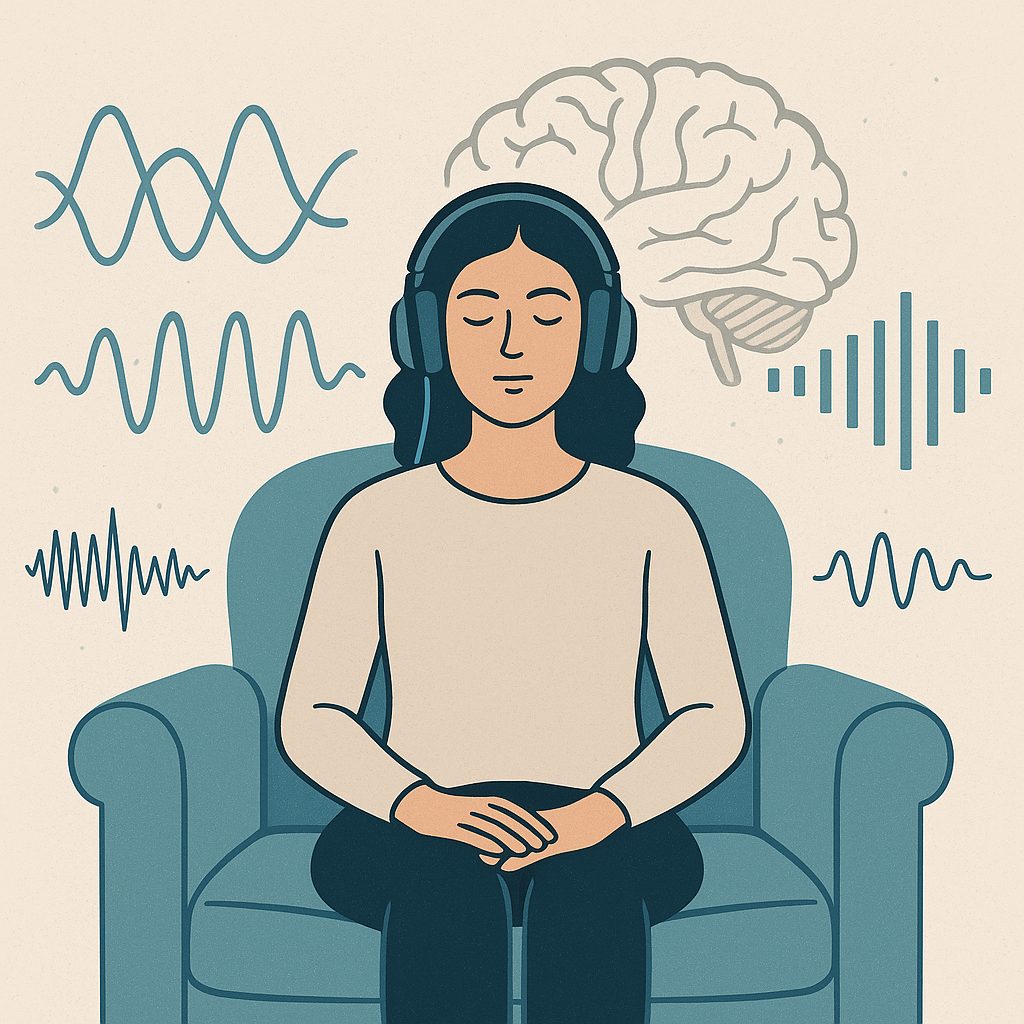
With traditional approaches, reaching this alpha level can take a long period of training. Sound-based methods aim to make that transition more accessible by encouraging the brain to adjust its dominant frequencies more quickly and more naturally. From there, some listeners may also move towards theta, a state often associated with deeper meditation, dreamlike imagery and a different quality of inner attention. The principle is not mystical or medical: it is a form of non-medical audio stimulation designed to support mental regulation through carefully structured sound.
In practical use, this means the listener does not need to perform complicated mental exercises from the outset. The first task is simply to remain present with the listening experience. For people who find silent meditation frustrating because the mind wanders constantly, this can be a more approachable starting point. The sound gives attention somewhere to rest, while still leaving space for inward observation.
Some people notice that thoughts do not disappear, but become less gripping. Others find that the body relaxes before the mind does, and that mental quiet follows only after several minutes. Both responses are entirely plausible. Meditation at home is rarely about instant control; it is more often about allowing the nervous system and attention to settle in stages.
Related offer
OM Meditation
This music is based on the particular frequency of the sacred chant OM. Listening to this program, the term...
View productWhy precise audio patterns matter
Binaural, monaural and isochronic tones are based on sound pulses arranged with precision. Their role is to guide the brain progressively towards particular states of consciousness by using specific frequencies, controlled variations and carefully timed changes in duration. In this context, these sounds are often described as helping to synchronise the two cerebral hemispheres, while supporting a gradual move towards altered states of awareness linked to relaxation and meditation.
What matters most is the way the sounds are composed. When the frequencies are organised correctly, they can act directly on perceived rhythm and attention, and may help train the brain towards a chosen mental level. This is why these methods are often presented as a practical complement to more traditional meditation techniques: they do not replace inner practice, but they can make the first stages of settling, relaxing and deepening attention feel more immediate and more approachable.
Precision matters because the effect is not only about hearing a pleasant background sound. It depends on timing, contrast, repetition and the way the auditory system detects pattern. A loosely assembled track may still be enjoyable, but a carefully designed one is more likely to provide a stable framework for attention. In that sense, the quality of the recording is part of the method rather than a secondary detail.
There is also a useful distinction between listening passively and listening intentionally. Passive listening may be soothing, but intentional listening tends to deepen the practice. When the listener notices the pulse, the texture of the sound and the gradual changes in internal state, the experience becomes more than background relaxation. It becomes a form of guided attentional training.
- Binaural sounds rely on slightly different frequencies presented to each ear.
- Monaural sounds combine pulses into a single auditory signal.
- Isochronic tones use regular, distinct pulses designed to be clearly perceived.
Each format may suit different listeners. Some prefer the subtlety of binaural beats, while others respond better to the clearer rhythmic structure of isochronic tones. Personal preference matters because comfort and adherence influence whether a practice is maintained over time. The most effective method is often the one a person is willing to use regularly and attentively.
A practical and reassuring way to meditate at home
Simple conditions for a regular practice
When these sounds are arranged correctly, they may act directly on brainwave activity and help guide the brain towards a particular mental state. In practice, the method is deliberately simple: sit somewhere comfortable, close your eyes, and listen using a good-quality pair of headphones or speakers. That simplicity makes it easier to build meditation into everyday life, without needing complex rituals, expensive equipment or a long period of technical training.
This approach can be used daily and independently of any religion, which is one reason many people find it accessible. The aim is not to force the mind, but to create favourable conditions for relaxation, inner calm and, in some cases, deeper meditative states at home. For people who want a more direct entry point into meditation, sound-based practice can offer a practical alternative to methods that may otherwise take years to master.
Regularity is often easier to sustain when the environment is prepared in advance. A quiet chair, a consistent time of day and a familiar recording can reduce decision fatigue and help the practice become automatic. Even short sessions may be worthwhile when repeated consistently. Ten or fifteen minutes of genuine attentiveness can be more useful than occasional long sessions approached with strain.
- Settle into a comfortable chair or seat
- Close your eyes to reduce distractions
- Use quality headphones or speakers for clearer sound delivery
It may also help to treat the first few minutes as a settling period rather than expecting immediate depth. Let the jaw soften, allow the shoulders to drop, and notice the contact of the body with the chair. These simple adjustments can support regulation of arousal and make the listening experience more effective. In many cases, meditation becomes easier when the body is no longer subtly braced against the day.
Why this method is considered gentle and accessible
The principle behind brainwave entrainment is based on frequencies that are already part of ordinary human experience, rather than on an invasive or medical intervention. For that reason, it is generally presented as a non-medical audio technique that may help you explore different levels of awareness when you choose to do so. Used in a calm and sensible way, it is often sought for its ease, its low cost and the sense of autonomy it gives to beginners as well as more experienced listeners.
Listening to binaural or isochronic recordings at home may therefore help you move towards deep meditation in a way that feels both straightforward and reassuring. It offers a way to practise regularly, at your own pace, and without turning meditation into something intimidating or inaccessible. If you would like to continue, you can explore our downloadable CDs of isochronic and binaural sounds, specially designed to make meditation easier to approach at home.
The reassuring aspect of this method also lies in its reversibility and simplicity. You remain seated, awake and in control of the session. If the sound does not suit you, you can stop, adjust the volume or try a different format. That sense of agency is important, particularly for people who are curious about meditation but wary of approaches that seem obscure or overly demanding.

Related offer
Meditation - Relaxation set
All the Mental Waves® know-how in a single pack for quick and easy access to meditation and...
View productAt the same time, gentle does not mean trivial. A practice can be simple without being superficial. When used attentively, sound-based meditation may support emotional regulation, reduce the felt intensity of mental overload and create a more stable platform for reflection or rest. Its value often lies not in dramatic transformation, but in repeated small shifts that accumulate over time.
The Mental Waves Home Meditation Framework
The Mental Waves frame is to make the first minutes easy enough to repeat. A home practice does not need a perfect room; it needs a clear cue, a modest duration and a reliable way back when attention wanders.
Sound can help mark the transition into practice. Keep the volume comfortable, choose a short session, let the body settle, and finish with one ordinary action so meditation connects back to daily life.
If starting feels harder than continuing, use the free Mental Reset session as a short doorway into home meditation.
Editorial note from Mental Waves
This article presents meditation as a general self-care practice. It is not medical or psychological treatment, and persistent distress should be discussed with a qualified professional.
Conclusion
Meditating at home does not have to mean mastering a demanding discipline from the outset. What this approach offers is something more practical: a way of creating conditions that may support relaxation, attention and a quieter mental state through carefully structured sound. In that sense, the value is not that technology replaces meditation, but that it can make the first steps more accessible and the experience more consistent for beginners as well as more experienced listeners.
That balance matters. Sound-based methods such as binaural, monaural or isochronic stimulation are presented here not as a miracle solution, but as a gentle tool for influencing the conditions associated with certain mental states, particularly those linked to calm and inward focus. Used simply, comfortably and regularly, they can make meditation at home feel less abstract, less intimidating and more immediately available. Sometimes, a quieter mind begins with a more accessible doorway.
For anyone who has postponed meditation because it seemed too difficult, too slow or too uncertain, this approach offers a credible middle path. It respects the complexity of attention and consciousness while still remaining practical. You do not need to adopt a doctrine or transform your life overnight. You simply need a quiet moment, a comfortable seat and a method that helps the mind become a little less busy and a little more available.
Frequently asked questions about meditating at home with sound-based methods
How can sound-based meditation make it easier to meditate at home?
Sound-based meditation uses carefully structured audio to help the mind move from an active state towards a calmer one. That can make meditation feel more accessible at home, especially for people who find traditional methods difficult or slow to learn. The practice is simple, does not require complex rituals, and can suit beginners as well as more experienced meditators.
What are binaural, monaural and isochronic sounds?
Binaural, monaural and isochronic sounds are forms of auditory stimulation designed to influence mental state through precise sound pulses. Binaural sounds use slightly different frequencies in each ear, monaural sounds combine pulses into one signal, and isochronic tones use regular, clearly marked pulses. Each method aims to support relaxation and meditation through structured listening.
Which brainwave states are linked to relaxation and meditation?
Alpha waves are linked to relaxation, calm and meditation, while theta waves are associated with deeper meditation, dreaming and hypnosis. Beta waves relate to active wakefulness and concentration, gamma waves to creativity, and delta waves to deep sleep. In this approach, meditation begins as the mind shifts from beta towards alpha, and sometimes further into theta.
Do you need years of practice to reach a meditative state at home?
No, sound-based methods are presented as a way to make meditation more immediate. Traditional techniques may take a long time before reaching the alpha state associated with relaxation and meditation, but binaural, monaural and isochronic sounds are used to help the brain move towards that state more quickly and naturally through listening.
What do you need to practise this kind of meditation at home?
A comfortable seat, closed eyes and good-quality headphones or speakers are enough to begin. The method is deliberately simple: sit comfortably, listen, and let the sound guide your attention towards a calmer state. It does not depend on expensive equipment, which makes it easier to practise regularly in everyday life.
Is this type of meditation connected to a religion?
No, this form of meditation can be practised independently of any religion. It is presented as a practical, sound-based method for encouraging relaxation, inner calm and deeper attention. That makes it accessible to people who want a meditative practice at home without adopting a spiritual or religious framework.
Is sound-based meditation described as safe to use at home?
Yes, it is described as a non-medical audio technique that uses frequencies already present in ordinary life. For that reason, it is presented as a gentle and accessible way to explore different levels of awareness at home. The emphasis is on calm, regular use rather than on any invasive or medical intervention.
Can this method help with stress, concentration and intrusive thoughts?
Yes, meditation is described as helping to reduce stress, support concentration and attention, improve cognitive functioning, encourage more positive feelings and quieten harmful or intrusive thoughts. Sound-based methods are used to create conditions that may make those effects easier to access by helping the mind settle into a calmer state.
Can beginners use binaural or isochronic sounds, or are they only for experienced meditators?
Beginners can use them, and so can regular or experienced meditators. One of the main advantages of this approach is that it offers a more direct entry point into meditation without requiring long technical training first. That makes it useful for people starting out as well as for those who already have an established practice.