en
enVotre panier est vide.


Most of us know the feeling of wanting life to soften a little: to breathe more easily, to feel less hemmed in by stress, to find some steadiness again. What makes yoga, meditation and tai chi so compelling is that they may offer more than a fleeting sense of calm. Emerging research suggests these mind-body practices could help counter some of the biological effects of stress and depression, including the inflammatory responses linked to the way our genes are expressed.
That idea deserves both interest and caution. A review published in Frontiers in Immunology, drawing on work analysed by British and Dutch researchers over more than a decade, points to lower signs of inflammation among people who practise these disciplines. The suggestion is not that they magically erase suffering, but that regular breathing, movement and concentration may help interrupt the damaging cycle set off by repeated stress or depressive episodes. It is a promising hypothesis rather than a final verdict, yet it opens up a striking possibility: that relatively simple daily habits might support the body as well as the mind.
There is something quietly reassuring in that. When stress has become chronic, or when low mood has settled in for longer than we would like to admit, the body can begin to feel as though it is no longer entirely on our side. Sleep becomes lighter, patience shorter, recovery slower. Practices such as yoga, meditation and tai chi are often spoken about as though they belong only to the realm of wellbeing, but the research hints at something more grounded: they may help the body shift out of a state of constant internal alarm.
In short: how can yoga, meditation and tai chi support stress?
Yoga, meditation and tai chi can support stress by combining breath, attention, posture and slow movement. Their value is strongest when the practice is short, regular and adapted to the person's body and emotional state.
- Yoga can reconnect breath, posture and body sensation.
- Meditation can train attention and reduce automatic reactivity.
- Tai chi can bring calm through slow coordinated movement.
- Fifteen minutes can be enough when repeated consistently.
For a short guided reset, try the free Mental Reset Session. For a wider stress guide, read How to Free Yourself from Stress.
That does not make them a substitute for proper medical care, nor does it mean every person will respond in the same way. But it does give these disciplines a seriousness they are sometimes denied. For many people, the first benefit is simply the return of a little space — a pause between stimulus and reaction, a breath before the mind runs away with itself. If that pause also carries measurable effects in the body, then their value is greater than many of us once assumed.
How Yoga, Meditation and Tai Chi May Help Protect the Body
Practices that work on both mind and body
What makes yoga, meditation and tai chi so compelling is that they do more than help us feel calmer in the moment. In the study in question, these three approaches are grouped under the label “mind-body interventions”: practices that use breathing, attention and gentle, repeated movement to influence the way the body responds to strain. Put simply, the idea is not just to soothe the mind, but to help the body step out of a stress pattern that has become too deeply ingrained.
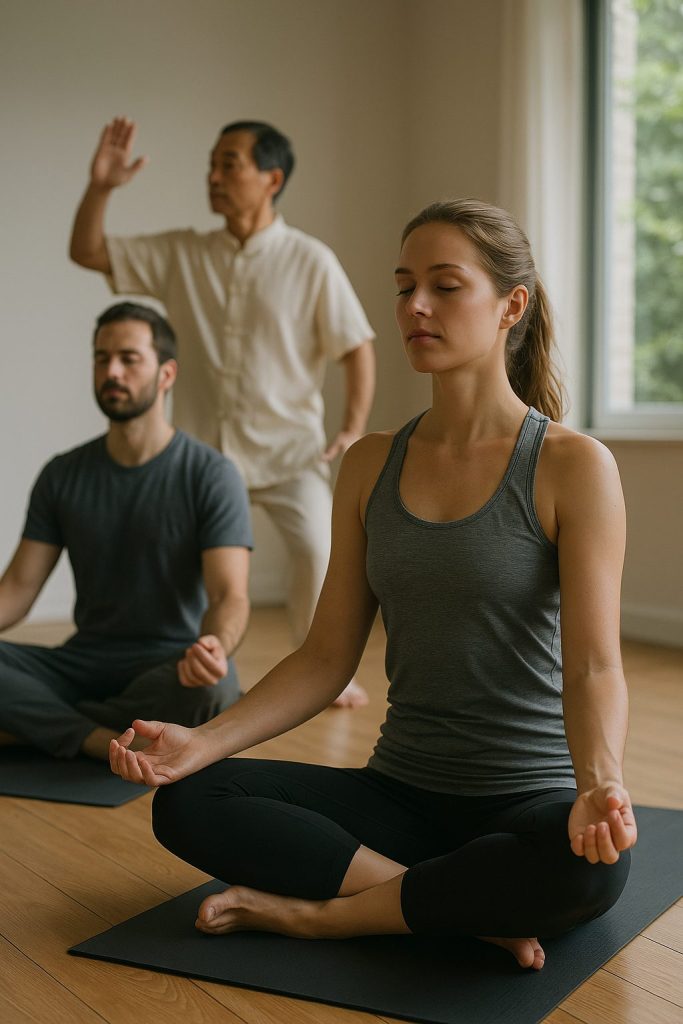
That may sound almost too good to be true, as though the body could simply wipe the slate clean and start again. Yet this is precisely the hypothesis being examined. According to the study published on 16 June in the American journal Frontiers in Immunology, yoga, meditation and tai chi may reduce the expression of genes linked to the spread of inflammation. And that matters, because inflammation becomes chronic and damaging when the body is repeatedly exposed to stress or to several episodes of depression.
- breathing exercises
- focused attention
- regular, calm practice
What these practices share, despite their obvious differences, is a way of bringing the nervous system back into a more regulated rhythm. Yoga may do it through posture and breath, tai chi through slow, deliberate movement, meditation through stillness and sustained attention. The route varies, but the destination appears similar: less physiological agitation, less reactivity, and perhaps a lower inflammatory burden over time.
That is part of why they can feel so different from more forceful forms of self-improvement. They do not demand that the body perform at its limit. They ask for presence, repetition and a willingness to stay with simple actions long enough for them to have an effect. For people already worn thin by stress or depression, that gentler entry point matters more than it may first seem.
A promising hypothesis, though not a final verdict
The underlying idea is that stress and depression trigger a molecular reaction in human DNA, one that increases inflammatory activity in the body. If these disciplines can help reverse that reaction, they may also help lower the risk of illnesses associated with long-term inflammation. In that sense, meditation is not being presented here as a vague wellbeing ritual, but as a practice that could have measurable biological effects.
That said, it is important to keep a sense of proportion. The findings are encouraging, but they do not amount to absolute proof. For now, this remains a strong and hopeful hypothesis, not a final conclusion. Still, the prospect is striking: simple daily practices, built around concentration and breath, may do more than bring relief in the moment — they may also help the body repair some of the wear caused by stress and depression over time.
That distinction matters. It is easy to overstate early findings, especially when they align with what many people already feel intuitively after practising. Yet good science asks for patience. The most sensible reading is neither cynical nor credulous: these disciplines are not instant solution, but neither are they merely decorative habits with no real depth. They sit in that more interesting middle ground where subjective relief and biological change may meet.
For readers living with persistent stress, this can be a useful way to think about them. You do not need to believe that a breathing practice will transform your life overnight in order to take it seriously. It is enough to recognise that the body responds to repeated experience, and that calm, attentive repetition may gradually become one of those experiences.
What Stress Does in the Body — and Why These Practices May Help
A clearer picture of the inflammatory chain reaction
British and Dutch researchers reviewed 18 studies covering 846 cases over 11 years. Their conclusion was striking: people who practised yoga, meditation or tai chi tended to show fewer signs of inflammation and produced fewer inflammatory proteins. In other words, these disciplines do not simply help people feel calmer in the moment; they may also influence some of the biological processes through which stress and depression wear the body down over time.
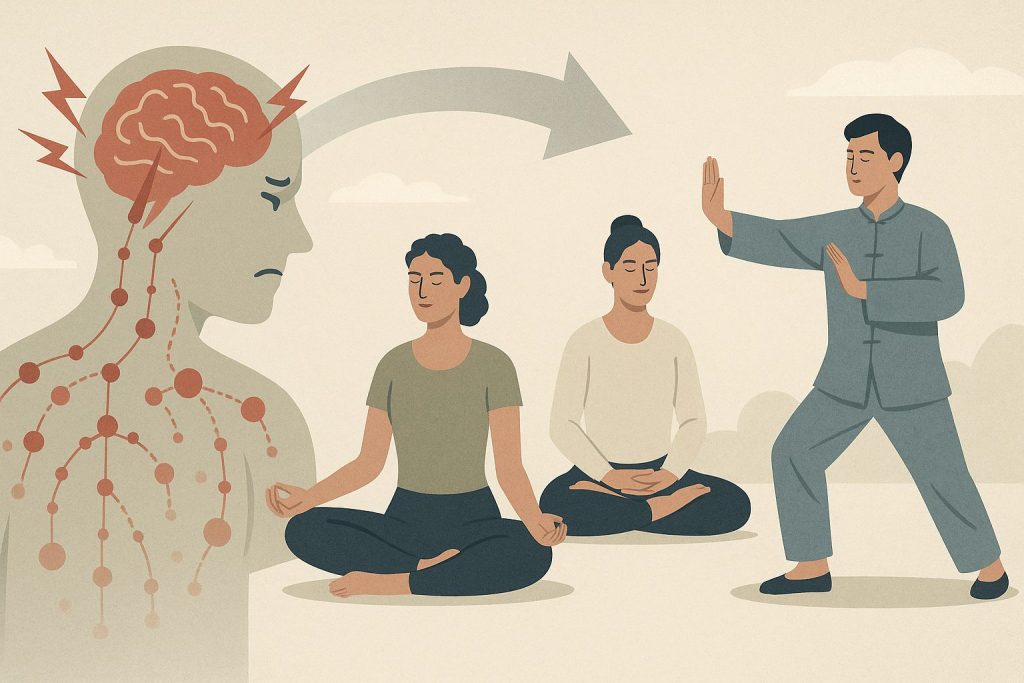
One of the mechanisms highlighted in the review involves the sympathetic nervous system, which switches on when we are under pressure. That response increases the production of a molecule called NF-kB, which then activates genes linked to the production of inflammatory proteins, or cytokines, in the body’s cells. This is not, in itself, a bad thing. In small doses, it is a useful defence response. The problem begins when stress or depressive episodes become repeated and prolonged: what should be a short-term protective reaction can turn into a chronic inflammatory state.
- Stress activates the sympathetic nervous system
- That raises NF-kB activity
- NF-kB promotes inflammatory cytokines
Anyone who has lived under sustained pressure will recognise something of this, even without the scientific language. The body stops behaving as though the threat has passed. Muscles remain braced, thoughts stay vigilant, rest no longer restores in the same way. What the research offers is a biological frame for that familiar experience: prolonged stress is not only felt emotionally, it is also translated into physical processes that can keep the body on edge.
Seen in that light, mind-body practices are not simply about “relaxing” in the casual sense of the word. They may help interrupt a chain reaction that has become too habitual. A slower breath, a steadier focus, a repeated movement pattern — these can seem modest from the outside, yet they may be precisely the sort of signals the body needs in order to stop preparing for danger that is no longer immediate.
Why lower inflammation matters
When this inflammatory process keeps being triggered, the effects are no longer trivial. According to the review, repeated exposure to stress or depression may speed up the body’s ageing process and, over time, contribute to the emergence of serious illness. That is why these findings matter. If yoga, meditation and tai chi really do reduce the production of NF-kB and inflammatory cytokines, they may help interrupt part of that cycle rather than merely masking its emotional symptoms.
That is the promising interpretation also relayed by Maxisciences: regular practice could help reverse gene-related inflammation. The idea remains encouraging rather than definitive, and it should not be overstated. Still, the review points in a consistent direction: these mind-body practices may offer a simple, accessible way to reduce some of the biological damage associated with chronic stress and depression, not only their immediate mental burden.
Related offer
Anxiety reducer
This session uses Alpha and Beta wave stimulation to relax, alleviate...
View productLower inflammation matters partly because chronic stress rarely stays in one corner of life. It tends to spread. Concentration becomes harder, recovery after illness slower, emotional resilience thinner. Over months or years, the cumulative effect can be profound. Anything that helps reduce that background strain deserves attention, especially when it is low-cost, widely accessible and gentle enough to be sustained.
There is also a psychological benefit in understanding that stress is not “all in the mind”. Many people blame themselves for not coping better, as though exhaustion were a personal failure rather than a whole-body state. Research into inflammation does not remove the emotional dimension of stress or depression, but it does remind us that these experiences have physical consequences. That recognition alone can make a more compassionate response possible.
Why a Short Daily Practice May Matter More Than You Think
Different practices, similar effects
Ivana Buric, the researcher who led this review, told Time that her team were struck by the fact that very different practices — even ones that seem almost opposite, such as tai chi and seated meditation — appeared to produce the same effects. That is one of the most intriguing parts of the findings. It suggests that these so-called mind-body interventions may share a common benefit, even when they take very different forms in practice.
Buric also points out that our genes are not fixed in the simplistic way people often imagine. The activity of our DNA shifts, at least in part, according to how we live and behave. As she explains, “By choosing healthy habits each day, we can create gene activity that is beneficial to our health.” In her view, around 15 minutes of meditation a day may already be enough to start reversing the trend. In other words, tackling stress and depression does not always begin with drastic change. Sometimes it starts with a modest daily habit that the body can actually sustain.
That may be the most heartening part of all. Many people abandon supportive practices not because they do not care about their health, but because the advice they receive feels punishingly unrealistic. An hour a day, a complete lifestyle overhaul, a level of discipline that simply does not match the reality of work, family, fatigue or low mood. Fifteen minutes is different. It feels possible, and what feels possible is far more likely to become real.
There is wisdom in the modesty of that. The nervous system often responds better to consistency than intensity. A short practice repeated daily can become familiar enough for the body to trust it. Over time, that familiarity may matter more than occasional bursts of effort followed by long gaps. In this area, steadiness tends to do more than ambition.
A realistic routine, not another impossible demand
That is what makes this idea so encouraging. The answer is not necessarily a punishing fitness regime or a complete overhaul of your diet — the kind of advice that often feels overwhelming when you are already stressed, low or exhausted. Here, the message is far more practical: 15 minutes a day of yoga, meditation or tai chi can make a real difference. It is a behavioural shift, certainly, but one that feels accessible rather than discouraging.
To give yourself the best chance of sticking with it, choose a place that feels calm and familiar, where you can focus without being interrupted. You might prefer to begin the day with a preventive 15-minute session, setting a steadier tone before everything starts pulling at your attention. Or you may find it more helpful to practise in the evening, after work, as a way of releasing the pressure that has built up over the day. Either way, the principle remains reassuringly simple: you do not need much to begin, only a little time, a quiet space and the willingness to return to it regularly.
- A calm, familiar place
- Fifteen minutes in the morning or evening
- Simple breathing or concentration exercises
It can help to lower the threshold even further. A yoga session does not need to mean an elaborate sequence on a mat; it may be a few stretches linked to slow breathing. Meditation does not require a perfectly silent mind; often it begins with noticing how noisy the mind already is and staying put anyway. Tai chi does not have to be mastered before it becomes useful; even learning a few gentle movements can create a different internal tempo.
What matters most is not performance but return. Returning to the chair, the mat, the quiet corner of the room. Returning after a difficult day, after a distracted session, after a week in which you forgot. Stress and depression often convince people that if they cannot do something well, there is no point doing it at all. These practices ask for a kinder logic: imperfect repetition is still repetition, and repetition is where the benefit begins to gather.
For some, morning practice creates a sense of ballast before the day becomes noisy. For others, evening is the only honest option, when the body is finally allowed to unclench. There is no moral superiority in either choice. The best routine is the one that fits the shape of your life closely enough to survive it.
A Simple 15-Minute Stress Practice
A useful session does not need to be complex. Begin with two minutes of slow breathing, continue with five minutes of gentle stretching, add five minutes of slow standing movement inspired by tai chi, then finish with three minutes of quiet attention. The sequence is simple, but it gives the nervous system a clear message: pause, move, breathe and settle.
The point is not to master three disciplines at once. It is to borrow the most accessible elements from each: breath from yoga, attention from meditation and fluidity from tai chi. If one element feels wrong, reduce it. The body should feel invited, not forced.
Consistency also matters more than intensity. A short practice done after waking, after work or before sleep can become a reliable transition signal. Over time, the body learns that stress is not only something to endure; it is also something that can be met, moved and softened.
Related offer
Anti-depression, anti-depression
Help for nervous, seasonal or depressive breakdowns. A revolutionary new 100% solution that is non-chemical, effective and has no...
View productThis is why a realistic routine should feel simple enough to return to on imperfect days.
The Mental Waves 15-Minute Stress Practice Framework
The Mental Waves frame is to make stress support practical enough to repeat. A small daily practice often works better than a perfect routine that never happens.
- Breathe: start by slowing the exhale.
- Move: release tension through gentle posture or movement.
- Attend: notice thoughts and body sensations without chasing them.
- Return: end with one calm action for the rest of the day.
For breathwork, continue with Breathing Techniques. For a related movement practice, read Qi Gong for Blood Pressure and Anxiety.
Editorial note from Mental Waves
This article is educational. Yoga, meditation and tai chi can support wellbeing, but persistent depression, anxiety, pain or crisis symptoms require qualified professional support.
Conclusion
What stays with us here is not the promise of a instant solution, but something more grounded and, in its own way, more hopeful: small, regular mind-body practices may help the body respond differently to stress. Yoga, meditation and tai chi do not erase difficulty, and the research itself still calls for caution, but they do point towards a quieter truth — that our biology is not entirely fixed, and that daily habits can shape more than our mood alone.
That matters because the real barrier for many people is not willingness, but exhaustion. When stress or low mood have become part of the background, the idea that fifteen calm minutes might be meaningful is no small thing. Not a grand transformation overnight, not a denial of medical or psychological care when it is needed, but a realistic practice that may soften the inflammatory wear and tear of repeated strain. Sometimes, repair begins in ways that look almost modest.
Perhaps that is why these disciplines continue to endure across cultures and generations. They offer no dramatic spectacle, only the repeated invitation to breathe, to notice, to move with more awareness, to sit still long enough to hear what the body has been saying all along. In a culture that often rewards urgency, there is something quietly radical about practices that work through patience.
If the science continues to confirm what early findings suggest, that will be valuable. But even now, there is enough here to justify taking these practices seriously — not as fashionable extras, but as realistic supports for people living under strain. And for anyone who feels daunted by the scale of their stress, that may be the most useful message of all: you do not always begin by changing everything. Sometimes you begin with fifteen minutes, and let the body learn from there.
Frequently Asked Questions About Yoga, Meditation and Tai Chi for Stress
Can yoga, meditation and tai chi help stress?
They may support stress regulation by combining breath, attention, gentle movement and body awareness.
Is fifteen minutes enough?
Fifteen minutes can be useful when the practice is regular, realistic and adapted to the person.
Which practice is best for stress?
It depends on the person. Some prefer stillness, while others regulate better through movement.
Can beginners start safely?
Yes, if they keep movements gentle, avoid strain and adapt the practice to comfort.
Why does breathing matter?
Breathing gives the nervous system a rhythm and helps attention return to the present moment.
Can these practices replace professional care?
No. They are supportive habits and should not replace appropriate medical or psychological care.
When should someone stop?
Stop or reduce practice if pain, dizziness, fear or emotional overwhelm appears.
How can someone build a routine?
Choose one short sequence, repeat it at the same time of day and adjust it gradually.
What is the main takeaway?
The best stress practice is gentle, repeatable and grounded in breath, movement and attention.