en
enVotre panier est vide.


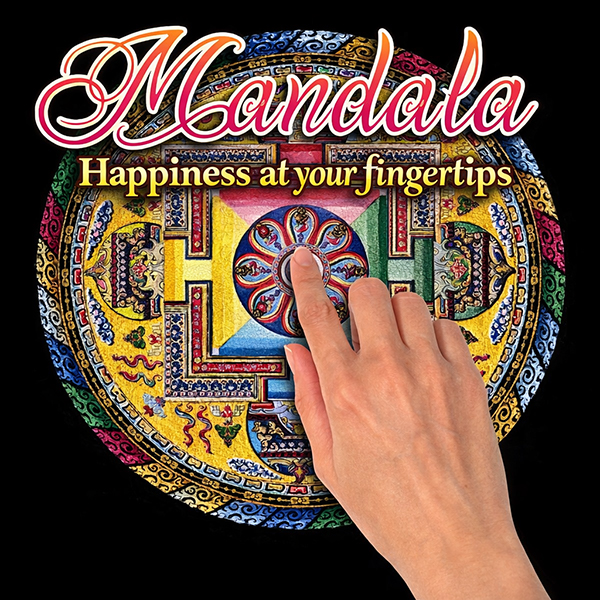
In a social climate that often feels rigid, overstimulating and mentally draining, it is hardly surprising that so many people look for simple ways to steady themselves. Stress, burnout, anxiety and low mood have made practices of attention and relaxation more than a passing interest; they answer a real need. In that search, the mandala continues to hold a particular place. More than a decorative pattern, it is a symbolic form built around a centre, long associated with unity, wholeness and the human relationship to the wider universe. Its enduring appeal lies in this double movement: outwardly simple, inwardly orienting.
That appeal is not merely a modern trend. Forms organised around a centre appear to be as old as humanity itself, and mandalas have carried meaning across a remarkable range of spiritual traditions, from Indigenous and Indian cultures to Tibetan Buddhism and even Christian cathedral rose windows. Thinkers and practitioners as different as Carl Gustav Jung, Erik Pigani and Laurence Luyé-Tanet have all treated them seriously, not as fashionable distractions but as tools that may support attention, self-observation and a calmer mental state. So before asking whether mandalas can bring happiness to our fingertips, it is worth asking a more grounded question: what, exactly, are we engaging with when we sit down to draw or colour one?
In short: what are mandala benefits?
Mandala benefits may include calmer attention, gentle focus, creative expression and a structured way to slow down. The effect comes less from a magical symbol than from repetition, colour, symmetry and the decision to stay with one simple task.
- The circular form gives attention a centre.
- Colouring slows the hand and narrows mental noise.
- Symmetry can make the practice feel orderly and contained.
- Meaning depends on the person, culture and context.
For a guided reset before creative practice, try the free Mental Reset Session. For setup ideas, read Meditation Space at Home.
The Mandala’s Ancient Roots and Spiritual Meaning
An ancient form that reaches across cultures
In a world that often feels overstimulating, rigid and mentally exhausting, many people look for simple ways to regain a sense of calm, focus and inner balance. Burnout, stress, anxiety and low mood have made practices of attention and self-regulation more appealing than ever. In that search, the mandala continues to stand out. More than a decorative pattern, it is a symbolic form that expresses the relationship between the human being, the cosmos and the wider universe. The word itself, from Sanskrit, evokes the ideas of circle, unity, wholeness and centre.
For figures as different as the Swiss psychiatrist Carl Gustav Jung, the psychotherapist and writer Erik Pigani, and Laurence Luyé-Tanet, teacher of energy yoga and author of several books on mandalas, these diagrams are far from a passing trend: they are a meaningful way of approaching the inner world.
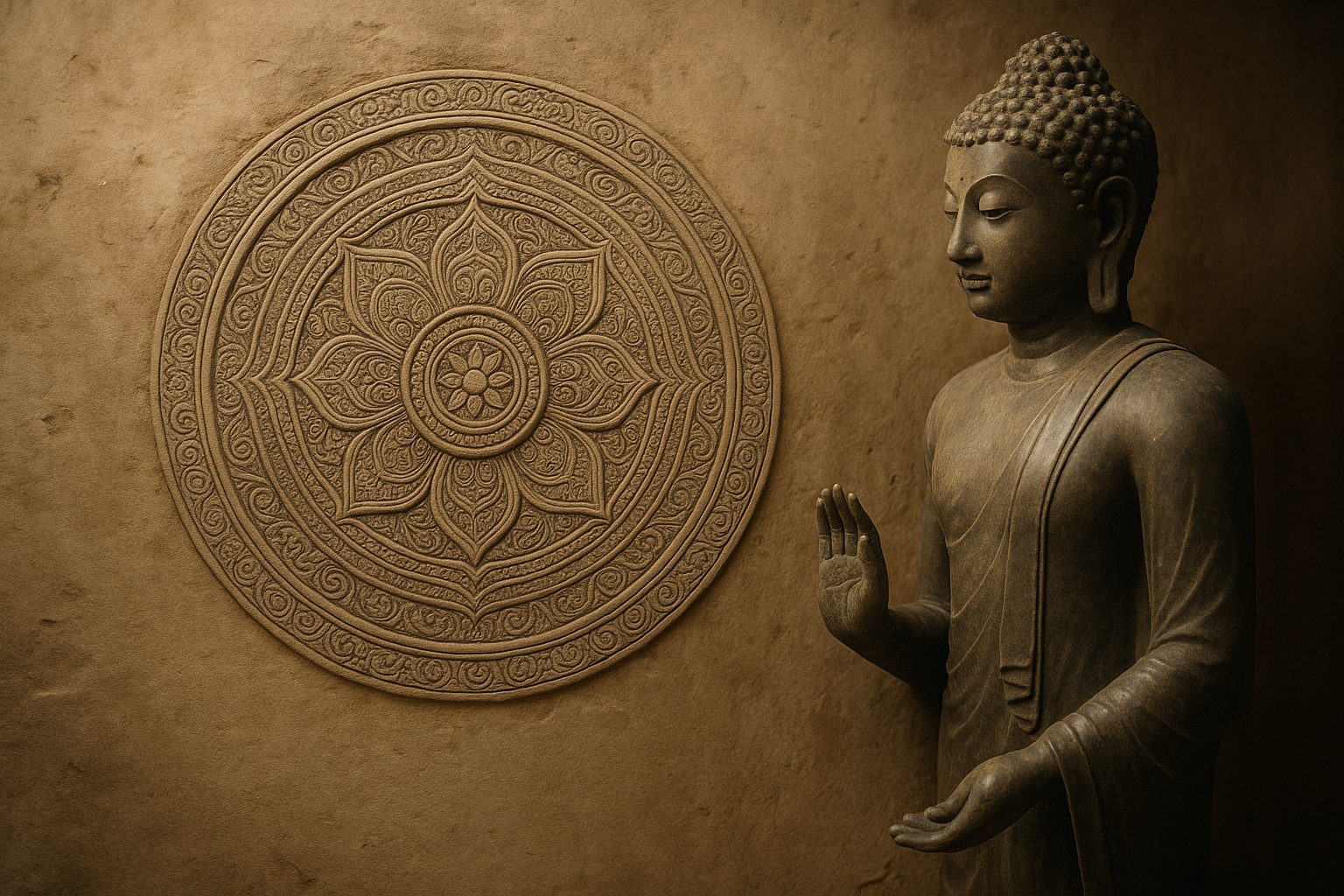
Nor are mandalas a modern invention. The discovery in Africa of a solar circle dating back to the Palaeolithic suggests that forms organised around a centre, whether circular, square or octagonal, are as old as humanity itself. They appear in a remarkable range of spiritual traditions: among Native American peoples and shamanic practices, in Indian traditions including Hinduism, in Tibetan and Buddhist cultures, and also within Christianity, where cathedral rose windows remain striking examples of this symbolic geometry, like bridges of light between earth and the divine.
As Laurence Luyé-Tanet notes, the mandala form also seems to echo structures found all around us: the brain, the solar system, a cell or a flower can all be seen through this lens. That recurring pattern helps explain why the mandala is so often associated with order, orientation and a return to centre.
This cross-cultural persistence matters. When a visual structure reappears in ritual, architecture, nature and spontaneous drawing, it suggests that the form answers something basic in human perception. The eye is naturally drawn towards symmetry, repetition and central organisation. Such arrangements can reduce visual chaos and create a sense of coherence, which may partly explain why mandalas are so often experienced as settling rather than agitating. Their symbolic history is rich, but their immediate perceptual logic is equally important.
It is also worth distinguishing between the mandala as a sacred object, the mandala as an artistic form and the mandala as a contemporary wellbeing practice. These are related, but not identical. In some traditions, the mandala belongs to a precise cosmology and ritual context; in modern use, it is often approached more personally, as a support for reflection, concentration or emotional regulation. Keeping that distinction in mind allows us to appreciate the practice without flattening its cultural depth or making claims it cannot sustain.
- Ancient forms organised around a centre
- Present in spiritual traditions across the world
- Often associated with unity, wholeness and orientation
Why the circle still speaks to the inner self
The mandala’s primary role is often described as therapeutic, not in the sense of a instant solution, but as a support for recentring attention and entering a meditative state more conducive to listening inwardly. Through colouring, drawing, stencils or art therapy workshops, it may help cultivate sustained attention and a quieter mental state. Some traditions also attribute a protective function to it, as with the Native American circle or dreamcatcher, intended to protect the spirit and prevent its dispersion. Erik Pigani writes that Jung, who spent his life working to restore the soul as a reality rather than reducing it to a mere psychic mechanism, studied mandalas with boundless admiration.
Jung had observed that, in periods of inner disturbance, the unconscious may lead us to produce mandala-like forms in drawings or dreams, sometimes as labyrinths. In that sense, they may also serve as clues to emotional disorder.
That is why the mandala is often sought out in moments of doubt, as a practical aid for both psychological steadiness and physical relaxation. Laurence Luyé-Tanet explains that working with a mandala, whether by drawing or colouring it, can help us reconnect with our deeper structure, our potential and what Jung called the Self. Today, pre-drawn mandalas are especially popular, but she stresses that the choice matters: a mandala may be selected according to the theme one wishes to explore, or simply by intuition. The aim is to return to the present moment, enjoy the sensory effect of colour, and move towards release and inner peace.
Luyé-Tanet also points to subtler effects: the form itself, and especially the centre, may naturally draw perception towards a sense of unity, while colours combined with shapes create visual volumes from which very different sensations and energies can emerge. In many traditions, the circle symbolises life and death, birth and rebirth, maturity and resurrection. To draw or colour a mandala is therefore, in a sense, to give form to one’s state of mind in the present moment: a mirror of emotions, experience and hope, and perhaps a small image of the cycle of existence itself. Jung expressed this personally: “Each morning, I drew a small circular figure...
which seemed to correspond to my inner state at the time. Only gradually did I discover what the mandala really is: the Self, the wholeness of the personality, which, when all is well, is harmonious.”
The circle retains this force because it combines simplicity with symbolic density. Unlike a more open or fragmented image, a circular form encloses space while still suggesting movement. It has no obvious beginning or end, which makes it especially apt for representing continuity, return, integration and cycles of change. Psychologically, that can make it feel containing. Not everyone will experience this in the same way, of course, but many people report that circular forms feel less confrontational than linear tasks and more inviting to sustained attention.
From a cognitive point of view, this may be linked to the way repetitive, bounded visual activity narrows the field of distraction. When attention is gently anchored to a centre and to repeated motifs, mental noise may become less dominant for a time. That does not mean the unconscious is being decoded in any strict scientific sense, but it does suggest a plausible bridge between symbolic experience and attentional regulation. The mandala can be meaningful because it is interpreted, and calming because it is structured.
How Mandalas Support Calm, Focus and Self-Reflection
A simple practice that can help the mind recentre
Beyond their symbolic dimension, mandalas are often used as a practical tool for calming attention and encouraging a more settled mental state. Their first function, as Laurence Luyé-Tanet explains, is therapeutic in the broad sense: they may facilitate recentring through a meditative state that makes it easier to listen to our inner signals. Whether through colouring books, stencils or art therapy workshops, the process invites sustained attention, sensory engagement and a temporary pause from mental overload. In a world marked by stress, burnout, anxiety and low mood, this kind of simple, accessible ritual is often sought precisely because it can bring us back to the present moment without requiring expensive equipment or complex training.
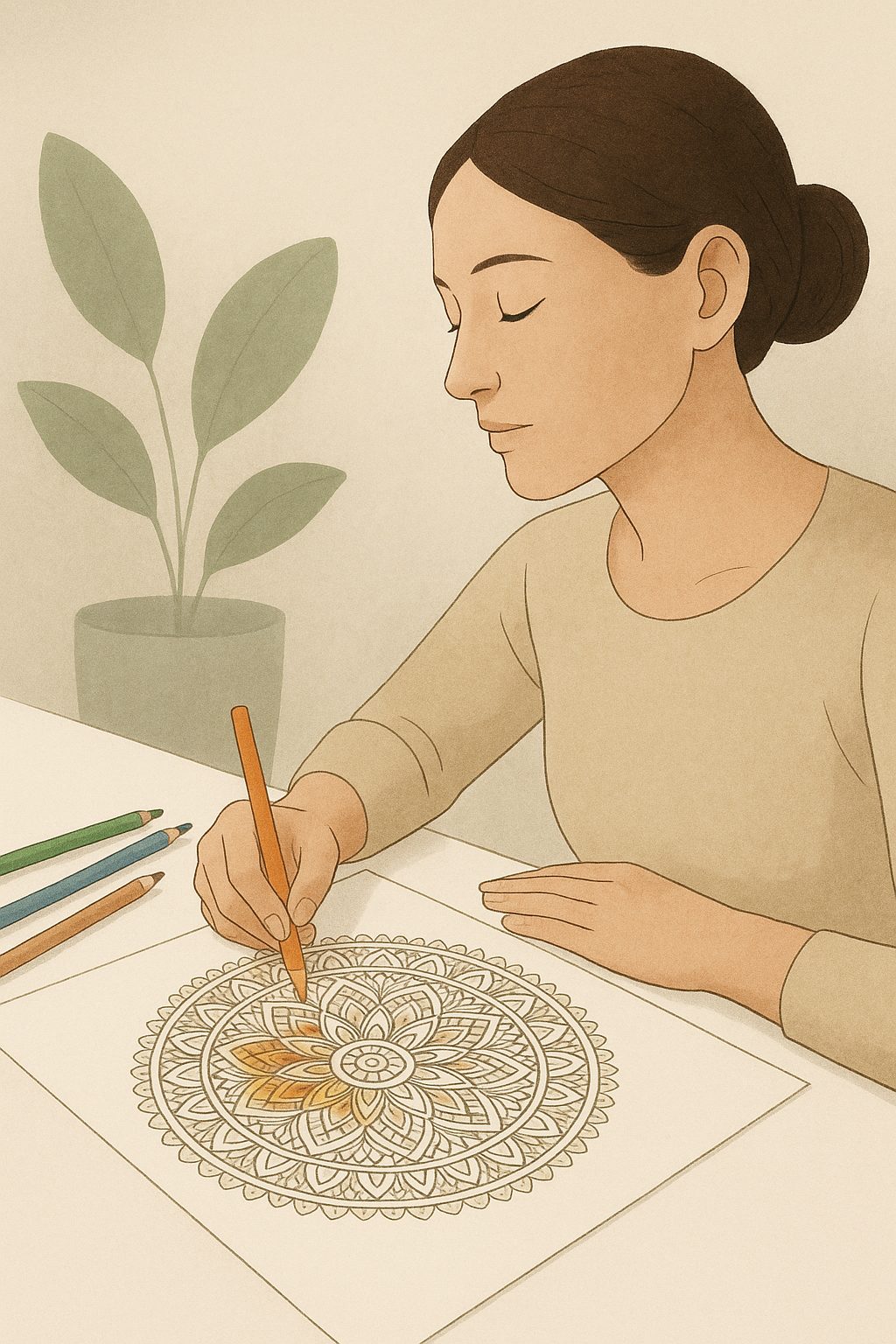
In that sense, the mandala can act as a form of psychological support during periods of doubt. Luyé-Tanet notes that working with a mandala, whether by drawing or colouring it, may help us reconnect with our deeper structure, our potential and what Jung would call the self. Erik Pigani also recalls Carl Gustav Jung’s deep interest in mandalas, pointing out that Jung observed how the unconscious, especially in troubled periods, may lead us to produce mandala-like forms in drawings or dreams, sometimes as labyrinths.
Related offer
Meditation - Relaxation set
All the Mental Waves® know-how in a single pack for quick and easy access to meditation and...
View productFrom this perspective, mandalas are not only associated with relaxation; they may also offer a way of noticing emotional disorder, giving shape to what is otherwise diffuse, and supporting a more reflective relationship with one’s inner life.
Part of the value of the practice lies in its modesty. One does not need to be skilled at drawing, spiritually trained or psychologically sophisticated to begin. The hand follows a line, the eye tracks a pattern, colour fills a space, and attention is gradually gathered. This sequence may sound ordinary, yet ordinary actions are often precisely what help interrupt rumination. By engaging perception, movement and choice at a manageable scale, the activity can create a small but meaningful shift in mental state.
Some clinicians and researchers interested in art-based practices have noted that repetitive visual tasks may support downregulation of arousal in certain people. The mechanism is unlikely to be unique to mandalas, but the mandala’s centred geometry may make the effect especially accessible. The practice can encourage a rhythm of breathing, a slowing of pace and a temporary reduction in cognitive fragmentation. In contemporary language, one might say that it helps move from scattered attention towards a more coherent attentional frame.
- They can encourage focused attention.
- They may support relaxation and emotional regulation.
- They can serve as a gentle aid to self-observation.
Why colour, form and the circle can feel so meaningful
Today, pre-drawn mandalas are especially popular, not least because they make the practice immediately accessible. Yet the choice of mandala still matters. The original text rightly stresses that it should be selected according to the need of the moment, the theme one wishes to explore, or simply intuition. The aim is not performance but experience: taking pleasure in colour, allowing the body and mind to loosen, and recovering a sense of inner quiet. Luyé-Tanet suggests that the effects may also be more subtle. The structure of the mandala, organised around a centre, can naturally draw perception towards unity and coherence, while colours combined with shapes create visual volumes from which very different sensations and energies may emerge.
Without overstating the mechanism, it is easy to see how form, repetition and colour can influence attention, mood and felt experience.
Across many traditions, the circle itself carries a powerful symbolic charge. It evokes life and death, birth and rebirth, maturity and resurrection. In that light, drawing or colouring a mandala can become a mirror of one’s state of mind in the present moment, projecting emotions, memories and hopes into visible form. The mandala then appears as an image of the cycle of existence itself. Jung saw it as a symbol of the self, and his own words remain striking: “Each morning, I drew a small circular figure... which seemed to correspond to my inner state at the time.
Only gradually did I discover what the mandala really is: the self, the wholeness of the personality which, when all is well, is harmonious.” That idea helps explain why this apparently modest practice continues to resonate so deeply: it joins concentration, expression and meaning in a single gesture.
Colour deserves particular attention here. Even without assigning fixed symbolic meanings to every shade, colour changes the emotional tone of the experience. Warm colours may feel activating or expansive; cooler tones may feel quieter or more containing. Contrast can sharpen alertness, while softer palettes may support a gentler mood. These effects are not universal laws, but they are familiar features of perception. In mandala practice, colour is not merely decorative; it becomes part of the regulation process by shaping how the image is felt as well as seen.
Form also matters because it guides action. Dense, intricate mandalas tend to slow the hand and demand finer concentration, which some people find absorbing and others find tiring. Simpler designs may be more suitable when the nervous system is already overloaded. This is one reason the “right” mandala depends on the moment. A person seeking stimulation, grounding, expression or quiet may not be drawn to the same pattern. Intuition, in this context, need not be mystical; it can simply be a subtle reading of what the mind and body are ready for.
There is also a difference between creating a mandala from scratch and colouring an existing one. Designing one’s own form may invite more projection, decision-making and symbolic interpretation. Colouring a pre-drawn mandala may reduce pressure and make it easier to enter a state of flow. Neither approach is inherently superior. They simply place emphasis on different aspects of the experience: one on creation, the other on guided attention. For many people, alternating between the two can be especially fruitful.
How to Use a Mandala as a Simple Focus Practice
Choose one mandala, one small set of colours and a realistic amount of time. The practice works best when it does not become another performance. Ten quiet minutes can be enough.
Before colouring, take three easy breaths and notice the body. Then begin from the centre or from the outer edge, whichever feels more natural. The direction matters less than the quality of attention.
When the mind wanders, return to the next shape and the next colour. That return is the meditative part of the practice. The finished image is secondary.
The Mental Waves Mandala Practice Framework
The Mental Waves frame is to use mandalas as a gentle bridge between creativity and calm.
- Choose: select a form that feels inviting rather than impressive.
- Colour: let colour guide attention without forcing meaning.
- Return: come back to the pattern whenever the mind wanders.
- Reflect: notice how the practice changed breath, mood or focus.
For a wider calming toolkit, continue with Relaxation Techniques to Reduce Stress. For symbolic context, read What Is Spirituality?.
Editorial note from Mental Waves
This article is educational. Mandala colouring can support relaxation and focus for some people, but it does not replace therapy or professional care for persistent distress.
Conclusion
In the end, the appeal of the mandala lies less in any miracle promise than in its quiet precision. Across traditions, and in more contemporary therapeutic or reflective settings, it returns us to the same movement: from dispersion towards centre, from mental overload towards a more ordered form of attention. That does not make it a remedy-all, but it may help create the conditions for calm, presence and a clearer reading of one’s inner state.
Perhaps that is why the practice endures. Whether drawn, coloured or simply contemplated, the mandala can become a modest but meaningful support for regulation: a way of slowing perception, engaging the senses and giving shape to what is otherwise difficult to name. In that sense, happiness may not be quite at our fingertips — but a little more steadiness sometimes is.
That may be the most credible way to understand its value. The mandala does not need to be surrounded by grand claims in order to matter. Its strength lies in the meeting point between symbol and practice, between what the image represents and what the act of attending to it actually does. For some, it will remain an aesthetic pleasure; for others, a contemplative discipline; for others still, a small daily ritual that helps restore continuity when life feels mentally fragmented.
Used in that spirit, the mandala is neither a fad nor a remedy, but a disciplined form of pause. And in an age of constant stimulation, a disciplined pause can already be a profound resource.
Frequently Asked Questions About Mandala Benefits
What are mandala benefits?
Mandala practice may support calm, focus, creativity and self-reflection through colour and repetition.
Can mandala colouring calm the mind?
It can help some people slow down because the task is structured, repetitive and visually contained.
Does mandala meaning matter?
Meaning can matter, but the practical effect often comes from attention, colour and rhythm.
Is colouring a mandala meditation?
It can become meditative when attention stays with the pattern, breath and present action.
Which colours should someone use?
Use colours that feel supportive, calming or expressive rather than trying to follow a fixed rule.
Is it better to create or colour a mandala?
Both can be useful. Creating adds expression, while colouring can be easier for beginners.
Are mandalas spiritual?
They have spiritual roots in several traditions, but they can also be used as a secular focus practice.
Can mandalas help with stress?
They may support a calmer state, but ongoing stress may also need lifestyle changes or professional support.
What is the main takeaway?
Mandala benefits come from focused repetition, colour and symbolic centre, not from forcing a perfect result.