en
enVotre panier est vide.



If you train hard, refine your technique and compete regularly, you are already doing much of what performance demands. Yet many athletes reach a point where physical preparation alone no longer explains the gap between what they can do in training and what they actually produce when it matters. The missing pillar is often mental preparation: the ability to arrive in the right state before effort, stay composed under pressure and access your best level without being derailed by doubt, fear or overthinking.
In short: sports performance mental training
Improving sports performance is not only about training harder; attention, confidence, recovery and mental preparation all shape how the body performs under pressure.
Use this article as a practical map: keep what helps attention become steadier, question anything that sounds absolute, and connect the idea back to repeatable daily practice.
This is not simply a question of motivation. In sport, success and failure are often closely tied to attention, self-regulation and the quality of your mental state in decisive moments. The source material points to research conducted at Brunel University in the UK on 400-metre sprinters, suggesting that audio-based brain training may support performance beyond traditional training alone. Whether you struggle more in competition than in practice, lose focus in front of a crowd, tighten up at critical moments or find that a return from injury is held back by hesitation rather than fitness, mental training may help restore a more stable and effective connection between brain, body and performance.
Why Mental Strength Matters in Sporting Performance
Physical training is not always enough to unlock your full level
If you train intensively or compete regularly, you already know the value of physical preparation and technical work. They are essential. Yet many athletes reach a point where progress no longer depends only on strength, endurance or skill. Another pillar becomes decisive: the mental dimension of performance. Are you always in the right state before an event? Can you raise your level exactly when it matters most? These questions often reveal the gap between what an athlete is capable of in theory and what they can actually produce on the day.

This is why mental training is increasingly taken seriously alongside traditional preparation. Research is often cited in this area, including a study carried out at Brunel University in the UK on 400-metre sprinters, which highlighted a beneficial effect of audio stimulation on running performance. Among the 20 men studied, all of the athletes who followed the audio-based brain training programme exceeded their previously recorded median level. That does not mean physical condition stops mattering, of course. It does suggest, however, that success or failure in sport is very often linked as much to mental condition as to physical condition. In practice, strengthening attention, confidence and emotional regulation may help athletes access more of the ability they already possess.
For many competitors, the issue is not a lack of talent but a lack of reliable access to that talent under variable conditions. Training sessions often take place in a relatively controlled environment, whereas competition introduces uncertainty, evaluation, noise, consequence and time pressure. These factors can alter perception, narrow attention too much or scatter it too widely, and change the quality of movement without any obvious change in physical capacity. This is one reason mental preparation is often sought not only by elite athletes, but also by committed amateurs who want their performance to become more consistent.
- better self-confidence and trust in your own abilities
- improved management of stress and performance-related fears
- sharper concentration when it matters most
- more effective preparation and recovery time
The situations where mental preparation can make the difference
There are several common situations in which a brain training programme may be especially useful. Some athletes are excellent in training, then underperform in competition. Others lose part of their ability in front of a crowd, whether those watching are important to them or complete strangers. In these moments, the issue is not simply nerves. It is often a form of doubt, sometimes barely conscious, tied to fear of failure or to becoming excessively self-aware under the gaze of others. The athlete starts thinking about how they look, what is at stake and what people might think of them, instead of staying anchored in the present action.
A similar shift happens in critical moments such as a match point, a final sprint or the last technical movement: attention drifts, pressure rises, and simple mistakes appear where none would usually happen in training.
Mental preparation can also help in more subtle profiles. Perfectionist athletes, for example, often draw motivation from high standards, but that same trait can turn against them when it creates unrealistic expectations in the moment. The result is frustration, harsh self-criticism and a loss of confidence that can wipe out hard-won progress. At the other end of the spectrum are experienced competitors who already perform well and want to regain their best state more consistently, almost on demand. Then there are athletes returning from injury: physically recovered, yet still held back by the fear of getting hurt again and by doubt about whether their previous level can truly return.
In all of these cases, the aim of mental training is not to promise a miracle. It is to help restore a more stable body–mind synchronisation. Mental Waves’ programme improving sporting performance, based on neuro-dynamic stimulation, is designed with that goal in mind for both individual and team sports. Using isochronic tones associated with the stimulation of Gamma brainwaves, this approach seeks to support concentration and mental readiness so that physical sensations can be expressed more freely. When that alignment is present, athletes often describe feeling more lucid, more available and less disturbed by doubt, fear or negative pressure.
What links these situations is not weakness of character, but instability in the way attention and emotion are regulated under load. A crowd, a scoreline, a coach’s expectations or the memory of a previous failure can all change the internal meaning of the moment. Once that happens, the athlete may become too self-monitoring, too outcome-focused or too cautious in movement. Mental preparation aims to reduce this interference so that perception, decision and execution remain closer to what has already been built in training.
- underperforming in competition despite strong training sessions
- losing focus in front of a crowd or in decisive moments
- struggling with perfectionism or excessive self-criticism
- returning from injury with lingering fear despite full physical recovery
How Mental Training Helps You Perform Under Pressure
The moments when the mind becomes the limiting factor
If you train hard, refine your technique and compete regularly, you are already doing a great deal to improve your performance. Yet many athletes reach a point where physical preparation alone no longer explains the gap between what they can do in training and what they actually produce on the day. In those moments, mental state becomes a decisive part of performance: how you feel before the effort, whether you can raise your level when it matters, and whether you stay clear-headed under pressure. This is why mental training, including sound-based stimulation, is often explored as a complement to traditional preparation rather than a replacement for it.
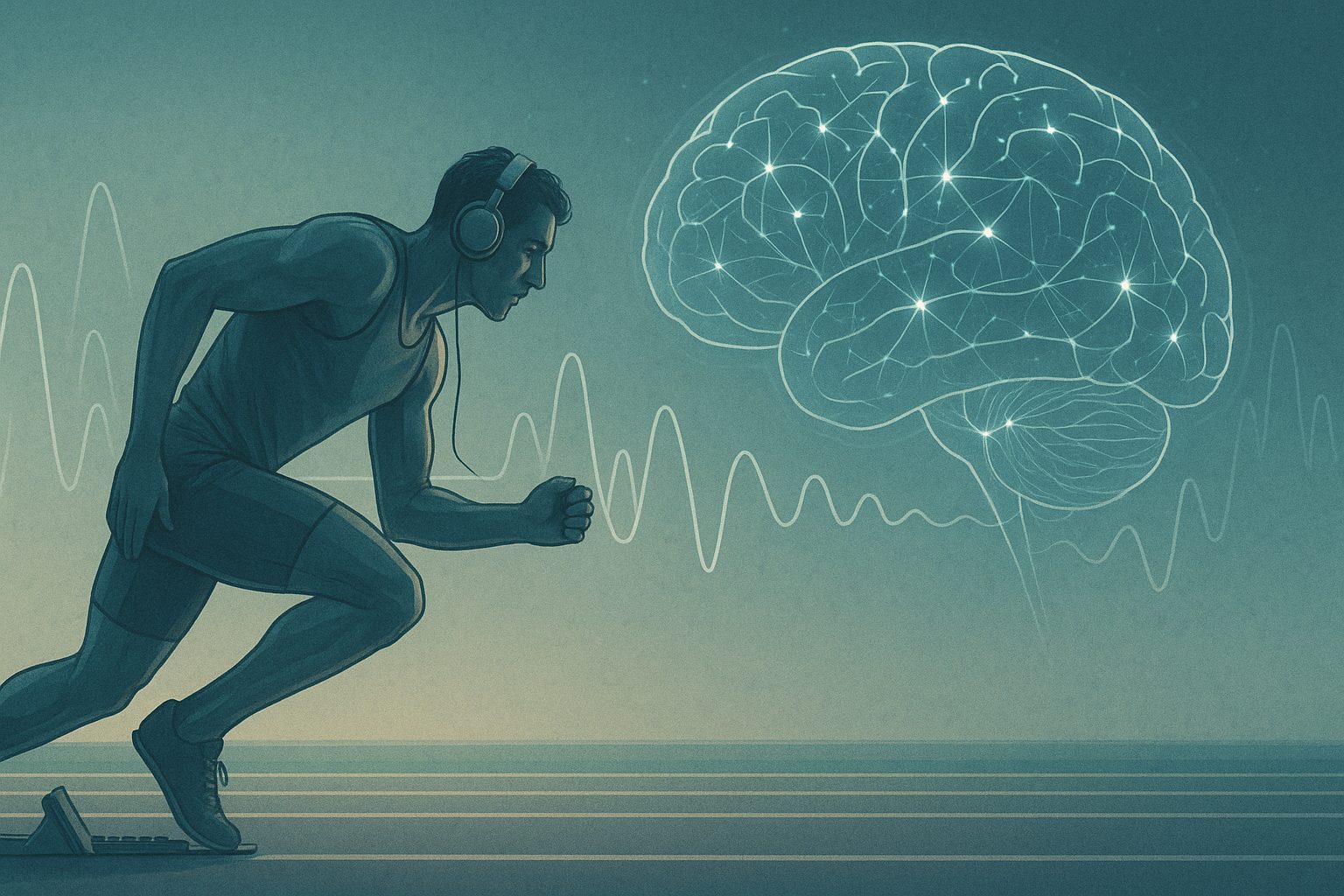
The source text points to a study carried out at Brunel University in the UK on 400-metre sprinters, which suggested a beneficial effect of audio stimulation on running performance. Among the 20 men observed, all of the athletes who followed the audio brain-training programme exceeded their previously recorded median level. Without turning one study into an absolute rule, the broader idea remains important: success or failure in sport is often shaped as much by mental condition as by physical condition.

Related offer
Attention focuser - helps concentration
This sound program has been designed specifically for people who want to focus their attention and their...
View productThis is especially true in familiar situations such as being excellent in training but below your real level in competition, losing focus in front of a crowd, or feeling your attention slip at the most critical moment of a match, sprint or final movement.
These are often the moments when the brain shifts from fluid execution to conscious control. Instead of allowing trained patterns to unfold, the athlete starts checking, correcting or anticipating too much. In precision sports this may disturb timing; in endurance or speed events it may alter pacing and effort perception; in team sports it may slow decision-making by a fraction that still matters. The body is ready, but the mental state is no longer serving the action efficiently.
- You perform better in training than in competition because doubt, and often fear of failure, takes over.
- You are less effective in front of an audience because self-consciousness disrupts concentration.
- Your mind drifts in decisive moments, making simple errors you would not usually make in training.
- You return from injury physically recovered, but still held back by the fear of getting hurt again.
What targeted mental preparation may help you regain
Pressure does not always come from the task itself. It may also come from opponents, a coach, team-mates, supporters or from your own internal standards. This is why perfectionism and excessive self-criticism can become so costly, even in successful athletes. Attention to detail can support motivation and commitment, but it can also create unrealistic expectations in the moment and trigger frustration when reality does not match the ideal. Likewise, some competitors do not feel blocked at all: they already know the sensation of being fully in the zone and executing the right gesture at the right time.
For them, the goal of mental training is not simply to remove obstacles, but to learn how to access that state more reliably and more deliberately.
A well-designed mental preparation programme may therefore help strengthen self-confidence, improve the regulation of stress and fear, and support concentration so that you are more fully available on the day that matters. It may also contribute to better preparation and recovery routines. In this context, the Mental Waves programme improve sports performance is presented as a neuro-dynamic training approach designed for both individual and team sports, and usable in everyday conditions. Its method relies on isochronic tones intended to stimulate Gamma brainwaves, frequencies often associated with attention, cognitive integration and high-level mental engagement. The aim is to support a more coherent body-mind state, in which concentration serves sensation and action more effectively.
Whatever your age or level, the underlying objective is twofold: to support performance, and to help you build greater autonomy in your own mental preparation.
In practical terms, this kind of work is often most useful when it becomes part of a routine rather than a last-minute fix. Athletes tend to benefit more when mental preparation is integrated before training, before competition and during recovery periods, because consistency helps the nervous system associate certain cues with readiness, calm or focus. Over time, this may make it easier to enter a useful state without forcing it. The aim is not to eliminate emotion, but to prevent emotion from hijacking attention and movement quality.
It is also worth keeping expectations realistic. No method can ensure perfect performance on demand, and no audio tool replaces coaching, physical preparation, sleep, nutrition or rehabilitation when these are needed. What it may do is support the conditions in which those efforts become more available. For many athletes, that margin is highly valuable: a clearer mind before the start, less internal noise during execution, and a better capacity to recover mentally after intense effort or disappointment.
- Greater confidence in your own abilities
- Better management of stress, pressure and fear of failure or re-injury
- Sharper concentration when it matters most
- More effective preparation and recovery time
The Mental Waves Performance Regulation Framework
The Mental Waves frame is to regulate before performing. Athletic progress depends on training, but pressure, self-talk, recovery and attention often decide whether that training can be expressed.

Related offer
Caffeine substitute
An effective substitute for caffeine to give you a boost. Energizing effect guaranteed!
View productUse sound as one support among others: before training to gather focus, after effort to recover, or in preparation phases to rehearse a calmer competitive state.
If pre-performance pressure makes the mind noisy, begin with the free Mental Reset session before returning to one clear training cue.
Editorial note from Mental Waves
This article is educational and does not promise athletic results. Sound practices do not replace training, coaching, medical care, injury management or sport-specific supervision.
Conclusion
Improving sporting performance is not only a matter of strength, technique or repetition. Very often, the decisive margin appears in the way attention is regulated, how pressure is interpreted, and whether the athlete can stay connected to the present moment when the stakes rise. Mental preparation does not replace physical training; it helps make it more fully available when doubt, overthinking, fear of failure or the memory of injury begin to interfere with what the body already knows how to do.
That is why a more complete approach to performance looks at the relationship between brain, perception and action together. Used with care, tools designed to support concentration, emotional regulation and recovery may help athletes find a steadier internal state before competition and a clearer response during it. The aim is not perfection, nor a permanent state of control, but a more reliable access to one’s real level when it matters most. Sometimes, that is where performance truly changes.
For athletes who already invest heavily in physical work, this perspective can be especially important. The final gains are often not dramatic changes in fitness, but finer improvements in readiness, clarity, confidence and execution under pressure. When mental preparation is approached seriously and integrated intelligently, it may help transform isolated good performances into something more repeatable. In competitive sport, that consistency is often what separates potential from results.
FAQ: How to Improve Sporting Performance
Why can an athlete perform well in training but fall short in competition?
Doubt is often the main reason. You may feel physically ready in training, yet struggle to reproduce the same level in competition because fear of failure interferes with concentration and decision-making. When the mind is unsettled, your real physical and technical ability becomes harder to access at the moment it matters most.
How can performing in front of a crowd affect sporting performance?
Being watched can make you overly self-conscious. Instead of staying focused on the action, you start thinking about how you look, what is at stake and what others may think of you. That shift in attention can reduce concentration and limit your physical capacity, even when your preparation is otherwise solid.
Why do simple mistakes happen in decisive moments such as a final sprint or match point?
Pressure can pull your attention away from the present moment. When your mind drifts towards the result, your opponents, your coach or the expectations around you, clear thinking becomes harder. That is often when basic errors appear, including mistakes you would not usually make during training.
Can perfectionism hold back sporting progress?
Yes, because perfectionism can become a double-edged trait. It may help with motivation and commitment, but it can also create unrealistic expectations in the moment. When that happens, self-criticism and frustration can take over, weakening confidence and undermining progress that has already been built through training and experience.
What mental difficulty can remain after returning from injury?
Fear of getting injured again can remain even after full physical recovery. That hesitation may stop you from fully committing to movement, effort or contact, which affects sensations and performance. In that situation, the body may be healed, but the mind is still holding back your ability to perform freely.
What benefits can mental preparation bring to sports performance?
Better self-confidence, improved stress management and sharper concentration are the main benefits highlighted. Mental preparation may also help with fears linked to failure, pressure or re-injury, while making preparation and recovery time more effective. The aim is to help you be more composed, lucid and available on the day.
What does the Brunel University study mentioned here suggest?
Research at Brunel University in the UK on 400-metre sprinters suggested that audio stimulation had a beneficial effect on performance. Among the 20 men observed, those who followed the audio-based brain training programme all exceeded their previously recorded median level, pointing to the importance of mental condition alongside physical preparation.
How is the mental training approach described in this piece supposed to work?
It uses sound stimulation, including isochronic tones, with the aim of stimulating Gamma brainwaves linked here to concentration and mental conditioning. The goal is to improve body-mind synchronisation so that attention supports physical sensation more effectively, helping you feel more ready, more focused and less disturbed by negative pressure.
Who can benefit from this kind of mental preparation?
Athletes in both individual and team sports may find it useful, whether they compete regularly or train intensively. It is presented as relevant for people who underperform in competition, lose focus under pressure, struggle with self-criticism, want more control over their mental state, or are returning from injury with lingering fear.