en
enVotre panier est vide.



Many of us spend far too long circling the darker parts of our lives, replaying what hurts and giving our full attention to what feels wrong. Yet the mind tends to strengthen whatever it dwells on. If we keep staring into the dark, we should not be surprised when the light disappears from view. Spiritual thinking, in this sense, is not about denying difficulty or pretending pain is unreal; it is about turning our attention towards what is still good, steady and life-giving, and allowing those thoughts to lead us somewhere better.
In short: spiritual thinking
Spiritual thinking becomes more useful when it quiets rumination, opens attention and returns meaning to ordinary life.
Use this article as a practical map: keep what helps attention become steadier, question anything that sounds absolute, and connect the idea back to repeatable daily practice.
That shift begins with a simple but demanding truth: our thoughts are not as fixed, or as powerful, as they often seem in the moment. The more we dissect the past, rehearse old feelings and sink into endless introspection, the more firmly we bind ourselves to them. By contrast, there is a quiet strength in returning to the present, refusing to feed destructive thought patterns, and choosing happiness not as a reward for perfect circumstances, but as a way of meeting life now. This is where a more grounded form of spiritual health begins.
Turning Away from Rumination and Back to the Present
When you keep staring at the dark, it fills your whole mind
We can spend hours going over what is wrong in our lives, replaying old scenes, dissecting them and trying to “get in touch” with every feeling they stir up. Yet this often deepens the very state we want to escape. If you want to loosen the grip of a problem, constantly focusing on it rarely helps; it usually feeds it. A genuinely happy person is not endlessly living in the past or projecting into the future, but rooted in the present moment. Too much thinking and too much introspection can make suffering heavier than it already is.
Today is here now, and there is something quietly healing in learning to live in the here and now rather than in yesterday’s shadows.

Children can believe in ghosts, goblins and monsters because, to them, those things feel real. As adults, we know they are not. In much the same way, many of our thoughts feel solid and authoritative simply because we keep producing them, believing them and attaching emotion to them. But a thought is not reality in itself. It is often only the reflection of what we have chosen, consciously or not, to reinforce in the mind. The more attention we give a fearful or hopeless inner story, the more convincing it seems. That does not make it true.
You may have more influence over your mood than you think
Take a simple example. You are sitting alone at home in the dark, low in mood and full of negative thoughts. Then the telephone rings: someone you have not seen for six years is calling. At once you become more animated, your mood lifts and you enjoy the conversation. But after you hang up, the heaviness returns and you slip back into the blues. Why? Because even when we do not fully realise it, our state is closely tied to the stream of thoughts we continue to entertain. The call interrupted that stream for a while. It showed that your depression was not the whole of reality; it was a mental atmosphere that could change.
That is the important clue: we often have more control over our thoughts than we assume. It is possible, after that phone call, to make a deliberate effort not to fall straight back into brooding and despair. You can choose to stay with what has opened up in you rather than returning automatically to the same inner tunnel. This does not mean pretending life is perfect or denying pain. It means recognising that attention is powerful, and that what you keep returning to in your mind shapes how you feel. When you stop feeding darkness at every turn, you give yourself a real chance to notice the light.
- Notice when your thoughts begin circling the same painful theme.
- Interrupt the pattern before it gathers force.
- Return your attention to what is alive and present now.
Choosing Your Inner Direction Instead of Waiting for Life to Change
Happiness does not have to wait for perfect circumstances
If you act in spite of what you feel, your beliefs and emotions often begin to follow. There are many things in life that none of us can control. Even so, it is still your life, and there is real power in deciding that your happiness will not be postponed until everything finally falls into place.
It is not only a matter of saying, “I’ll be happy when I get the promotion,” or “I’ll be happy when I can speak confidently in front of a group.” The deeper work is learning how to be as well as possible now, in the life you are already living, and drawing on your inner peace in whatever way genuinely helps you.
In that sense, happiness begins as a choice before it becomes a feeling. Your emotions are shaped, to a large extent, by the thoughts you keep returning to. Misery does not simply appear out of nowhere and stand on its own; it is sustained by patterns of thought, and those patterns can be changed. This does not mean pretending that pain is unreal or forcing cheerfulness. It means recognising that you do not have to hand over your whole inner life to every passing mood. You can begin to guide it.
- Stop tying happiness to a future condition
- Look for steadiness in the present moment
- Use whatever helps you reconnect with inner calm
Past thoughts lose their grip when you stop feeding them
Many of the thoughts that trouble us are tied to things that no longer exist except in memory. A bad experience happened yesterday; it is over. That moment is not still unfolding in front of you, even if your mind keeps replaying it. When you spend your energy dwelling on the past, you close yourself off from the reality of the here and now, and from the possibility that today may be different, even better. A new day has already begun, but it is hard to enter it fully if your attention remains fixed on what has gone.
You are, in a sense, a factory of thoughts. Once you see that clearly, something important shifts: you no longer have to treat every thought as truth, destiny or instruction. You can start to slow the stream, loosen your attachment to anxious ideas, and let fear pass without building your whole day around it. That recognition is simple, but it is powerful. The mind produces thoughts constantly; spiritual health begins when you realise you do not have to strengthen every one of them.

Related offer
Developing extrasensory perception
Develop your extrasensory perceptions with our powerful method based on synchronization and rhythm training...
View productStepping Out of the Mind and Back Into Life
Destructive thoughts are not facts
We all have a natural tendency to think a little more than is helpful, and then to become trapped by our own mental loops. The danger is not only the thought itself, but the way we keep returning to it until it begins to feel solid, inevitable and true. Yet a destructive thought is still only a thought. It is not reality, even if it arrives with strong emotion attached to it. Once you recognise that, something important shifts: you can stop treating every fearful or self-defeating idea as a verdict, and start seeing it as passing mental activity.
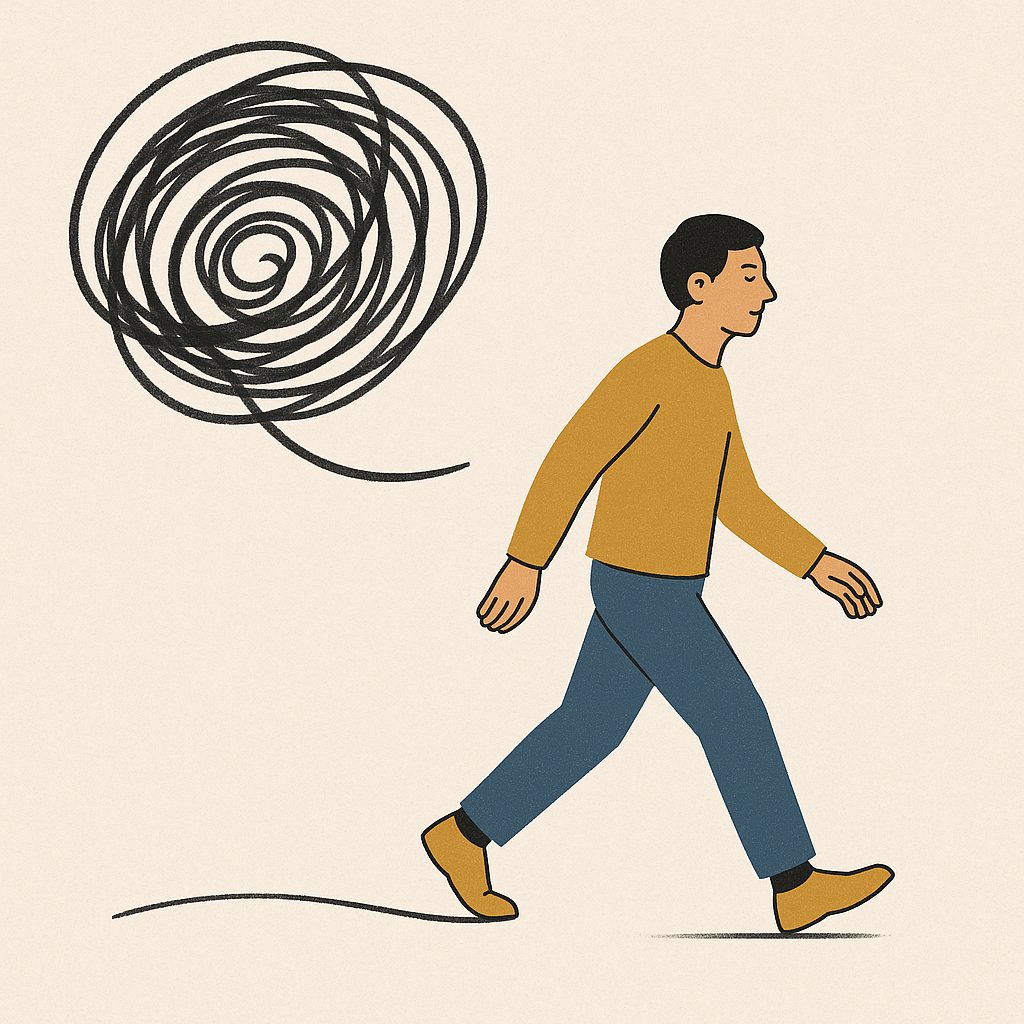
That is where choice comes in. We can notice what we are doing to ourselves, get up, interrupt the spiral, and turn towards something healthier: a task, a walk, a conversation, anything genuinely engaging or constructive. Happy people are not happy because they analyse life more deeply than everyone else, but because they actually live it. They understand, consciously or not, that enjoyment comes from participation. If you stay locked in contemplation, life remains at a distance; if you re-enter it, your mind often loosens its grip.
- Notice the spiral
- Interrupt it physically
- Turn towards something absorbing
Why presence comes more naturally to children
Think for a moment of a room full of nursery children. They are not standing back from life, analysing whether they should enjoy it or wondering what every feeling means. They are simply there. Their attention is on the game, the sound, the colour, the person in front of them. That is why they seem so alive: they are fully immersed in the moment without making a project of it.
There is something worth learning in that. To enjoy life, you have to be in it. Children do this instinctively; adults often forget and retreat into commentary, worry and over-interpretation. The point is not to become childish, but to recover that direct contact with the present. When you are fully engaged in what is here, rather than endlessly circling your thoughts, the mind quietens and life becomes more vivid again.
When Overthinking Feeds Anxiety
Why analysing everything can make you feel worse
If anxiety is eating away at you, the instinct to keep thinking about the thing that frightens you can feel almost irresistible. Yet that very habit often gives the fear more power. Thoughts grow in proportion to the attention you give them: dwell on what is harmful, and it expands in your mind; turn instead towards your progress and the healthier thoughts you are trying to build, and those begin to strengthen and gradually take the place of the old ones.
This is why endless analysis so often becomes a trap. Understanding every detail of why you feel bad does not necessarily help you get better. In many cases, going over the causes again and again is like rubbing salt into a wound. What keeps distress alive is the stream of thoughts itself. So rather than following each one to the end, try to relax, let it pass, and refuse to keep feeding it.
- What you rehearse becomes stronger
- What you stop feeding begins to lose force
- Progress often starts before full explanation
Interrupt the spiral and choose a different direction
When limiting or self-destructive thoughts appear, it helps to answer them clearly instead of surrendering to them. Sometimes a firm inner interruption is needed: “STOP! I am not going to lose control. I have important things to do.” The point is not to pretend nothing is wrong, but to remember that you do not have to obey every thought that enters your mind. You can interrupt the spiral before it drags you further down.
Little by little, this changes your inner life. If you learn to return to constructive thoughts whatever the situation, you move closer to real spiritual health. That does not mean forcing cheerfulness at every moment. It means no longer treating every anxious thought as truth, and choosing, again and again, the mental direction that gives you more steadiness, more freedom and more life.

Related offer
Developing your Clairvoyance
Our audio brain training program «Developing your Clairvoyance» will bring your brain to a Delta state in low...
View productThe Mental Waves Quiet Reflection Framework
The Mental Waves frame is to make spiritual reflection quieter and more embodied. Thinking becomes more useful when it opens attention instead of circling endlessly around the same worry.
Choose one grounding cue, one compassionate question and one small action. This keeps reflection connected to life rather than turning it into rumination.
If reflection starts looping, use the free Mental Reset session as a short pause before returning to one simple question.
Editorial note from Mental Waves
This article offers spiritual reflection and self-care ideas. Persistent rumination, anxiety, depression or intrusive thoughts should be discussed with a qualified professional.
Conclusion
Spiritual thinking, in this sense, is not about denying pain or pretending every moment feels light. It is about seeing that not every thought deserves your loyalty, and that the mind can deepen suffering when it keeps circling the same fear, regret or imagined threat. The article’s deeper point is simple but not simplistic: peace begins when attention is gently brought back to what is alive now, rather than endlessly handed over to what has already gone or what may never happen.
That is why inner change is presented less as a grand revelation than as a practice of direction. You may not control every circumstance, but you can begin to notice which thoughts you are feeding, which moods you are rehearsing, and when analysis has stopped being helpful. There is a quiet freedom in that recognition. To live more spiritually is, perhaps, to stop mistaking every passing thought for the truth — and to return, again and again, to the life that is actually here.
Frequently Asked Questions About Spiritual Thinking
What does spiritual thinking mean here?
Spiritual thinking means directing your attention towards what is good, steady and life-giving instead of feeding dark, repetitive thoughts. It is not about denying pain or pretending difficulties do not exist. It is about recognising that the mind strengthens what it dwells on, and choosing thoughts that help you live more fully in the present.
Why can dwelling on the past make emotional pain worse?
Dwelling on the past can deepen pain because replaying old experiences tends to reinforce the feelings attached to them. A bad moment may be over in reality, yet it continues to feel active when the mind keeps revisiting it. Staying fixed on yesterday can also block your awareness of what is possible in the present.
Are destructive thoughts treated as real problems or just thoughts?
Destructive thoughts are treated as thoughts rather than facts. They can feel convincing because they come with strong emotion and repeated attention, but that does not make them true. Seeing this clearly helps loosen their grip, because you no longer have to treat every fearful or self-defeating idea as a final verdict on your life.
How does the telephone call example show that mood can change?
The telephone call shows that a low mood is not always as fixed as it seems. One unexpected conversation can interrupt a stream of negative thinking and lift your state for a while. That shift suggests your thoughts are shaping your mood more than you may realise, and that you may have more influence over your inner direction than you assume.
Why does the piece say happy people live in the present?
Happy people are presented as rooted in the present because they are not endlessly trapped in regret about the past or worry about the future. Their attention is on life as it is being lived now. That present focus reduces rumination and makes it easier to engage with what is actually happening rather than with mental replay.
Can happiness be chosen before circumstances improve?
Happiness is described as something that can begin with a choice rather than waiting for perfect conditions. Instead of postponing wellbeing until a promotion, confidence or some future milestone arrives, the aim is to learn how to meet life as it is now. That choice does not erase hardship, but it changes your relationship with it.
What does it mean to be a 'factory of thoughts'?
Being a 'factory of thoughts' means the mind is constantly producing mental activity, whether helpful or harmful. Once you recognise that, you can stop treating every thought as truth or instruction. That awareness makes it easier to slow the stream, let anxious ideas pass, and avoid building your whole day around whatever appears in your mind.
Why can too much analysis make anxiety stronger?
Too much analysis can strengthen anxiety because thoughts tend to grow with the attention given to them. Repeatedly examining the same fear often keeps it alive instead of resolving it. Understanding why you feel bad is not always enough to help you recover, especially when the analysis becomes another way of staying trapped in the problem.
What practical response is suggested when limiting thoughts appear?
A practical response is to interrupt the spiral firmly and redirect your attention. That may mean saying something clear to yourself such as, 'STOP! I am not going to lose control. I have important things to do,' then getting up and turning towards something constructive or absorbing. The aim is to stop feeding the thought before it gathers force.