en
enVotre panier est vide.


Music has long been credited with more than simple pleasure. Well before Western researchers began taking a serious interest in its vibratory effects in the 1950s, older traditions had already linked sound with the body, emotion and inner balance. From the ancient Chinese Hong Fan to the Taoist Qi Gong practice of Liu Zi Jue, and even to Plato’s conviction that rhythm and harmony reach deep into the soul, one idea returns across cultures: sound may do more than accompany life — it may help regulate how we feel, focus and recover.
That question now extends beyond philosophy and tradition into observation and research. Music is being explored in settings as varied as depression care, childhood development and hospital support, while public experiments have also suggested measurable effects on behaviour and atmosphere. At the same time, our response to sound is never purely mechanical: it is shaped by memory, upbringing, context and perception. This is what makes the subject so compelling. Music acts on us as vibration, certainly, but also as experience — somewhere between the physiology of the brain and body, and the deeply personal way each of us hears the world.
In short: is there a frequency of happiness in music?
There is no single musical frequency that creates happiness for everyone, but music can support happiness by influencing attention, memory, rhythm, emotion and the body's sense of safety. The effect depends on the listener, the context and the way the sound is used.
- Tempo and rhythm can shift energy and attention.
- Harmony and timbre can feel soothing or stimulating.
- Memory shapes whether a sound feels joyful, sad or safe.
- Silence can deepen the effect of intentional listening.
For a practical listening context, read Music for Wellbeing. For a free contemplative sound cue, receive the Sacred Frequency Session.
What Science Reveals About Music’s Effects on Mind and Body
From ancient traditions to modern therapeutic use
Long before Western researchers began studying the effects of sound in earnest in the 1950s, many healing traditions had already treated music and vibration as meaningful forces in human life. Edgar Cayce, often described as one of America’s best-known mediums and healers, stressed the importance of music as something that can soothe, calm, stimulate and, in some contexts, help relieve both physical and psychological distress, including anxiety, stress, memory difficulties and problems with concentration. Much earlier still, the Chinese treatise Hong Fan was said to describe links between musical notes and the internal organs some 5,000 years ago.
One of the clearest examples of this heritage is the Taoist Qi Gong method Liu Zi Jue, or the six healing sounds, which combines breath, visualisation, movement and specific vocal sounds with the aim of dispersing harmful energy believed to be lodged in the organs — the liver, heart, spleen-pancreas, lungs, kidneys and the so-called triple burner.

From Chinese sages to Plato, who wrote that “music is a more potent instrument than any other, because rhythm and harmony find their way into the inward places of the soul”, the idea that vibration can influence inner balance has been present for millennia. What is striking today is that this intuition has not remained purely philosophical or traditional. Researchers now use music in approaches associated with music-based wellbeing practices, childhood autism and certain psychotic disorders. Across the world, musical interventions have often produced encouraging results. In Florida, for example, the so-called “Beethoven’s Babies Bill” introduced half an hour of daily classical music for very young children during rest time, with the aim of supporting brain development.
As Psychologies noted, early musical learning may encourage the development of neural circuits involved in spatial representation, while a Chinese research team suggested that, by stimulating memory, musical learning may also support language acquisition.
How sound influences behaviour, perception and the developing brain
Other observations suggest that music may shape behaviour and emotional regulation well beyond the clinic. In Newcastle’s Tyne & Wear Metro stations, security managers replaced the pop and rock usually played for travellers with gentler music. The reported result was a 50% reduction in vandalism and assaults. In France, hospitals such as Armand-Trousseau and Necker, along with many dental and general medical practices, also use soft music to create a calmer atmosphere. Erik Pigani has pointed out that sound can play a positive role in the success of anaesthesia and may help children cope better with the stress of a hospital stay.
These examples do not mean that music is a remedy-all, but they do suggest that it can contribute to a more regulated mental and physiological state.
Each sound carries its own vibratory frequencies, and these frequencies interact physically with the body, even if their emotional impact varies from one person to another. As the sound resource cochlea.org explains, frequency is simply the number of vibrations per second: fewer vibrations produce a low sound, more vibrations a high one. Sound also travels differently depending on the medium — around 340 m/s in air, 1500 m/s in water, faster still in denser materials such as bone or steel — and it does not travel at all in a vacuum. Yet perception is never purely mechanical.
The sound of wind, forest or sea may feel meditative and restorative to one person, but oppressive or unsettling to another, depending on personal history, culture, education and circumstance. Note duration and pitch, tempo, rhythm, melody, timbre, harmony, intensity and volume all shape the brain’s response. Some combinations may slow mental rhythms, as often sought in classical, sacred or new age music, while others may heighten arousal, as can happen with certain ethnic forms, techno or hard rock. American experiments in sonoluminescence have also been cited to show that sound has a physical action on matter, reinforcing the idea that it can influence the body and biological rhythms.
Even singing in the shower can become a small therapeutic pause, much like laughter or yawning, both associated with the release of feel-good neurochemicals such as oxytocin, serotonin, dopamine and endorphins. Howard Gardner went so far as to describe musical creativity as one of the brain’s fundamental functions, alongside language and mathematical logic — which may help explain why so many mathematicians are drawn to Bach. More broadly, research suggests that the brain is shaped by its environments, including the sonic one. That is why the sounds offered in early childhood matter: they may leave lasting associations, just as fear or phobias sometimes do.
As Li Wing Chuen said, “Listen to silence and you will see the invisible.” In that sense, there may be no strict boundary between sound and silence. Silence, too, can resonate within us, and perhaps offer the most intimate music of all — the one tuned to a more balanced listening state.
- Music may support relaxation, attention and emotional regulation.
- Its effects depend both on acoustic properties and personal perception.
- Early sound environments can influence memory, learning and later associations.
How sound can influence the brain, behaviour and care settings
Modern research has taken seriously what many older traditions had already intuited: music may do far more than entertain. Today, it is used in approaches linked to music-based wellbeing practices, childhood autism and certain psychotic disorders, not as a instant solution, but as a supportive tool that can help regulate attention, emotion and mental state. Across the world, a number of musical experiments have produced striking results. In Florida, for example, the so-called “Beethoven’s Babies Bill” introduced half an hour of daily classical music during children’s compulsory rest time, with the aim of supporting early brain development in a calm setting.
As Psychologies noted, early musical learning may encourage the development of neural circuits involved in spatial representation, while Chinese researchers have also suggested that, by stimulating memory, musical learning may support language acquisition.
The effects are not limited to childhood. In Newcastle’s Tyne & Wear Metro stations, security teams replaced the usual pop and rock background music with gentler music, and reported a 50% drop in vandalism and assaults. In France, hospitals such as Armand-Trousseau and Necker, along with many dental and general medical practices, also use soft music to create a more regulated atmosphere for patients. Erik Pigani has pointed out that sound can play a positive role in the success of anaesthesia and may help children cope better with the stress of a hospital stay.
Taken together, these examples suggest that music can influence not only mood, but also behaviour, perception of stress and the overall emotional climate of a place.
- supporting attention and emotional regulation
- encouraging early cognitive and language development
- reducing stress in medical environments
- shaping behaviour in shared public spaces
Why the same sound can soothe one person and unsettle another
Each sound carries its own vibrational frequencies, and these physical properties matter. As the specialist site cochlea.org explains, frequency is simply the number of vibrations per second: fewer vibrations produce a low sound, while more produce a high one. Sound waves also travel differently depending on the medium: around 340 m/s in air, 1500 m/s in water, roughly 3500 m/s in bone and up to 6000 m/s in steel. In a vacuum, by contrast, sound cannot propagate at all because there is no material to carry it.
Related offer
Sacred frequency 963 Hz
963Hz : INNER LIGHT Reveal the power of your perfect nature... STRENGTH - ELEVATION - FULL AWARENESS
View productThis reminder is useful, because it grounds the discussion in a basic fact: sound is a physical phenomenon, and researchers studying sonoluminescence have used this to show that sound can indeed act on matter. From there, it becomes easier to understand why sound may also have a vibratory effect on the body and on biological rhythms.
That said, the way we experience sound is never purely mechanical. Emotional response also depends on personal history, culture, education, circumstances and individual sensitivity. The sound of wind, forest or sea may feel meditative and restorative to one person, yet oppressive or unsettling to another. Much depends on the note itself, its duration and pitch, but also on tempo, rhythm, melody, timbre, harmony, intensity and volume. Certain combinations may help slow mental rhythms, which is one reason classical, sacred or new age music is often sought for relaxation, while other forms, including some ethnic music, techno or hard rock, may intensify arousal and even induce trance-like states.
Howard Gardner went so far as to describe musical creativity as one of the brain’s fundamental functions, alongside language and mathematical logic. This may help explain why sound leaves such deep traces in us from early childhood onwards. Our brain is shaped by visual, family, school and sonic environments alike, and some sounds become linked to positive or negative memories for years. Even singing in the shower can feel therapeutic, much like laughter or yawning, because the voice engages the body, attention and emotion all at once.
As Li Wing Chuen said, “Listen to silence and you will see the invisible.” There may be no absolute boundary between sound and silence: silence, too, can resonate inwardly and reconnect us with a more balanced listening state.
Why Sound, Memory and Silence Shape Our Inner World
How sound leaves a mark on the brain and the body
According to the American psychologist Howard Gardner, musical creativity is one of the brain’s fundamental functions, alongside language and mathematical logic — which may help explain why so many mathematicians have felt drawn to Bach. More broadly, a growing body of research suggests that the brain is shaped through the environments in which it develops: visual, family, educational and, crucially, sonic. What we hear does not simply pass through us. It can influence attention, emotional regulation, behaviour and even the way certain memories are encoded. That is why the sounds and vibrations surrounding early childhood deserve particular care, as both our psychological and physical responses may be influenced by music from a very young age.
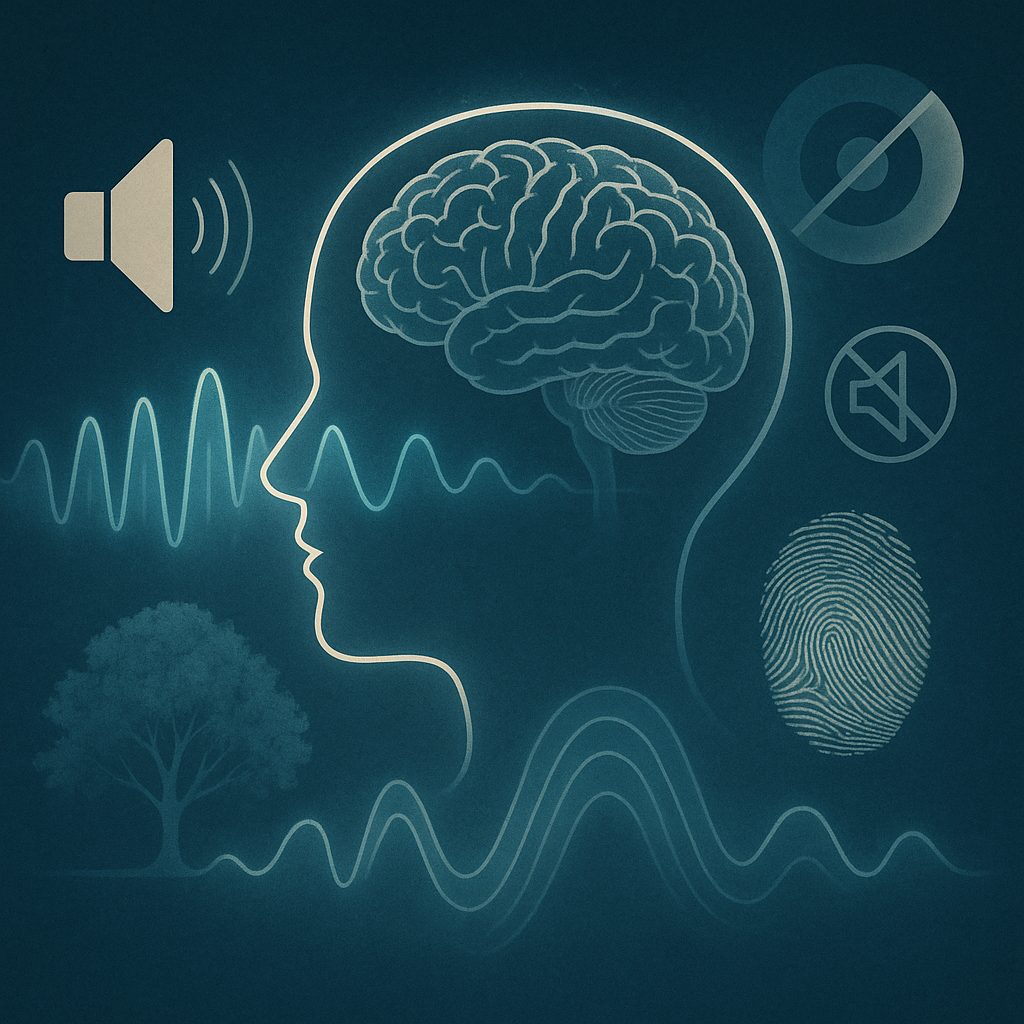
This influence is not only symbolic or emotional. As noted earlier, each sound carries its own vibratory frequencies, and researchers have long explored the fact that sound has a physical action on matter. The sonoluminescence experiments cited by American researchers are often used to illustrate this principle: sound can produce measurable effects in a material medium, which supports the idea that it also interacts with the body’s biological rhythms. In practical terms, elements such as pitch, duration, tempo, rhythm, melody, timbre, harmony, intensity and volume all shape our response.
Certain combinations may help slow mental activity and support relaxation — as is often sought with classical, sacred or new age music — while others may heighten arousal and drive the brain towards a more intense, even trance-like state, as can happen with some ethnic music, techno or hard rock.
- Pitch and duration
- Tempo and rhythm
- Timbre, harmony and intensity
Why memory, emotion and silence are so closely linked
Yet no sound has a universal meaning. The emotion it evokes also depends on personal history, culture, circumstances, education and individual sensitivity. The sound of the wind, the forest or the sea may feel deeply meditative and restorative to one person, and oppressive or unsettling to another. In the same way, certain sounds become tied to specific moments in childhood, whether positive or painful. Just as fears or phobias can remain deeply anchored over time, some sonic memories continue to shape our reactions long after the original experience has passed. This helps explain why music can sometimes comfort us instantly, and at other times stir unease without any obvious reason.
There is also a more intimate dimension to sound: the voice. Even singing in the shower can become a small therapeutic pause, much like laughter or yawning, because these simple acts are associated with the release of so-called happiness hormones such as oxytocin, serotonin, dopamine and endorphins. It is no coincidence that people often say the voice is the human being’s true nerve centre. And beyond sound itself lies silence. As my teacher Li Wing Chuen used to say, “Listen to silence and you will see the invisible.” With time, that idea becomes clearer: there is no absolute boundary between sound and silence.
Silence allows our inner world to resonate, deepens self-perception, and may offer the most subtle music of all — the one attuned to a more balanced listening state.
How to Listen for Happiness Without Forcing It
Happiness in music is not always cheerful. Sometimes a slow piece helps someone feel understood. Sometimes a bright rhythm restores movement. Sometimes silence after a track is what allows the body to register relief.
Related offer
Sacred frequency 432 Hz
432Hz : COSMIC COHERENCE Enter into perfect resonance with the universe... COHERENCE - UNITY - ENERGY - BLISS
View productA useful practice is to listen with one clear intention: calm, energy, tenderness, focus or release. Choose one track, lower the volume enough to stay comfortable and notice what changes in breathing, posture and emotional tone. If the music becomes too intense, change it. The listener's state matters more than the reputation of the sound.
That is why claims about a universal frequency of happiness should stay modest. Sound can invite a state, but it does not command it. The most reliable guide is the repeated observation of what a particular sound does for a particular person at a particular moment.
The Mental Waves Happiness Listening Framework
The Mental Waves frame is to approach happiness through resonance, memory and presence rather than through one promised frequency.
- Choose: select music for a real emotional need.
- Listen: give the sound enough attention to be felt.
- Notice: observe breath, mood, images and body response.
- Integrate: keep the effect with one simple next action.
For instrument-based sound work, continue with Therapeutic Music Instruments. For a wider frequency map, read Sacred Frequencies.
Editorial note from Mental Waves
This article is educational. Music can support wellbeing and emotional regulation, but persistent depression, trauma, severe anxiety or neurological symptoms require appropriate professional support.
Conclusion
What emerges here is not the idea of a single miraculous “frequency of happiness”, but something more subtle and more credible: music can influence our inner state because it acts at once on the body, attention, memory and emotion. Across traditions, care settings and everyday life, sound is repeatedly associated with soothing, stimulation or regulation — yet never in exactly the same way for everyone. Culture, personal history, early experience and context all shape how a piece of music is received, which is precisely why its effects can feel so intimate.
That is perhaps the article’s most important balance: sound has real, observable effects, but its meaning is never purely mechanical. A melody may support relaxation, focus or emotional release; silence, too, may help the mind settle and reveal what constant noise tends to cover over. In that sense, happiness is less a note to be found than a state to be cultivated, through the sounds — and the pauses — that help us return to ourselves.
Frequently Asked Questions About Music and the Frequency of Happiness
Is there a frequency of happiness in music?
There is no single frequency that creates happiness for everyone, but music can support emotional balance through rhythm, memory and attention.
Why does music affect mood?
Music engages attention, memory, movement, emotion and body rhythm, which can change how a moment feels.
Can sad music feel good?
Yes. Sad music may feel comforting when it helps someone process emotion or feel less alone.
Does frequency matter in music?
Frequency is a real physical property of sound, but emotional response depends on much more than pitch alone.
What music supports happiness best?
The best music depends on the person, the memory attached to the sound and the state they want to support.
Can silence support happiness too?
Yes. Silence can help the mind integrate what has been heard and notice the body more clearly.
Can music replace professional care?
No. Music can be supportive, but it does not replace qualified medical or psychological support.
How can someone practise happiness listening?
Choose one intention, listen to one track with attention and observe the effect before deciding what to play next.
What is the main takeaway?
Music supports happiness best when listening is intentional, personal and grounded in real response rather than universal claims.