en
enVotre panier est vide.


Sound therapy
ad-free meditation music
binaural beats
deep listening
free healing frequency videos
guided sound protocol
healing frequency videos
mental reset
Solfeggio frequencies
sound ritual
YouTube healing frequencies
There are thousands of healing frequency videos on YouTube.
At first, that feels like a gift. You type a few words, press play, and the atmosphere changes. A low drone fills the room. A 528 Hz track promises renewal. A 432 Hz video feels softer than expected. A long ambient loop helps you slow down after a crowded day. For many people, this is the first doorway into frequency meditation, Solfeggio frequencies, binaural beats and the wider world of sound therapy music.
But after a while, something else can happen.
You search for a sleep track. Then a focus track. Then a "third eye" frequency. Then Schumann resonance. Then a playlist with a dramatic title. Then another one that seems more powerful. The listening starts as curiosity, but the evening becomes a chain of choices. You are no longer inside the sound. You are searching around the sound.
This article is not against YouTube. YouTube is one of the best places to discover healing frequency videos. It gives people access. It opens doors. It lets someone who has never heard of sacred frequencies experiment without pressure.
But discovery is not the same as depth.
Free platforms help you discover healing frequencies. Mental Waves helps you experience them as a deeper, guided sound ritual.
The problem is not that free healing frequency videos exist. The problem is that many people listen randomly, jump from one promise to another, and never build a real listening ritual.
This article explains why random listening often feels incomplete, how to choose a frequency more consciously, and why a structured sound ritual can create a more intentional and immersive experience.
1. The abundance of free healing frequency videos is not the problem
The abundance of healing frequency videos says something real about modern life. People are looking for sound that supports their inner world.
They search for better sleep, calmer evenings, deeper meditation, clearer focus, emotional reset, sacred atmosphere, energetic balance and a more peaceful relationship with their own thoughts. They look for YouTube healing frequencies, ambient soundscapes, chakra music, theta waves, Solfeggio frequencies, nature sounds, brainwave music and long-form meditation tracks they can leave playing in the background.
That demand is not superficial. It shows that people instinctively understand something important: sound changes atmosphere.
A room with silence is not the same as a room with a slow, low-frequency drone. A night routine with scrolling is not the same as one with dim light and a repeated audio session. A meditation practice with notifications is not the same as one built around uninterrupted listening.
The issue is not abundance itself. The issue is that abundance without guidance can become a second layer of noise.
Choice can feel liberating at first, then strangely tiring. Research on choice overload, including the well-known work by Iyengar and Lepper, suggests that more options do not always make choosing easier. Anyone who has searched for frequency music knows the feeling: twenty possible tracks, ten frequency claims, five open tabs and no clear reason to choose one.
Abundance creates access, but it does not automatically create clarity.
Mental Waves begins where random searching usually stops: with the listening intention.
Do you want to prepare for sleep? Rebuild focus? Create a mental reset after overload? Enter a sacred inner space? Support meditation? Slow down the emotional tempo of the day?
A better listening experience begins before the audio starts.
2. Random listening creates a fragmented experience
There is a familiar scene.
It is late. The phone is still in your hand. You are tired, but not ready to sleep. You search "528 Hz healing frequency." The first result looks good. You press play.
After two minutes, the sound feels too bright. You skip.
The next video says 432 Hz for deep sleep. That feels better, but the comments mention 963 Hz, so you search again. Now you are watching a cosmic-looking video. Then another title appears with a dramatic biological promise. You know some of these claims sound exaggerated, but curiosity keeps pulling you forward.
By the time you finally settle, you are not really resting. You are comparing.
That is the hidden problem with random listening. It gives you stimulation when what you wanted was a state.
Listening to a random frequency video without knowing your intention is like choosing a wellness practice at random without understanding what state you actually want to support.
Or more simply: listening to frequencies randomly is like opening a cabinet full of wellness tools and picking one blindfolded. The tool may be interesting, but the experience becomes more powerful when you know why you are using it.
A focus frequency does not ask the same thing from you as a sleep ritual. A sacred frequency session does not have the same emotional shape as background music while working. A mental reset is not the same as deep meditation. The sound matters, but the context matters too.
Listener feedback across Mental Waves pages often points to the same theme: people do not only remember the frequency number. They remember the quality of the recording, the feeling of returning to a practice, the way a session becomes part of daily life, and the atmosphere created around the listening moment.
That is the difference between consuming sound and entering a ritual.

3. A frequency alone is not the same as a ritual
A frequency can be beautiful. It can be intriguing. It can create a mood. It can help you begin.
But a frequency alone is not a ritual.
A sound ritual includes the sound, but it also includes the moment around the sound: the time of day, the environment, the breath, the posture, the repetition, the instruction, the emotional availability and the reason you chose to listen in the first place.
The same track can feel completely different depending on how it is used.
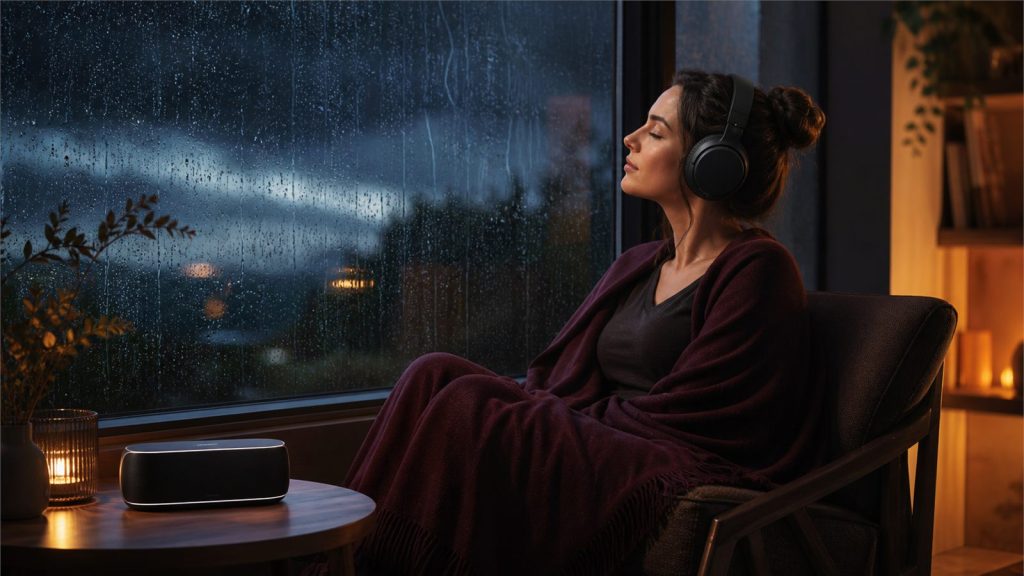
Played through a phone speaker while you answer messages, it becomes background noise. Played with headphones, low light, a clear intention and twenty uninterrupted minutes, it becomes an experience.
A frequency is a sound. A ritual is a relationship with that sound.
That relationship is where depth begins.
A ritual tells the mind: this is not another piece of content. This is a transition. This is where the day changes rhythm. This is where you stop scanning and start listening.
Mental Waves is built around that distinction. It is not generic relaxing music. It is not just one more binaural beats track. It is a premium sound ritual brand built around intention, psychoacoustic design, frequency layering, symbolic meaning and deep listening.
The listener is not left alone with a search bar. The experience is framed.
This matters because many people do not need more content. They need a clearer way to enter the content they already know they are seeking.
4. The algorithm is not designed for your inner state
YouTube recommendations can be useful. They help people discover creators, styles, long-form ambience, meditation channels and healing frequency videos they might never have found otherwise.
But the algorithm is not a meditation guide.
It does not know whether you are exhausted, overstimulated, emotionally heavy, mentally scattered, trying to sleep, preparing to work, or entering a sacred inner practice. It does not know whether you need continuity or novelty. It does not know if the next suggested video will support your state or pull you out of it.
It can help you discover. It cannot truly hold the space.
This is not a criticism of YouTube as a platform. It is simply a difference in purpose. YouTube is designed around discovery, recommendation and continued watching. A deep listening ritual is designed around presence, continuity and intentional return.
Those are different design philosophies.
A listener who wants a premium sound experience may not want the next video to compete for attention. They may not want comments, thumbnails, autoplay, shorts, unrelated recommendations or visual stimulation. They may not want to decide again after every track.
Mental Waves removes that wandering.
No algorithmic drift. No random next video. No unrelated recommendation waiting at the edge of the screen. Just a direct path into the session.
That simplicity is not a small detail. In deep listening, simplicity is part of the experience.
5. Why ad-free and distraction-free listening matters
Meditation, sleep and inner work need continuity.
A sudden interruption may seem minor from the outside, but it can change the whole state from the inside. You are finally slowing down. The body is beginning to release. The mind is less verbal. Then an ad, notification or unrelated visual pulls you back outward.
For sleep, interruption can break relaxation.
For meditation, interruption can pull attention away from the breath and body.
For focus, interruption can damage concentration.
For sacred listening, interruption can break the atmosphere.
This is why ad-free meditation music matters. It is not only about convenience. It is about protecting the listening state.
To be fair, YouTube itself offers Premium features such as ad-free viewing, downloads and background play, as described in YouTube's official Help Center. For many users, that improves the general platform experience.
But Mental Waves is not a general platform with fewer ads. It is a curated listening environment.
The difference is not only technical. It is experiential.
Mental Waves sessions are meant to be entered deliberately. Downloadable access means the listener can return to the same session without searching again. A structured catalogue means the listener can choose by need: sleep, focus, mental reset, stress release, sacred frequencies, inner alignment or deep meditation.
The goal is not just to remove interruption. The goal is to make the whole experience feel coherent.
6. Quality is not only sound quality; it is experience quality
When people hear "premium audio," they often think of file resolution, mastering and production value. Those things matter. Poor sound quality can make a frequency session tiring, harsh or flat.
But quality is bigger than sound quality.
Quality includes the whole relationship between the sound, the listener and the intention.
It includes sound design, frequency layering, emotional progression, listening instructions, visual atmosphere, ritual framing, brand consistency, downloadable access and the ability to return to the same session without searching again.
A sleep frequency should feel different from a focus session. A mental reset should not feel like a random ambient loop. A sacred frequency ritual should have atmosphere, pacing and symbolic coherence. A guided sound protocol should make the listener feel oriented, not lost.
This is where Mental Waves takes a more deliberate position.
Premium does not only mean better sound. It means a better relationship between the sound, the listener and the intention.
That relationship shows up in small details. The title is not sensational. The instructions are clear. The session has a purpose. The listener knows when to use it. The experience can be repeated. The product is downloadable. The brand voice does not need to shout.
Mental Waves does not sell one more frequency. Mental Waves offers a more conscious way to listen.
7. What science supports, and what it does not prove
Sound can influence state. Most people know this directly.
A certain song can soften a memory. A rhythm can energize the body. A low drone can make a room feel larger. A steady ambient tone can help attention settle. A familiar meditation track can become associated with evening, breath and release.
Scientific research supports a cautious version of this everyday truth.
A study published in PLOS ONE found that music listening can affect aspects of the human stress response, including recovery patterns in some physiological measures. Research on binaural beats and auditory beat stimulation is also interesting, though still nuanced. A review in Frontiers in Psychiatry notes that findings can be contradictory and may depend on stimulation parameters and context. A meta-analysis in Psychological Research reported effects across certain outcomes, while also pointing to the importance of exposure time and listening conditions.
That nuance matters.
Mental Waves does not claim to resolve medical conditions, replace healthcare or guarantee transformation through a single sound. The goal is more responsible and more useful: to support relaxation, focus, sleep preparation, meditation, emotional reset and inner alignment through intentional listening.
In other words, a frequency session may support the conditions for a state. It is not a magic switch.
This is also why structure matters. If sound-based research depends on duration, frequency, protocol and context, then random listening is already missing part of the point.
YouTube discovery vs. Mental Waves ritual
Here is the clearest way to see the difference.
| Random YouTube listening | Mental Waves listening ritual |
|---|---|
| Search begins with a frequency number or dramatic title. | Listening begins with a clear intention. |
| The next video is shaped by recommendations. | The next step is shaped by the ritual. |
| Ads, comments and thumbnails can pull attention outward. | The experience is designed to reduce distraction. |
| Quality varies from one upload to another. | Sound design, structure and atmosphere are curated. |
| The listener may jump after a few minutes. | The listener is encouraged to give the session time. |
| There is often no progression. | The practice can be repeated and integrated. |
| The platform is excellent for discovery. | The brand environment is built for depth. |
YouTube helps people find the world of frequency listening. Mental Waves helps people make that listening more deliberate.
A simple 7-day guided listening protocol
If you want to stop listening randomly, do not begin by adding more tracks. Begin by simplifying.
Try this for seven days.

Day 1: Choose one intention
Pick one state only: sleep, focus, reset, relaxation, meditation or sacred inner alignment. Do not try to solve everything in one session.
Day 2: Choose one session
Select one audio experience that matches the intention. If your intention is sleep, choose a sleep preparation session. If your intention is clarity, choose a focus or mental reset session.
Day 3: Prepare the space
Use headphones if recommended. Lower the light. Put the phone face down. Close other tabs. Let the environment tell your body that this is not background music.
Day 4: Give the sound enough time
Do not skip after two minutes. Let the sound settle. Some sessions need time before the mind stops evaluating and the body begins to respond.
Day 5: Repeat the same practice
Repetition is not boring when the intention is depth. Returning to the same session helps the mind recognize the ritual more quickly.
Day 6: Notice the after-state
After listening, ask one simple question: what changed? Do you feel calmer, clearer, heavier, lighter, more present, more ready to sleep, or more able to focus?
Day 7: Decide what belongs in your routine
If the session helped create the state you wanted to support, keep it. If not, adjust the intention or choose a different listening path. The goal is not to collect frequencies. The goal is to build a practice that makes sense for your life.
This is the difference between a search habit and a listening ritual.
When free YouTube videos are enough
Free YouTube videos are enough when you are curious, exploring different styles, testing whether frequency-based music resonates with you, looking for background ambience, or not ready to buy.
That is a valid use. YouTube is a doorway.
It is also useful when you want variety. Maybe you want to hear how different creators approach 432 Hz, 528 Hz, rain ambience, Tibetan bowls, drones, nature sound or binaural textures. Discovery has value.
But discovery has a limit.
If every listening session begins with a new search, you may never build continuity. If every title promises something different, you may never learn which state actually helps you. If you change tracks every few minutes, you may be training the mind to keep scanning instead of settling.
That is when a more structured approach begins to make sense.
When Mental Waves makes more sense
Mental Waves makes more sense when you want to stop searching and start returning.
It is for the listener who wants clear intentions, no ads, downloadable access, premium audio design, ritual structure, organized categories and a coherent brand environment. It is for the person who wants a sound practice that feels held from beginning to end.
Mental Waves turns frequency listening from a random search into a conscious ritual.
It is also for people who already know that sound affects them, but who want a more serious container than random uploads and sensational titles.
If you want to explore sacred listening, begin with a frequency pathway such as Sacred Solfeggio Frequencies or Sacred Healing Frequency 128 Hz.
If you want to understand the science-adjacent language of frequency following, start with Brainwave Entrainment.
If your need is practical and immediate, start with Mental Reset sound rituals or the free Mental Reset session.
The real question is not "free or paid?"
The real question is: "Do I want discovery, or do I want depth?"
Both can have a place. But they are not the same experience.
Conclusion: YouTube is a doorway. Mental Waves is a deeper room.
The question is not whether healing frequency videos are good or bad.
The question is whether you want random discovery or intentional depth.
YouTube can introduce you to YouTube healing frequencies, Solfeggio tones, ambient meditation, binaural beats and the language of sacred sound. It can help you explore. It can help you find what attracts you.
But if you keep jumping from one track to another, never choosing a clear intention, never giving the sound enough time, never building a ritual, the experience may remain fragmented.
Mental Waves exists for the next step.
A clearer path. A quieter container. A more intentional relationship with sound.
YouTube is a doorway. Mental Waves is a deeper room.
Explore the Mental Waves sound rituals and choose the inner state you want to support today: sleep, focus, reset or sacred inner alignment.
Try a simple sound ritual
Frequently Asked Questions
Are free healing frequency videos on YouTube bad?
No. Free healing frequency videos are useful for discovery. They help many people explore sound, frequency meditation and relaxation music for the first time. The limitation is that they are often not structured into a clear ritual.
Why should I pay for frequency music if YouTube has so much for free?
Because you may want no ads, better organization, downloadable access, guided intention and a more immersive ritual experience. Mental Waves is not only about accessing sound. It is about entering a coherent listening environment.
Does Mental Waves claim to heal medical conditions?
No. Mental Waves is a wellness and deep listening experience. It is not healthcare and does not replace professional support. Its purpose is to support relaxation, focus, sleep preparation, meditation and inner alignment.
What makes a sound ritual different from a normal frequency video?
A sound ritual includes intention, structure, duration, atmosphere, repetition and guidance. It turns listening into a conscious practice instead of a random audio choice.
Can I still use YouTube and Mental Waves together?
Yes. YouTube can be useful for discovery. Mental Waves can be used for deeper, more intentional listening when you want structure and continuity.
Which Mental Waves experience should I start with?
Start with your intention. Choose sleep if you want evening support, focus if you want concentration, mental reset if you need a pause, or sacred inner alignment if you want a deeper meditative atmosphere.
Do I need headphones?
Headphones can improve immersion, especially for binaural or spatialized audio. Some sessions may also work through speakers. Follow the recommendation for each session.
How often should I listen?
Consistency matters more than intensity. A simple repeated ritual can be more meaningful than jumping randomly between many tracks.