en
enVotre panier est vide.


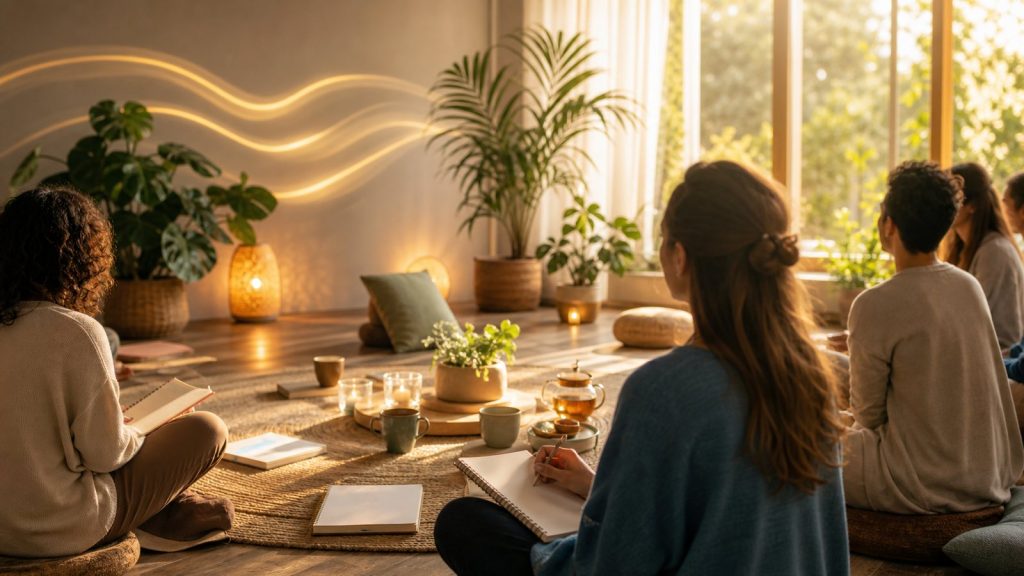
Happiness is now being taught with surprising seriousness. At Yale, a course called Psychology and the Good Life, launched on 12 January, drew 1,200 students according to figures released on 26 January, making it the university’s most popular class. That success says something about the moment we are living through: the idea of learning how to live better, with more steadiness and perspective, no longer feels marginal. It has become a subject people are willing to study in earnest.
What these courses promise is not a permanent state of cheerfulness, but something more grounded: ways of building enough inner resources to face life’s harder moments. Drawing on positive psychology, they aim to help people become more optimistic and more engaged with daily life, whether through university teaching, group workshops or one-to-one sessions. Behind the popularity of these programmes lies a simple question, and a very human one: can happiness be practised rather than merely hoped for?
What Happiness Courses Actually Teach
From Yale’s lecture halls to a practical science of wellbeing
According to the New York Times, Yale University’s course Psychology and the Good Life, launched on 12 January, attracted 1,200 students in their first and second years of psychology in Connecticut. It quickly became the university’s most popular class. That success says something in itself: many students are not simply looking for abstract theory, but for tools that might help them live better. The course is rooted in positive psychology, with the aim of helping people become more optimistic, more enthusiastic and, in very practical terms, better equipped to handle everyday life.
In short: what do happiness classes teach?
Happiness classes teach habits that make wellbeing more trainable: gratitude, self-knowledge, attention, emotional regulation, social connection and realistic daily practice. They do not promise permanent happiness; they help people notice and repeat what supports a more stable inner life.
- Gratitude turns attention toward what is already nourishing.
- Self-knowledge clarifies needs, values and limits.
- Meditation and breathing help regulate stress.
- Joy becomes easier when it is practised in small, repeatable ways.
For a short reset before practising, try the free Mental Reset Session. For emotional grounding, read Making Peace with Emotions.

That same spirit appears in the way Corinne Cosseron, founder of the International School of Laughter and a rigologist for the past sixteen years, describes this kind of learning. In her view, people come to these courses to “store up enough happiness to face the difficult moments in life”. It is not about denying hardship or pretending everything is fine. The idea is to strengthen inner resources before life becomes overwhelming, so that joy, confidence and perspective are not left entirely to chance.
- positive psychology
- greater optimism and enthusiasm
- practical tools for difficult moments
Exercises designed to turn reflection into daily habits
Corinne Cosseron also runs a weekend programme called Training bonheur two or three times a year. These sessions take place at the Maison du bonheur in Frontignan and usually bring together around ten participants, most of them women aged between 30 and 65. Over fourteen hours, the work combines personality tests, meditation, laughter sessions and ideas drawn from positive psychology. The format matters: rather than staying at the level of theory, participants are invited to test things out, notice what resonates and begin to understand their own relationship with happiness.
The course also leaves room for both group reflection and personal reflection on what happiness means to each person. That balance is important, because it allows participants to hear other people’s experiences while also clarifying their own. By the end of the training, the goal is not just to feel uplifted for a weekend, but to go home with one concrete resolution that can be applied in everyday life. In other words, these courses try to make happiness less of a vague ideal and more of a practice that can be worked on, step by step.
- personality tests
- meditation and laughter sessions
- individual and group reflection
- one concrete resolution to apply at home
When happiness is taught in a more personal way
For those who prefer one-to-one guidance
Not everyone feels at ease in a group setting. Some people would rather work on their wellbeing in a more private, tailored way, through one-to-one lessons on platforms such as Superprof. That is the approach offered by Thierry Penda, a teacher of positive psychology and former salsa instructor, who builds his sessions around simple exercises that can be repeated at home.
These practical exercises focus on self-esteem, gratitude and satisfaction. The aim is not to deliver a grand theory of happiness, but to help people feel better in everyday life by drawing on their own strengths. In that sense, the work is deliberately concrete: small practices, revisited regularly, to make happiness feel less like an abstract ideal and more like something that can be cultivated.
- self-esteem
- gratitude
- satisfaction

Creative workshops that help people shape their own happiness
There are also formats that sit somewhere between teaching and personal exploration. Florence Servan Schreiber, author and happiness teacher, runs workshop-conferences in which participants are encouraged to create their own happiness, rather than wait for it to arrive from outside. The spirit is active and personal: each person is invited to reflect, test things out and find what genuinely resonates with them.
To do that, she uses creative exercises such as collage, the interpretation of photographs and writing letters addressed to oneself. These activities may seem simple, but they give people another way of putting words and images to what they feel, what they want and what might help them live more fully. Here again, the underlying idea remains the same: happiness can be worked on through concrete practices, provided they are rooted in one’s own experience.
- collage
- photo interpretation
- letters written to oneself
Seven Lessons That Make Happiness More Practical
The useful side of happiness classes is that they bring a vague ideal back into daily behaviour. Happiness becomes less about chasing a mood and more about training attention, repairing habits and giving the nervous system better conditions.
- Notice: pay attention to what repeatedly drains or nourishes you.
- Thank: practise gratitude without denying difficulty.
- Move: use the body to change mental state.
- Breathe: regulate before reacting.
- Connect: protect relationships that support real presence.
- Create: make room for playful or meaningful action.
- Repeat: prefer small habits over dramatic resolutions.
How to Turn a Happiness Class Into a Daily Practice
The difficult part is not understanding these lessons. Most people already know that gratitude, movement, breathing, friendship and meaningful activity are helpful. The difficult part is remembering them when the day becomes noisy, when fatigue takes over or when the mind returns to its familiar loops.
A good happiness class therefore needs a bridge between insight and repetition. The bridge can be very simple: one practice in the morning, one short reset during the day and one review in the evening. That rhythm is modest enough to be repeated, which is why it can become more useful than a long list of ambitious exercises.
- In the morning, name one quality you want to bring into the day.
- At midday, pause for three slow breaths before continuing.
- In the evening, write down one moment that gave energy rather than taking it away.
- Once a week, notice which relationships, tasks or places support a steadier mood.
This is where happiness becomes less theatrical. It does not need a perfect mood, a perfect diary or a perfect meditation posture. It needs small acts of return. Each return teaches the nervous system that pressure is not the only possible rhythm.
Some people benefit from writing practices; others need movement, music or conversation. The best practice is not the one that sounds most impressive. It is the one you can actually repeat when life is ordinary, imperfect and a little demanding.
Related offer
Mental Dynamism and Good Mood
The action of our audio recording affects the limbic system, where our emotional keyboard is located. The...
View productWhere Happiness Courses Need Healthy Limits
Happiness classes also need limits. If they are taught badly, they can make people feel responsible for emotions that are shaped by grief, trauma, illness, financial stress, isolation or difficult relationships. That is not useful. A mature approach does not ask people to smile over pain or turn every problem into a lesson.
The better message is more respectful: even when life is hard, some habits can protect a small space of agency. That agency may be tiny at first. It may be a breath, a boundary, a walk, a call, a meal, a decision to rest or a refusal to attack yourself for struggling.
In that sense, happiness is not a demand. It is a direction. The practices taught in happiness classes are most helpful when they support honesty, not denial. They should make life more inhabitable, not add another standard people feel they are failing to meet.
- Avoid forcing gratitude when grief needs to be recognised first.
- Do not confuse positive thinking with emotional avoidance.
- Use joy practices as supports, not as proof that everything is fine.
- Seek deeper help when symptoms are persistent, frightening or isolating.
This balanced view makes happiness education more humane. It leaves room for laughter, gratitude and beauty, but also for complexity. A person can practise happiness and still be honest about pain. In fact, that honesty is often what makes the practice trustworthy.
The Mental Waves Everyday Happiness Framework
The Mental Waves frame is to treat happiness as a rhythm, not a trophy. The goal is not to feel good every minute. It is to return more easily to clarity, gratitude and inner steadiness after pressure.
- Reset: pause the stress loop before choosing the next action.
- Recognise: name the emotion rather than fighting it.
- Reorient: choose one small behaviour that supports life.
- Repeat: make wellbeing ordinary enough to practise.
A Simple Week of Happiness Practice
A practical way to use happiness classes is to test one theme per day instead of trying to change everything at once. This keeps the work light enough to remain honest. It also makes the practice observable: you can notice what actually changes your state, rather than assuming the same exercise works for everyone.
- Monday: write down three things that already support you, however small they seem.
- Tuesday: identify one recurring stressor and remove one unnecessary layer from it.
- Wednesday: contact one person with a message that is simple, sincere and undramatic.
- Thursday: move the body for ten minutes without turning it into performance.
- Friday: practise one moment of deliberate laughter, play or creative looseness.
- Saturday: give yourself a longer pause from screens, noise or comparison.
- Sunday: review the week and choose one habit worth repeating.
The value of this rhythm is not perfection. If one day is missed, the practice is not ruined. In fact, the ability to return without self-criticism may be one of the most important lessons of all. Happiness becomes more realistic when it allows interruption.
This also keeps the work from becoming another productivity system. The point is not to optimise every emotion. The point is to create small conditions in which joy, rest, gratitude and connection have a better chance to appear.
How to Know Whether the Practice Is Working
The effects of happiness practice are often subtle. A person may not feel euphoric, but they may react less harshly, recover faster after stress or notice beauty a little more easily. These are meaningful signs because they show that the inner climate is changing.
Useful questions include: Do I return to calm a little sooner? Do I speak to myself with less contempt? Do I notice supportive people and places more clearly? Do I make fewer decisions from panic? These markers are quieter than a dramatic mood shift, but they are often more reliable.
If the practice creates pressure, comparison or guilt, it needs to be simplified. A wellbeing habit should make life more spacious, not more crowded. That is why the best happiness class teaches people to listen inwardly as much as it teaches techniques.
Another sign is the quality of ordinary transitions. Notice how you move from work to home, from conflict to repair, from tiredness to rest, or from distraction back to presence. Happiness training becomes real when these transitions soften. The person may still have hard days, but the return path is easier to find.
Related offer
Anti-depression, anti-depression
Help for nervous, seasonal or depressive breakdowns. A revolutionary new 100% solution that is non-chemical, effective and has no...
View productThis is why the most useful happiness lessons are often modest. They teach the mind to stop overlooking what helps. They make care, gratitude and humour easier to recognise before everything becomes urgent. Over time, that recognition can change the emotional texture of daily life.
For Mental Waves, that is the heart of the practice: not chasing a perfect emotional state, but learning how to create small openings. A breath before speaking, a gentler interpretation, a clearer boundary or a moment of music can all become signs that wellbeing is being practised in real life. The more ordinary the gesture is, the easier it becomes to repeat when the day is not ideal. That is how happiness moves from concept to lived rhythm.
This also makes the practice more resilient. A person does not need to wait for a retreat, a course date or a perfect mood to begin again. The next small gesture is already available, and that availability is what turns happiness education into something practical.
If stress is the main obstacle, continue with How to Free Yourself from Stress. For a simple breathing method, read Cardiac Coherence.
Editorial note from Mental Waves
This article is educational and reflective. Happiness courses can support wellbeing, but persistent depression, anxiety or distress deserve appropriate professional care.
Conclusion
What these courses seem to offer, whether in a packed Yale lecture hall or a much smaller workshop, is not a miracle formula but a set of ways to pay closer attention to how we live. Happiness is treated less as a permanent state than as something that can be practised: through gratitude, self-knowledge, reflection, laughter, meditation or small concrete actions that make difficult periods a little more bearable. That nuance matters, because the promise is not a life without struggle, but a better footing within it.
There is also something telling in the variety of formats. Some people need the energy of a group, others the privacy of one-to-one support, and others still respond better to creative exercises than to theory. In that sense, these classes do not really teach people to “be happy” on command; they help them find a language, a rhythm and a few tools that feel believable in everyday life. Sometimes that is already a meaningful shift.
{
"@context": "https://schema.org",
"@type": "FAQPage",
"mainEntity": [
{
"@type": "Question",
"name": "What are happiness classes?",
"acceptedAnswer": {
"@type": "Answer",
"text": "Happiness classes are courses or workshops that teach practical habits linked with wellbeing, gratitude, attention and emotional balance."
}
},
{
"@type": "Question",
"name": "What do happiness classes teach?",
"acceptedAnswer": {
"@type": "Answer",
"text": "They often teach gratitude, self-knowledge, meditation, social connection, laughter, creativity and daily habit practice."
}
},
{
"@type": "Question",
"name": "Do they promise permanent happiness?",
"acceptedAnswer": {
"@type": "Answer",
"text": "No. A responsible course should not promise permanent happiness, but it can help people build more supportive habits."
}
},
{
"@type": "Question",
"name": "Why is gratitude often included?",
"acceptedAnswer": {
"@type": "Answer",
"text": "Gratitude helps attention notice what is already supportive, which can soften stress and comparison."
}
},
{
"@type": "Question",
"name": "Can breathing help with happiness?",
"acceptedAnswer": {
"@type": "Answer",
"text": "Breathing can regulate stress, making it easier to access steadier thoughts and warmer emotions."
}
},
{
"@type": "Question",
"name": "Are private sessions useful?",
"acceptedAnswer": {
"@type": "Answer",
"text": "They may help people who prefer personalised guidance or find group workshops uncomfortable."
}
},
{
"@type": "Question",
"name": "Is happiness trainable?",
"acceptedAnswer": {
"@type": "Answer",
"text": "Some habits linked with wellbeing can be trained, although mood is also shaped by health, life context and support."
}
},
{
"@type": "Question",
"name": "What if someone is depressed?",
"acceptedAnswer": {
"@type": "Answer",
"text": "Happiness practices may support daily life, but depression deserves qualified care when symptoms persist or become heavy."
}
},
{
"@type": "Question",
"name": "What is the main takeaway?",
"acceptedAnswer": {
"@type": "Answer",
"text": "Happiness classes are useful when they turn wellbeing into simple, honest and repeatable daily practices."
}
}
]
}
Frequently Asked Questions About Happiness Classes
What are happiness classes?
Happiness classes are courses or workshops that teach practical habits linked with wellbeing, gratitude, attention and emotional balance.
What do happiness classes teach?
They often teach gratitude, self-knowledge, meditation, social connection, laughter, creativity and daily habit practice.
Do they promise permanent happiness?
No. A responsible course should not promise permanent happiness, but it can help people build more supportive habits.
Why is gratitude often included?
Gratitude helps attention notice what is already supportive, which can soften stress and comparison.
Can breathing help with happiness?
Breathing can regulate stress, making it easier to access steadier thoughts and warmer emotions.
Are private sessions useful?
They may help people who prefer personalised guidance or find group workshops uncomfortable.
Is happiness trainable?
Some habits linked with wellbeing can be trained, although mood is also shaped by health, life context and support.
What if someone is depressed?
Happiness practices may support daily life, but depression deserves qualified care when symptoms persist or become heavy.
What is the main takeaway?
Happiness classes are useful when they turn wellbeing into simple, honest and repeatable daily practices.