en
enVotre panier est vide.


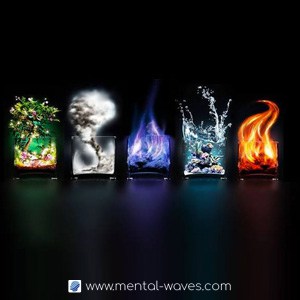
Long before the language of modern science, people tried to make sense of the world through a handful of elemental forces. In the 5th century BC, the Sicilian Greek thinker Empedocles — physician, engineer, poet and philosopher — proposed that existence could be understood through four elements: water, earth, fire and air. What gave his vision its depth was not simply the elements themselves, but the tension between opposing powers of union and division, forces that shape both the cosmos and human life. In that view, health, temperament and even thought arise from a particular balance of these constituents, with harmony depending on how they combine.
That early intuition still feels strangely recognisable. Even now, when our explanations are more technical and our language more precise, we continue to look for patterns that connect body, mood, environment and change. The old elemental systems do not speak in the vocabulary of laboratories, yet they do preserve something enduring: the sense that human life is never entirely separate from the wider order in which it unfolds.
That elemental imagination did not remain fixed, nor did it belong to one civilisation alone. Aristotle would later add a fifth element, the ether, while other traditions developed their own systems according to different religious, philosophical and cultural frameworks. In Chinese and Korean thought, the five elements — or more precisely the five phases, Wu Xing — became a far-reaching way of understanding movement, transformation and correspondence between the human being and the wider universe. Joined to the ideas of yin and yang and vital energy, this was never just a theory of matter: it became a way of reading the links between nature, the body, order and imbalance.
In short: what is five elements theory?
Five elements theory is a symbolic way to understand balance, transformation and relationship. In Greek thought, elemental systems described the fabric of the cosmos. In Chinese Wu Xing, the five elements are better understood as five phases or movements: wood, fire, earth, metal and water.
- Elemental systems connect body, nature, temperament and change.
- Wu Xing is more about cycles and movement than fixed substances.
- The theory is useful as symbolic language, not modern laboratory science.
- Balance matters because each phase influences the others.
For a related Mental Waves lens on vibration and harmony, read Sound, Frequency and Vibration and the 128 Hz sacred frequency guide.
What makes these traditions so compelling is that they do not merely ask what things are made of. They ask how things relate, how they alter one another, and what happens when a living balance is lost. That shift — from substance to relationship — is where the theory of the five elements begins to feel less like a relic and more like a disciplined way of seeing.
From Empedocles to Wu Xing: how elemental systems took shape
Empedocles and the Western search for first principles
In the 5th century BC, Empedocles — the Sicilian Greek physician, engineer, thaumaturge and poet — tried throughout his life to grasp the underlying fabric of the cosmos. His thinking rested on two opposing principles: friendship, described as “a force of unification and cohesion that draws things towards unity”, and hatred, “a force of division and destruction that draws things towards multiplicity”. From their tension arise the four elements: water, earth, fire and air. For Empedocles, these were not abstract symbols alone. Their mixture helped explain health, character and temperament. As the source text notes, “For Empedocles, it is blood that determines thought, because it is above all in the blood that the various elements are mutually tempered.
His religious teaching gives a large place to the need for purification. He believes in the transmigration of souls and conceives the cycle of existences as an expiation.”
There is something strikingly concrete in that vision. Thought is not imagined as floating above the body, untouched by matter, but as arising from a living composition within it. In that sense, Empedocles belongs to a very old lineage of thinkers who refused to split the physical, moral and spiritual dimensions of life too neatly. To modern ears, some of his claims may sound remote, yet the underlying instinct — that inner life depends on a certain proportion and order — has never entirely disappeared.
In the Western tradition, Aristotle later added a fifth element to Empedocles’ four: quintessence, or ether. Even so, no single elemental model became universal. Depending on a people’s religion, culture or philosophy, the list changes. In Hinduism, one finds earth, water, fire, wind and space. In Buddhism, the set expands to six elements — earth, water, fire, wind, space and spirit — and this legacy also appears in traditional Japanese culture, where the Godai retains five elements derived from Buddhism, but without spirit. What remains constant across these traditions is the same intuition: the world can be understood through a small number of fundamental forces or substances whose combinations shape both nature and human life.
Yet it would be a mistake to flatten these traditions into one interchangeable idea. Each system carries its own metaphysics, its own religious atmosphere, its own way of imagining the bond between the visible world and what exceeds it. The resemblance lies less in identical content than in a shared human gesture: the attempt to find order in multiplicity without losing sight of mystery.
Why the Chinese five elements are really five movements
Chinese and Korean traditions take a different path with the Wu Xing, often translated as the five elements, though “five phases” is often closer to the original idea. Here the sequence is metal, wood, water, fire and earth. These are not simply materials sitting side by side; they describe five movements that govern cosmic and human phenomena alike. They became the basis of a vast system of classification and correspondences, closely linked with the notion of qi or energy, and with the Yin-Yang system. As the source puts it, “this system had a considerable impact on the whole history of Chinese thought.”
The distinction matters. When modern readers hear the word “element”, they often imagine a stable substance, something like a building block. Wu Xing points elsewhere. It suggests tendencies, processes, modes of transformation — the way something rises, descends, expands, contracts, nourishes, contains or reshapes. Once that is understood, the theory becomes far more supple and far more alive than a simple list of symbolic materials.
The Hong fan, often regarded as the oldest essay in Chinese philosophy, gives a vivid sense of how these phases were understood: “it is in the nature of water to moisten and flow downwards; in that of fire to burn and rise into the air; in that of wood to be bent and straightened; in that of metal to be ductile and accept the shape given to it; in that of earth to lend itself to cultivation and harvest.
Water, which moistens and flows downwards, becomes salty; fire, which burns and rises, becomes bitter; wood, bent and straightened, becomes sour; metal, which changes form in its ductility, becomes acrid; earth, when cultivated, takes on a sweet flavour” (Anne Cheng, Histoire de la pensée chinoise, Seuil, 1997). This already shows the real spirit of the theory: not a fixed catalogue, but a way of reading patterns, qualities and transformations across the world.
Read slowly, those descriptions reveal a remarkably observational cast of mind. Water is known by what it does. Fire is known by its tendency. Earth is understood through fertility and yield. The phases are therefore not detached concepts imposed on reality from above; they arise from close attention to how things behave. That practical sensitivity helps explain why the model could travel so easily into medicine, governance, ritual, music and everyday life.
- Western antiquity: earth, water, fire and air, later joined by ether
- Hindu thought: earth, water, fire, wind and space
- Buddhist thought: earth, water, fire, wind, space and spirit
- Wu Xing: metal, wood, water, fire and earth as dynamic phases
The web of correspondences in Chinese thought and medicine
A system of qualities, movements and relationships
In Chinese thought, the five elements are not treated as isolated substances so much as patterns of movement and relationship. Joined to the ideas of qi as vital energy and the dynamic balance of Yin and Yang, this framework became one of the great organising principles of Chinese civilisation. As Anne Cheng notes in Histoire de la pensée chinoise (Seuil, 1997), “this system had a considerable impact on the whole history of Chinese thought”.
The Hong fan, often regarded as the oldest essay in Chinese philosophy, describes each element through its natural tendency: water moistens and flows downwards; fire burns and rises; wood can be bent and straightened; metal is ductile and accepts the form given to it; earth lends itself to cultivation and harvest. The text then links these tendencies to flavours: water becomes salty, fire bitter, wood sour, metal pungent, and earth sweet.
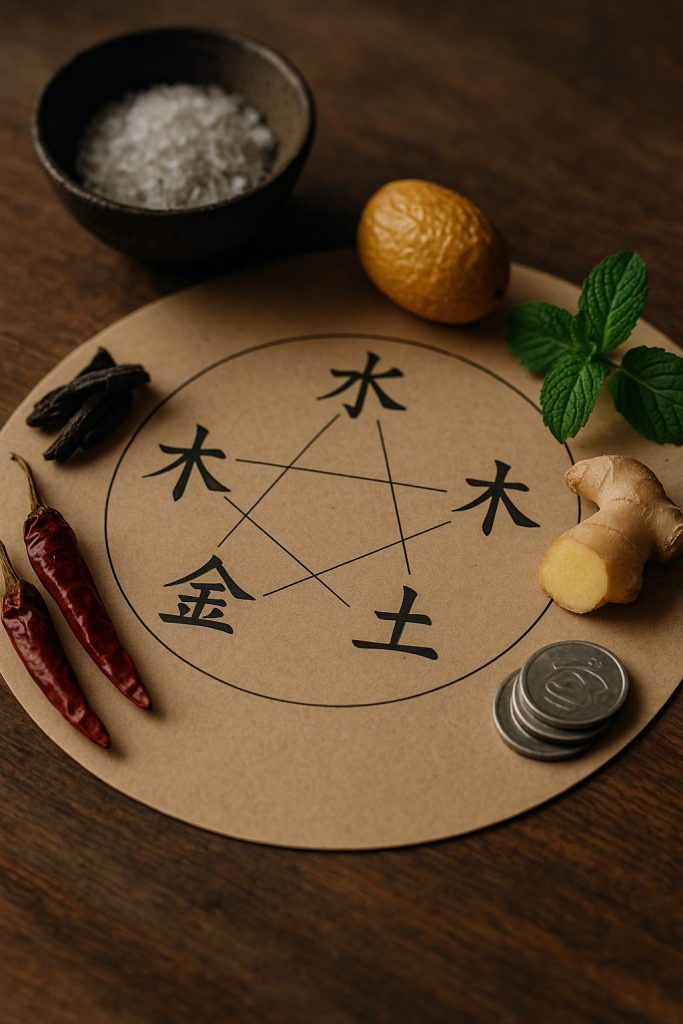
What emerges is a way of thinking in which qualities are never random. Taste, season, direction, colour, climate, organ, emotion and rhythm can all be read as part of a larger pattern. To a modern mind, that may seem at first either poetic or overly schematic. In practice, it is both more subtle and more demanding than that. A correspondence is not merely a decorative analogy; it is a proposed relationship that must make sense within the whole fabric of the system.
This way of thinking was used to classify a great many phenomena into groups of five, creating chains of correspondence between nature and human life, between the macrocosm and the microcosm. The aim was not simply to sort the world into neat categories, but to bring human understanding into tune with the mechanisms of the universe. The familiar generative sequence expresses that logic clearly: molten metal becomes liquid like water; water nourishes trees and gives rise to wood; wood feeds fire; fire reduces vegetation to ash, which returns to earth; and earth contains the minerals from which metal emerges again.
Once everything is seen as part of cycles of creation and transformation, the five-element model becomes a way of reading both natural processes and human experience.
Alongside this generative cycle, Chinese thought also developed controlling relationships between the phases, showing how one movement can restrain another when excess appears. That point is essential, because balance is not achieved by endless growth alone. A healthy order requires nourishment, certainly, but also regulation. In lived terms, this is often where the theory feels most psychologically acute: what supports us can also overwhelm us if nothing counterbalances it.
Related offer
Meditation - Relaxation set
All the Mental Waves® know-how in a single pack for quick and easy access to meditation and...
View productSeen in that light, the web of correspondences is less a rigid chart than a map of dynamic proportion. It asks not only what belongs with what, but what should strengthen, temper or redirect what. That is why the system could remain intellectually fertile for so long: it offered a grammar for change.
- Water: moistening, descending, salty
- Fire: rising, burning, bitter
- Wood, metal and earth: growth, shaping and cultivation
How correspondences shaped traditional Chinese medicine
It is through these multiple correspondences that Traditional Chinese Medicine seeks to identify imbalances affecting a person’s health. The Huangdi Nei Jing, or Inner Canon of the Yellow Emperor, the oldest foundational text of Chinese medicine, develops the idea that different parts of the body correspond to different elements of the universe. In chapter 11, we read that “man is in union with the heavenly way; within the body there are five viscera in correspondence with the five sounds, the five colours, the five seasons, the five flavours, the five positions”. In other words, the body is not viewed as separate from the world around it, but as a living echo of it.
That phrase — a living echo — comes close to the heart of the matter. Within this medical imagination, the body is not a sealed machine made up of isolated parts. It is porous to season, climate, diet, emotion, rhythm and environment. To diagnose well, one must therefore notice patterns: whether something is rising too sharply, sinking too heavily, drying out, stagnating, overheating or failing to transform. The language differs from modern biomedicine, but the clinical intention is recognisable enough: to perceive imbalance before it hardens into deeper disorder.
That is why the five elements came to include not only bodily functions, but also rhythms, sensations and qualities found throughout life. Starting from the principle that everything in the universe is shaped by cycles of generation and destruction, this mode of classification extends across both natural and human phenomena. In medicine, it offers a way of detecting where harmony has been disturbed; more broadly, it reflects a deeper conviction that health depends on balance, adjustment and the right relationship between inner life and the wider order of things.
In practical terms, this means that symptoms are rarely read in isolation. A disturbance in sleep, digestion, mood, voice, complexion or appetite may be interpreted as part of a broader energetic pattern rather than as a disconnected complaint. Whether one fully accepts the framework or not, there is something undeniably humane in that effort to see the person as a whole — not just a malfunctioning organ, but a being situated within time, habit, feeling and environment.
It also explains why prevention occupies such an honoured place in traditional Chinese medicine. If health is a matter of proportion, then care begins long before crisis. One adjusts food, rest, activity and emotional life not because perfection is possible, but because small corrections made early are gentler than dramatic interventions made late.
- organs and bodily functions
- sounds, colours and flavours
- seasons, positions and energetic balance
Balance, power and practical harmony across the ages
Harmony as something to maintain, not assume
Seen through the lens of the five elements, harmony is never a fixed state. It is something that has to be continually adjusted, because everything in the universe moves through cycles of creation and destruction. That idea was not confined to one field. Over the centuries, these five phases were used to think about health, sport, religion, politics, medicine, food, warfare, colours, construction, music and sound. In other words, the theory offered a way of reading the world as a set of living relationships rather than isolated parts.
There is a quiet realism in that. Balance is not imagined as a serene plateau one reaches once and keeps forever. It is more like good posture: alive, responsive, easily lost, always needing renewal. Seasons change, bodies age, emotions surge, climates shift, societies harden or loosen. A tradition built around movement rather than stasis is naturally well suited to that kind of world.
That is why tables of correspondences still matter within this tradition: they are meant to show the links and harmonious relations between elements, whatever the domain in question. The underlying intuition is simple, even if the system itself is complex: when one force shifts, others shift with it. Balance depends less on freezing things in place than on recognising these movements early and responding with the right adjustment.
Used well, such tables are not there to imprison thought. They are memory aids for perception. They train attention towards relationship: if this becomes excessive, what weakens; if that is depleted, what overcompensates; if one rhythm is forced, what elsewhere begins to fray. The wisdom of the system lies not in mechanical application, but in the quality of discernment it asks for.
- creation and destruction
- correspondence and adjustment
- macrocosm and microcosm
From political power to the art of the middle way
This search for balance also had very concrete consequences. From the Qin dynasty onwards, rulers drew on the theory of the five elements to legitimise their reign and authority. The same framework could also be applied in practical matters: more surprisingly to modern eyes, the Chinese are said to have used these five phases to help overcome flooding successfully. So this was never just a speculative doctrine. It could serve at once as a political language, a practical guide and a way of aligning human action with what were understood to be the deeper mechanisms of the universe.
That political use deserves a moment’s pause. Systems of order are rarely innocent once they enter public life. If a ruler can present his reign as cosmically aligned, opposition may be cast not merely as disagreement, but as disorder itself. The five-element theory therefore had prestige not only because it explained things, but because it could authorise them. Like many powerful ideas, it moved easily between insight and instrument.
And yet its practical appeal is equally understandable. A worldview built on cycles, tendencies and mutual influence lends itself naturally to agriculture, architecture, military planning and environmental management. When people live close to seasonal rhythms and material constraints, a theory that emphasises timing, proportion and interaction is not an abstract luxury. It becomes a way of making decisions with consequences that are immediate and tangible.
In that sense, the five-element tradition belongs to a much wider human concern: the search for the right middle. From Aristotle to the technological age, many cultures have returned to this intuition that excess and imbalance carry consequences. In the West, Blaise Pascal expressed it memorably in his Pensées (Brunschvicg edition): “La nature nous a si bien mis au milieu que si nous changeons un côté de la balance, nous changeons aussi l'autre. Il y a des ressorts dans notre tête qui sont tellement disposés que qui touche l'un touche aussi le contraire... Qu'est-ce que l'homme dans la nature ?
Related offer
Mental and Physical Recovery
This session uses waves with extremely precise frequencies that target healing and recovery. Guidance...
View productUn néant à l'égard de l'infini, un tout à l'égard du néant, un milieu entre rien et tout.” The wording is his, but the resonance is familiar: human beings live in relation, in tension, and in constant need of measure.
That idea of measure can sound modest, even old-fashioned, until one notices how often modern life is organised around the opposite impulse: acceleration, amplification, overstimulation, extraction. Against that backdrop, the older language of balance regains a certain force. Not because it offers a sentimental return to the past, but because it reminds us that every gain has a cost when nothing checks it.
The Mental Waves Elemental Balance Framework
The Mental Waves frame approaches the five elements as a contemplative map. Rather than asking whether an element is literally inside an emotion, ask what kind of movement is active in you: expansion, heat, grounding, refinement or flow.
- Wood: growth, direction and the courage to begin.
- Fire: warmth, expression and the risk of excess intensity.
- Earth: stability, nourishment and the need for centre.
- Metal: clarity, boundaries and the art of letting go.
- Water: depth, rest, fear and trust in slow movement.
For a sound-based ritual around inner alignment, receive the free Sacred Frequency Session. For emotional energy hygiene, continue with 11 Elements That Can Lower Your Vibration.
Editorial note from Mental Waves
This article approaches five elements theory as symbolic, cultural and contemplative knowledge. It should not be confused with modern diagnosis or used as a replacement for medical or psychological care.
Conclusion
What endures across these traditions is not a single universal list of substances, but a shared intuition: human life makes more sense when it is read in relation to the wider order of things. From Empedocles’ tension between union and division to the Chinese understanding of the five elements as phases or movements, the point is less to freeze the world into categories than to notice how change, balance and disruption shape both nature and ourselves. That nuance matters: these systems are not all saying the same thing, yet they meet in their refusal to separate the body, the mind and the cosmos too neatly.
Seen in that light, the theory of the five elements is not just an old way of naming the world, but a disciplined way of looking for correspondences, imbalances and right proportion. It helped structure medicine, thought and even political legitimacy because it offered a language for relationship rather than isolation. Perhaps that is why it still speaks to us: not as a relic to admire from afar, but as a reminder that harmony is rarely given once and for all — it is something to be adjusted, with care.
One does not need to accept every historical claim literally to feel the intelligence behind the tradition. Its lasting value may lie less in whether it matches modern scientific categories than in the quality of attention it cultivates: attention to rhythm, to context, to interdependence, to the subtle ways one excess breeds another. That is not a small inheritance.
And perhaps that is the most human lesson of all. We are never made of one thing only. We are mixtures, tensions, seasons, impulses, corrections. We flourish not by escaping that complexity, but by learning how to live within it with a little more sensitivity and a little more measure.
Frequently Asked Questions About Five Elements Theory
What is five elements theory?
Five elements theory is a symbolic framework for understanding nature, human life, change and balance through elemental qualities or phases.
Are the five elements the same in every culture?
No. Greek elemental thought, Aristotle’s ether and Chinese Wu Xing use different systems, meanings and philosophical assumptions.
What does Wu Xing mean?
Wu Xing is often translated as five elements, but five phases or five movements is more precise because it describes dynamic cycles.
What are the five phases in Chinese thought?
The five phases are wood, fire, earth, metal and water. They describe patterns of movement, transformation and relationship.
Why is balance central to the theory?
The elements or phases influence one another. Harmony depends on relationship, proportion and timing rather than one element dominating everything.
Is five elements theory modern science?
No. It is best approached as a symbolic and historical framework, not as modern laboratory science.
Can the five elements help personal reflection?
Yes, when used carefully. The elements can offer language for growth, intensity, stability, boundaries and rest.
How does this relate to vibration or sound?
Both elemental and vibrational language explore harmony, pattern and inner balance. They are useful as contemplative maps when kept grounded.
What is the main takeaway?
Five elements theory remains valuable as a map of relationship and transformation. Its strength is symbolic insight, not literal proof.