en
enVotre panier est vide.


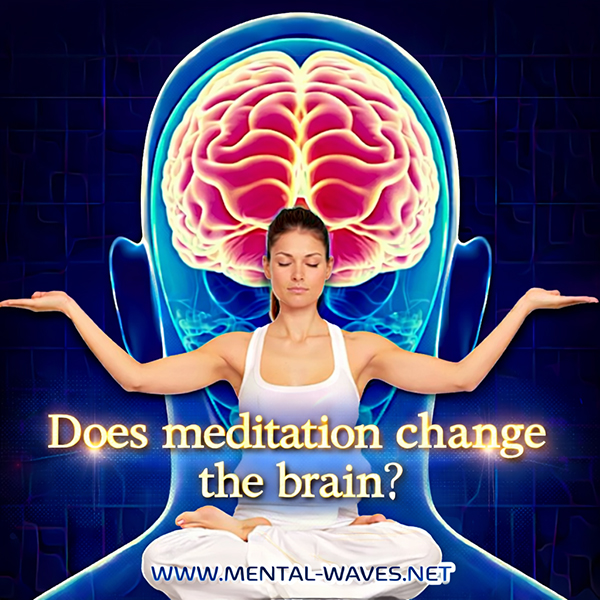
Can meditation actually change the brain? It is a question neuroscience now takes seriously, not least because practices such as meditation and psychosomatic relaxation are increasingly associated with better regulation of chronic stress and its effects, including excess cortisol. Beyond the immediate sense of calm, meditation may help us relate differently to the constant flow of thoughts that shapes attention, judgement and emotional balance. This matters in a world where stress, insomnia, anxiety and burnout have become deeply woven into everyday life, and where non-pharmacological approaches are being explored with growing care.
What makes the subject especially compelling is the meeting point between an ancient discipline and modern brain science. Using tools such as functional MRI, researchers have begun to observe changes in brain activity linked to attention, self-regulation and emotional processing, lending scientific weight to what contemplative traditions have suggested for centuries. The central idea is not that meditation performs miracles on demand, but that regular practice may gradually influence how the brain and mind respond to pressure, memory and emotion. That is why mindfulness is now being studied not only for stress, pain and sleep difficulties, but also for its potential role in supporting people facing more complex psychological or physical strain.
In short: does meditation change the brain?
Meditation may change the brain by training attention, stress regulation and emotional awareness over time. The evidence is interesting, but it should be read as support for gradual neuroplasticity rather than proof of a miracle effect.
- Practice can shape attention and self-awareness.
- Stress regulation may improve through repetition.
- Brain studies show patterns, not instant transformation.
- Duration, method and context all matter.
For a focused research companion, read Meditation and the Brain. For a free contemplative sound cue, receive the Sacred Frequency Session.
What Neuroscience Suggests About Meditation and the Stressed Brain
A practice now studied far beyond spiritual tradition
This is no longer only a philosophical question. Neuroscience is now examining meditation closely because techniques such as meditation and psychosomatic relaxation are increasingly associated with a better response to stress, including patterns often discussed around cortisol and chronic strain. In practical terms, meditation may help us regain a measure of control over our thoughts. That matters in a world where we are said to experience around 60,000 thoughts a day, many of them shaped by judgements about ourselves and others.
By training attention and encouraging a calmer mental state, meditation is often sought as one of the simplest and least expensive ways to support emotional balance and orient the mind towards the so-called “happiness hormones” such as dopamine, serotonin, oxytocin and endorphins.
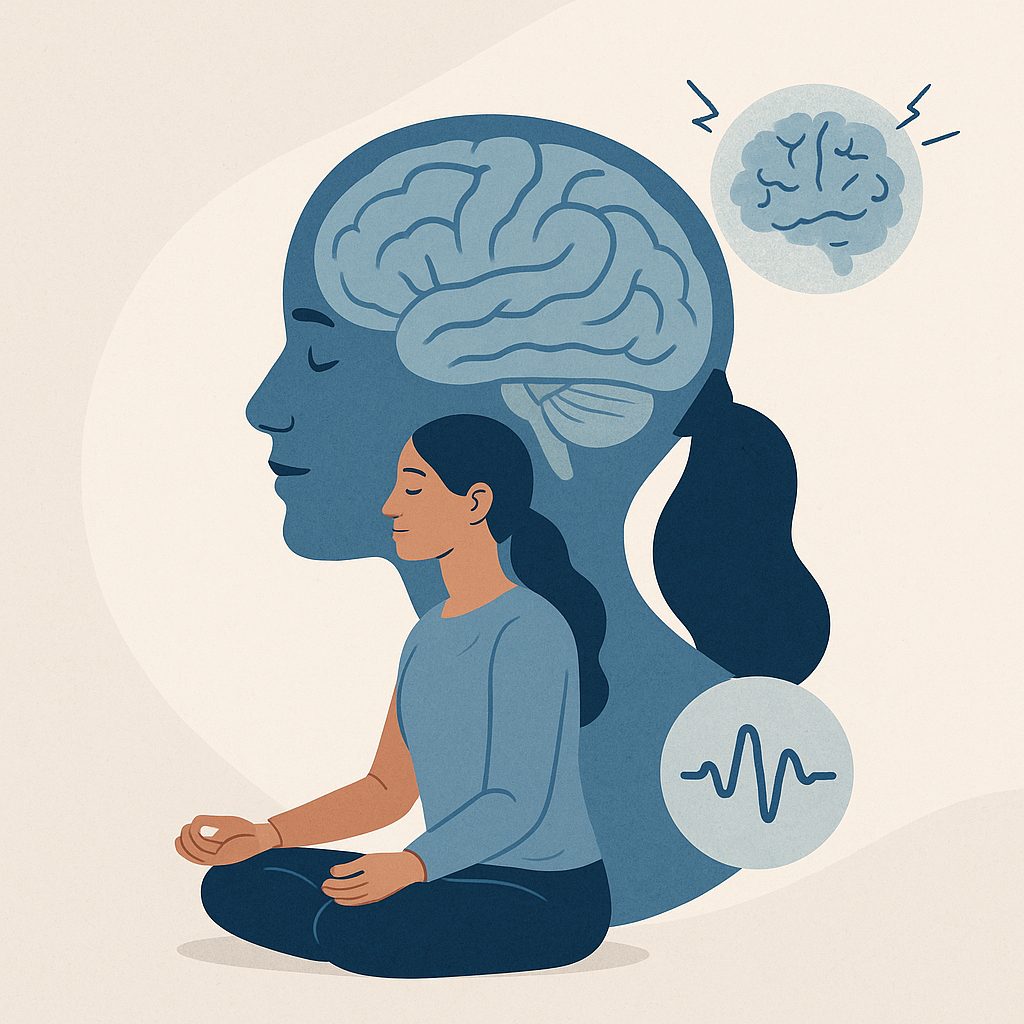
It is worth adding a note of precision here. Researchers do not usually describe meditation as directly producing happiness chemicals in a simple mechanical way. Rather, regular practice may support conditions in which reward processing, social bonding, stress regulation and mood become better balanced over time. In other words, the subjective feeling of greater ease may reflect changes across several systems at once: attention becomes less scattered, rumination may soften, breathing slows, and the body is no longer reacting as if every thought were an emergency.
Researchers have studied the practice from many angles, and modern tools such as functional magnetic resonance imaging (fMRI) now make it possible to observe changes in brain activity associated with this ancient discipline. Without turning meditation into a instant solution, a growing body of work suggests that regular practice may support people dealing with stress, burnout, insomnia, anxiety and chronic pain, and may also be explored alongside broader care for conditions that weigh heavily on modern societies, including heart disease, diabetes and cancer.
Long before contemporary discussions of neuroplasticity, Siddhartha Gautama, better known as the Buddha, expressed a related intuition some 2,500 years ago: “He who gives himself to clear meditations quickly finds joy in all that is good. He sees that wealth and beauty are impermanent and that wisdom is the most precious of jewels.”
From a neuroscientific perspective, the most plausible explanation lies in neuroplasticity: the brain changes in response to repeated mental training, just as it changes with learning, therapy, sleep habits or chronic stress. Meditation does not suspend biology; it works through it. Repeatedly returning attention to the breath, bodily sensations or present-moment experience may strengthen networks involved in monitoring distraction, regulating impulses and recovering from emotional reactivity. This does not mean every study finds the same effect, but the overall direction of research remains sufficiently consistent to justify serious interest.
- better regulation of attention
- reduced reactivity to chronic stress
- support for a calmer emotional state
Why clinicians and practitioners continue to take it seriously
Given the rise in modern stressors, it is easy to understand why meditation now attracts interest not only from the public but also from health and safety professionals. It is widely recognised as a useful support for insomnia, stress-related difficulties, anxious states and pain management. For readers wishing to go further, James Kingsland’s book Buddha au temps des neurosciences (Éditions Dunod) remains a valuable reference. Drawing on contemporary neuroscience, Kingsland argues that there is now strong evidence that mindfulness-based therapy may help prevent relapse in patients with major depression.
He also notes that clinical research into its potential value for insomnia, post-traumatic stress disorder, bipolar disorder, psychosis and many other conditions is still developing, while its usefulness appears increasingly supported in anxiety disorders, chronic pain and addiction.
This clinical interest is important because it moves the discussion away from vague enthusiasm and towards measured application. In healthcare settings, mindfulness-based approaches are generally not presented as replacements for clinical care, psychotherapy or medication when these are needed. They are more often used as structured complements that may help patients notice automatic reactions, tolerate discomfort more skilfully and reduce the cognitive overload that often accompanies distress. That distinction matters, especially when meditation is discussed in relation to serious illness.
What seems clearer today is that meditation is often discussed alongside brain regions involved in self-regulation, stress response, memory and emotional balance. The point is not to promise control over the mind, but to describe a training process: stabilising attention, observing thoughts with more distance, breathing with more awareness and returning to the present moment with less force.
For a practical starting point, begin with five minutes of breath awareness. Let the session be short, repeatable and simple enough to continue.
Some studies also suggest that experienced meditators show differences in baseline brain activity or in the speed with which they recover after distraction or stress. In practical terms, this may translate into something quite ordinary yet valuable: less mental spillover from one moment to the next. A difficult conversation, a painful memory or a surge of anxiety may still arise, but it may no longer dominate the whole field of consciousness with the same force. That is often where meditation becomes meaningful in lived experience: not in the disappearance of difficulty, but in a more flexible response to it.
An Extraordinary Story and What Mindfulness Can Realistically Offer
The case of Phakyab Rinpoche: a striking account that still challenges explanation
Even today, science remains cautious when faced with certain unusual cases linked to meditation. One of the most frequently cited is that of the Tibetan monk Phakyab Rinpoche. After suffering torture, he fled his country and arrived in New York in April 2003. During a hospital stay for gangrene in his right foot, doctors reportedly recommended immediate amputation. Despite the seriousness of his condition, he refused. According to the account, the Dalai Lama encouraged him to seek healing within himself, telling him: “Why do you seek healing outside yourself? You have within you the wisdom that supports repair, and once healed you will teach the world how to heal.”

Living in a small studio in Brooklyn, Rinpoche then spent three years meditating on unconditional love and on the secret yogas of inner energy in which he had been initiated at the age of 16. His story claims that he overcame the infection and rebuilt the bones in his ankle, something normally associated with bone grafting rather than spontaneous recovery. After reviewing the medical file, Dr Lionel Coudron described this double healing as a “phenomenon of exceptional power”.
For readers who wish to explore this account in more depth, his book La méditation m'a sauvé, co-written with Sofia Stril-Rever, is presented by its publisher as a remarkable contribution to the debate around contemplative neuroscience and as a vivid account of awakening to the loving and luminous nature of the mind. It remains an extraordinary testimony rather than a standard medical model, but it continues to fuel reflection on the possible links between mental states, stress regulation and recovery.
Cases like this should be approached with both openness and discipline. They may invite questions about the interaction between belief, autonomic regulation, inflammation, pain perception, immune function and the body’s capacity for repair, yet they do not by themselves establish a general rule. Singular recoveries can be deeply moving without becoming proof that meditation can reliably reproduce the same outcome in others. Scientific seriousness requires that we preserve this distinction.

Related offer
10 States of Consciousness - Infinity Elementary Pack
Elementary Infinity - The 10 States of Consciousness A unique sound box designed to explore the 5 states of...
View productAt the same time, such accounts remind us that the relationship between mind and body is not trivial. Expectations, fear, hope, attention and emotional state can all influence physiology to some degree, particularly through stress pathways. Meditation may therefore be relevant not because it overrides medicine, but because it may alter the internal conditions in which illness is experienced and, in some cases, in which recovery unfolds. That is a more modest claim, but also a more credible one.
Mindfulness in everyday life: accessible, grounded and far from a monastic cliché
This is also why mindfulness continues to resonate so widely: not because it promises miracles, but because it may help people relate differently to pain, stress and daily life. The Zen master Thich Nhat Hanh wrote that “mindfulness is the miracle by which we master and restore ourselves”, and that anyone can rediscover the beauty of life through ordinary moments. In that spirit, meditation is not about withdrawing from the world. It begins with something much simpler and more concrete: returning attention to the present moment, noticing the breath, observing thoughts without immediately identifying with them, and bringing awareness to even the smallest gesture.
As Christophe André reminds us: “The more we suffer, the more we must make sure we stay connected with everything around us... Living mindfully means regularly bringing a calm attention to the present moment. This attitude can radically change our relationship with the world, soothe our suffering and deepen our joys.”
For many people, this shift is subtle before it is profound. One does not suddenly become serene in all circumstances. Rather, there may be brief intervals in which attention is less captured, breathing is less constricted, and thoughts are seen more as events in the mind than as commands that must be obeyed. Over time, these small intervals can accumulate into a different style of consciousness: less fused with inner commentary, more capable of pause, and often more compassionate towards oneself and others.
In an age shaped by technology and constant stimulation, understanding a little more about how the brain works can put us in a stronger position. It may help us step back from negative thought loops and return to what matters with greater steadiness. In that sense, meditation is a valuable resource available to almost everyone, far removed from the old stereotype of the monk or ascetic cut off from ordinary life. Today, many people use posture, breathing and attention training to cultivate a calmer mental state, sometimes with the support of audio or visual tools.
The essential point is that mindfulness can be practised simply, practically and almost anywhere — at home, at work, while walking, or in a few quiet minutes carved out of a busy day.
It is also helpful to remember that accessibility does not mean uniformity. Some people respond well to silent breath awareness, while others find body scanning, guided practice, mindful walking or compassion-based meditation more suitable. For individuals with trauma histories or intense anxiety, certain forms of inward attention may initially feel destabilising rather than soothing. In such cases, gentler formats and appropriate guidance can make a significant difference. Mindfulness is simple, but not simplistic.
- bringing attention back to the breath
- observing thoughts without immediately reacting
- using simple posture and relaxation cues
- practising in short moments throughout the day
How to Read Meditation Brain Studies Carefully
Brain imaging can make meditation look more dramatic than it is. A coloured scan or a statistical map may show a meaningful pattern, but it does not automatically explain the full inner life of the person practising.
The most responsible reading is gradual. Meditation can train attention, soften automatic reactivity and support a more stable relationship with bodily signals. Those changes may be reflected in brain networks, but they are usually built through repetition.
It is also important to separate meditation as a daily practice from meditation as a clinical intervention. A short home practice, a retreat, a research protocol and therapy-supported mindfulness do not have the same role.
This distinction protects the reader from two opposite mistakes. The first is dismissing meditation because it sounds too simple. The second is expecting brain research to turn it into an instant solution. A grounded practice can be modest and meaningful at the same time.
What Brain Change May Look Like in Daily Life
For most people, the useful signs are ordinary rather than spectacular. A person may notice the first wave of irritation sooner, pause before reacting, return to the breath more easily, or recover a little faster after stress.
Those changes may sound modest, but they are exactly the kind of shifts that matter in daily life. Attention becomes less scattered. Emotion becomes a little easier to name. The body gives clearer signals before overload takes over.

Related offer
Meditation - Relaxation set
All the Mental Waves® know-how in a single pack for quick and easy access to meditation and...
View productThis is why the phrase “meditation changes the brain” should not be read as a promise of becoming someone else. It is better understood as training the relationship between attention, body and response through repeated practice.
The Mental Waves Meditation and Brain Framework
The Mental Waves frame is to connect meditation research with practical discernment.
- Practise: repeat simple attention training consistently.
- Observe: notice breath, body and emotional response.
- Interpret: read brain studies with context and humility.
- Support: seek qualified help when distress is persistent.
For brainwave context, continue with Brainwave Frequencies and Meditation. For a beginner practice route, read 5 Easy Ways to Meditate.
Editorial note from Mental Waves
This article is educational. Meditation may support attention and emotional regulation, but mental health concerns, trauma symptoms or medical questions require qualified support.
Conclusion
So, does meditation change the brain? The most careful answer is yes, it appears to influence brain activity and mental regulation, particularly in areas linked to attention, emotional balance and the stress response. What matters, though, is the nuance: meditation is not a instant solution, nor is it simply a vague wellness trend. It sits in a more interesting space, where lived experience, clinical observation and neuroscience begin to meet without fully collapsing into one another.
That is also why the subject continues to hold attention across both healthcare and contemplative traditions. For some people, meditation may help reduce mental overload, improve self-observation and support a steadier relationship with pain, anxiety or exhaustion. For others, its value is quieter but no less real: a more stable attention, a calmer nervous system, a different way of inhabiting the present. Perhaps its deepest effect is not to take us out of life, but to bring us back to it with greater clarity.
If there is a scientific lesson here, it is not that the mind can do anything, but that repeated mental practice appears to matter more than older assumptions once allowed. Attention is trainable. Emotional reactivity is not entirely fixed. The brain remains responsive to experience across life, and meditation may be one structured way of shaping that experience with intention. That is already a significant finding, even before one reaches for more extraordinary claims.
Seen in this light, meditation deserves neither blind reverence nor dismissive scepticism. It deserves careful practice, careful study and careful language. When approached in that spirit, it may offer something both modest and profound: a disciplined way of changing our relationship to thought, stress and presence, with effects that may be felt subjectively and, increasingly, observed objectively.
Frequently Asked Questions About Meditation and the Brain
Does meditation change the brain?
Research suggests meditation may influence attention, emotion and stress-related brain patterns over time.
Is this neuroplasticity?
It can be discussed as neuroplasticity when repeated practice is linked with changes in brain function or structure.
How long does meditation take to affect the brain?
Timing varies by person, method and consistency, so gradual practice is more realistic than instant change.
What brain areas are often discussed?
Studies often discuss attention, emotion regulation and self-referential networks, depending on the method.
Can meditation reduce stress?
It may support stress regulation for some people by training awareness and response flexibility.
Does meditation replace care?
No. It can support wellbeing, but it does not replace therapy, diagnosis or medical care.
What practice is a good start?
A short breath or body-awareness practice is often the simplest starting point.
Why should evidence be read cautiously?
Study design, sample size, method and interpretation all shape what brain research can really show.
What is the main takeaway?
Meditation may shape the brain gradually, but its value comes from consistent practice and realistic expectations.