en
enVotre panier est vide.


Reiki is a Japanese term: Rei refers to the universal dimension of life, while Ki — sometimes written Qi — describes the vital energy understood to flow through each of us. In that sense, Reiki is presented as a way of bringing universal energy back into contact with our own life force, with the aim of supporting healing. Simple on the surface, the idea carries a much wider view of the person, one that does not separate body, mind and inner life quite so neatly.
For many people, that is precisely where Reiki begins to feel different from more familiar approaches to wellbeing. It does not start from symptoms alone, nor from the body as a machine to be corrected, but from the sense that imbalance can be felt across several layers of experience at once. Whether one accepts that language literally or more symbolically, the appeal often lies in this promise of wholeness.
That is also why Reiki has long sat in an unusual place, somewhere between care, spirituality and inherited tradition. Its modern history is usually traced back to Japan in the early twentieth century, around the figure of Mikao Usui, before the practice was carried westward and gradually reshaped along the way. To understand Reiki properly, it helps to hold both sides together: the practical method described by its practitioners, and the more discreet, sometimes mystical background that has always formed part of its identity.
In short: what is Reiki?
Reiki is a Japanese energy practice in which a practitioner uses presence and light touch or hands-off intention to support relaxation and inner balance. It is often approached spiritually, but health claims should remain cautious.
- Reiki is associated with presence, intention and energy work.
- Sessions are usually gentle and non-invasive.
- People may seek it for relaxation or spiritual support.
- It should not replace medical or psychological care.
For a broader spiritual foundation, read What Is Spirituality?. For a free contemplative sound cue, receive the Sacred Frequency Session.
It is also worth saying that Reiki tends to mean slightly different things depending on who is speaking about it. For some, it is a quiet complementary practice used to encourage rest and inner steadiness. For others, it belongs to a more initiatory world, with symbols, lineages and teachings that are not treated lightly. That variation is part of Reiki’s history rather than a contradiction to it.
How Reiki Is Meant to Work in Practice
A treatment based on channelling energy
In Reiki, the practitioner is understood to channel a universal energy and direct it towards the person receiving the treatment. In traditional descriptions of the practice, this is done through hand positions placed over different areas of the body, sometimes alongside esoteric symbols and sacred sounds. Physical contact is not always considered necessary: Reiki may also be practised without touch, and some practitioners believe it can even be transmitted at a distance.
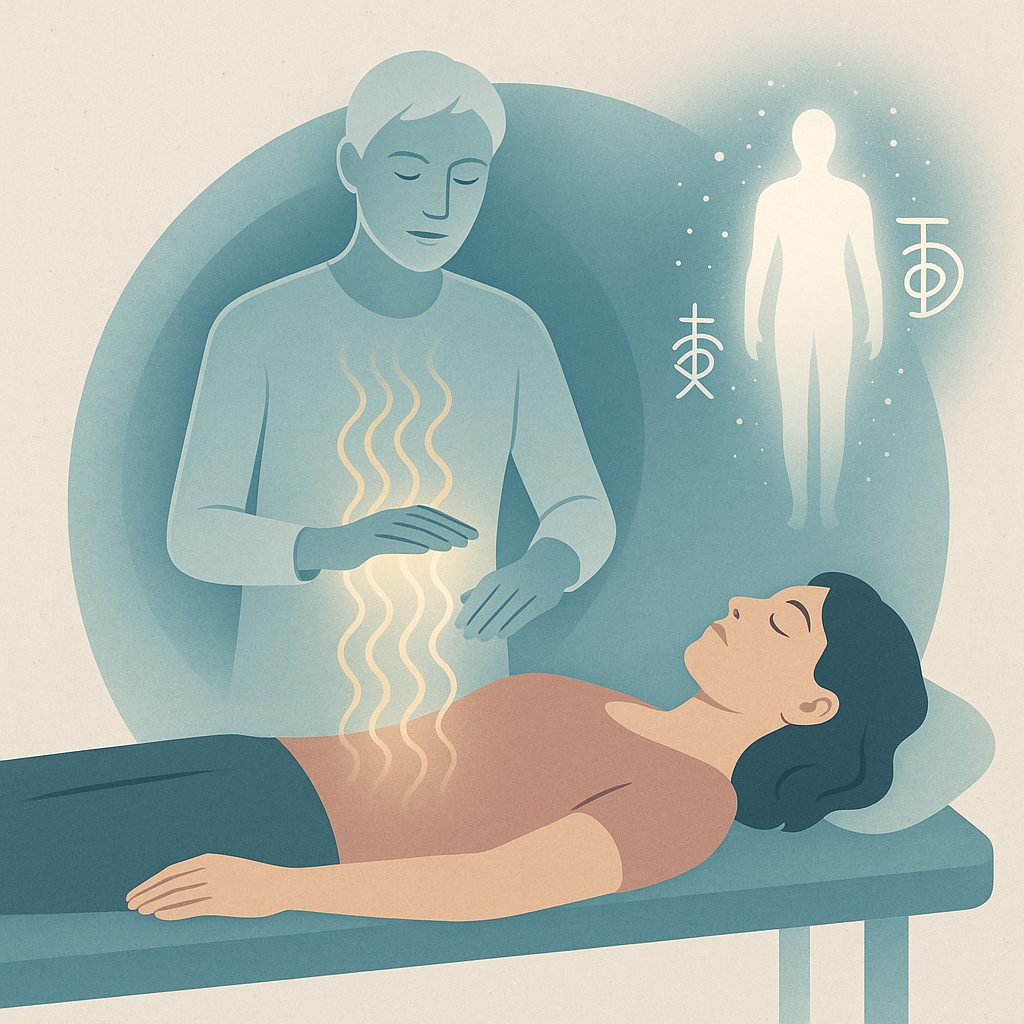
Within this framework, the energy itself is said to act with its own form of intelligence. In other words, it is believed to move towards the person who needs it and to go where intervention is required, without producing side effects. The practitioner’s own personal energy is not supposed to be used up in the process; rather, they are seen as a channel through which this universal force passes.
In lived practice, a Reiki session is often described as remarkably simple from the outside. The recipient usually lies down fully clothed in a quiet room while the practitioner places their hands lightly on the body or just above it, moving through a sequence of positions. There is rarely anything dramatic to see. The emphasis is on stillness, attention and receptivity, which is one reason people sometimes underestimate how significant the experience can feel to those who seek it out.
Accounts of what is felt during a session vary widely. Some people report warmth, tingling, heaviness, emotional release or a deep sense of calm; others notice very little in the moment and only recognise afterwards that they feel more settled. Practitioners generally take this variation as normal. In Reiki circles, the absence of a strong sensation is not usually treated as failure, because the process is believed to work beyond what can be immediately perceived.
An accessible practice with a spiritual dimension, but no formal religion
Reiki is often presented as a practice that is relatively easy to learn. According to this view, almost anyone can become a practitioner in as little as 7 to 14 days, then use it for self-treatment or to care for those close to them. It is described as an energy discipline that works directly on the recipient’s vibrational field, which is one reason it is often placed in the broader family of energy-based healing methods.
At the same time, Reiki is generally not framed as a religion. The original presentation insists that neither the practitioner nor the person receiving treatment needs to follow a particular faith or undertake a specific spiritual path in order to practise it. That point matters, because Reiki often sits in a space that feels spiritual to some people while remaining, in principle, open to anyone regardless of belief.
That accessibility has played a large part in Reiki’s spread. Unlike disciplines that demand years of doctrinal study before any practice begins, Reiki is often introduced through direct experience: a treatment received, a training attended, a sense of curiosity that becomes more personal once the body has had time to register the quietness of it. For many, the first attraction is not ideology but relief — the feeling of being allowed, for an hour, to stop bracing.
Even so, experienced practitioners often make a distinction between learning the basic form and maturing within it. The hand positions can be taught quickly enough, but presence, discernment and ethical steadiness take longer. In that sense, Reiki may be accessible without being trivial. Its simplicity is part of its character, yet simplicity should not be confused with superficiality.
- It may be practised with or without physical touch.
- Some traditions also accept distance healing.
- It is often taught as something ordinary people can learn quickly.
Those points help explain why Reiki has remained so approachable across different cultures. It asks for very little equipment, can be adapted to different settings, and is often presented in language that feels gentle rather than technical. For some people, that very gentleness is what makes it easier to trust.
How Reiki Took Shape and Spread Beyond Japan
The figure at the origin of Reiki
According to the tradition most often told, Reiki as we know it was founded in the early 20th century by the Japanese teacher Mikao Usui (1865–1926). His story has long been surrounded by legend. He was sometimes presented as a Christian theologian, yet a synthesis of studies published in Alternative Therapies in Health and Medicine suggests something rather different: Usui appears instead to have been a very young Buddhist apprentice. It was in that setting that he is said to have learned martial arts and formed a friendship with a Japanese convert to Christianity, without himself undertaking any formal theological training.
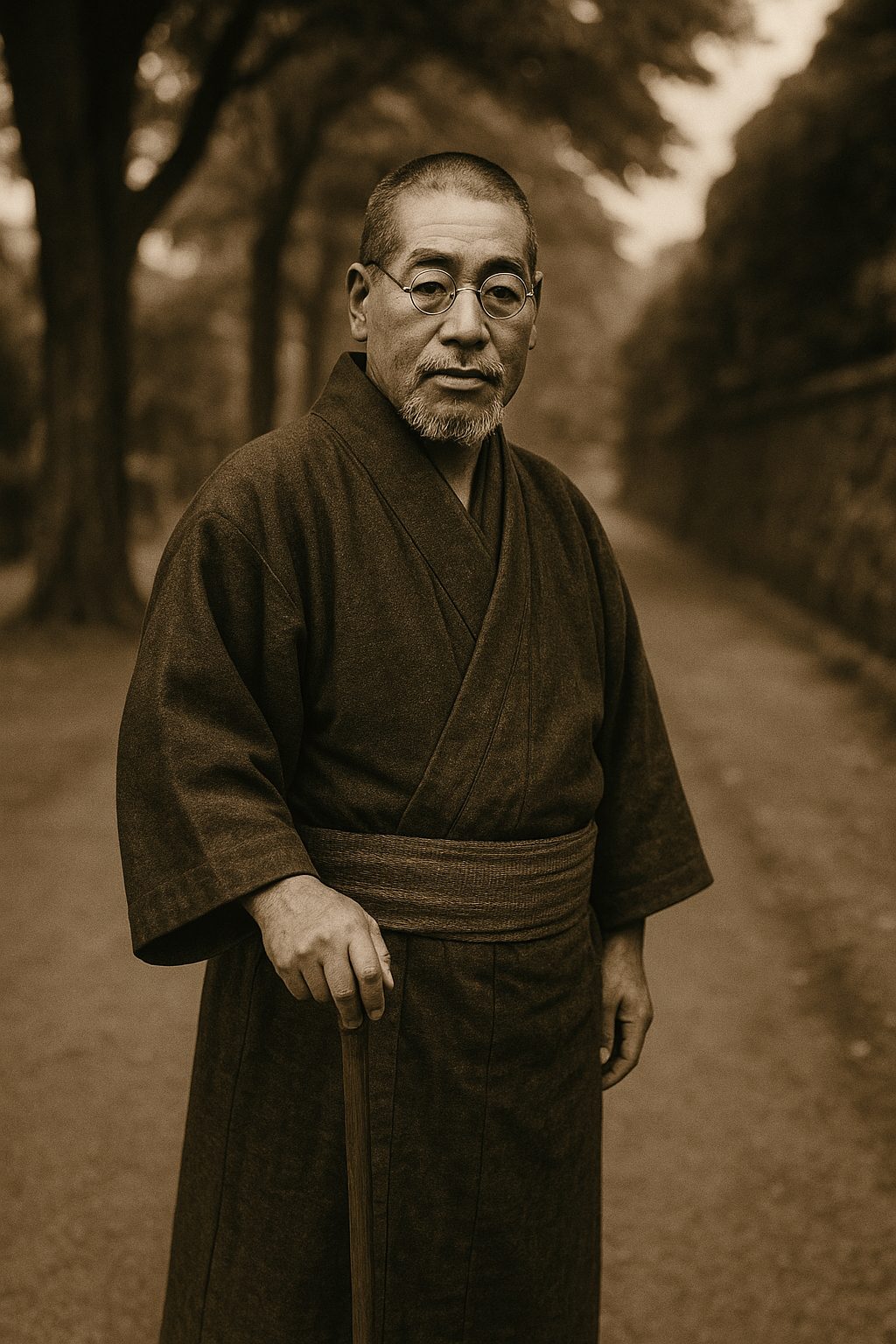
That distinction matters because it helps explain the spiritual background usually associated with Reiki. The practice was not originally framed as Christian in Japan, even if later accounts sometimes moved in that direction. In other words, the roots attributed to Usui point more towards a Japanese spiritual and cultural context than towards Christian doctrine, despite the way his biography was later retold.
As with many healing traditions, the founder’s life has often been polished by retelling. That does not make the history meaningless, but it does invite caution. Reiki has been transmitted not only through documents and institutions, but through reverence, memory and oral teaching. When a practice travels in that way, biography can become part history, part teaching story — a way of expressing values as much as recording facts.
Usui’s place in Reiki therefore carries more than a simple founder’s title. He represents an origin point, certainly, but also a source of legitimacy for later lineages. That is one reason debates about what he really taught, how he understood healing, and how closely later forms resemble his own approach still matter to practitioners today. Beneath those debates lies a familiar question: when a tradition spreads, what exactly is being preserved?
From Usui to Takata: the Western transmission
The spread of Reiki beyond Japan is closely tied to Hawayo Takata, often seen as the key figure in its Western development. She helped make Reiki more acceptable in the West by referring to Christianity in the way she presented it. In 1937, she brought the practice from Japan to Hawaii after receiving Reiki treatment herself from Chujiro Hayashi, one of Usui’s disciples. Hayashi had opened a Reiki clinic after being authorised by Usui to apply and develop its therapeutic use.
Even so, the lineage was not entirely straightforward. Hayashi is said to have altered Usui’s original approach, and Usui ultimately chose Jusaburo Ushida as his official successor. After Usui’s death, Ushida became president of the Usui Reiki Ryoho Gakkai. Takata, for her part, died in 1980 after passing her teaching on to 22 Reiki masters in North America. By then, Reiki had spread widely across the West, evolving along the way as different masters adapted it according to their own aims and interpretations.
That Western expansion changed more than geography. As Reiki moved into new cultural settings, it was often translated not just linguistically but conceptually. Ideas that may have sat naturally within a Japanese spiritual framework were sometimes recast in more therapeutic, universal or psychologically accessible terms. This made Reiki easier to receive, but it also meant that some of its original texture could become softened or rearranged.

Related offer
Mental and Physical Recovery
This session uses waves with extremely precise frequencies that target healing and recovery. Guidance...
View productTakata’s role is especially striking for that reason. She was not merely a messenger carrying an untouched tradition from one place to another; she was an interpreter, and interpretation always leaves a mark. Much of what many Western students came to know as Reiki passed through her voice, her emphases and her sense of what would be heard. That is not unusual in the life of a tradition, but it does explain why Reiki today exists in several forms that feel related without being identical.
By the late twentieth century, Reiki had become broad enough to include both highly structured lineages and more eclectic adaptations. Some schools remained close to inherited ritual forms, while others placed greater emphasis on intuitive healing, personal development or complementary wellbeing. The result is a practice with a recognisable core, yet with edges that have never been entirely fixed.
- Mikao Usui is presented as the founder of modern Reiki.
- Chujiro Hayashi helped develop its therapeutic application.
- Hawayo Takata played the decisive role in its Western expansion.
Seen this way, Reiki’s history is not a straight line but a series of transmissions, each shaped by context. That helps explain both its resilience and the disagreements that sometimes surround it. A practice carried by people will always bear the imprint of people.
Between Spiritual Healing and Medical Tradition
A practice often linked to older spiritual lineages
Some people see Reiki as an older traditional method that Mikao Usui is said to have rediscovered and reworked through a Buddhist experience. That idea is not entirely implausible. In the tantras of Tibetan Buddhism, there are indeed traces of healing practices carried out through the laying on of hands, which helps explain why Reiki is sometimes placed within a much longer spiritual lineage rather than treated as a wholly modern invention.
That said, the comparison has limits. These forms of healing do not appear in the medical practices derived from Buddhism in any clear or direct way. So while Reiki may echo older spiritual gestures and ideas, it cannot simply be described as a branch of Buddhist medicine. The resemblance is real, but it remains partial.
This is where nuance matters. It is tempting either to romanticise Reiki as an ancient secret preserved intact across centuries, or to dismiss it because its historical links are not perfectly linear. In reality, many spiritual practices emerge through a mixture of inheritance, reinterpretation and fresh formulation. Reiki seems to belong to that more complex middle ground, where older motifs survive without proving an unbroken system.
The laying on of hands itself is one of those motifs that appears in many cultures. It carries an almost universal human intuition: that presence can be conveyed physically, that care can travel through touch or near-touch, and that healing is not always experienced as a purely technical act. Reiki gives that intuition a particular language and structure, but the underlying gesture is older and wider than any single tradition.
- possible links with Tibetan Buddhist tantras
- healing through the laying on of hands
- no clear place within Buddhist medical practice
For that reason, Reiki often feels both familiar and unusual at once. Familiar, because the human impulse behind it is easy to recognise; unusual, because the framework of universal energy, symbols and transmission places it outside ordinary secular categories.
Why Reiki is usually understood as a spiritual practice
From that perspective, Usui appears less as a physician than as a spiritual healer working with the laying on of hands, in a way that also recalls practices found in both Buddhism and Vedic traditions. This distinction matters, because it changes how Reiki is understood: not as a medical system in the conventional sense, but as an energy-based approach rooted in a spiritual view of healing.
In the end, Reiki sits in an in-between space. It borrows the language of care and relief, yet its foundations remain largely spiritual, and at times openly mystical. That is why it is often described as a practice marked by a degree of secrecy, with teachings, symbols and meanings that are not always presented in the same way from one lineage to another.
Calling Reiki spiritual does not necessarily mean placing it beyond all questioning, nor does it require dramatic beliefs. More often, it means recognising that its central assumptions are not those of modern biomedicine. Reiki speaks in terms of energy, attunement, intention, symbolism and subtle influence. Whether one receives those ideas as literal truths, working metaphors or meaningful ritual forms, they belong to a spiritual rather than clinical imagination.
This is also why Reiki can provoke both devotion and scepticism. To those who have found comfort in it, the practice may feel quietly profound, especially because it offers a kind of care that is slow, attentive and non-invasive. To others, its language can seem too elusive, too difficult to verify, too dependent on belief. Both reactions are understandable. Reiki asks to be approached in a register that is not purely empirical, and not everyone is willing to enter that register.
Yet even among those who practise it seriously, there is often an awareness that Reiki should not be confused with clinical care in the ordinary sense. It may accompany a person through stress, fatigue, grief or periods of inner disarray, but that is not the same as replacing diagnosis or clinical care. The most grounded practitioners tend to understand this boundary clearly. In fact, Reiki is often at its most credible when it remains modest about what it is.
Perhaps that is the clearest way to place it: Reiki belongs to the long human history of healing practices that work through meaning, presence, ritual and the felt sense of connection. It may not fit neatly into modern categories, but that untidiness is part of its nature. It lives where care and mystery still overlap.
How to Approach Reiki With Discernment
Reiki can be meaningful for people who value spiritual practice, relaxation and subtle forms of presence. The safest approach is to separate personal experience from exaggerated claims. A session may feel calming, symbolic or supportive without proving every statement made about energy.
Related offer
Meditation - Relaxation set
All the Mental Waves® know-how in a single pack for quick and easy access to meditation and...
View productGood discernment also protects the client. A serious practitioner should respect consent, comfort, boundaries and the person's existing care. Reiki should never pressure someone to stop medical advice, medication or therapy.
Before a session, it is reasonable to ask what will happen, whether touch is involved and how the practitioner handles discomfort. Clear expectations make the experience calmer and help the person remain free to choose.
The Mental Waves Reiki Discernment Framework
The Mental Waves frame is to approach Reiki through respect, grounding and clear limits. Spiritual openness works best with practical responsibility.
- Respect: understand the tradition and the person receiving the session.
- Ground: keep the body, consent and comfort central.
- Discern: avoid absolute claims and pressure.
- Integrate: notice whether the session supports calm, reflection and daily balance.
For a related tradition around subtle influence, continue with Magnetism and Magnetizers. For another spiritual tradition, read Shamanism.
Editorial note from Mental Waves
This article is educational and reflective. Reiki can be explored as a complementary spiritual or relaxation practice, but health concerns require qualified medical or psychological support.
Conclusion
Reiki sits in a space that many modern readers find both intriguing and difficult to pin down. It presents itself as a practice of channelling universal energy, yet its history, transmission and meanings have shifted over time, especially as it moved from Japan to the West. That is why it makes more sense to approach it with both openness and discernment: not as a fixed medical system, and not simply as a vague spiritual trend, but as a practice shaped by belief, ritual, lineage and personal experience.
What remains constant is the underlying intention: to restore balance through the laying on of hands, or sometimes at a distance, within a framework that is spiritual without necessarily being religious. Seen in that light, Reiki belongs less to conventional medicine than to a broader tradition of spiritual healing, where symbolism, presence and the idea of vital energy all matter. Its appeal lies precisely in that in-between space — part care, part mystery, and still, for many, deeply meaningful.
For some, Reiki will remain too intangible to trust fully. For others, that very subtlety is what allows it to reach places that more practical forms of support do not always touch. Either way, it is best understood neither through caricature nor through blind idealisation, but through careful attention to what it claims, where it comes from, and why it continues to speak to so many people.
In the end, Reiki endures because it answers a need that is older than any modern debate about it: the need to feel held, rebalanced and met with a form of care that does not rush. Whether one sees it as energy work, spiritual practice or a ritual of deep presence, its staying power suggests that it touches something many people still recognise instinctively.
Frequently Asked Questions About Reiki
What is Reiki?
Reiki is a Japanese energy practice associated with presence, intention, relaxation and spiritual support.
Where does Reiki come from?
Modern Reiki is generally traced to Japan and the teaching tradition associated with Mikao Usui.
What happens during a Reiki session?
A session may involve light touch or hands held near the body while the receiver rests comfortably.
Is Reiki a religion?
Reiki is not usually presented as a religion, though many people approach it spiritually.
Can Reiki support relaxation?
Some people experience Reiki sessions as calming, reflective or emotionally supportive.
Can Reiki replace medical care?
No. Reiki should not replace qualified medical or psychological care.
How should someone choose a practitioner?
Look for clear boundaries, consent, humility, respect and no pressure around health decisions.
Is Reiki scientifically proven?
Evidence is debated, so Reiki is best approached with openness, personal discernment and cautious claims.
What is the main takeaway?
Reiki can be explored as a gentle spiritual practice when approached with grounding, respect and clear limits.