en
enVotre panier est vide.



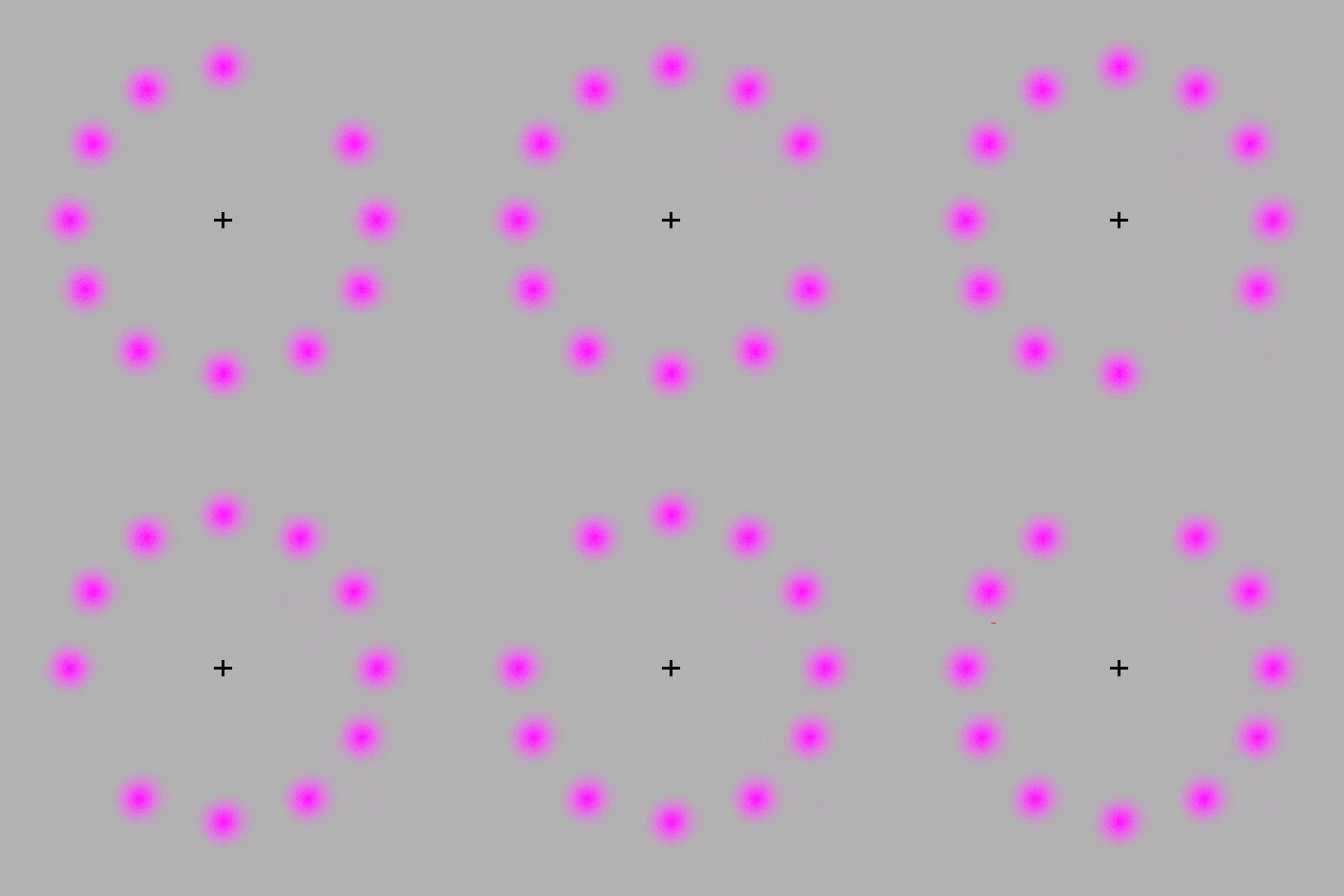
Before you look at the image, it helps to know what to expect. The spinning pink dots optical illusion, also known as the Lilac Chaser, changes depending on where you place your attention. If your eyes follow the moving gap, the dots look pink. If you hold your gaze on the black + at the center, a green dot may seem to appear and the pink dots may fade away.
In short: spinning pink dots optical illusion
The spinning pink dots optical illusion is a playful way to notice how attention changes perception, colour, movement and what seems to disappear.
Use this article as a practical map: keep what helps attention become steadier, question anything that sounds absolute, and connect the idea back to repeatable daily practice.
That is what makes the test so memorable. There is no green dot in the image, and the pink dots do not truly vanish. The experience is created by the visual system in real time. With one small shift in attention, the brain edits color, motion and background into a result that feels obvious even though it is not physically present.
Try the Spinning Pink Dots Illusion Properly
Use the test in two passes. The contrast between the two experiences is the point: first you follow movement, then you fix attention.
- Follow the moving gap with your eyes. The dots should continue to look pink, and the illusion stays relatively mild.
- Return your gaze to the black cross. Keep your eyes as steady as you comfortably can.
- Notice the moving green impression. After a few seconds, the missing pink dot may seem to become a green dot.
- Keep looking at the center. If your fixation remains steady, the surrounding pink dots may seem to fade.
- Look away and reset your eyes. The image has not changed. Your perception has.
What Is Happening in the Brain?
This illusion is not just a trick image. It is a compact demonstration of how visual perception is assembled. The image gives the eyes a simple pattern, but the brain turns that pattern into motion, color and disappearance.
1. A negative afterimage creates the green impression
The dots are pink or magenta. When a colored stimulus stays in the same retinal area for long enough, the visual system can adapt to it. When the dot briefly disappears, a complementary afterimage can appear. For magenta, that complementary impression is green.
This is why the green dot feels real even though it is not drawn in the file. The image gives you a pink dot that disappears in sequence; your visual system supplies the green afterimage.
2. Troxler fading makes the pink dots disappear
When your eyes fixate on the center, the surrounding dots sit in peripheral vision. If a peripheral stimulus is steady enough, the brain may start to fade it from awareness. This is known as Troxler fading.
In everyday life, tiny eye movements keep visual information refreshed. During this test, the instruction to stare at the cross makes the fading easier to notice.
3. Motion perception ties the afterimages together
The image is built from separate moments, but the mind reads them as a continuous moving object. As the gap moves from dot to dot, the green afterimage seems to travel around the circle.
The result is elegant: a dot that is not green seems green, dots that are present seem absent, and a sequence of changes feels like a smooth moving object.
The Mental Waves Attention Reset Framework
For Mental Waves, this illusion is more than a curiosity. It is a short lesson in attention. Where you place attention changes what becomes vivid, what fades and what your nervous system prioritizes.

Related offer
10 States of Consciousness - Infinity Elementary Pack
Elementary Infinity - The 10 States of Consciousness A unique sound box designed to explore the 5 states of...
View productUse the illusion as a one-minute attention reset with this simple framework: fix, observe, name, release and return.
- Fix: choose one clear anchor, such as the black cross in the center.
- Observe: notice what appears, fades or changes without rushing to explain it.
- Name: say plainly what happened: "I saw a green dot, but it was not in the image."
- Release: let the effect go by looking away, blinking and softening the eyes.
- Return: bring the same clean attention to the next task, breath or sound cue.
This is the bridge between an optical illusion and a focus ritual. The lesson is not that the brain is unreliable in a frightening way. It is that perception is selective, and attention can be trained to become more deliberate.
What This Illusion Teaches About Focus
The first version of the test feels ordinary because you chase motion. The second version feels surprising because you stop chasing and hold a single anchor. That difference is useful beyond the image.
Many attention problems begin the same way: the mind follows the moving thing. A notification, a thought, a worry, a tab, a memory, a sound. The illusion gives you a visible version of that pattern. When attention follows every movement, the system stays reactive. When attention stabilizes, different layers become visible.
That does not mean you should force concentration. It means you can practice returning to one anchor gently. In Mental Waves work, that anchor is often sound: a pulse, a tone, a breathing rhythm or a guided transition that gives the mind one clean place to land.

Related offer
18 States of Consciousness - Integral Infinity Pack
Integral Infinity - The 18 States of Consciousness A unique sound box designed to explore all the...
View productEditorial note from Mental Waves
This article is a perception exercise for curiosity and attention. Stop if visual effects feel uncomfortable, and avoid prolonged staring if you are sensitive to visual stimulation.
Conclusion
The spinning pink dots illusion is powerful because it makes perception visible. The green dot is not in the image. The pink dots do not truly disappear. Yet the experience can feel immediate and convincing.
That gap between what is present and what is perceived is the real lesson. We do not simply record the world; we assemble it moment by moment. And sometimes a small visual test can remind us that attention is not passive. It shapes what becomes real enough to notice.
If this experiment made you more aware of how quickly attention can be steered, you can turn that awareness into a short practice. Try the free Mental Reset Session when you want to move from scattered attention into a calmer, clearer transition.
Spinning Pink Dots Illusion FAQ
What is the spinning pink dots optical illusion?
The spinning pink dots optical illusion is a fixation illusion, also known as the Lilac Chaser. When you stare at the black cross in the center, a green moving dot may appear and the pink dots may fade, even though the image itself has no green dot and the pink dots are still present.
Why does a green dot appear in the spinning pink dots illusion?
The green dot is usually explained as a negative afterimage. When the visual system adapts to the pink or magenta dots, the complementary green impression can appear when a dot disappears briefly against the neutral background.
Why do the pink dots seem to disappear?
The fading effect is linked to Troxler fading. When your eyes stay fixed on one point, unchanging or low-contrast objects in peripheral vision can begin to fade from awareness, even though they are still physically present.
How do you see the full effect?
Keep your gaze on the black cross in the center and avoid following the moving gap. After a few seconds, the moving gap may look green. If your fixation stays steady, the pink dots may seem to fade from view.
Is the spinning pink dots illusion an eye test?
No. It is a visual perception demonstration, not a medical eye test. If you have concerns about your vision, sudden visual changes or persistent visual symptoms, speak with a qualified eye-care professional.
What does this illusion show about attention?
It shows that attention changes perception. Following the moving dot keeps the experience simple, while fixing your gaze on the center lets afterimages, fading and motion perception combine into a stronger illusion.
Is there really anything green in the image?
No. The green dot is not drawn in the image. It is a perception created by the visual system when attention is held on the central cross and the magenta dots disappear briefly in sequence.
What is the Mental Waves takeaway from this illusion?
The Mental Waves takeaway is that attention is an active force. A small change in focus can change what feels real for a moment. This makes the illusion a useful doorway into a simple focus reset practice.
Can the spinning pink dots illusion be used as a focus exercise?
Yes, it can be used as a brief attention exercise because it shows how focus changes what becomes visible. Keep it short, observe the effect, then rest your eyes.