en
enVotre panier est vide.


Before turning to the Triskell itself, it helps to pause over the wider symbolic world of Brittany. A place is rarely understood through a single emblem, and Brittany has long expressed its identity through a dense visual language: the ermine, the black-and-white Gwenn ha Du, the Celtic cross, the Tro Breizh, its motto, its music and its regional dress. As Teilhard de Chardin once observed, nothing is truly intelligible apart from its history. That feels especially true here, where signs that may seem decorative at first glance carry layers of memory, belief, belonging and continuity.
Within that landscape, the Triskell holds a singular place. Strongly associated with Breton culture, it also reaches far beyond it, which is precisely what makes it so compelling. Its three branches have been read in many ways over time: as natural elements, stages of life, moments of the sun’s course, or even divine figures within the Celtic world. That abundance of meanings is not a weakness but part of the symbol’s enduring force.
From some of its oldest known forms in prehistoric Europe to its later presence across the Celtic nations and even in distant traditions such as Sicily, Japan, Tibet and Korea, the Triskell seems to return wherever human beings try to give shape to movement, balance and the mystery of existence itself.
In short: what does the Triskell symbol mean?
The Triskell is usually understood as a three-branched symbol of movement, cycles and relationship. In Breton and Celtic contexts, it is often linked with land, sea and sky, past, present and future, or body, mind and spirit, but its strength comes from the way it keeps meaning open.
In simple terms, triskell symbol meaning is about motion, threefold balance and the way life returns to itself through cycles.
A grounded triskell symbol meaning keeps two dimensions together: Breton cultural memory and a broader meditation on movement, return and balance.
- It is one of the most recognizable symbols associated with Brittany.
- Its three spiralling branches suggest motion rather than stillness.
- The number three gives it wide symbolic resonance across cultures.
- Its meaning changes with context, tradition and personal interpretation.
For a related reflection on harmony, read Sound, Frequency and Vibration and the 128 Hz sacred frequency guide.
Perhaps that is why it still speaks so easily to the present. Popularised anew in Brittany during the 1970s, not least through Alan Stivell and the Celtic musical revival, it has since become both familiar and strangely inexhaustible: a sign worn as a charm, chosen as a tattoo, or contemplated as a meditation on the power of three. And behind all the competing interpretations, one question remains quietly persuasive: might the Triskell be, at heart, a symbol of universality — a way of gathering life’s cycles, oppositions and continuities around a single living centre?
Brittany’s Symbolic Landscape Beyond the Triskell
The signs that shape Breton identity
Before looking at the history of the Triskell, it helps to pause over the wider symbolic world of Brittany, because, as Pierre Teilhard de Chardin wrote in The Future of Man, “Nothing is understandable except through its history.” Even small details carry that history. The letters BZH seen on car stickers, for instance, are simply the abbreviation of Breizh, the Breton word for Brittany. The region’s best-known emblem is the ermine, long associated with purity and still present in the coats of arms of many Breton towns. This small carnivorous animal, white in winter except for the black tip of its tail, is stylised as a mark with three downward points.
The same motif appears eleven times on the Gwen ha du, the Breton flag, alongside its nine alternating black and white stripes, traditionally linked to the nine historic territories or bishoprics of Brittany and to the idea of diversity held together by unity.
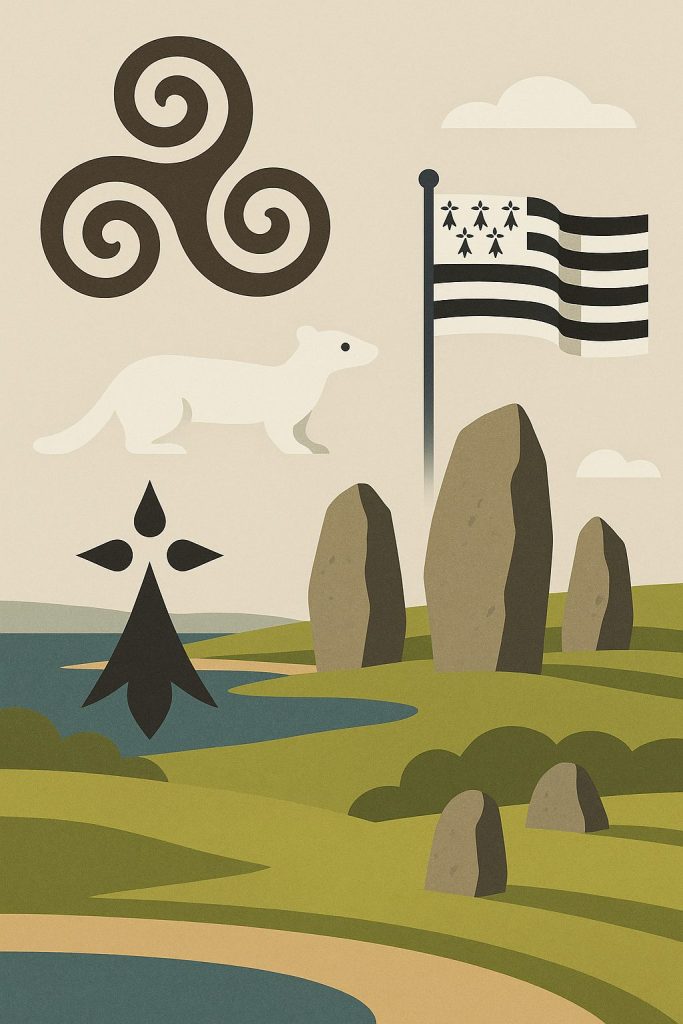
Other markers of Breton identity are just as telling. The region has its own motto, kentoc'h mervel eget em zaotra — “Rather death than defilement” — as well as distinctive traditional dress, once used as a visible sign of social recognition and of the divide between Lower Brittany, where Breton was spoken, and Upper Brittany, where Gallo prevailed. Music and song also remain central. Bro Gozh Ma Zadoù, often treated as the Breton national anthem, was once played by the SNCF in Rennes and Redon stations to welcome travellers, and it is still heard before certain sporting events.
Its words are strikingly close across Breton, Cornish and Welsh, which says a great deal about the deeper inter-Celtic ties that run beneath regional identity.
- BZH: shorthand for Breizh
- Ermine: emblem of purity
- Gwen ha du: 11 ermine marks and 9 black-and-white stripes
Crosses, pilgrimage and a culture steeped in symbols
Travel through western France and you will also come across many Celtic crosses, some erected from the beginning of the 8th century. These crosses are often read as joining time and space. According to one interpretation, they evoke the Nordic god Odin, while their four arms point towards the cardinal directions or the four seasons. The Celtic cross, or ringed cross, is distinguished by the circle set within it — a form deeply rooted in Celtic tradition. That circle can suggest the wheel, but also the universe and knowledge itself. In that sense, it invites comparison with the famous Ensō, the Zen Buddhist symbol of emptiness and completion, itself connected through Taoist Chinese wu and Korean son traditions.
Some even see in the Celtic cross a relationship with the planets. Whether or not every interpretation convinces, the point remains the same: in Brittany, symbols rarely stay on the surface.
The same is true of the Tro-Breizh, the medieval pilgrimage honouring the seven founding saints of Breton Christianity. For a long time, every Breton was expected to complete it during their lifetime in order to gain paradise. Seen together, these emblems, rites and visual codes create the backdrop against which the Triskell later takes on its full force. It does not appear in isolation, but within a region already shaped by sacred journeys, heraldic signs, songs, crosses and inherited forms of belonging. That is why the Triskell became such a powerful inter-Celtic symbol: Brittany had long been speaking the language of symbols before it came to stand at the centre of it.
The Triskell’s Many Meanings Across Cultures and Time
A symbol shaped by many readings
Among the best-known inter-Celtic symbols, the Triskell — also written triskelion, triscèle or sometimes linked in popular usage to the triquetra — remains one of the most recognisable. Its name comes from the Greek triskélès, meaning “three legs”, which already tells us something essential about its form and its mystery. In popular tradition, its three branches are often said to represent water, earth and fire. Others prefer sky, earth and water. Some historians associate them with Lug, Ogme and Dagda, the three principal gods of the Celtic religion. Healers have sometimes read in it the sequence of sleep, dream and waking, while older interpretations see the three ages of life: childhood, adulthood and old age.
New Age readings tend to favour past, present and future. For the archaeologist and Celtic specialist Venceslas Kruta, however, the Triskell refers above all to the three stages of the sun’s movement across the horizon: sunrise, zenith and sunset.
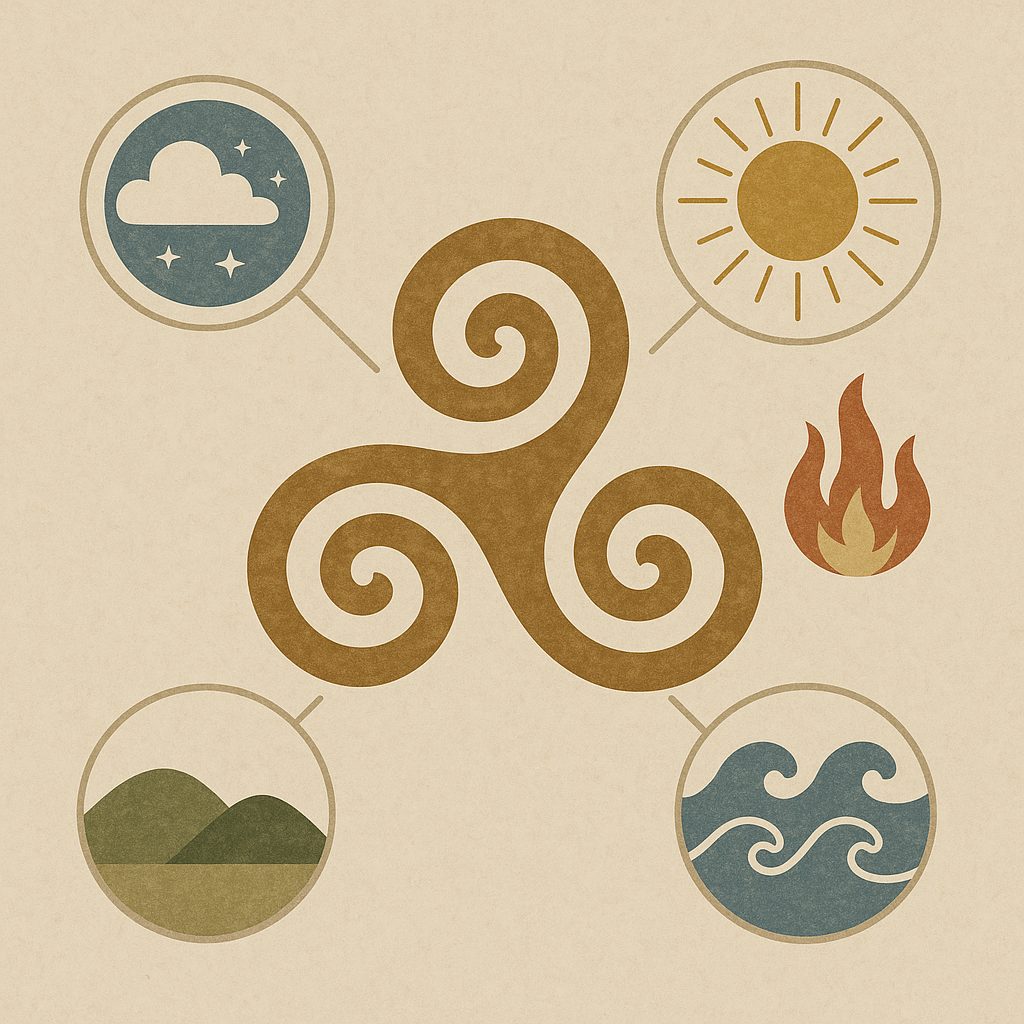
That abundance of meanings can feel bewildering, and one more hypothesis has even been added in recent years: the idea that the motif may echo the shamrock. Rather than trying to force a single definitive explanation, it makes more sense to recognise what the symbol has always invited: interpretation. The Triskell’s oldest known forms appear far beyond Brittany, on the megalithic temples of Malta and at the Neolithic tomb of Newgrange, dated to around 3200 BCE. Its rounded geometry gives it a sense of movement, continuity and vitality. Traditionally, its three limbs — whether seen as human legs or as a cyclic symmetry — are meant to turn in a clockwise direction, associated with peace and the sacred.
Turned the other way, it has sometimes been read as a sign of war, conflict, ill omen or death. Even that detail shows how a simple graphic form can carry an entire symbolic world.
Related offer
Sacred frequency 432 Hz
432Hz : COSMIC COHERENCE Enter into perfect resonance with the universe... COHERENCE - UNITY - ENERGY - BLISS
View product- Popular reading: water, earth and fire
- Historical reading: Lug, Ogme and Dagda
- Symbolic reading: childhood, adulthood and old age
- Kruta’s reading: sunrise, zenith and sunset
From the Celtic world to a wider human imagination
The Triskell belongs unmistakably to the wider Celtic world — from the Isle of Man and Scotland to Asturias, Galicia, Ireland and Brittany — yet what is striking is how often a closely related form appears elsewhere. It can be seen in the Japanese tomoe-Mitsudomoe, notably on the taiko drum, in the Tibetan Buddhist Gankyil, in the Korean Sam Taegeuk, and even on the flag of Sicily. These parallels do not necessarily prove a single origin, but they do suggest that the threefold spiral or rotating triad speaks to something deeply shared in human symbolism.
In Brittany itself, the emblem gained renewed visibility in the 1970s thanks in large part to Alan Stivell, whose role in the revival of Celtic music helped bring the Triskell back into everyday cultural life.
Since then, it has become almost impossible to miss: in magazines, at Breton gatherings, and in the worlds of jewellery and tattooing, where it is often worn as a good-luck symbol or as an image of the cycle of life. That long survival matters. The Triskell has crossed centuries, from the Iron Age to the present day, without losing its power to attract meaning. Like the pyramids, it continues to generate theories, some more convincing than others, because it sits at the meeting point of history, belief and imagination.
That may be precisely why it endures: not because everyone agrees on what it means, but because each age finds in it a form spacious enough to hold its own questions.
Why the Power of Three Gives the Triskell Universal Reach
A symbol that echoes one of humanity’s oldest patterns
By this point, it becomes clear why the Triskell has inspired so many interpretations, some persuasive, others more speculative. At the heart of them all lies the same question: why does the number three speak so powerfully to us? If the Triskell’s three branches do indeed evoke the sun’s three visible stages — sunrise, zenith and sunset — it is hardly surprising that people have also read into it the three ages of life: childhood, adulthood and old age.
From there, the associations multiply almost endlessly: man, woman and child; the Father, the Son and the Holy Spirit; past, present and future; morning, afternoon and evening; birth, life and death; body, mind and soul; the material, the mental and the spiritual; earth, sky and humankind; wisdom, strength and beauty; even length, width and height.
And the pattern does not stop at religion or philosophy. It runs through myth, language and everyday life with remarkable persistence. We find it in the Capitoline Triad, the three Fates, the three Graces, the three wise men, the three primary colours and the three oceans. We hear it in familiar expressions such as “good things come in threes”, just as French says jamais deux sans trois.
We see it in sport, from the football hat-trick to the number three in rugby union, and across literature, comics, cinema and theatre: The Three Little Pigs, Goldilocks and the Three Bears, Chekhov’s Three Sisters, The Three Musketeers, Asimov’s three laws of robotics, the three Deathly Hallows in Harry Potter, the three protagonists of Grand Theft Auto V, the three Elven rings in Tolkien, even Donald Duck’s three nephews. One could add the three pyramids of Giza, which still prompt the same curious question: why three? The recurrence is so striking that it feels less like coincidence than a deep symbolic reflex shared across cultures.
- creation, union and harmony
- beginning, middle and end
- balance between distinct but connected forces
From symbolic abundance to a universal reading
One could write volumes on the symbolism of three. As has often been noted, in many cultures it is the largest number written with as many lines as the number itself, and human societies have repeatedly given the idea of the triplet a special symbolic charge. That is why groups of three so often become triads, trinities, trilogies, trios or triplets. Even numerology gives the number 3 a dense and ambivalent personality: sociability, communication, creativity, adaptability, expression, originality and sensitivity on one side; vanity, superficiality, arrogance, discouragement and dispersion on the other. In other words, three is rarely neutral. It suggests movement, relation and tension — exactly the qualities that make the Triskell feel alive rather than static.
So after all these winding interpretations, one final thought naturally emerges. What if the Triskell’s three branches simply point towards something more timeless: a symbol of universality? Its central axis can be read as a stable core, while the three human-like legs, or cyclic symmetry, suggest the many paths of existence unfolding around it. Seen in that light, the Triskell does not belong only to one doctrine, one era or one people, even if Brittany has made it one of its most recognisable emblems. It becomes an invitation to reflect on meaning, direction and the purpose of a human life.
Whether one is a child, an adult or an old person, the underlying idea remains disarmingly simple: the most important thing in life is life itself, in all its forms.
The Mental Waves Threefold Symbol Framework
The Mental Waves frame reads the Triskell as a symbol of dynamic balance. Its three branches do not lock meaning in place; they invite the mind to see relationship, rhythm and movement.
Related offer
11 Sacred Frequencies + Climax Bundle
Sacred Frequencies Pack including 10 videos and 11x 20-minute tracks of activating music.
View product- Movement: the spiral form suggests life in motion.
- Relationship: each branch exists because the others complete the form.
- Cycle: the symbol points toward recurrence, transformation and return.
- Integration: three becomes a way to hold complexity without splitting it apart.
For a contemplative sound ritual, receive the free Sacred Frequency Session. For another frequency-based reflection, continue with 432 Hz Tuning.
Why the Triskell Still Speaks to Modern Readers
The Triskell survives because it is both specific and open. It belongs strongly to Breton visual identity, yet it does not depend on one narrow explanation to remain meaningful. A person can see heritage in it, another can see the movement of life, and another can see the threefold structure that appears in so many human stories.
That openness is not a weakness. Symbols become durable when they can carry memory without becoming rigid. The Triskell can point back to place, ancestry and culture, while also inviting a more universal meditation on change. It moves between collective identity and private reflection.
Reading the Triskell Without Overinterpreting It
A grounded reading avoids two traps. The first is reducing the symbol to decoration, as if it had no history or depth. The second is claiming one hidden meaning with too much certainty. The more useful middle path is to recognize that symbols gather layers through use, transmission and imagination.
If you use the Triskell as a contemplative emblem, let it ask simple questions. What in your life needs movement? Which three forces are asking to be balanced? Where are you returning to an old pattern with a new level of awareness? Read this way, the symbol becomes less an answer than a doorway.
Editorial note from Mental Waves
This article presents symbolic and cultural interpretations of the Triskell. Because symbols live through many communities and eras, no single explanation should be treated as the only valid meaning.
Conclusion
The Triskell endures because it resists being reduced to a single, tidy meaning. It is unmistakably rooted in Breton and wider Celtic memory, yet it also seems to travel far beyond any one land, period or doctrine. That is where its strength lies: not in certainty, but in resonance. Whether it is read through the elements, the rhythm of the sun, the stages of life or the deeper pull of the number three, the symbol keeps opening rather than closing interpretation.
Perhaps that is why it still feels alive. The Triskell does not ask us to choose between history and imagination, or between cultural identity and universal meaning; it holds those tensions together. In that sense, calling it a symbol of universality is less a final verdict than a careful invitation: to recognise, within its turning form, something shared about movement, balance and the human search for meaning. Some symbols survive because they explain the world. Others survive because they keep us thinking.
Frequently Asked Questions About the Triskell Symbol
What is the Triskell?
The Triskell is a three-branched spiral symbol strongly associated with Brittany and Celtic imagery, though related forms appear in many cultures.
What does the Triskell mean?
It often suggests movement, cycles, the power of three and the relationship between different dimensions of life.
Why does it have three branches?
The number three carries symbolic force: land, sea and sky; past, present and future; body, mind and spirit; or birth, life and death.
Is the Triskell only Breton?
It is strongly linked with Brittany today, but threefold spiral forms and related motifs appear across different ancient cultures.
Does the direction of the Triskell matter?
Some traditions give meaning to direction, but interpretation varies. Context matters more than one universal rule.
Is the Triskell a religious symbol?
It can be used spiritually, culturally or decoratively. Its meaning depends on who uses it and in what context.
Why is it called universal?
Because its threefold form can express many human patterns: movement, relationship, time, transformation and balance.
How does this relate to frequency or vibration?
Both symbolic and vibrational language use rhythm, pattern and harmony to think about inner experience and balance.
What is the main takeaway?
The Triskell remains powerful because it is rooted in heritage while staying open to universal interpretations of movement and wholeness.