en
enVotre panier est vide.


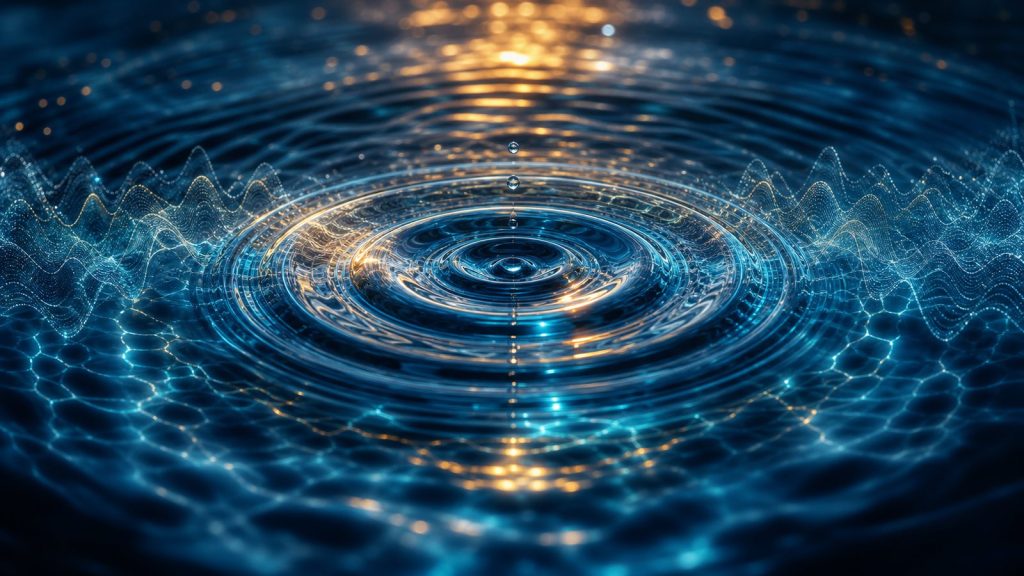
Can music, water and waves really play a part in healing? It is a question that sits at the edge of conventional explanation, yet it continues to return in research, conferences and lived experience alike. At the heart of it is one striking idea: water may be able to receive, retain and retransmit vibrational information, with possible effects on both body and mind.
This perspective did not appear out of nowhere. It draws on work revisited by Professor Luc Montagnier after the earlier research of Benveniste, and is echoed in the reflections of Didier Rauzy and Professor Marc Henry, each from a different angle. What emerges is not a simplistic promise of instant solution, but a more intriguing possibility: that sound, electromagnetic waves and certain forms of energetic stimulation may influence water in ways that help explain why frequency-based approaches to care continue to fascinate both practitioners and the wider public.
Part of the enduring pull of this subject lies in the fact that it touches something people often sense before they can explain it. Most of us have felt, at one time or another, that a piece of music can alter the body almost instantly, that certain environments leave us lighter or heavier, or that calm and agitation seem to move through us in ways that are not purely psychological. For those who take the idea of vibrational healing seriously, water becomes the missing link between those subtle experiences and the physical body itself.
In short: can music, water and waves support healing?
Music, water and waves may support wellbeing by influencing emotion, attention, relaxation and the way the body responds to sound. The stronger claims around water memory and frequency-based healing remain debated, so this subject needs curiosity and caution at the same time.
- Sound can affect mood, breathing and nervous system rhythm.
- The body contains water, but that does not make every wave a therapy.
- Water memory ideas are fascinating but scientifically controversial.
- Listening practices are safer when framed as support, not cure.
For a wider foundation, read Sound, Frequency and Vibration. For a contemplative audio cue, receive the free Sacred Frequency Session.
That does not mean every claim should be accepted uncritically. It means, rather, that the conversation deserves a little more subtlety than either blind belief or outright dismissal. When researchers, therapists and speakers return again and again to the relationship between water, sound and waves, they are trying to describe a layer of influence that many people recognise intuitively, even if the mechanisms remain debated.
Luc Montagnier and the idea of water memory
A documentary built around a controversial but influential claim
One of the best-known formulations of this idea comes from Professor Luc Montagnier, who said: “The day we accept that waves can act, we can act through waves, and at that point we can treat through waves.” Montagnier, known for his role in the discovery of HIV and for receiving the Nobel Prize in Medicine, drew on the earlier research of Jacques Benveniste. In his own work, he reported identifying electromagnetic waves during an initial experiment on the blood plasma of patients infected with HIV.
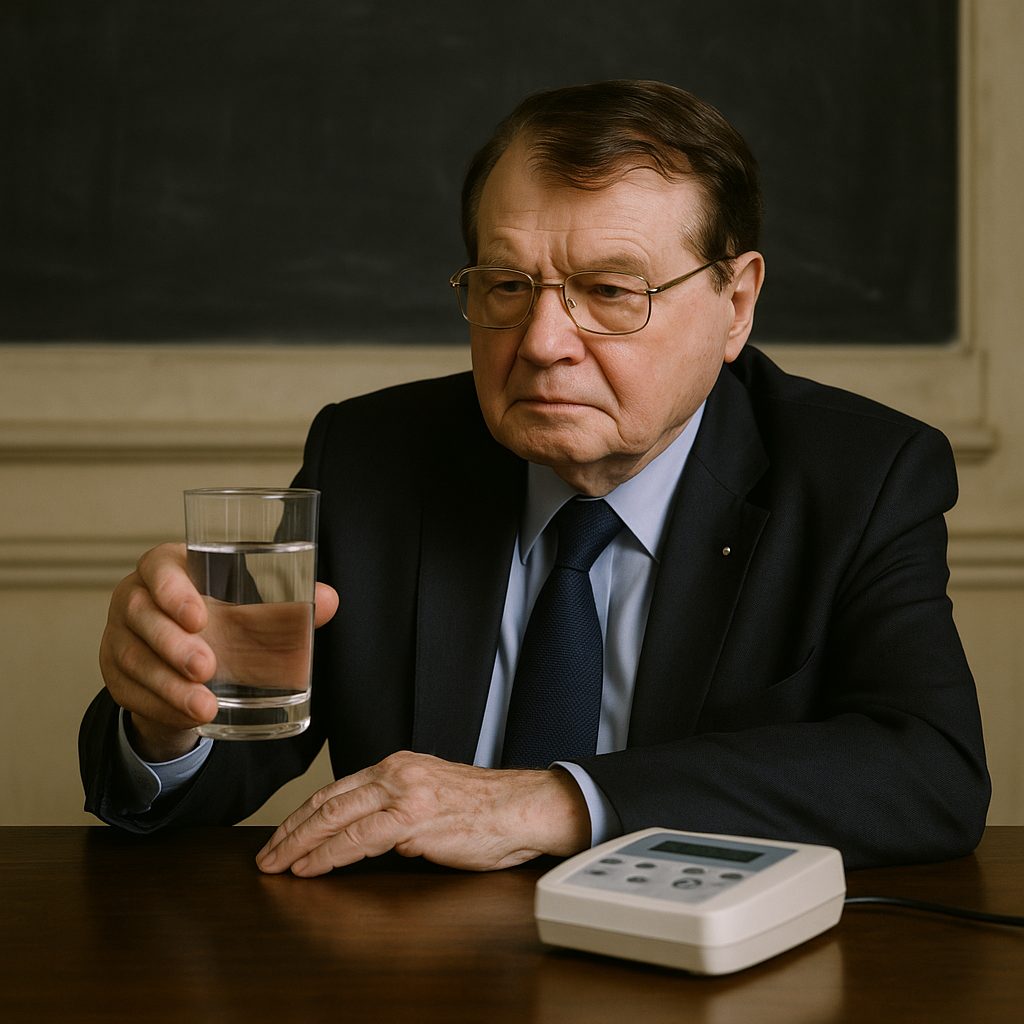
That is the starting point of the 2013 documentary On a retrouvé la mémoire de l’eau, which presents his line of thought in a more accessible way. The film suggests that water may be able to retain, carry and then retransmit data, vibrations and elements that pass through it or even come close to it. In that sense, water is compared to a magnetic tape: it would not simply contain substances, but also preserve a trace of their properties.
What gives this documentary its particular force is not only the claim itself, but the way it asks viewers to reconsider what water is. We are used to thinking of it as neutral, passive and chemically simple. Yet in this account, water becomes responsive, almost archival in nature, as though it were capable of holding a subtle record of encounter. Whether one finds that persuasive or provocative, it shifts the discussion from matter alone to the possibility of information carried through matter.
That is one reason the film has continued to circulate well beyond specialist circles. It speaks to a wider unease with the idea that only what is materially measurable in the most immediate sense can have an effect on the body. For many viewers, Montagnier’s work did not settle the debate so much as open it wider, giving language to a possibility that had long hovered at the edges of complementary healing practices.
Why this notion of “memory” matters
The central claim is that water can keep the imprint of molecules that have been in contact with it, even when those molecules are no longer physically present. In other words, what remains would not be the material substance itself, but a kind of vibrational or informational signature. This is what supporters of the theory mean when they speak of the memory of water.
For readers who want to understand the argument in its original form, the documentary runs for 52 minutes and was directed by Christian Manil and Laurent Lichtenstein in collaboration with France Télévisions. It brings together the details of Montagnier’s experimentation and helps explain why this subject continues to attract interest: if water can truly record and retransmit what has affected it, then waves, frequencies and sound may have a far more direct role in care than conventional medicine has usually allowed.
The importance of this idea lies in its implications. If water can retain an imprint, then healing may not depend solely on introducing a substance into the body in the usual chemical sense. It may also involve the transmission of patterns, signals or resonances capable of interacting with living tissue. That possibility remains controversial, of course, but it helps explain why the theory has had such a long afterlife. It offers a framework in which subtle therapies are not merely symbolic or comforting, but potentially active.
It also resonates with a simple biological fact: the body is not a dry mechanism. It is fluid, conductive and constantly exchanging signals. Seen from that angle, the notion of water memory appeals not only because it is unusual, but because it seems to fit a more dynamic image of life itself. The body is not just built from components; it is also shaped by rhythms, exchanges and patterns of communication that are still not fully understood.
- Reference figure: Professor Luc Montagnier
- Key influence: the earlier work of Benveniste
- Main idea: water can retain and retransmit an imprint
Didier Rauzy’s vision of frequency-based healing
A medicine centred on sound, light and vibration
In one of his conference extracts, Didier Rauzy makes a striking prediction: “One day our medicine will be entirely frequency-based, or sonic, or luminous.” The idea is simple, but far-reaching. Rather than seeing healing only through a chemical lens, he suggests that waves, sound and light may one day be recognised as central therapeutic tools in their own right.
Rauzy speaks from the perspective of a bio-energetician, a Celtic healer and a trainer in frequency signature therapy. In that context, his remarks focus on the potential benefits of waves and the way subtle forms of stimulation might act on the body. Whether one approaches that claim with conviction or caution, his conference extract clearly belongs to a broader current of thought in which healing is understood not only as a matter of substances, but also of frequencies.
There is something quietly radical in that shift. Modern medicine has achieved extraordinary things through chemistry, surgery and imaging, yet many people still feel that these do not account for the whole of human experience. Rauzy’s language speaks to that gap. He is pointing towards a medicine that would take resonance seriously: the possibility that the body responds not only to compounds and procedures, but to tonal, luminous and energetic environments.
For anyone who has felt the nervous system settle under certain sounds, or noticed how light can alter mood and vitality, his words do not feel entirely abstract. They feel like an attempt to formalise something already half-known through experience. That does not make the theory proven, but it does help explain why it continues to find an audience among those who sense that healing is sometimes less like forcing a change and more like restoring a lost harmony.
- frequency-based medicine
- sound as a therapeutic force
- light as a healing medium
Why he believes frequencies can act so deeply
Rauzy goes further by arguing that, “at the infinitely small level, at the nanometric level, sound and frequencies are more powerful than the most powerful chemistry there is.” This is the heart of his position. At the scale of the very small, he believes vibratory action may reach further than conventional chemical intervention, precisely because it works through resonance rather than through matter alone.
That claim helps explain why frequency-based approaches continue to attract interest in discussions around sound treatments and energetic care. In Rauzy’s view, waves are not secondary or symbolic influences: they are active forces that can affect the body in a concrete way. Within the logic of this article, his words reinforce the same underlying thread: that sound and frequencies may have a real capacity to influence living systems and, in some cases, help to relieve physical suffering.
Related offer
Magical whale song - therapeutic frequencies
Scientists as a whole report that auditory «contact» with whale song induces a...
View productResonance is a useful word here because it suggests relationship rather than impact alone. A frequency does not necessarily impose itself in the way a drug might; it may instead invite a system to respond, entrain or reorganise. This is one reason sound-based practices often describe their effects in terms of regulation, release or rebalancing. The language may vary, but the intuition is similar: the body can sometimes be guided by pattern as much as by force.
That way of thinking also helps explain why people often report subtle but meaningful effects from sonic practices. The change may not always be dramatic or immediate. It may arrive as deeper breathing, reduced muscular tension, clearer mental space or a sense that the body has stopped bracing against itself. Such experiences do not prove every theoretical claim attached to frequency medicine, but they do show why the field continues to hold attention. It speaks to forms of change that many people recognise in themselves, even when the explanatory model remains open to debate.
Marc Henry’s view of water as a receptive medium
How water is said to receive and retain information
In his conference Quelle eau boire ?, Professor Marc Henry starts from something very ordinary: the water we drink. From there, he broadens the discussion to the ways water can be stimulated or “dynamised”, whether through electrical tension, a vortex, light, sound or more subtle waves. In this perspective, water is not treated as an inert substance, but as a medium that can react to what passes through it or comes close to it.
He also refers to scientific work suggesting that water can pick up and record electromagnetic frequencies, particularly in the ELF and infrared ranges. Taken together, these ideas present water as capable of receiving, registering and retransmitting frequency-based information. That matters all the more because, at cellular level, the human body is made up largely of water. In this framework, water is described as able to retain the frequency “memory” of molecules that have been in contact with it, even when those molecules are no longer physically present, and to express that contact again through frequency.
What makes Henry’s contribution especially compelling is that he begins with the familiar rather than the exotic. Drinking water is part of daily life, so his argument quietly suggests that the question is not remote or theoretical. If water is indeed sensitive to different forms of stimulation, then the quality of our relationship with water may be richer than we usually imagine. It is no longer just a carrier of minerals or hydration, but potentially a participant in a wider energetic exchange.
That idea can sound unusual at first, yet it also has a certain intuitive coherence. Water is mobile, adaptive and deeply present in living systems. It circulates, connects and mediates. To describe it as receptive is, in one sense, simply to take those qualities seriously and extend them beyond chemistry alone. Henry’s work invites readers to consider whether water might be one of the body’s most important interfaces with its environment.
- electrical tension
- vortex movement
- light, sound and subtle waves
Why this idea is linked to sound-based healing
The conference also insists on another point: water may be influenced and energised by sound itself. That is where the subject connects directly with sound treatments and sound journeys, which are presented as practical examples of frequencies acting on the body through its watery composition. If water can be modified by sound, then sound is no longer just something we hear; it becomes a possible means of affecting the body more deeply.
Seen in that light, the argument is simple but far-reaching: if water can store and transmit vibrational information, and if the body is so largely composed of water, then waves and sounds may help support healing in a range of physical complaints. Whether one sees this as established science, an emerging field or a hypothesis still being debated, Marc Henry’s contribution gives a clearer shape to the central idea running through these works: water is not merely present in the body, but may also act as a carrier of frequencies.
This is also why sound-based practices are often described in such embodied terms. People do not merely say they heard something beautiful; they say they felt it in the chest, the abdomen, the spine, the jaw. Low tones can seem to settle into the bones, while higher frequencies may sharpen attention or create a sense of spaciousness. In a framework where water is receptive, these reports are not treated as poetic exaggerations but as clues to how vibration may move through living tissue.
There is, too, a more reflective dimension to this. If sound can influence the body through water, then the environments we inhabit may matter more than we think. Noise, rhythm, silence, music, even the emotional charge carried in a voice could all become part of the wider ecology of health. That does not mean every sound supports repair, nor that every frequency is beneficial. It means the body may be listening more deeply than the conscious mind realises.
How to Read Frequency Claims Without Losing the Wonder
The most useful way to approach healing with music, water and waves is to separate three levels of discussion. First, sound clearly affects lived experience: rhythm, volume, voice and resonance can change how the body feels. Second, water is central to biological life. Third, the claim that water can store and transmit complex information remains much more debated.

Related offer
Ancestral Sacred Songs
Free your Senses and Vibrate to the Magical Rhythms of Sacred Harmonic Chants. Welcome to an extraordinary Spiritual Journey...
View productWhen these three levels are mixed too quickly, the subject becomes either exaggerated or dismissed. A more balanced view keeps the question open without turning it into a promise.
- Use sound for relaxation, presence and emotional regulation.
- Stay careful with claims about disease, DNA or fixed effects.
- Notice how your body responds to rhythm, silence and vibration.
- Keep medical decisions separate from listening rituals.
The Mental Waves Sound and Water Discernment Framework
The Mental Waves frame is to hold sensitivity and evidence together. Sound can become a meaningful support because it changes the inner atmosphere of attention. That does not require overstating what science has proven.
- Feel: notice the real bodily response to music and vibration.
- Question: ask which claims are experiential, symbolic or scientific.
- Listen: choose sound environments that help the body settle.
- Integrate: use the calmer state to support daily choices.
For the body side of this discussion, continue with Body Resonance of Sound. For a more neuroscience-oriented view, read How Sound Affects the Body and Brain.
Editorial note from Mental Waves
This article is educational and reflective. Sound, water and waves can be explored as wellbeing supports, but they should not be presented as a substitute for qualified medical care or as a proven cure for illness.
Conclusion
What remains, once the claims and testimonies are set side by side, is not a simple miracle story but a particular way of looking at the living body: as something responsive to frequency, vibration and environment, not only to matter in its most visible form. In that perspective, water becomes more than a neutral substance. It is presented as a medium that receives, carries and perhaps retransmits information, which is why music, sound and waves are given such a central place in these approaches to healing.
That does not remove the need for discernment. These ideas continue to sit at the meeting point of scientific research, personal experience and more intuitive forms of care, which is precisely why they fascinate as much as they divide. Still, the underlying intuition is clear: if the body is largely made of water, then what passes through us acoustically, energetically and emotionally may matter more than we once assumed. Sometimes the most unsettling questions are also the ones that quietly open new doors.
Perhaps that is the most honest place to leave the subject. Not with certainty where certainty does not yet exist, but with a more attentive way of listening. To music, to the body, to the quality of the spaces we inhabit, and to the possibility that healing is sometimes carried not only by substances, but by patterns, tones and fields of influence we are only beginning to describe properly.
For some readers, these ideas will remain speculative. For others, they will echo experiences already lived but never fully named. Either response is understandable. What matters is that the question itself remains alive: whether water, sound and waves may together reveal a more subtle picture of how the body receives the world, and how, under the right conditions, it may begin to recover its balance.
Frequently Asked Questions About Music, Water and Waves
What does healing with music, water and waves mean?
It refers to the idea that sound, vibration and wave-based signals may influence wellbeing, especially through relaxation, attention and bodily resonance.
Is water memory proven?
Water memory remains controversial. It is discussed here as a debated idea, not as settled medical science.
Why is Luc Montagnier mentioned?
He is mentioned because he helped popularise later discussions around water, electromagnetic signals and controversial frequency-based ideas.
Can sound affect the body?
Yes, sound can affect breathing, attention, emotion and stress response, although that is different from claiming it resolves disease.
Why is water important in this topic?
Water matters because the body is largely water-based, but that fact alone does not prove every claim made about waves or memory.
What is frequency-based healing?
It is a broad term for approaches that use sound, light or vibration as supports for wellbeing or care.
Why should the claims stay cautious?
Because some ideas are experiential or symbolic, while others would require strong clinical evidence before being treated as medical facts.
How can someone use sound safely?
Use comfortable volume, choose calming sound, stop if the body reacts badly and keep listening rituals separate from urgent health decisions.
What is the main takeaway?
Sound and vibration can be meaningful wellbeing supports, but the strongest water-memory claims should be approached with discernment.