en
enVotre panier est vide.


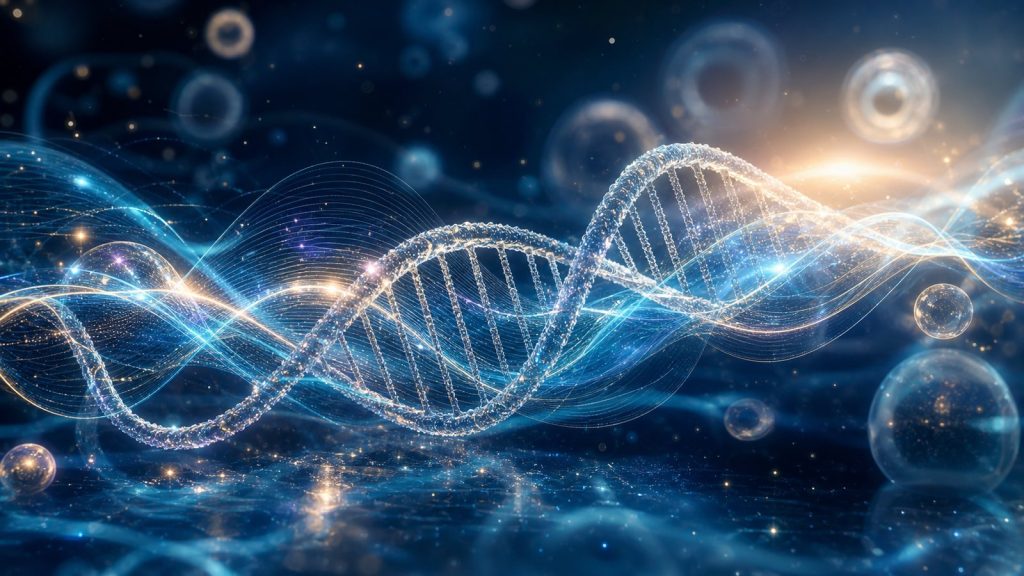
There is something quietly radical in the idea that our biology is not fixed once and for all. Epigenetics has reshaped the way many people think about health, not by denying the role of genes, but by suggesting that daily life matters more deeply than we once assumed. Food, movement, stress, pleasure and the way we live from one day to the next may all influence how certain genes are expressed. In that sense, the body is not simply a structure we inherit, but a living process that responds, adapts and, to a degree, reflects the choices we make.
That thought can feel both liberating and sobering. It offers room for change, yet it also asks something of us: attention, consistency and a more intimate relationship with the ordinary habits that shape our days. Health, seen in this light, is not only a matter of crisis or diagnosis. It is also woven through repeated gestures so familiar that we often stop noticing them.
Set alongside that is a more spiritual tradition: sacred solfeggio, a scale of nine frequencies said to support balance in body and mind. Within that framework, music is not treated as background or ornament, but as something that can affect our emotional state, our stress levels and even our sense of inner alignment through rhythm, harmony and resonance. The frequency of 528 Hz, often described here as a central or “miracle” tone linked to transformation and restoration, is presented as a bridge between these two worlds. The underlying message is both hopeful and measured: sound may be a meaningful support for wellbeing, but it does not replace proper medical care when illness needs treatment.
In short: how are epigenetics and 528 Hz connected?
Epigenetics shows that gene expression can be influenced by environment and lifestyle, while 528 Hz belongs to a sacred solfeggio tradition often associated with harmony and repair. The connection is best approached as a wellbeing reflection, not as proof that one frequency changes genes in a simple or fixed way.
- Epigenetics highlights the importance of context and lifestyle.
- Music can influence stress, emotion and regulation.
- 528 Hz has symbolic and experiential meaning for many listeners.
- Scientific and spiritual claims need to be kept distinct.
For a related frequency debate, read 432 Hz Tuning. For a contemplative sound cue, receive the free Sacred Frequency Session.
Many people recognise this instinctively long before they ever encounter the language of epigenetics or sacred frequencies. A certain piece of music steadies the breath, softens agitation or brings back a feeling of coherence after a difficult day. Whether one approaches that through science, spirituality or simple lived experience, the intuition is much the same: what surrounds us, and what we repeatedly absorb, leaves a trace.
How Epigenetics Reframes Health and Human Behaviour
Why epigenetics changed the conversation about health
Epigenetics is often described as one of the most striking biological shifts in recent years because it changes the way we think about genes, health and personal responsibility. Rather than treating our biology as a fixed script, it looks at how gene expression can be modulated through the way we live. In that sense, it invites a different mindset: not one in which everything is predetermined, but one in which daily habits matter. In a video on the subject, the scientist, speaker and writer Joël de Rosnay explains that “the programme of life codes for only 15% of the machine tools that make the living cell function”.
The remaining 85% of DNA, in his account, plays a regulatory role, influencing how genes function in response to the behaviours we repeat in ordinary life.
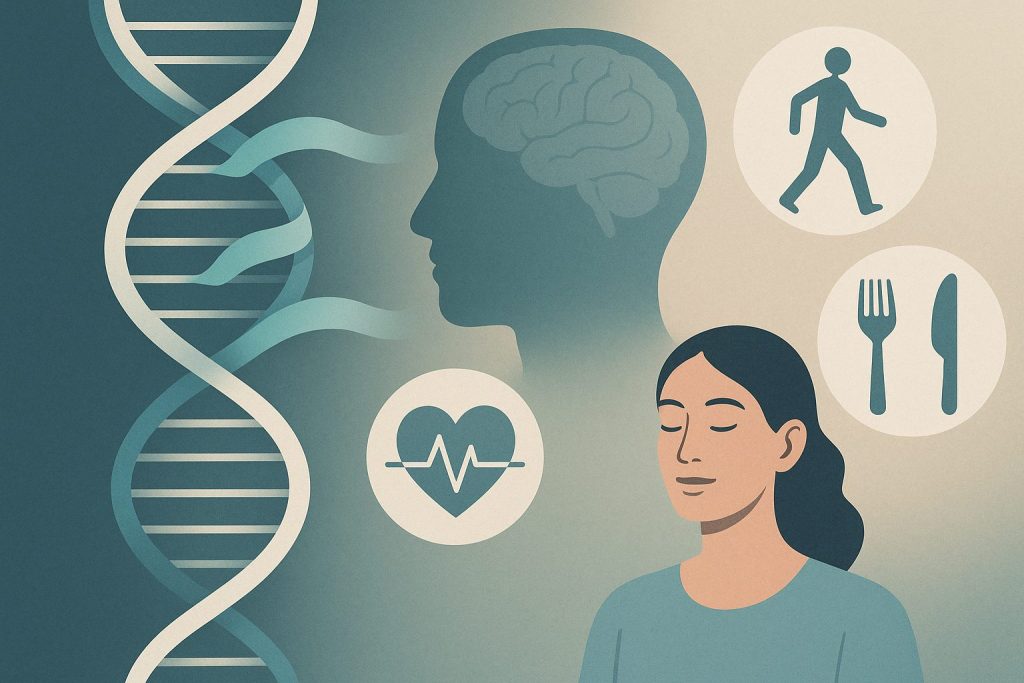
That idea brings the subject down to earth very quickly. What we eat, how much we move, the way we handle stress, and even the pleasure we feel in what we do are not minor details on the edge of health; they become part of the picture itself. De Rosnay’s point is that each of us can act to improve our health and become more fully responsible for our own life.
This practical thread also runs through several of his books, including La Malbouffe : comment se nourrir pour mieux vivre (Éditions Olivier Orban, 1979), La Plus Belle Histoire du monde – Les Secrets de nos origines (Éditions du Seuil, 1996) and Une vie en plus – la longévité pourquoi faire ? (Éditions du Seuil, 2005).
What makes this shift so compelling is that it restores nuance. It does not promise total control over health, and it certainly does not suggest that illness is simply a personal failure. Rather, it reminds us that biology is responsive. The body listens, in its own complex way, to nourishment, exhaustion, tension, rest, connection and deprivation. That is a more humane vision than strict determinism, because it leaves space for influence without pretending to offer certainty.
For many readers, this is where epigenetics becomes more than a scientific term. It becomes a way of seeing everyday life differently. A meal, a walk, a period of chronic stress, a sense of joy, a lack of sleep, a nourishing relationship: none of these is trivial. Over time, they form an atmosphere in which the body must continually adjust. That atmosphere may not explain everything, but it clearly matters.
- food and nutrition
- physical activity
- stress management
- the capacity to feel pleasure in daily life
Even this short list carries a quiet truth. We tend to separate these elements for convenience, yet in lived experience they overlap constantly. When stress rises, sleep often suffers. When sleep suffers, movement becomes harder. When movement drops away, mood can flatten. And when pleasure disappears from daily life, even healthy routines begin to feel mechanical. Epigenetics, at its most useful, encourages us to see these links rather than treating each factor in isolation.
From fixed biology to living processes
This same shift appears in the ideas of Deepak Chopra, the Indian endocrinologist, speaker and author known for writing on spirituality and alternative medicine. In his talks, he argues that the body and the brain are not simply structures, but processes in continual movement. He also insists that “genes are not deterministic”, which echoes the broader epigenetic view that inherited biology does not tell the whole story. Chopra extends this reflection through a more philosophical reading of nature, suggesting that its components operate with an intrinsic intelligence. He illustrates this with a simple image: flowers, he says, send a measurable signal to the insects that feed on pollen, indicating whether pollen is present or not.
Seen from this angle, epigenetics also helps explain why behaviour matters so deeply to wellbeing. Some genes may be inhibited, others silent, and others actively expressed. The source text refers to five aspects of daily behaviour that need attention if we want to move towards better health, and it stresses that these dimensions are interconnected rather than separate. One change can influence the next: better physical activity, for example, may increase the pleasure we feel in what we do and improve our relationships with other people. The underlying message is both simple and demanding: our behaviours affect our health, so we do have some influence over how well we age and how resilient we remain.
That is precisely where the later link with music and sacred frequencies begins to make sense.
Whether one agrees with Chopra’s wider spiritual framework or not, the image of the body as process rather than object has real force. We are not static beings. Hormones fluctuate, neural pathways adapt, immune responses shift, and emotional states alter the chemistry of the body in ways that are subtle but real. To think in terms of process is to accept that change is always under way, even when it is invisible.
That perspective also softens the old opposition between mind and body. Stress is not merely “mental” if it changes sleep, digestion, inflammation or energy. Pleasure is not merely decorative if it affects motivation, resilience and the willingness to care for oneself. In practice, the body often responds less to our theories than to the quality of our lived experience. This is one reason the bridge to music feels less strange than it may first appear. Sound, after all, is also experienced as process: vibration, rhythm, repetition, anticipation, release.
How Sacred Frequencies and 528 Hz Are Framed in Wellbeing
How music is believed to affect stress, mood and inner balance
Music is presented here as more than background comfort. Through rhythm, harmony, melody and frequency, it can stir very different emotional states, from joy to serenity, calm and deep relaxation. In that sense, sound is seen as something that can influence stress levels, shape behaviour and even support self-confidence. The idea is that we do not simply hear music intellectually; we respond to it physically, emotionally and mentally, often in ways that feel immediate and instinctive.
Related offer
Sacred frequency 432 Hz
432Hz : COSMIC COHERENCE Enter into perfect resonance with the universe... COHERENCE - UNITY - ENERGY - BLISS
View productThis is also where cymatics is brought into the discussion. It is used to support the view that each frequency has its own effect on matter, and therefore its own particular influence. From that perspective, harmonising vibrations through music, sound and repeated tones may help restore a sense of energetic, physical and psycho-emotional balance. The resonance produced by one frequency will not be identical to that of another, and the balancing effect is thought to come through repetition, synchronisation, resonance, proximity and rhythm. Whether one approaches this in a spiritual or experiential way, the central idea remains the same: certain sounds are believed to help the body and mind settle into a more coherent state.
Anyone who has lived closely with music knows that this is not merely a decorative claim. A slow, spacious piece can lower the felt pressure of the day within minutes. A steady pulse can help gather a scattered mind. Certain harmonies seem to open emotion gently, while others create containment and steadiness. We may not always have the language for what is happening, but the effect can be unmistakable. The nervous system responds before the intellect has finished analysing.
There is also something deeply personal about musical response. The same sound that soothes one person may leave another untouched. Memory, culture, temperament and circumstance all shape the way music lands in the body. That does not weaken the argument; if anything, it makes it more believable. Sound works through relationship, not through abstraction alone. The body listens through history as much as through the ear.
When people speak of resonance in this context, they are often trying to describe that felt sense of being met by a sound that seems to organise inner chaos. Not every piece of music does this, and not every frequency will feel meaningful to every listener. Yet when it happens, the experience can be strikingly concrete: breathing deepens, muscular tension eases, thoughts slow, and a person feels more present to themselves. That is one reason music has remained part of healing rituals, contemplative practices and emotional recovery across so many traditions.
- Rhythm may help regulate tension and agitation.
- Melody and harmony can encourage calm, pleasure or emotional release.
- Repeated frequencies are thought to work through resonance and synchronisation.
Used well, music can become a form of hygiene for the inner life. Not a remedy-all, and not a substitute for treatment, but a deliberate way of shaping atmosphere. Just as some environments leave us overstimulated or depleted, others help us return to a more balanced state. Sound belongs to that environment more than we sometimes admit.
The sacred scale and the special place of 528 Hz
The sacred scale, or solfeggio frequencies, is described as a musical system more than a thousand years old. It brings together nine frequencies: 174, 285, 396, 417, 528, 639, 741, 852 and 963 Hz. In this tradition, these tones are said to help relieve many forms of suffering. At the centre of the scale sits 528 Hz, often called the “frequency of Love” and sometimes the “miracle frequency”. In the original account, it is credited with supporting the transformation and restoration of DNA, which is why it is linked so directly to epigenetics and to the part of our genetic functioning thought to be influenced by daily life and behaviour.
Following that logic, listening to 528 Hz is not only supposed to soothe the mind but also to encourage changes in behaviour over time. It is presented as a way of raising vitality, awakening consciousness, stimulating creativity and helping a person reconnect with joy and inner peace, especially after difficult life experiences that may have left a mark. Combined with sound massage, its effects are described as beneficial for both body and mind. At the same time, the text makes an important point of balance: however meaningful music and 528 Hz may feel, they are not a complete substitute for medical care.
They may support wellbeing and help someone feel more grounded, but in the case of illness, seeing a doctor remains necessary.
The special status given to 528 Hz says something interesting about the human search for healing. People are rarely looking only for symptom relief. They are also looking for restoration, for a sense that something in them can be repaired, reordered or brought back into harmony. That is part of the emotional power behind the language surrounding this frequency. Even where the claims become expansive, the longing beneath them is recognisable and deeply human.
For some, listening to this tone becomes a contemplative practice rather than a technical intervention. It may be used during meditation, rest, breathwork, journalling or sound massage, not because one expects instant transformation, but because repetition creates a ritual of return. In difficult periods, that matters. A repeated sound can become an anchor, a way of stepping out of mental noise and back into a steadier inner rhythm.
It is also worth reading the stronger claims with both openness and discernment. Many people report feeling calmer, clearer or more emotionally settled when listening to certain frequencies, and those experiences should not be dismissed simply because they are subjective. At the same time, subjective benefit is not the same as proof of universal biological effect. The wisest position is often the most grounded one: to recognise the value of what genuinely helps, while keeping medical judgement and critical thinking intact.
- Sacred frequencies listed: 174, 285, 396, 417, 528, 639, 741, 852 and 963 Hz.
- 528 Hz is presented as the central tone of the scale.
- Its claimed benefits include vitality, creativity, peace and emotional recovery.
- It should complement, not replace, proper clinical care.
Seen in that balanced way, sacred solfeggio becomes less a rigid doctrine and more a practice of attentive listening. It invites the listener to notice what changes in the body, what softens in the mind, and what emotional tone emerges after sustained contact with sound. That kind of listening is valuable in itself. It asks us to become less hurried, less fragmented and more responsive to the subtle conditions that support wellbeing.
Keeping the Science and the Symbolism in the Right Place
The temptation with epigenetics and 528 Hz is to fuse everything into one dramatic claim. That would be misleading. Epigenetics is a biological field concerned with gene expression, while sacred solfeggio belongs to a symbolic, musical and contemplative tradition.
Related offer
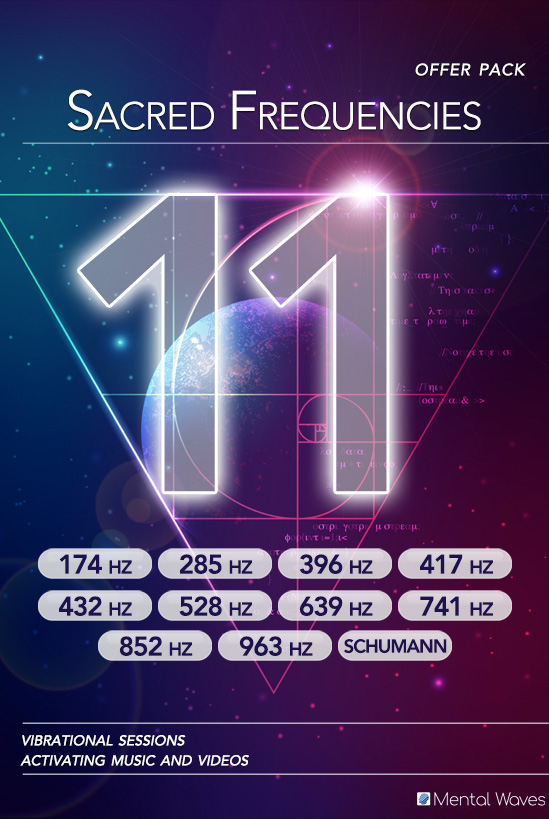
11 Sacred Frequencies + Climax Bundle
Sacred Frequencies Pack including 10 videos and 11x 20-minute tracks of activating music.
View productStill, the two can meet in a more careful way. Stress, sleep, environment and emotional life can influence the body. Music can influence emotion and regulation. A frequency may become meaningful as part of a ritual, but that does not make it a simple biological switch.
- Use epigenetics to remember that context matters.
- Use music to support regulation and attention.
- Use sacred frequency language symbolically and experientially.
- Avoid turning wellbeing practices into medical promises.
The Mental Waves Frequency Discernment Framework
The Mental Waves frame is to hold wonder and discernment together. Sound can be powerful in lived experience, but responsible writing keeps evidence, metaphor and personal practice separate.
- Evidence: ask what science actually shows.
- Experience: notice how music affects the body and mood.
- Symbol: respect sacred frequency language without overstating it.
- Integration: combine listening with sleep, movement, food and emotional care.
For a broader foundation, continue with Sound, Frequency and Vibration. For practical context, read 432 Hz Tuning.
Editorial note from Mental Waves
This article is educational and reflective. Music and 528 Hz can be used as wellbeing supports, but they should not be presented as clinical care, gene therapy or a fixed biological intervention.
Conclusion
What remains, beneath the stronger claims and the more spiritual language, is a simple but meaningful thread: our biology is not always as fixed as we once imagined, and our daily environment matters. Food, movement, stress, pleasure, relationships and the sounds we live with all shape the quality of our inner life. In that sense, epigenetics and music meet on shared ground: both point back to the way small, repeated influences can alter how we feel, how we cope and, perhaps, how we heal.
At the same time, the article keeps an important balance. Sacred frequencies, including 528 Hz, are presented here as tools for wellbeing, calm and reconnection rather than as a reason to abandon medical care. That nuance matters. Music may support the body and mind in ways many people recognise intuitively, but it sits best as part of a wider approach to health, not in place of one. Sometimes the most powerful shift begins there: listening more carefully to what helps us return to ourselves.
Perhaps that is the most useful way to hold the whole subject. Not as a promise of miracles, nor as something to dismiss out of hand, but as an invitation to pay closer attention to the forces that quietly shape us. We are influenced by what we repeat, what we consume, what we endure and what we allow to nourish us. If music helps restore a sense of order, tenderness or vitality, then it has already done something worthwhile.
And if epigenetics has taught us anything at a human level, it is that life is more responsive than many of us were led to believe. We are not infinitely malleable, but neither are we sealed shut by inheritance. Between biology and experience there is an ongoing conversation. In that conversation, sound may have a modest yet meaningful place.
Frequently Asked Questions About Epigenetics and 528 Hz
What is epigenetics?
Epigenetics studies how gene expression can be influenced by factors such as environment, stress, nutrition and lifestyle.
What is 528 Hz?
528 Hz is one of the frequencies associated with sacred solfeggio traditions and is often linked with harmony or repair symbolism.
Does 528 Hz directly change genes?
The article does not claim that. Any connection should be treated carefully and not reduced to a simple biological switch.
Why is music mentioned with epigenetics?
Music can influence stress and emotion, which are part of the broader context in which wellbeing is discussed.
What role does lifestyle play?
Sleep, stress, food, movement and emotional environment are more grounded entry points for thinking about epigenetic influence.
Is sacred solfeggio the same as science?
No. It is better understood as a symbolic and musical tradition, while epigenetics is a scientific field.
Can music replace clinical care?
No. Music can support wellbeing, but it does not replace qualified medical or psychological care.
How can someone use 528 Hz responsibly?
Use it as a listening ritual for calm or reflection, while keeping expectations grounded.
What is the main takeaway?
Epigenetics and 528 Hz can be explored together only if science, symbolism and personal experience remain clearly distinguished.