en
enVotre panier est vide.


Few subjects in the world of alternative practices provoke quite as much argument as radiesthesia. To some, it is a genuine sensitivity to subtle emissions from minerals, plants, living beings or chemical substances; to others, the movement of a pendulum or dowsing rod is better explained by the ideomotor effect — those small, unconscious muscular actions that can shape perception without deliberate intent. That tension has never really gone away, and it helps explain why radiesthesia still sits in an uneasy space between conviction, observation and scientific doubt.
In short: dowsing science charlatanism
Dowsing sits between tradition, personal experience and scientific controversy, so it deserves a balanced look rather than automatic belief or dismissal.
Use this article as a practical map: keep what helps attention become steadier, question anything that sounds absolute, and connect the idea back to repeatable daily practice.
The subject is not new, nor is it marginal in cultural memory. The very term “radiesthesia”, coined by Abbés Bouly and Bayard, reflects an attempt to give language to a practice associated with pendulums, rods and, more recently, the Lecher antenna, while some practitioners claim to work without any tool at all. Its roots are often presented as ancient — with traces said to reach back thousands of years, including early evidence in Brittany and a written description in Georgius Agricola’s 1556 work on mining techniques. Yet for all this long history, the central question remains strikingly current: are we looking at a misunderstood phenomenon, or at a belief sustained by expectation, suggestion and interpretation?
Why Radiesthesia Still Divides Opinion
A practice suspended between belief and the ideomotor effect
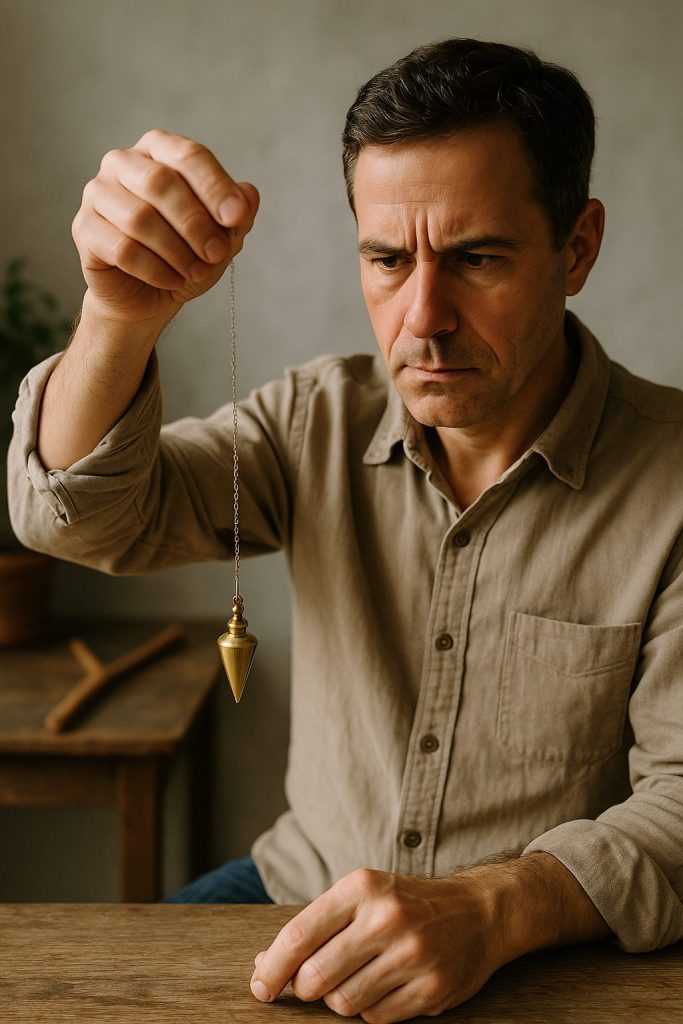
If one subject still seems locked in controversy, it is radiesthesia. For its supporters, it is based on the supposed sensitivity of living beings to certain radiations emitted by minerals, plants, animals, human beings or chemical substances. For its critics, the movements of a pendulum or dowsing rod can be explained far more simply: by the ideomotor effect, a psychological phenomenon in which a person produces small, unconscious muscular movements without realising it. This mechanism has long been used to account for many so-called paranormal manifestations, from mysterious forces to spiritual energies, and it helps explain why sincere, intelligent people may still feel convinced by what they experience.
From a scientific point of view, the balance of evidence remains cautious at best. Rigorous studies carried out, among others, at the universities of Munich and Kassel have not demonstrated the effectiveness of radiesthesia. Earlier work by Michael Faraday, Eugène Chevreul, William James and Ray Hyman also pointed in the same direction: many striking effects may arise from suggestion, expectation and unconscious motor activity rather than from an external force that can be measured. That does not make the debate emotionally simple, however. Radiesthesia sits precisely at the crossroads between lived perception, attention, belief and the hope that some subtle influence may exist beyond current instruments.
- For some, radiesthesia detects real radiations or subtle fields.
- For others, it reflects unconscious movement shaped by expectation and suggestion.
- Scientific testing so far has not confirmed reliable effectiveness.
Unanswered questions keep the controversy alive
The very word radiesthesia — from the Latin radius (“ray”) and the Greek aisthêsis (“sensitivity”) — was coined by the abbés Bouly and Bayard. Its most familiar tools are the pendulum, various rods and, more recently, the Lecher antenna, derived from Ernst Lecher’s invention and said by some practitioners not only to receive but also to emit. Others claim they need no tool at all. The practice is often presented as ancient: some traces are linked to a Chinese bas-relief dated to more than 3000 BC, while other findings in Brittany are said to push its origins back to around 4500 to 5000 years ago.
Its first written description is usually dated to 1556, in Georgius Agricola’s work on mining techniques. This long history helps explain why the subject still resists easy dismissal.
Yet the central questions remain unresolved. Is radiesthesia a myth, a fantasy or a reality? Should dowsing for underground water, geobiology or radionics be treated as genuine fields of inquiry, or as forms of charlatanism? Is the pendulum guided by the subconscious, or by so-called form waves? And when scientific protocols fail to support practitioners’ claims, does that mean the claims are false, or that the tests are poorly suited to the phenomenon being described? These are exactly the questions that keep public interest alive, even when expert opinion remains sceptical.
The result is a debate that is not only scientific, but also cultural and psychological, shaped by testimony, tradition and the enduring appeal of what seems to lie just beyond ordinary perception.
- Is radiesthesia a real phenomenon or a misreading of perception?
- Are dowsing, geobiology and radionics sciences or unsupported claims?
- Do current experimental methods truly capture what practitioners say they do?
A Practice Rooted in History and Persistent Claims
An old practice with its own tools, vocabulary and unanswered questions
The word radiesthesia itself was coined by Abbés Bouly and Bayard, from the Latin radius (“ray”) and the Greek aisthêsis (“sensitivity”). Its most familiar tools are the pendulum, various rods and, more recently, the Lecher antenna, derived from the work of Ernst Lecher and presented by some practitioners as an instrument able not only to receive signals, but also to emit them. Others claim they need no physical support at all. The practice is often described as ancient: some accounts point to a Chinese bas-relief dating back more than 3,000 years BC, while other traces discovered in Brittany are said to push its origins back even further, to around 4,500 to 5,000 years ago.
Its first written description is usually linked to 1556, in Georgius Agricola’s work on mining techniques.

This long history helps explain why radiesthesia still attracts curiosity, even when clear answers remain elusive. The same core questions return again and again: is it a myth, a fantasy or a genuine phenomenon? Should dowsing, geobiology and radionics be treated as serious fields of inquiry, or as forms of charlatanism? Is radiesthesia really an art of perceiving what remains invisible, or are the movements of the pendulum guided by the subconscious rather than by so-called form waves? And when scientific protocols fail to confirm practitioners’ claims, does that mean the phenomenon is absent, or simply that the methods used are not suited to what is being tested?
These unresolved questions are a large part of why the debate has never truly settled.
- Pendulums and dowsing rods remain the best-known tools.
- The Lecher antenna is often presented as a more technical modern instrument.
- Some practitioners say the body alone can serve as a detector.
Why belief persists despite scientific objections
Although science has largely taken a sceptical position, public opinion has never fully aligned with expert conclusions. Many defenders of radiesthesia and geobiology argue that certain radiation fields, such as the Curry, Hartmann and Ley lines, cannot be measured by modern instruments. They often cite the case of radon, a colourless, odourless radioactive noble gas of mostly natural origin, which was long invoked by users of pendulums and universal rods before being formally recognised by scientists. Critics, however, point to geometric and polarity problems that would undermine the theories advanced by dowsers and geobiologists.
One detractor frames the issue bluntly: if these tools are so powerful, why are they not used in a clearly useful way, such as locating the thousands of anti-personnel mines that still maim people today? The same objection extends to so-called E-rays: if they were truly electromagnetic in nature, why have they never been reliably detected, especially when modern technology can measure brain activity, signals from geostationary satellites, radio frequencies from stars and even the cosmic background radiation?

Related offer
Developing your Clairvoyance
Our audio brain training program «Developing your Clairvoyance» will bring your brain to a Delta state in low...
View productAnd yet the case for radiesthesia continues to draw support from both testimony and reputation. Charles Richet, Nobel Prize winner in Physiology or Medicine, once declared: “We must accept radiesthesia as a fact. There is no need to carry out experiments to prove its existence. It exists. What is needed now is to develop its possibilities.” The practice was also defended by well-known scientists such as Professor Yves Rocard, inventor of the French H-bomb, who wrote extensively on the subject. Walter Kunnen likewise argued that, where applied science had failed to produce a satisfactory measuring instrument, a properly trained human being using a carefully calibrated Lecher antenna might achieve reproducible measurements.
On the ground, supporters also point to the enduring figure of the dowser: from the Sahara to the countryside, from China to Argentina, many people claim to know an ordinary individual capable of finding water with a pendulum or a hazel branch. For some, this is coincidence; for Rocard, it suggested that the rod may act as a simple detector of an unconscious tremor in the hands, itself triggered by a geophysical variation in the Earth’s magnetic field. There are even claims that dowsers were used during the First World War to locate tunnels, hiding places and mines, according to research published by Armand Viré, Henri Mager and Abbé Bouly.
In the absence of decisive scientific proof, the debate remains open — and the old English proverb still feels apt: no one holds the whole truth, and even a stopped clock is right twice a day.
Between Scientific Doubt and Believers’ Testimonies
Why the scientific case remains unconvinced
If science has largely chosen its side, public opinion has never fully aligned with that verdict. Many defenders of radiesthesia and geobiology argue that certain fields of radiation — including the Curry, Hartmann and Ley lines — simply cannot be measured with modern instruments. They often point to the example of radon, a colourless, odourless radioactive noble gas of usually natural origin, which was long cited by pendulum and dowsing-rod enthusiasts before being formally confirmed by scientists. Even so, critics maintain that problems of geometry and polarity weaken the theories put forward by dowsers and geobiologists.
One sceptical objection is particularly striking: if these tools are truly so powerful, why are they not used in a demonstrably useful way, for instance to locate the thousands of anti-personnel mines that still maim people today? The question goes further. Can L-shaped or Y-shaped rods, a pendulum, a bobber or universal rod, a Lecher antenna, or even the human body itself, really detect so-called E-rays when highly sensitive technology can already measure brain activity, signals from geostationary satellites, radio frequencies from stars and even the cosmic background radiation of the universe? If these rays were genuinely electromagnetic in nature, many argue, they should have been detected and quantified long ago.
We can register signals coming from the far reaches of the Solar System with power levels of around 20 watts — roughly that of a light bulb — so why would terrestrial “negative fields” remain beyond measurement? These arguments undeniably put radiesthesists under pressure. Yet the debate has never entirely closed, not least because Charles Richet, Nobel Prize winner in medicine and physiology, once stated: “We must accept radiesthesia as a fact. It is useless to carry out experiments to prove its existence. It exists. What is needed now is to develop its possibilities.”
- Supporters claim some fields are not measurable by current instruments.
- Critics reply that genuinely physical rays should already be detectable.
- The radon example is often used to argue that science may confirm some claims late.
Famous defenders, field examples and the unresolved divide
Radiesthesia has also drawn support from well-known scientific figures, which helps explain why the subject continues to resist a simple dismissal. It was notably practised by Professor Yves Rocard, the French scientist associated with the development of the atomic H-bomb, who became one of its most committed defenders and wrote several reference works on the subject. In the same spirit, Professor Walter Kunnen argued that where applied science had failed to produce a valid measuring instrument, a trained human being, using a properly calibrated Lecher antenna, might be capable of making perfectly reproducible measurements — a claim presented as controllable and therefore scientific.
This is where the fault line becomes clear: physicists and mainstream researchers continue to wait for evidence robust enough to imply new fundamental laws of physics, while some believers see in this refusal a form of scientific bias, or even a deliberate dismissal of dowsing and radiesthesia.
From the scientific side, the response remains consistent: despite centuries of claims and official attempts to test them, no tangible proof has firmly validated the conclusions of radiesthesists and geobiologists. And yet supporters continue to point to thousands of concrete examples, especially in the search for water. From the Sahara to the European countryside, and from China to Argentina, many people can name a dowser using a pendulum or a hazel branch who is said to have located water for a well.
For some, this is coincidence; for others, including Rocard, it suggests that the rod acts as a simple detector of an unconscious tremor in the hands, itself triggered by a geophysical variation in the Earth’s magnetic field. There are even claims that dowsers were used by various armies during the First World War to detect tunnels, hiding places and mines, as reported in work published by Armand Viré of the Muséum national d'histoire naturelle, Henri Mager and Abbé Bouly.
In the absence of decisive scientific proof, the debate remains suspended between testimony, interpretation and doubt — which makes the old English proverb feel especially apt: no one holds the whole truth, and even a stopped clock is right twice a day.

Related offer
Developing extrasensory perception
Develop your extrasensory perceptions with our powerful method based on synchronization and rhythm training...
View productThe Mental Waves Discernment Framework
The Mental Waves frame is to keep sensitivity and discernment together. Some practices may sharpen observation or ritual attention, but claims about external detection need careful evidence.
A grounded approach is simple: notice the experience, avoid absolute conclusions, compare impressions with reality, and do not use dowsing to replace practical checks or professional advice.
For a calmer way to explore subtle perception, receive the free 128 Hz sacred frequency session and observe your inner state before interpreting it.
Editorial note from Mental Waves
This article discusses dowsing as a cultural and experiential topic. It does not validate dowsing as a scientific diagnostic tool, safety method or substitute for qualified expertise.
Conclusion
Radiesthesia endures because it sits at the meeting point of lived experience and scientific scrutiny. On one side, controlled studies have not established reliable proof of its effectiveness, and the ideomotor effect remains a serious and coherent explanation for many observed movements. On the other, the practice continues to draw support from its long history, from repeated personal testimonies, and from the conviction that not everything people perceive is yet fully captured by current instruments or protocols.
That is why the question is not settled simply by calling radiesthesia either science or fraud. A more careful reading suggests a field shaped by belief, perception, expectation, attention and interpretation, but also by genuine human attempts to make sense of subtle experience. For now, the most rigorous position is to keep both discernment and curiosity in view: to respect what people report, while recognising that extraordinary claims still require demonstrable evidence.
In that tension, radiesthesia remains less a conclusion than an open test of how we decide what counts as proof.
Radiesthesia FAQ: science, scepticism and unresolved questions
What is radiesthesia meant to detect?
Radiesthesia is presented as a sensitivity to subtle emissions or radiations coming from minerals, plants, animals, human beings or chemical substances. Supporters see it as a way of perceiving influences that are not easily visible, while critics argue that what seems to be detection may instead come from unconscious muscular movements and expectation.
How does science usually explain the movement of a pendulum or dowsing rod?
Science commonly points to the ideomotor effect, a psychological phenomenon in which a person makes small, unconscious muscular movements without realising it. Work by Michael Faraday, Eugène Chevreul, William James and Ray Hyman is often cited because it showed how suggestion and expectation can produce effects that feel meaningful without proving an external force.
Have scientific studies proved that radiesthesia works?
No rigorous proof has been established. Studies carried out at universities including Munich and Kassel did not demonstrate the effectiveness of radiesthesia, and the wider scientific position remains sceptical. The main objection is that, despite long-standing claims and repeated testing, no tangible evidence has firmly confirmed the phenomenon under controlled conditions.
Where does the word 'radiesthesia' come from?
The term was coined by Abbés Bouly and Bayard. It combines the Latin word "radius", meaning "ray", with the Greek "aisthêsis", meaning "sensitivity". The name reflects the idea that a person might be sensitive to rays or subtle influences that are thought to come from the surrounding environment.
Which tools are most often used in radiesthesia?
The best-known tools are the pendulum and various rods, including L-shaped and Y-shaped forms. The Lecher antenna, linked to Ernst Lecher, is also mentioned as a more recent instrument that some practitioners believe can both receive and emit. Others claim they can carry out searches without any physical support at all.
How old is radiesthesia supposed to be?
Its origins are described as very ancient. A Chinese bas-relief is said to point to use more than 3000 years BC, while traces found in Brittany are presented as even older, around 4500 to 5000 years ago. The first written description is usually linked to Georgius Agricola's 1556 work on mining techniques.
Why do some people still defend radiesthesia despite scientific criticism?
Support persists because many people trust repeated field examples, especially in water divining, and because some well-known figures defended the practice. Charles Richet accepted it as a fact, while Professor Yves Rocard argued that a rod might detect an unconscious tremor in the hands triggered by geophysical variations in the Earth's magnetic field.
What are Curry, Hartmann and Ley lines, and why are they part of the debate?
They are presented by many defenders of radiesthesia and geobiology as radiation fields or networks that influence living beings. The dispute arises because supporters say these fields cannot be measured with modern instruments, while critics reply that if such rays were genuinely physical, they should already have been detected and quantified.
Does the example of radon strengthen the case for radiesthesia?
It is used by some supporters to argue that science can confirm certain realities only later. Radon, a colourless and odourless radioactive gas of mostly natural origin, was long cited by pendulum and rod users before being formally recognised by scientists. Even so, that example does not amount to proof that radiesthesia itself works as claimed.