en
enVotre panier est vide.


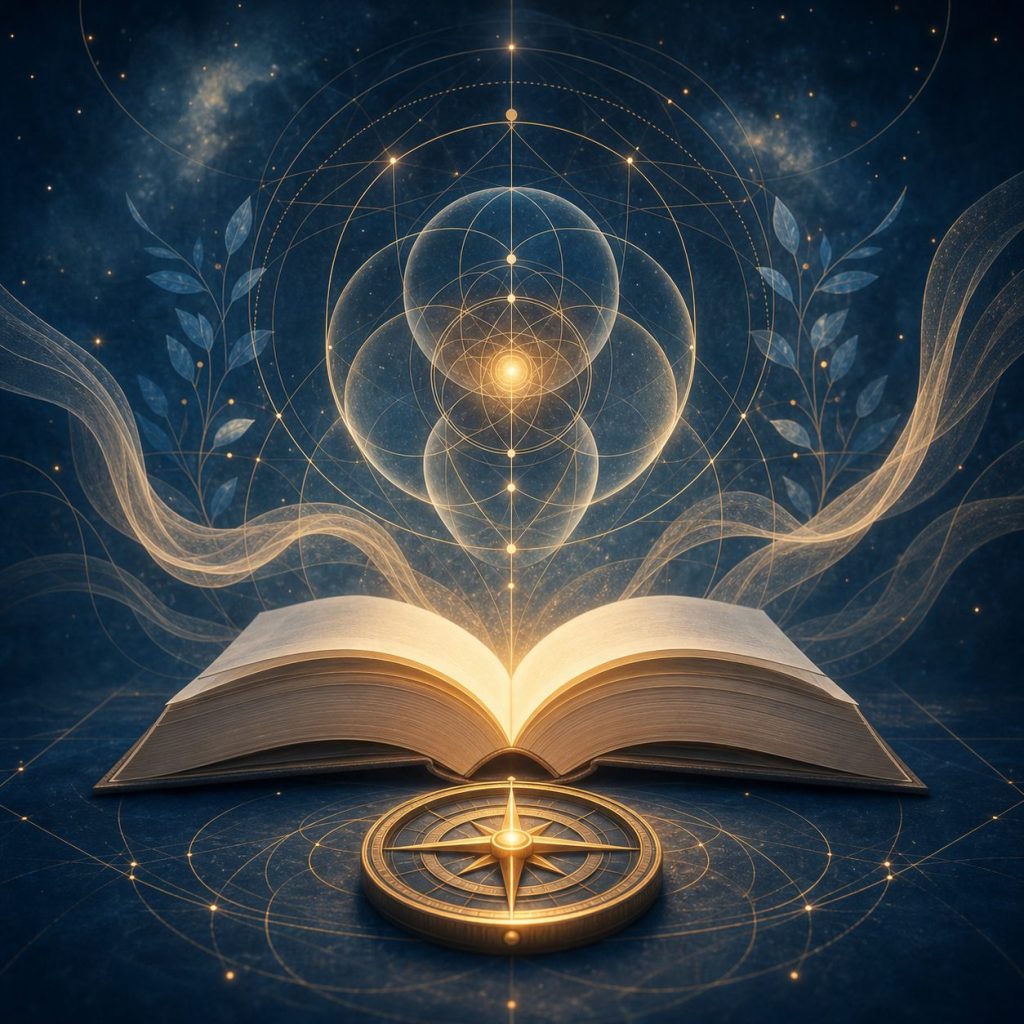
Few words are used as loosely as esotericism. It turns up everywhere: in bestselling fiction, on television, across social media, and in the renewed appetite for astrology, numerology, Kabbalah, occult traditions and secret societies. Yet the term itself is far less straightforward than its popularity suggests. Coined only in the nineteenth century, though rooted in the Greek idea of what is “inner”, it has long referred to teachings, symbols or modes of expression not immediately accessible to everyone, but reserved for those considered initiated.
In short: define esotericism
To define esotericism clearly, it helps to separate inner teaching, symbolic language and lived practice from vague mystery.
Use this article as a practical map: keep what helps attention become steadier, question anything that sounds absolute, and connect the idea back to repeatable daily practice.
That is precisely where the difficulty begins. Depending on the period, the author and the tradition in question, esotericism can describe anything from the hidden dimension of a public teaching to a broader spiritual search shaped by symbolism, mystery and metaphysical insight. In antiquity, it was associated with teachings reserved for a select few, including the mystery cults; later, it came to overlap with ideas such as hermeticism and occultism, sometimes helpfully, sometimes confusingly. As Frédéric Lenoir observed, it is often treated as a catch-all term.
So before judging either its appeal or its excesses, it is worth pausing to ask what the word really contains, and why it continues to draw people back towards what modern life so often leaves at the edges: the symbolic, the sacred and the unseen.
What Esotericism Really Means
A word rooted in secrecy, but not limited to it
Esotericism is one of those words that seems to mean everything and nothing at once. Its popularity says a great deal: the success of books linked to the subject, from Dan Brown’s The Da Vinci Code — which sold more than a million copies in France — to the enduring appeal of television programmes about occultism, numerology, Kabbalah, secret societies and astrology, shows how strongly it still captures the public imagination. Yet the noun esotericism itself is relatively recent, having been coined only in the nineteenth century. Its deeper root is Greek: esôteros, meaning “inner”. That origin already points us towards the heart of the matter.
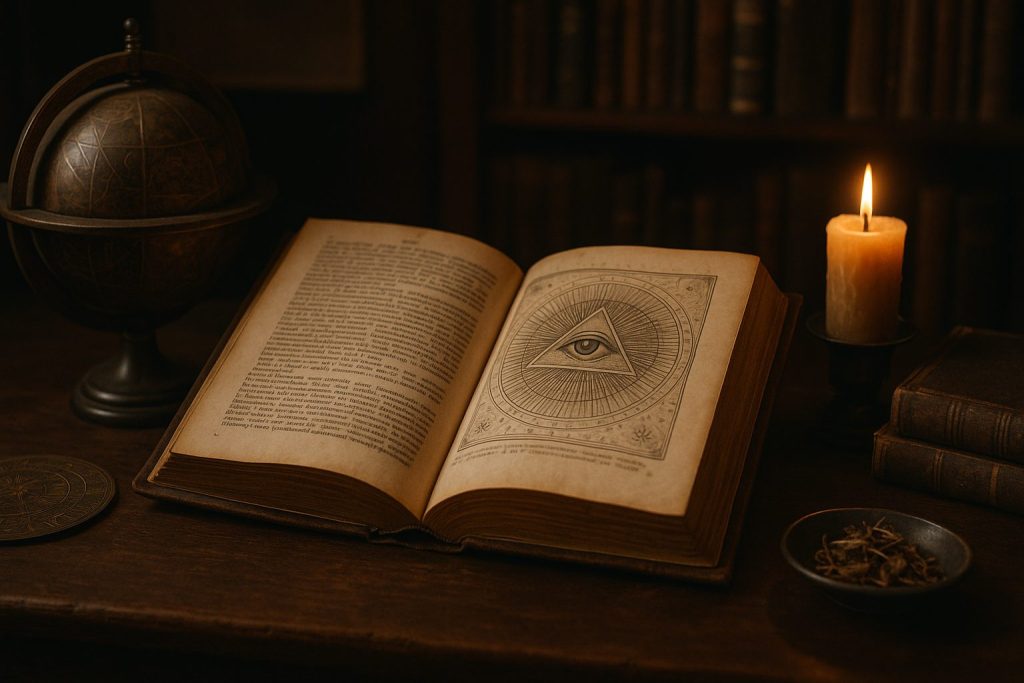
According to the Larousse dictionary, esotericism refers to the hidden part of certain philosophies, teachings or practices that was not meant for the uninitiated. In that sense, it is closely associated with traditions such as Pythagorean thought, Kabbalah and, more broadly, doctrines built around initiation and hierarchy. The word can also describe a mode of expression that only initiates can truly understand: something hermetic, obscure or deliberately veiled. In Antiquity, the term commonly referred to teachings reserved for a small circle, especially within the Mysteries, such as the Mysteries of Eleusis.
A useful distinction follows from this: the esoteric does not necessarily contradict the public, or exoteric, teaching; rather, it often adds a second level of meaning, opening onto metaphysical perspectives or higher states of consciousness.
That last point matters more than it first appears. People often imagine the esoteric as something hidden because it is forbidden, dangerous or conspiratorial. In reality, many traditions have understood hidden teaching in a quieter way: not as a secret withheld out of malice, but as a meaning that only becomes intelligible when a person has acquired the language, discipline or inner maturity to receive it. In that sense, esotericism is not merely about concealment. It is about depth.
There is also a difference between what is obscure because it is confused and what is difficult because it is layered. A symbolic text, a ritual gesture or a mythic image may appear opaque at first glance, yet reveal coherence over time. Anyone who has returned to an old story years later and found that it suddenly speaks differently will recognise something of this movement. Esoteric traditions often rest on that very intuition: that reality itself may have more than one register of meaning.
- Esoteric: directed inward, reserved for initiates
- Exoteric: outward-facing, accessible to the wider public
- Related ideas: hermeticism, occultism, symbolic interpretation
Why the definition remains so difficult
The difficulty is that the meaning of the word shifts noticeably depending on the period and the author. As Frédéric Lenoir observed in 2004 in Le Nouvel Observateur Hebdo, esotericism is indeed a catch-all term covering very different realities. He insists first on separating the adjective esoteric from the noun esotericism. The adjective came first and derives from the Greek idea of “going inward”, in contrast to exoterikos, “towards the outside”. That clarification matters, because it moves the discussion away from fantasy and towards a more precise understanding: esotericism is not simply about secrecy, but about an inner reading of reality.
In that perspective, it can point towards what Lenoir describes, in line with Pythagorean thought, as a universal harmony and a kind of sacred mathematics at work in the cosmos.
This also helps explain why the word attracts such varied interpretations. For some, it names a spiritual path that restores symbolism, mystery and the sense of the sacred where rigid theological systems have flattened them. For others, it remains a vague label attached indiscriminately to the occult, the strange or the irrational. That ambiguity is part of the subject itself. Esotericism sits at the crossroads of philosophy, religion, myth, initiation and symbolic language. So any serious definition has to hold two things together at once: on the one hand, the historical reality of teachings reserved for a few; on the other, the broader idea of an inward, layered understanding of the world.
Without that nuance, the term quickly becomes either empty or misleading.
It is also difficult because the word has been burdened by projection. Some approach it with romantic longing, as though anything hidden must be profound. Others dismiss it at once, as though anything symbolic must be irrational. Both reactions are too quick. The field includes serious traditions of interpretation, disciplined spiritual practice and rich symbolic thought, but it also includes confusion, fantasy and opportunism. To define esotericism honestly is to accept that it has never been one clean, unified thing.
Perhaps that is why the term resists tidy modern categories. It does not sit comfortably inside religion alone, or philosophy alone, or literature alone. It moves between them. At times it appears in initiatory schools, at times in mystical commentaries, at times in alchemical imagery, cosmological speculation or sacred number. The same word therefore gathers together currents that are related by family resemblance rather than strict identity. That makes the subject harder to define, but also more revealing of the human need to search beneath appearances.
Why Esotericism Still Resonates Today
A search for meaning in a disenchanted culture
Frédéric Lenoir argued in Le Nouvel Observateur Hebdo in 2004 that many organised religions, by locking belief into rigid theological forms, gradually stifled mystery, imagination and the sacred. In doing so, they also weakened their symbolic dimension, which helps explain why so many people have drifted away from systems of dogma, ritual and moral instruction experienced as one-way and closed. For some, esotericism has become an alternative spiritual path precisely because it restores the language of symbols and opens a way back to what feels inward, living and meaningful. Lenoir also makes a useful distinction here: our rational, Cartesian and sanitised culture has increasingly separated the sacred from reason, leaving little room for imagination or symbolic thought.
Related offer
Contact your Spiritual Guide
Brain training program to enable you to contact your spirit guide... The spirit guide is a disembodied entity...
View productThat helps to explain the present revival. In a world shaped by globalisation, routine and the weary logic of métro-boulot-dodo, many people feel out of step with a purely material vision of life. The reference to Edgar Cayce’s “law of One” points to the same unease: instead of seeing ourselves as inhabitants of the world, we behave as though we own it, defending a disenchanted reality cut off from nature and universal laws. From that perspective, the renewed interest in esotericism is not simply a fad.
It reflects a desire to reconnect with the depth of reality, to recover myths and symbols, and to regain a sense of harmony with the universe and, for some, with what they would call their divine nature.
One can feel this without subscribing to every claim made in esoteric circles. Many people are not looking for spectacle; they are looking for orientation. They sense, often quite quietly, that a life made only of efficiency, productivity and measurable outcomes leaves something essential untouched. Symbolic thought answers a hunger that statistics cannot. It gives shape to inner experience, to coincidence, to grief, to vocation, to the strange feeling that certain moments carry more meaning than their surface facts can explain.
There is also a reason why symbolic languages return whenever a culture becomes too flat. Myths, archetypal stories, sacred images and ritual forms do not merely decorate life; they help human beings inhabit it. They offer patterns through which suffering, change, love, loss and transformation can be understood. When those patterns disappear, people do not become purely rational. More often, they become spiritually undernourished. The attraction of esotericism often begins there, in that half-spoken sense that the visible world is not the whole of the world.
- Reason without symbol can feel spiritually barren.
- Myth and imagination help many people make sense of experience.
- Esotericism often appeals where official belief feels too narrow.
Popular fascination, real risks and the need for balance
The scale of public fascination says a great deal. The history of esotericism is now far more visible through the internet, books and mass media, while interest in magnetisers, bonesetters and rural healers persists even in an age of advanced medical technology. Popular culture has amplified that attraction: The Lord of the Rings, Harry Potter, The Alchemist and The Da Vinci Code have all become global successes. Lenoir uses Paulo Coelho’s The Alchemist to explain why. In his view, the book reworks the old idea of the soul of the world by linking it to modern individualism, with its memorable promise that “the universe conspires” to help us fulfil our personal legend.
That mixture of destiny, symbolism and inner calling clearly speaks to something many readers feel is missing elsewhere.
Yet the same appeal can also mislead. Lenoir warns that esotericism can offer both the best and the worst: the best when it rekindles wonder and restores a symbolic depth to religion, the worst when symbols are distorted or plainly false information is passed on as truth. The danger becomes sharper still with sectarian excesses and pseudo-gurus claiming obedience to invisible masters, sometimes with tragic consequences, as in the case of the Order of the Solar Temple.
Umberto Eco’s The Name of the Rose, brilliantly adapted for the screen by Jean-Jacques Annaud with Sean Connery, Christian Slater and Helmut Qualtinger, offers another striking example of how fear, delirium and apocalyptic interpretation can take hold: in 1327, amid a crisis in Christendom, monks read murders in their monastery as the fulfilment of the Book of Revelation. The wiser response, then, is neither blind belief nor sterile dismissal, but balance. Human beings need love, understanding and emotion as much as science and rationality; certainty and security, yes, but also myths and journeys of the imagination.
As Confucius reminds us, wisdom lies in the just middle, and Nicolas de Chamfort puts it neatly: pleasure may rest on illusion, but happiness rests on reality.
This need for balance is especially pressing now that esoteric material circulates so freely. What was once transmitted slowly, within a tradition and with some degree of discipline, is now often consumed in fragments: a symbol here, a ritual there, a grand claim clipped into a short video and detached from any serious context. That does not make modern interest illegitimate, but it does make discernment indispensable. A symbol without context can become a slogan. A spiritual practice without grounding can become theatre.
At its best, esotericism invites humility because it reminds us that meaning is not exhausted by first appearances. At its worst, it flatters the ego by making people feel specially chosen, secretly superior or exempt from ordinary standards of truth. That is usually the point at which a living symbolic path hardens into manipulation. Any mature approach therefore has to keep one foot in inwardness and the other in reality: psychological honesty, historical awareness and a willingness to question what one wants to believe.
- Esotericism can inspire, but it can also deceive.
- Symbols matter, yet they need discernment.
- The healthiest path joins the sacred and reason, rather than setting them against each other.
The Mental Waves Symbolic Practice Framework
The Mental Waves frame is to approach symbolic traditions with both openness and discernment. A symbol can orient attention, but it should not replace direct experience or critical thinking.
Related offer
Developing extrasensory perception
Develop your extrasensory perceptions with our powerful method based on synchronization and rhythm training...
View productWhen exploring esoteric ideas, ask what the practice does to attention, emotion and behaviour. That keeps the inquiry grounded instead of getting lost in impressive language.
If symbolic and vibrational practices interest you, receive the free 128 Hz sacred frequency session as a simple sound-based point of exploration.
Editorial note from Mental Waves
This article is cultural and reflective. It does not present esotericism as proof of hidden powers, a medical method or a substitute for professional guidance.
Conclusion
In the end, esotericism is not one fixed doctrine so much as a way of approaching reality: inwardly, symbolically, and with the sense that not everything worth knowing can be reduced to plain surface meaning. That is precisely why the word remains difficult to pin down. It can point to initiation, hidden teaching and metaphysical depth, but it can also become a vague catch-all. The real distinction is not between reason and mystery, but between depth and confusion.
Its enduring appeal says something about a culture that often feels materially saturated yet spiritually thin. Many people are not simply chasing the occult; they are looking for symbols, imagination and a language for inner life that modern rational habits do not always provide. Yet the article is right to keep the tension intact: esotericism can restore meaning, but it can also distort it when symbols are emptied of their substance or placed in the hands of false guides.
Perhaps the wisest definition, then, is also the most demanding one: esotericism matters when it helps us hold the sacred and reason together, without surrendering either. That balance is not a compromise; it is a discipline.
And perhaps that is why the word continues to return, even after periods of dismissal. Human beings do not live by facts alone. We also live by meanings, correspondences, images and intimations that ask to be interpreted rather than merely measured. When esotericism honours that need without abandoning reality, it becomes less a refuge from the world than a more attentive way of reading it.
Frequently Asked Questions About Esotericism
What does esotericism actually mean?
Esotericism refers to teachings, symbols or practices understood as inward, hidden or reserved for initiates rather than the general public. The word is linked to the Greek idea of what is “inner”, and it often points to a deeper level of meaning rather than something simply secret for its own sake.
Is esotericism the same thing as occultism or hermeticism?
No, not exactly. Occultism and hermeticism are closely related terms, and they are sometimes used as near synonyms, but esotericism is broader and less precise. It can include hidden teachings, symbolic interpretation and initiation, which is why it is often treated as a catch-all term covering quite different realities.
What is the difference between esoteric and exoteric teaching?
Esoteric teaching is directed inward and reserved for those considered initiated, while exoteric teaching is outward-facing and accessible to everyone. The hidden part does not necessarily contradict the public one; it often adds a second level of meaning, opening the way to metaphysical perspectives or higher states of consciousness.
Why is esotericism so difficult to define clearly?
Its meaning changes noticeably depending on the period, the author and the tradition involved. Sometimes it refers to ancient teachings reserved for a small circle, such as the Mysteries of Eleusis. At other times, it describes a wider spiritual search shaped by symbolism, mystery, inner knowledge and a layered reading of reality.
Why does esotericism still attract so much interest today?
It appeals to people looking for meaning, symbols and a sense of the sacred in a culture often dominated by rationalism and routine. For many, it offers a way back to imagination, myth and inner life, especially when formal systems of belief feel too rigid, overly dogmatic or stripped of symbolic depth.
How does Frédéric Lenoir distinguish between the word 'esoteric' and 'esotericism'?
He stresses that the adjective came first and is rooted in the idea of “going inward”, in contrast to what turns outward. That distinction matters because it shifts the discussion away from vague fantasy and towards an inner reading of reality, one linked to symbolism, mystery and even the idea of universal harmony highlighted by Pythagoras.
Why are books and films linked to esotericism so popular?
They often reconnect modern audiences with myth, destiny, hidden meaning and the feeling that life contains more than surface appearances. Works such as The Da Vinci Code, The Lord of the Rings, Harry Potter and The Alchemist draw on that appeal, combining symbolism and mystery with a search for personal meaning.
Can esotericism be harmful or misleading?
Yes, it can. Symbolic and spiritual material can enrich thought, but it can also be distorted, emptied of its real meaning or mixed with false claims. The danger becomes more serious with sectarian excesses and pseudo-gurus, as shown by the tragedy of the Order of the Solar Temple and other breaks with reality.
What is the most balanced way to approach esotericism?
A balanced approach joins the sacred and reason instead of setting them against each other. Human beings need rational thought, but also symbols, imagination and emotional depth. The wisest path is neither blind belief nor total dismissal, but a just middle that keeps discernment, reality and inner meaning in view.