en
enVotre panier est vide.


Chromatotherapy®, formerly referred to as chromotherapy, is presented as a colour-based therapeutic approach in which light and specific wavelengths are used with the aim of influencing both body and mind. That promise naturally invites curiosity, but also caution. This is an alternative practice, not a substitute for conventional medicine, and it has not received official endorsement from the scientific establishment or the Academy of Medicine. Any serious discussion therefore has to hold both ideas at once: the interest it continues to attract, and the limits that must be stated plainly.
Colour is never only decorative in human experience. It shapes atmosphere, expectation, attention and, in some contexts, physiological rhythms linked to light exposure. That does not in itself validate every therapeutic claim made in its name, but it helps explain why colour-based methods continue to attract both practitioners and patients. The subject sits at the intersection of sensory perception, subjective experience and attempts at clinical application, which is precisely why it deserves a careful and disciplined reading rather than either dismissal or credulity.
In short: what is chromatotherapy?
Chromatotherapy, or colour therapy, is an alternative wellbeing approach that uses coloured light, colour symbolism and sensory perception to influence mood, attention and inner state. It should be understood as a complementary practice, not as a replacement for qualified care.
- Colour can shape atmosphere, attention and emotional association.
- Light-based practices need careful and realistic claims.
- Symbolic meaning varies across cultures and individuals.
- The safest reading is sensory support, not clinical proof.
For a related resonance topic, read Sacred Frequencies. For a free contemplative sound cue, receive the Sacred Frequency Session.
To explore that tension properly, the original article turns to Doctor Agrapart, a physician, neuropsychiatrist and acupuncturist who founded Chromatotherapy® around forty years ago and created the CEREC research centre devoted to energy and colour. His work frames the method not as a vague fascination with colour, but as a structured use of coloured radiation, with distinctions between light-based and molecular applications. He also insists on an important point that still matters today: while colour therapy is increasingly sought in areas where people feel conventional care has limits, that interest should not blur the line between a defined method and the unsafe confusion of imitations.
What Chromatotherapy Claims to Do
A colour-based approach presented with caution
Chromatotherapy®, formerly referred to as chromotherapy or chromathérapie, is presented as a therapy based on colour and light. According to its practitioners and users, it aims to support a form of overall harmonisation, with possible effects on both mental and physical states. In that view, specific colours may help the body and mind respond more effectively to certain emotional or bodily disturbances. That said, caution is essential. This remains an alternative practice: it does not replace conventional medicine, and it has not received official validation from the wider scientific community or from the Académie de Médecine.
To better understand the claims made for this method, the original article turns to Doctor Christian Agrapart, a physician, neuropsychiatrist and acupuncturist, and a pioneer in research on the therapeutic use of what he describes as vibrational reference units known as colours. Around forty years ago, he founded Chromatotherapy® as a method intended to use coloured radiation in a rational way. He also created the Centre d’études et de recherches sur l’énergétique et la couleur (CEREC).
Doctor Agrapart points to a growing interest in colour-based therapy, particularly in areas where conventional medicine may have limits, while also warning against imitations and simplified offshoots that, in his view, can be both poor in quality and potentially unsafe.
That distinction between a codified method and looser popular uses of colour is important. In everyday language, people often speak of colours as calming, stimulating or uplifting, but Chromatotherapy® presents itself as something more specific than a general preference for certain tones in one’s environment. Its practitioners describe a system in which wavelength, mode of application and clinical intention are meant to be selected deliberately. Whether one accepts those claims or not, the method is presented as structured rather than merely symbolic.
How its effects are described by practitioners
Doctor Agrapart summarises the principle in these terms: each colour, understood as a specific wavelength, is said to produce a consistent biological and psychological effect on a living organism, whether human, animal or plant. From that perspective, the therapeutic implications are considered significant. Chromatotherapy® is described as being used when the body has been affected by an external environmental event, such as trauma, a burn, a chill or an insect bite. The method is often presented as especially relevant where regulation, recovery or relief are being sought, whether the issue is physical discomfort or a more diffuse disturbance affecting attention, mood or stress levels.
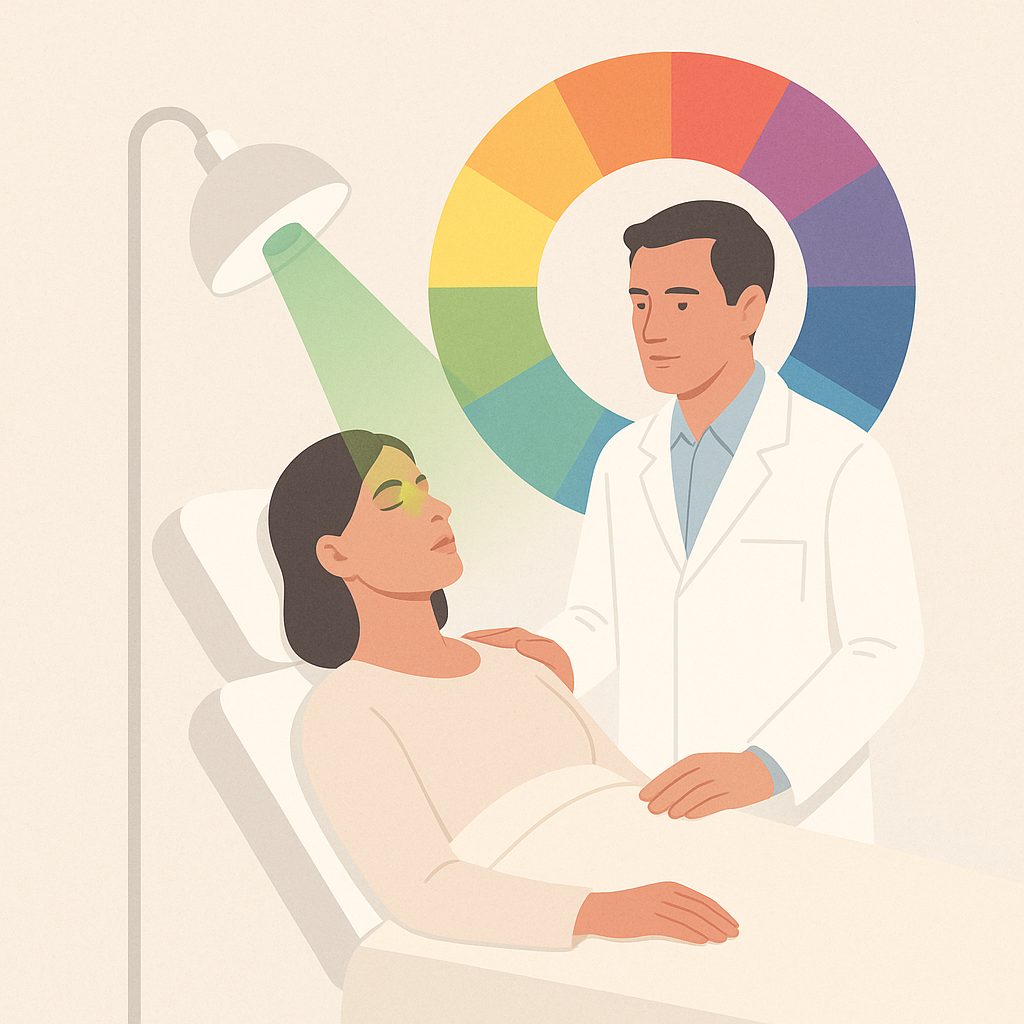
Within this framework, practitioners distinguish between two main forms: luminous Chromatotherapy® and molecular Chromatotherapy®. The first uses coloured light produced by passing white light through filters that isolate precise visible wavelengths, perceived by the eye as colours. The second is based on the same wavelengths, but sourced from matter rather than from projected light, and is described as a complementary approach rather than a separate philosophy. This distinction matters because it sets up the practical side of the method explored in the next sections: one branch works through light exposure, while the other relies on material preparations chosen according to the area being treated.
From a contemporary scientific point of view, the most plausible part of the discussion concerns the fact that light can influence human physiology and behaviour in certain contexts, particularly through circadian regulation, visual pathways and changes in arousal. However, those established observations should not be confused with proof of the broader therapeutic model claimed by Chromatotherapy®. The gap between a general effect of light on the nervous system and a precise colour-based treatment system remains substantial, which is why careful wording is necessary throughout.
- It is presented as acting on both psychological and bodily regulation.
- It is described as a complementary practice, not a substitute for standard medical care.
- Its two main branches are luminous and molecular Chromatotherapy®.
How Light and Colour Are Applied in Chromatotherapy
Two forms of treatment described by Dr Agrapart
To explain how chromatotherapy® is used in practice, Dr Christian Agrapart distinguishes between two main approaches: luminous chromatotherapy® and molecular chromatotherapy®. In his view, each colour corresponds to a precise wavelength capable of producing a consistent biological and psychological effect in a living organism, whether human, animal or plant. This is the principle on which the method is built. He presents it as a way of using coloured radiation in a rational manner, particularly when the body has been affected by an external event such as trauma, a burn, a chill or an insect bite.
As throughout this article, it is important to keep a measured perspective: these are the claims and observations associated with the method, not a substitute for conventional medical care.

Luminous chromatotherapy® involves projecting coloured light rays obtained by passing white light through filters that isolate precise visible wavelengths, perceived by the eye as colours. Molecular chromatotherapy®, by contrast, is said to use the same wavelengths, but through matter rather than light. Dr Agrapart describes it as a possible complement to luminous treatment rather than a separate universe of care. This distinction is central to his method, because it shapes both the way treatment is delivered and the type of support practitioners believe it may offer.
In practical terms, the emphasis on precise wavelengths is meant to distinguish the method from a more casual use of coloured lamps or ambient lighting. The claim is not simply that blue, red or yellow have broad emotional associations, but that carefully selected spectral bands may be applied with a therapeutic intention. That is a much stronger proposition, and one that requires more evidence than anecdotal reports alone. Even so, it helps explain why proponents insist on technical precision and practitioner training.
- Luminous chromatotherapy®: coloured light projected through carefully selected filters.
- Molecular chromatotherapy®: the same wavelength logic applied through material substances.
Where practitioners say coloured light may be used
According to Dr Agrapart, luminous chromatotherapy® is used on three main levels: traumatology, rheumatology and dermatology. In traumatology, it is presented as being used for pain following injury, as well as for certain after-effects of head trauma, with reported aims that may include supporting memory, attention, anxiety and low mood. In rheumatology, it is associated with conditions such as osteoarthritis, arthritis and tendinitis. In dermatology, it is described in relation to shingles, herpes, burn scars and post-surgical scarring. He also states that it may be used in cases such as sunstroke or shock, and at the ocular level, where it is said to have a central regulatory action through the eyes, with both psychological and physical effects.
In that framework, it is often sought for anxiety, depression, stress and sleep difficulties.
Another application highlighted by Dr Agrapart is its use on acupuncture points, in what he calls Chromatopuncture®. Here, the practitioner first identifies the relevant point according to its own trigrammatic writing, then analyses the body as a whole in order to understand the person’s broader energetic imbalance. After an in-depth consultation and an assessment of the dominant energies involved, selected acupuncture points are illuminated with the aim of benefiting the person’s symptoms more globally. Dr Agrapart presents this as a more advanced use of the method, reserved for the most experienced Chromatotherapists® and intended for more serious pathologies.
Related offer
Meditation - Relaxation set
All the Mental Waves® know-how in a single pack for quick and easy access to meditation and...
View productThe underlying idea is not simply local action, but a broader attempt at regulation based on the person’s overall state.
For many readers, the ocular dimension is one of the most intriguing aspects, because the eyes are not only organs of vision but also major gateways for light-related signalling in the brain. Light exposure is known to interact with alertness, sleep-wake timing and aspects of mood regulation. Yet here again, one must separate what is broadly established about light biology from the more specific therapeutic claims attached to particular colours in this method. The former offers a plausible background; it does not automatically confirm the latter.
Similarly, when practitioners describe effects on attention, memory or emotional tone, these claims should be understood as part of the method’s own framework rather than as settled clinical facts. Some people may report subjective benefit, especially in contexts where relaxation, expectation, focused care and sensory modulation all play a part. Those dimensions are not trivial: they can meaningfully shape lived experience. But they are not the same thing as robust proof of a direct and specific treatment effect.
- Traumatology: pain after injury, head trauma after-effects.
- Rheumatology and dermatology: arthritis, tendinitis, shingles, herpes, scars.
- Ocular and acupuncture-point use: stress, sleep difficulties and broader regulation.
Molecular Chromatotherapy and Where to Learn More
How molecular chromatotherapy is described
Alongside light-based treatment, Dr Agrapart also distinguishes a second approach: molecular chromatotherapy. In his presentation of the method, it works with the same wavelength logic as luminous chromatotherapy, but the source is no longer light itself. Instead, the effect is sought through matter, and this form is described as a possible complement to coloured-light treatment rather than a replacement for it. As with the rest of chromatotherapy, this remains a field presented by its practitioners with conviction, but it should still be approached with appropriate caution and should not be confused with a substitute for conventional medical care.
In practical terms, molecular chromatotherapy is said to be used in two main ways: topically, through local application of ointments containing the chosen trace element, and orally, in the form of potions or homeopathic granules. According to Dr Agrapart, the choice of trace element depends on the area being treated. This part of the discipline is less immediately intuitive than the use of coloured light, which is one reason the subject can seem difficult to grasp in a few lines. Even so, within the framework he describes, it is presented as an extension of the same broader attempt to act on bodily and psychological regulation through colour-related principles.
This molecular branch is also the point at which the method moves furthest away from what most people spontaneously imagine when they hear the phrase “therapy by colours”. It asks the reader to accept not only a relationship between wavelength and effect, but also a continuity between luminous and material forms of application. That conceptual leap is one reason the field remains difficult to evaluate from outside its own internal logic. For a critical reader, it is therefore sensible to distinguish clearly between description of the method and independent validation of its claims.
- Local use on the skin via ointments
- Oral use via potions or homeopathic granules
- Choice of trace element according to the area treated
Scientific references, books and a wider cultural thread
For readers who want to explore the subject in more depth, Dr Agrapart and his colleagues have published a number of texts on colour therapy and its proposed mechanisms. These include Chromatothérapie et recherche biomédicale (V. Agrapart, Bulletin du CEREC, no. 40, September 2016), Utilisation de la lumière en thérapeutique (N. Pages, P. Bac, P. Maurois, J. Durlach and C. Agrapart; Bulletin du CEREC, no. 29, September 2005), Comparison of a short irradiation (50 sec) by different wavelengths on audiogenic seizures in magnesium-deficient mice: evidence for a preventive neuroprotective effect of yellow (N. Pages, P. Bac, P. Maurois, J. Durlach and C.
Agrapart; Magnesium Research, March 2003; 16(1):29–34), Chronopathological forms of magnesium depletion with hypofunction or with hyperfunction of the biological clock (J. Durlach, N. Pages, P. Bac, M. Bara, A. Guiet-Bara and C. Agrapart; Magnesium Research, December 2002; 15(3–4):263–8), and Effect of Chromatotherapia on Audiogenic Seizures in Magnesium-deficient DBA/2 Mice Preliminary Results (N. Pages, P. Bac, P. Maurois, J. Vamecq and C. Agrapart; in Advances in Magnesium Research: Nutrition and Health, edited by Andrzej Mazur and Jean Durlach, 2001, John Libbey & Company Ltd, pp. 427–430).
Those looking for a more introductory route can also turn to books such as Le Guide Thérapeutique des Couleurs by Christian Agrapart and Michèle Agrapart-Delmas, Se soigner par les couleurs by Dr Christian Agrapart, and Quand la couleur guérit by Michèle Delmas. More broadly, the fascination with colour reaches far beyond therapy alone. From Goethe’s The Theory of Colours to Baudelaire’s famous line, “Les parfums, les couleurs et les sons se répondent”, colour has long been linked with perception, emotion and the way we interpret the world.
Whether one approaches chromatotherapy with curiosity, reserve or both, that wider intuition remains compelling: if we learned to think more carefully in colours, we might well see the world differently.
It is worth noting, however, that the existence of publications does not by itself settle the question of efficacy. Readers interested in the topic should pay attention to the type of evidence involved: theoretical texts, practitioner bulletins, animal studies, preliminary findings and controlled human trials do not carry the same weight. A mature reading of the subject means being open to observation while remaining attentive to methodology, reproducibility and the difference between promising hypotheses and clinically established results.
- Chromatothérapie et recherche biomédicale — V. Agrapart
- Utilisation de la lumière en thérapeutique — N. Pages, P. Bac, P. Maurois, J. Durlach and C. Agrapart
- Le Guide Thérapeutique des Couleurs — Christian Agrapart and Michèle Agrapart-Delmas
- Se soigner par les couleurs — Dr Christian Agrapart
How to Read Colour Therapy Without Overclaiming
Colour clearly affects the way a place feels. A red room, a blue light, a golden candle or a green forest path can change attention, expectation and emotional tone. That is enough to make colour interesting without turning it into a universal answer.

Related offer
Mental and Physical Recovery
This session uses waves with extremely precise frequencies that target healing and recovery. Guidance...
View productThe more careful question is not whether colour has meaning, but what kind of meaning it has. Some meanings are cultural, some are personal, some are sensory and some may relate to light exposure. Mixing those layers too quickly can create confusion.
A grounded approach therefore keeps the experience close to the body: what does this colour do to breathing, posture, mood, focus or memory right now? That direct observation is more useful than dramatic claims.
The Mental Waves Colour and Resonance Framework
The Mental Waves frame is to treat colour as a sensory and symbolic support for awareness.
- Observe: notice the actual response to colour and light.
- Contextualize: separate personal meaning from universal claims.
- Soften: use colour to create a calmer practice environment.
- Limit: keep health decisions in qualified hands.
For a broader sound-and-vibration lens, continue with Body Resonance of Sound. For a science-and-sense companion, read Therapeutic Benefits of Sound.
Editorial note from Mental Waves
This article is educational. Chromatotherapy and colour therapy are presented as alternative wellbeing practices and should not replace diagnosis, treatment decisions or professional care.
Conclusion
Chromatotherapy® sits in a delicate place: between a long-standing human sensitivity to colour, light and perception, and a therapeutic framework that remains outside official scientific validation. That balance matters. The approach described by Dr Agrapart is presented as structured rather than mystical, with distinct uses of coloured light and molecular support, and with claims that practitioners associate with regulation, relief and broader mind-body effects. But none of this removes the need for medical caution, nor does it place chromatotherapy® on the same footing as conventional care.
What remains genuinely interesting is the question it raises about how light, sensory experience and attention may influence our physical and mental state. Even when the evidence is debated, the subject invites a more careful look at the links between perception, regulation and lived experience. In that sense, chromatotherapy® is perhaps less a miracle answer than a reminder that colour is never entirely superficial. Sometimes, the way we perceive the world also shapes how we inhabit it.
For that reason, the most responsible position is neither blind enthusiasm nor reflex scepticism. It is to recognise that colour and light can matter deeply in human experience, while also insisting that therapeutic claims be examined with rigour. Used as a complementary practice within clear limits, and never in place of appropriate diagnosis or treatment, Chromatotherapy® remains a subject of interest precisely because it touches a real question: how far can sensory modulation contribute to regulation, comfort and recovery?
Frequently Asked Questions About Chromatotherapy
What is chromatotherapy?
Chromatotherapy is an alternative wellbeing approach that uses coloured light or colour symbolism as a sensory support.
Is colour therapy scientifically proven?
Evidence is limited, so it is best approached as a complementary sensory practice rather than a proven clinical method.
Can colour affect mood?
Colour can influence atmosphere, attention and association, but responses vary by person and context.
Can chromatotherapy replace professional care?
No. Health concerns should be discussed with qualified professionals.
Why does light matter in colour therapy?
Light changes visual perception and can shape the felt atmosphere of a room or practice.
Is colour symbolism universal?
Not completely. Some associations are cultural, while others are deeply personal.
How can colour be used safely?
Use colour gently for atmosphere, relaxation or focus, and avoid strong health promises.
What should readers explore next?
Readers can explore vibration, sound, sacred frequencies and the sensory design of calming spaces.
What is the main takeaway?
Chromatotherapy is most useful when read as sensory support, not as a substitute for evidence-based care.