en
enVotre panier est vide.


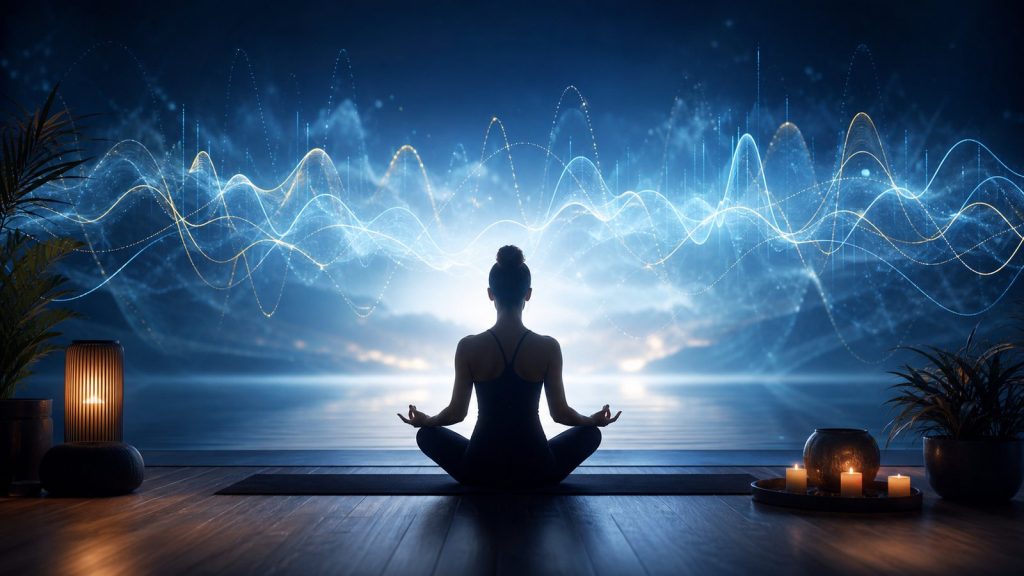
Brain waves are commonly grouped by their frequency and intensity, with alpha, beta, delta and gamma describing different patterns of electrical activity in the brain. Gamma waves, generally measured at 30 Hz and above, are often associated with heightened integration of perception, attention and conscious processing. In that context, meditation has drawn sustained interest, not as a mystical shortcut, but as a practice that may influence how the brain regulates certain mental states.
This broad classification is useful, but it should not be mistaken for a set of rigid mental boxes. In real EEG recordings, several frequency bands can coexist, overlap and shift according to task, arousal, sensory input and training. Meditation therefore does not simply “switch on” one type of wave while turning the others off. Rather, it may alter the balance and coordination of brain activity in ways that become more stable with practice.
This link between meditation and gamma activity has been explored both through lived experience and through EEG research. States such as dreaming, altered consciousness and meditative absorption have all been associated with gamma peaks, including the kind sometimes described as sudden “Aha!” moments of insight. Longer-term studies have also reported higher gamma activity in experienced meditators, including Vipassana practitioners and Tibetan monks, suggesting that regular practice may contribute to measurable shifts in brain activity alongside the more familiar effects of relaxation, sensory clarity and sustained attention.
In short: how are brainwave frequencies and meditation connected?
Brainwave frequencies and meditation are connected because meditative practice can change patterns of attention, relaxation and awareness that appear in EEG recordings. Gamma activity is especially discussed in experienced meditators, but brainwaves should be read as signals, not as proof of mystical achievement.
- Alpha is often linked with relaxed wakefulness.
- Theta can appear in deep relaxation and inner imagery.
- Gamma is associated with integration, attention and insight.
- EEG findings need context, training history and careful interpretation.
For a foundation, read The Different Brain Waves. For a free contemplative sound cue, receive the Sacred Frequency Session.
That does not mean gamma activity is automatically a sign of superiority, enlightenment or psychological health. It is better understood as one possible marker of intensified neural coordination under certain conditions. The scientific interest lies precisely in this nuance: meditation may shape attention and awareness in ways that are both experientially meaningful and, at least in part, physiologically observable.
How Meditation Is Associated with Gamma Brainwaves
Gamma activity, insight and altered states
Dreaming, altered states of consciousness and meditation are all associated with the production, and in some cases the strengthening, of Gamma brainwaves. In meditation, this is sometimes linked to the well-known “Aha!” moment: a sudden flash of understanding accompanied by a spike in gamma activity. At the same time, meditation may help the body settle into a state of deep relaxation, while some experienced practitioners report more transcendent states in which unusually deep or spiritual insights seem to emerge.
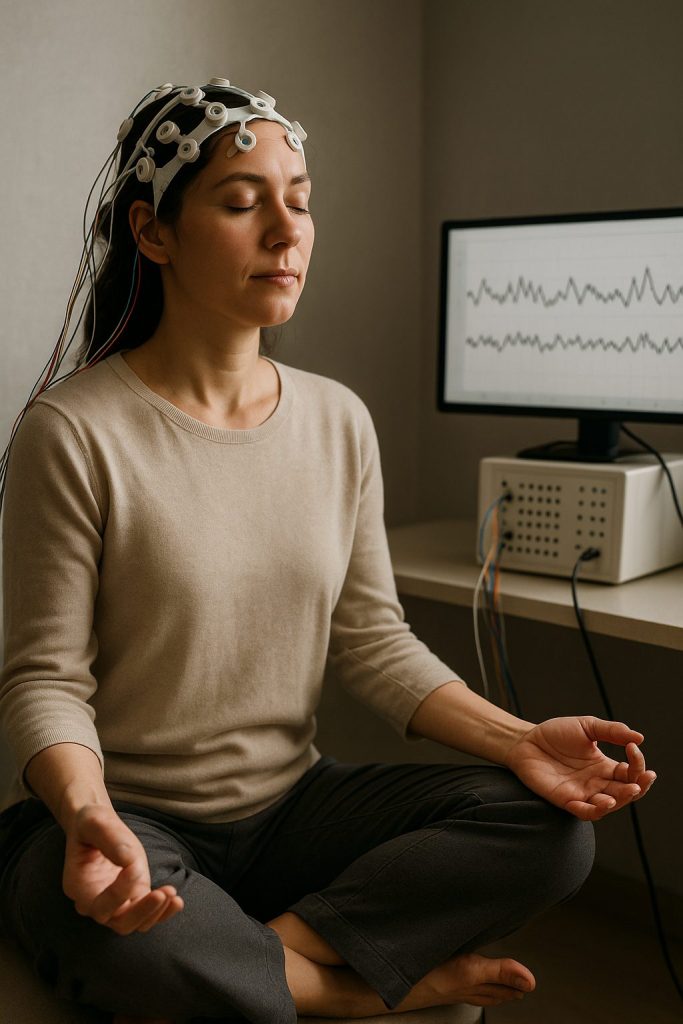
These experiences are difficult to reduce to simple formulas, even when some of their effects can be measured. That tension matters: meditation is lived subjectively, yet it can also be observed through tools such as EEG. Rather than proving every inner experience in a definitive way, this research helps show that certain shifts in attention, perception and consciousness may correspond to identifiable changes in brain activity.
One reason gamma attracts attention is that it has often been discussed in relation to large-scale neural integration. In practical terms, this means the brain may be coordinating information across different regions more efficiently during moments of heightened clarity, focused awareness or sudden insight. Meditation, especially when practised consistently over time, may create conditions in which this kind of integration becomes more likely, though the exact mechanisms remain an active area of research.
It is also important to distinguish between relaxation and meditative depth. A person may feel calm without showing the same pattern of high-frequency activity seen in advanced contemplative practice. Conversely, some forms of meditation involve intense vigilance, refined sensory monitoring or open awareness rather than simple rest. This helps explain why meditation research often finds a more complex picture than the popular idea that meditation merely “slows the brain down”.
- Gamma waves are generally defined as frequencies of 30 Hz and above.
- They are often discussed in relation to insight, heightened awareness and complex mental processing.
What EEG studies have observed in long-term meditators
A study published in the Proceedings of the National Academy of Sciences fourteen years ago examined the electroencephalographic (EEG) states of long-term meditation practitioners. It found that meditators showed higher gamma frequency activity than people who did not practise yoga, both at baseline and during meditation itself. This suggests that regular practice may be associated not only with temporary changes during a session, but also with a different underlying pattern of brain activity.
Another study, published eight years ago in Cognitive Processes, compared Vipassana meditators with non-practitioners and reported a significant increase in parieto-occipital gamma power (35–45 Hz) among the meditators. As the article states, “These findings suggest that long-term Vipassana meditation contributes to increased occipital gamma power, linked to long-term meditation expertise and enhanced sensory awareness.” Taken together, these results do not mean that meditation produces the same effect in everyone, but they do support the idea that sustained practice may be associated with measurable changes in attention, sensory processing and gamma activity.
From a neuroscientific perspective, these findings are especially interesting because they concern both state effects and trait effects. A state effect refers to what happens during meditation itself: the immediate shift in attention, bodily regulation or sensory processing while the practice is underway. A trait effect refers to a more enduring pattern, visible even outside formal practice. When experienced meditators show elevated gamma activity at baseline, researchers naturally ask whether long-term training may have contributed to a more stable reorganisation of attentional habits and neural responsiveness.
At the same time, EEG findings should be interpreted carefully. Gamma measurements can be technically demanding, and high-frequency signals may sometimes be influenced by muscle activity, eye movements or methodological differences between studies. For that reason, the strongest conclusions come not from a single dramatic result, but from converging evidence across multiple experiments, populations and meditation styles. The value of the literature lies less in sensational claims than in the gradual emergence of a coherent pattern.
Vipassana is particularly relevant here because it is often described as a practice of sustained observation: noticing bodily sensations, mental events and perceptual changes with increasing precision and equanimity. If long-term practitioners show stronger parieto-occipital gamma activity, one plausible interpretation is that this reflects refined sensory monitoring and a more stable form of attentional engagement. That interpretation remains cautious, but it fits both the phenomenology of the practice and the regions highlighted in the EEG data.
What Tibetan Monks Reveal About Exceptional Gamma Activity
Richard Davidson’s EEG findings in experienced meditators
One of the most frequently cited examples in this area comes from the work of neuroscientist Dr Richard Davidson, who analysed the EEG patterns of Tibetan monks with many years of meditation practice. In research published around fourteen years ago, he observed gamma activity that was not simply elevated, but markedly stronger than what had been recorded in previously known cases. These findings helped draw wider scientific attention to the possibility that long-term meditation may be associated with unusually intense forms of high-frequency brain activity.
Related offer
Alpha states of consciousness
Easily reach the state of Alpha Brain Rhythm to reduce anxiety and stress, soothe pain, enter...
View productThis does not mean that meditation produces a single, fixed brain state, nor that every practitioner will show the same pattern. Even so, the results remain striking because they suggest that sustained contemplative training can be linked to measurable changes in brain dynamics. In that sense, the Tibetan monk studies are often discussed as an extreme but illuminating example of how meditation may shape attention, perception and states of consciousness over time.
What makes these cases so compelling is not only the amplitude of the reported gamma activity, but the training history behind it. Many of the monks studied had accumulated thousands of hours of formal contemplative practice, often across different techniques involving compassion, focused attention and open monitoring. From a research standpoint, this offers a rare opportunity to examine what prolonged mental training might do to the brain when pursued with unusual consistency and discipline.
These observations also broaden the conversation beyond stress reduction. In mainstream settings, meditation is often presented primarily as a tool for relaxation. The Tibetan monk data suggest that, at advanced levels, contemplative practice may involve far more than calming down. It may include highly refined forms of attentional stability, emotional regulation and conscious monitoring that are not well captured by everyday language, but may still leave detectable traces in EEG recordings.

The Matthieu Ricard case and the limits of ordinary comparison
Another study led by Davidson focused on the Buddhist monk Matthieu Ricard. According to the report, his EEG signals reached a level of power described as being “outside the expected range”. Ricard is also widely known in the media as “the happiest man in the world”, a label that should be treated cautiously, but which helped bring public attention to the broader question of how meditation may relate to emotional regulation and mental wellbeing.
Accounts of advanced Buddhist meditators sometimes mention gamma frequencies reaching 80 Hz, or even 200 Hz, levels that have been described as almost “unreal” because they sit so far outside what is usually observed in ordinary resting states. Such figures should be approached with care, yet they remain part of why these cases continue to fascinate both researchers and practitioners. Rather than proving anything mystical, they point to something more grounded and perhaps more interesting: in rare and highly trained individuals, meditation may be associated with forms of brain activity that challenge standard expectations.
The Ricard case is useful precisely because it highlights the limits of casual comparison. It is tempting to contrast an advanced monk with an average non-meditator and draw sweeping conclusions, but such comparisons can oversimplify both the science and the practice. Exceptional EEG results may reflect years of training, individual differences, the specific meditation being performed and the context of the recording itself. They are informative, but they are not a template for what every practitioner should expect.
There is also a broader methodological lesson here. Extreme cases can reveal what the human brain may be capable of under unusual conditions, yet they do not automatically tell us what is typical, necessary or desirable. For most readers, the practical significance lies elsewhere: not in chasing extraordinary frequencies, but in understanding that disciplined contemplative practice may gradually influence attention, emotional balance and sensory awareness in measurable ways.
- Tibetan monks are often studied because of their very long meditation training.
- EEG research suggests unusually strong gamma activity in some advanced practitioners.
- These observations are remarkable, but they should still be interpreted with scientific caution.
What EEG Can and Cannot Tell Us About Meditation
EEG is useful because it gives researchers a way to observe electrical rhythms during meditation. It can show patterns associated with attention, calm, sensory processing or integration. But it cannot tell the whole story of inner experience.
A high or unusual brainwave pattern does not automatically prove enlightenment, healing or superiority. It is one piece of information inside a wider context: training, posture, breathing, intention, emotional state and the method being practised.
- Use EEG as a window into brain activity, not as a spiritual scoreboard.
- Distinguish beginner relaxation from long-term contemplative training.
- Remember that different practices may produce different patterns.
- Keep subjective experience and measured activity in dialogue.
The Mental Waves Brain Rhythm Meditation Framework
The Mental Waves frame is to use brainwave language as a map for practice, not as a rigid identity. Meditation works best when the listener stops chasing a frequency and begins cultivating a repeatable state of presence.

Related offer
Theta states of consciousness
Easily reach the state of Theta brain rhythm to communicate with your unconscious, improve your body's regeneration,...
View product- Settle: reduce sensory noise and soften the breath.
- Attend: choose one anchor: sound, breath, body or image.
- Observe: notice shifts in clarity, calm and attention.
- Return: bring steadiness back into ordinary action.
For the sound-technology side, continue with Mental Waves Sound Technology. For the symbolic foundation of sound, read Sound, Frequency and Vibration.
Editorial note from Mental Waves
This article is educational. Brainwave research can illuminate meditation, but EEG patterns should not be used to diagnose, rank or promise specific mental or medical outcomes.
Conclusion
What emerges most clearly is not a simplistic claim that meditation “creates” extraordinary brain states on demand, but a more careful picture: certain meditative practices are associated with higher gamma activity, particularly in experienced practitioners, and this may relate to attention, sensory clarity and moments of insight. EEG findings give these observations a measurable frame, while lived experience reminds us that relaxation, heightened awareness and shifts in perception do not always fit neatly into one explanation.
The examples drawn from long-term meditators and Tibetan monks are striking precisely because they sit at the meeting point of disciplined practice and observable brain activity. Yet the most useful takeaway remains a balanced one: meditation may help cultivate forms of mental regulation and awareness that are reflected in the brain, without reducing the whole experience to numbers alone. The signal matters, but so does the state of mind behind it.
For that reason, gamma activity is best seen as one part of a larger picture rather than the sole measure of meditative value. A practice may be beneficial even without spectacular EEG findings, and a sophisticated brain signal does not by itself explain the quality of a person’s inner life. The most credible view is therefore both scientific and modest: meditation may support meaningful changes in cognition, attention and self-regulation, and some of those changes may be visible in the brain, especially when practice is sustained over many years.
In other words, the interest of this research lies not in turning meditation into a performance metric, but in clarifying how disciplined mental training may interact with neural activity. That is a serious and worthwhile question. It respects subjective experience without romanticising it, and it respects measurement without pretending that measurement captures everything that matters.
Frequently Asked Questions About Brainwave Frequencies and Meditation
How are brainwaves and meditation connected?
Meditation can influence attention, relaxation and awareness, and these shifts may appear as changes in EEG brainwave patterns.
What are gamma waves?
Gamma waves are fast brain rhythms often associated with attention, integration and certain forms of high-level cognitive processing.
Can meditation increase gamma activity?
Some studies have observed unusual gamma activity in experienced meditators, but results depend on practice, method and context.
What does alpha activity mean?
Alpha activity is often linked with relaxed wakefulness and a calmer but alert state.
What does theta activity mean?
Theta activity is often associated with deep relaxation, imagery, memory and inward attention.
Does EEG prove enlightenment?
No. EEG measures electrical activity, not spiritual maturity or the full quality of lived experience.
Why are Tibetan monks mentioned?
Experienced meditators are often studied because long-term practice may reveal patterns that are less visible in beginners.
Can sound support meditation?
Sound can help some people settle attention, but it should be used as a support rather than a promise of a fixed result.
What is the main takeaway?
Brainwave research can enrich meditation practice when it stays grounded, contextual and free from exaggerated claims.