en
enVotre panier est vide.



Meditation is now widely recognised for its effects on everyday wellbeing. Research, including work carried out by Inserm, suggests that it may help reduce stress and anxiety, while also supporting better sleep. Taken together, these benefits matter because they influence the body’s broader balance over time: when stress regulation and sleep improve, overall health may be better supported.
These effects are especially relevant in the context of aging because chronic stress is not simply an unpleasant feeling. Over time, it is associated with physiological wear, disturbed sleep architecture, reduced attentional stability and a greater sense of mental fatigue. A practice that helps regulate arousal, calm repetitive thought patterns and restore a steadier internal rhythm may therefore have consequences that extend beyond immediate relaxation.
More recently, researchers have also explored a more ambitious question: whether meditation could play a part in the aging process itself. Studies conducted in the mid-2010s, including research linked to Gaël Chételat in Caen and Lyon for Inserm, point towards a careful but intriguing hypothesis. In people with many years of sustained practice behind them, certain brain systems appeared to be better preserved than might normally be expected with age. That does not amount to a instant solution, but it does suggest that meditation may be associated with a more resilient brain, particularly in areas involved in attention, emotion and memory.
In short: what does research suggest about meditation and aging?
Research suggests that meditation may support healthy aging by influencing stress, sleep, attention, memory and emotional regulation. The findings are promising, but they should be read as supportive evidence rather than proof that meditation can stop aging.
- Stress regulation may protect daily cognitive energy.
- Better sleep can support recovery and memory.
- Long-term practice may be linked with preserved attention.
- The strongest claims still require larger and longer studies.
For a broader research view, read Meditation and the Brain. For a free contemplative sound cue, receive the Sacred Frequency Session.
It is important to keep the distinction clear between association and proof. People who meditate regularly may also differ in other ways, including lifestyle, sleep habits, diet or social environment. Even so, the convergence between subjective reports, cognitive observations and brain imaging findings makes the subject scientifically serious rather than merely fashionable.
What Research Suggests About Meditation and Aging
Early findings point to a promising link
By now, the benefits of meditation are no longer seen as purely anecdotal. Several studies, including work carried out by Inserm, suggest that meditation can help reduce stress and anxiety, while also supporting better sleep. Taken together, these effects are already associated with a clearer improvement in overall health, which helps explain why researchers have also looked at its possible role in the aging process.

Around 2015, a study conducted by an American university reported scientific observations and experimental findings indicating that meditation may have a genuinely positive effect on aging. The idea is not that meditation stops time, but that it may influence some of the mechanisms that tend to deteriorate with age, particularly those linked to mental regulation, stress and cognitive resilience.
From a scientific point of view, this is plausible because aging is not only a matter of chronological years. It also involves cumulative exposure to stress, inflammatory processes, changes in sleep quality, shifts in attentional control and gradual alterations in brain networks that support memory and self-regulation. Meditation may not act on all of these dimensions equally, but it may help modulate some of them in a favourable direction.
Researchers are particularly interested in the fact that meditation trains capacities that often become more fragile with age: sustained attention, emotional balance, awareness of internal states and the ability to disengage from automatic mental rumination. These are not abstract skills. They shape how a person copes with fatigue, uncertainty, discomfort and cognitive load in daily life.
Long-term practice may help preserve the brain
Another study, led by Gaël Chételat in Caen and Lyon on behalf of Inserm, focused on people who had been meditating for many years. These participants had accumulated between 15,000 and 30,000 hours of practice, which makes them highly experienced meditators rather than occasional practitioners. According to the researchers, their brain systems appeared to be comparatively well protected against certain effects commonly associated with aging.
These findings should be read with appropriate caution, as they do not amount to absolute proof. Even so, they support a serious and increasingly studied hypothesis: regular meditation may contribute to slowing some aspects of brain aging. This is precisely why the subject continues to attract attention in scientific research, especially where memory, attention and long-term cognitive preservation are concerned.
The emphasis on long-term practice matters. In this kind of research, the most striking observations are rarely linked to a few isolated sessions. They tend to concern people whose practice has become stable over many years, suggesting that repetition, consistency and depth of training may be more important than intensity alone. In other words, meditation is being studied less as a quick technique and more as a sustained form of mental exercise.
That perspective also helps explain why the results are often discussed in terms of preservation rather than enhancement. The question is not whether meditation turns people into cognitive outliers, but whether it may help maintain functions that would otherwise decline more sharply with age. For many people, that is already a meaningful outcome.
- Reduced stress and anxiety
- Better quality sleep
- Possible support for cognitive preservation over time
How the Study on Experienced Meditators Was Designed
A comparison between older adults and long-term practitioners
The study focused first on a group of 73 people with an average age of 65. Within this group of older adults, six were expert meditation practitioners, while the others did not practise meditation. This comparison gave researchers a concrete way to observe whether very long-term practice might be associated with differences in the aging brain.
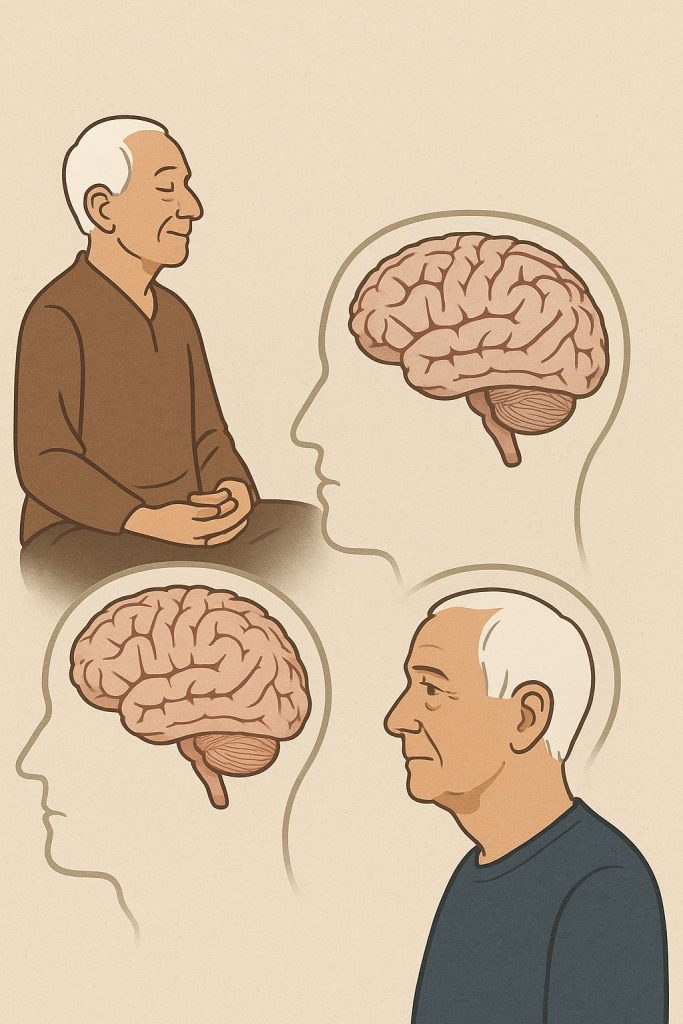
Rather than looking only at general wellbeing, the researchers were interested in how meditation may affect the brain itself, especially in later life. The aim was to examine whether regular practice could be linked to better preservation of certain mental functions that are often affected by aging.
This kind of design is useful because it moves beyond broad impressions such as “feeling younger” or “feeling calmer”. It asks more precise questions about cognition and brain structure: are there measurable differences in memory, attention or neural integrity between people of similar age who differ in meditation experience? That is a more demanding standard, and therefore a more informative one.
At the same time, the small number of expert meditators means the findings should be interpreted carefully. Such participants are rare, and their life trajectories may differ from those of the wider population. The value of the study lies less in claiming final certainty than in identifying a pattern worthy of deeper investigation.

Related offer
Meditation - Relaxation set
All the Mental Waves® know-how in a single pack for quick and easy access to meditation and...
View productA broader age range to place the findings in context
To make the analysis more complete, the study also included another group of 186 people aged between 20 and 87. This wider sample helped the researchers compare the effects usually associated with age across different stages of adult life, instead of relying only on one senior group.
In practical terms, the study was designed to assess the effects of meditation practice on the brain alongside the more familiar consequences of growing older, such as changes in attention, memory and overall cognitive functioning. This broader framework makes the results more meaningful, because it places experienced meditators within a larger picture of how the brain can change over time.
Including a broad age range also helps researchers estimate what “normal” age-related change tends to look like. Without that wider reference, it would be harder to know whether the profiles observed in experienced meditators are genuinely unusual or simply part of ordinary variation. Context is essential in aging research, because the brain does not change in a uniform way from one person to another.
Such studies often combine behavioural testing with neuroimaging methods, allowing researchers to compare performance with structural or functional markers in the brain. This is important because a person may report feeling mentally clear, yet the scientific question is whether that subjective experience corresponds to observable differences in the systems that support cognition.
- 73 participants with an average age of 65
- 6 expert meditators within the senior group
- 186 additional participants aged 20 to 87
What These Findings May Mean for the Aging Brain
The brain areas involved in meditation are also vulnerable to age-related decline
As Gaël Chételat points out, the brain regions engaged during meditation are largely the same ones that tend to be most affected by aging. These areas are involved in emotional regulation, attention and executive functioning, all of which play a central role in day-to-day mental balance. One example mentioned in the research is the posterior cingulate cortex, a region closely linked to memory and internal mental processing.
In the study, people of the same age who had practised meditation extensively appeared to have these brain regions in a better preserved state than non-practitioners. The researchers observed larger and less stressed areas in experienced meditators, alongside stronger memory performance. As Carole Chatelain notes, this greater preservation may suggest that cognitive functions such as memory and attention, which often decline with age, can remain better maintained in those who have practised over many years.
This point deserves emphasis because meditation is not only about relaxation. Many forms of practice involve repeatedly noticing distraction, returning attention to a chosen object, monitoring internal experience and regulating emotional reactivity without becoming overwhelmed by it. In cognitive terms, that resembles training in attentional control and metacognitive stability, both of which may be relevant to healthy aging.
The posterior cingulate cortex is particularly interesting because it is often discussed in relation to self-referential thought, autobiographical memory and the brain’s default mode network. These functions are central to ordinary consciousness, but they can also become sources of mental noise when rumination, worry or repetitive self-focus dominate experience. Meditation may help alter the way these networks are engaged, which could partly explain why long-term practice is associated with a different profile of mental regulation.
- Emotional regulation
- Attention and executive control
- Memory-related processing
Promising results, but still a field that calls for caution
The findings also point to another important factor: sleep quality. Meditation is often associated with better sleep, and that matters because restorative sleep supports physical recovery, mental regulation and the body’s natural regenerative processes. In that sense, the benefits observed may not depend on the brain alone, but also on broader mechanisms that influence how well the body copes with the effects of time.
That said, caution remains essential. Larger studies will still be needed to confirm these results more firmly and to understand exactly how meditation may influence the aging process over time. Even so, the current body of research already suggests that meditation may play a meaningful role in slowing certain aspects of cognitive aging and could help delay the onset of brain disorders associated with later life, including conditions such as Alzheimer’s disease.
It is also worth remembering that meditation is not a single, uniform intervention. Focused attention, open monitoring, compassion-based practices and body-based contemplative methods may not produce identical effects. Future research will need to distinguish more clearly between these approaches, as well as between short-term benefits and the consequences of decades of practice.
Another important question concerns mechanism. The observed effects may arise through several overlapping pathways: reduced stress reactivity, improved sleep, better emotional regulation, changes in attentional habits, or indirect lifestyle effects linked to people who maintain a contemplative discipline. The most credible scientific position is therefore a nuanced one. Meditation may support healthier aging, but it is unlikely to do so through one simple cause.

Related offer
Mental and Physical Recovery
This session uses waves with extremely precise frequencies that target healing and recovery. Guidance...
View productFor readers, the practical implication is modest but valuable. Meditation should not be seen as a ensure against decline, nor as a substitute for medical care, physical activity, social connection or good sleep hygiene. It may, however, form part of a broader ecology of healthy aging by helping the mind remain steadier, less reactive and more capable of recovery.
Three Research Insights to Keep in Perspective
The first insight is that stress matters. A calmer nervous system can make daily life less costly for the body and mind. The second is that sleep matters, because recovery and memory depend on it. The third is that long-term consistency may matter more than occasional intensity.
- Stress: meditation may help reduce reactivity and mental overload.
- Sleep: calmer evening states can support better rest for some people.
- Attention: repeated practice may help preserve focus and working memory.
The Mental Waves Healthy Aging Meditation Framework
The Mental Waves frame is to approach meditation as maintenance, not as a promise of youth. Practice becomes valuable when it helps the person recover, notice stress earlier and stay connected to daily meaning.
- Settle: begin with breath or sound rather than effort.
- Repeat: choose a short practice that can be sustained for months.
- Restore: protect sleep and recovery alongside meditation.
- Relate: use practice to soften stress in real relationships.
For sleep context, continue with Natural Sleep Aids. For daily body timing, read Circadian Rhythms and the Body Clock.
Editorial note from Mental Waves
This article is educational. Meditation can support wellbeing and attention, but cognitive decline, sleep disorders or neurological concerns should be discussed with qualified professionals.
Conclusion
Meditation does not offer a way to stop aging, and the research does not justify that kind of promise. What it does suggest, more carefully, is that a sustained practice may help support the brain systems most exposed to age-related change — especially those linked to attention, emotional regulation and memory. When stress is lower and sleep is more restorative, the wider terrain of aging may also become a little less taxing on the body and mind.
That is where the real interest lies: not in a miracle claim, but in the possibility that meditation can contribute to healthier cognitive aging through regular, long-term regulation of mental state and brain function. The findings remain preliminary and deserve larger studies, yet they point towards something both modest and meaningful — a practice that may help preserve inner balance as the years move on. Sometimes, slowing down is also a way of protecting what matters.
Seen in that light, meditation is less a promise of youth than a discipline of maintenance. It may help people remain more present, less overwhelmed by stress and better able to preserve the quality of their attention over time. In a culture that often approaches aging as a purely physical problem, that reminder is valuable: how we relate to our own mental activity may also shape how we age.
Frequently Asked Questions About Meditation and Aging
Can meditation help with aging?
Meditation may support healthy aging by helping with stress, sleep, attention and emotional balance, but it does not stop aging.
What does the research suggest?
Some research suggests that long-term meditators may show differences in brain areas linked with attention and memory.
Why does stress matter for aging?
Chronic stress can affect sleep, mood and cognitive energy, so stress regulation is an important part of healthy aging.
Does meditation support sleep?
It may help some people unwind and create a calmer evening state, which can support better rest.
How much practice is needed?
The research on expert meditators involves very long practice histories, but beginners can still benefit from regular short sessions.
Can meditation replace care for cognitive concerns?
No. Memory loss, confusion or neurological symptoms deserve qualified evaluation and support.
Why is memory mentioned?
Memory is often affected by aging, and some studies examine whether meditation is associated with better preserved memory systems.
Is more research needed?
Yes. Existing findings are encouraging, but larger studies are needed to clarify how strong the connection is.
What is the main takeaway?
Meditation and aging are linked most responsibly through stress, sleep, attention and long-term consistency.