en
enVotre panier est vide.


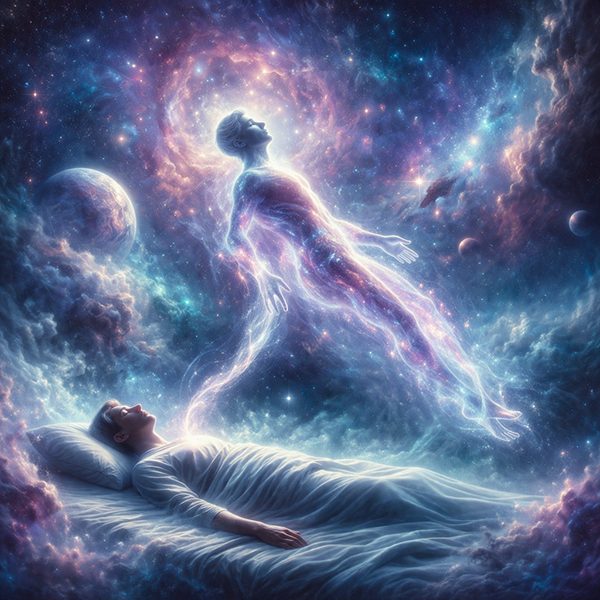
We often hear it said that the soul can leave the body and move freely as a spirit. Whether it is described as an out-of-body experience or astral travel, the idea of decorporation sits at the meeting point of lived testimony, religious interpretation and scientific curiosity. It is a subject that continues to fascinate because it raises difficult, deeply human questions: is the experience real, what does it feel like, and does consciousness remain intact when a person feels separated from their body?
These questions are not only theoretical. They are often shaped by accounts from people who report near-death experiences, unexpected episodes of dissociation, or altered states reached through practices such as meditation or hypnosis. That does not mean every explanation points in the same direction. Some traditions read these experiences through a spiritual lens, while scientific research tends to examine perception, brain activity and the way consciousness can be altered under extreme or unusual conditions. To talk about decorporation seriously, it helps to hold both dimensions together: the intensity of what people say they have lived through, and the need for a careful, grounded reading of what may be happening.
It is also worth distinguishing between the fact of an experience and the interpretation attached to it. A person may sincerely report having felt outside their body, above the bed, in a tunnel, or moving through an unfamiliar space. The sincerity of that report does not automatically settle the question of mechanism. In other words, the experience may be psychologically real and deeply memorable without proving, in scientific terms, that consciousness has literally detached from the body.
In short: what are astral travel and decorporation?
Astral travel and decorporation refer to experiences in which consciousness seems to leave the physical body. Some traditions interpret this spiritually, while science studies related experiences through altered perception, body awareness and brain activity.
- Accounts often describe floating, distance or observing the body from outside.
- Spiritual traditions may frame the experience as travel through subtle realms.
- Research usually examines perception, attention and body mapping.
- The safest approach is open, grounded and non-dogmatic.
For a related sleep-state topic, read Lucid Dreams. For a free contemplative sound cue, receive the Sacred Frequency Session.
Understanding out-of-body experience and astral travel
What people mean by decorporation
Decorporation is generally described as the moment when the soul appears to leave the body. In that sense, it refers to a form of journey said to take place while a person is still alive, which is why it is often called astral travel. In accounts of this experience, the person does not feel simply distracted or dreamlike: they describe a clear impression of separation, as though consciousness were no longer fully anchored to the physical body.
According to these descriptions, decorporation may occur in very different circumstances. It is sometimes linked to a violent shock or accident, the use of substances such as drugs, or a temporary clinical death. Some people also believe it can be induced deliberately through hypnosis or meditation. In that framework, the experience may be either spontaneous or intentional, but in both cases it is understood as the same core phenomenon: a perceived departure of the self from the body.
From a more careful psychological perspective, these reports may also be understood as disturbances in self-location, body ownership or sensory integration. That does not empty them of meaning. Rather, it suggests that what people call astral travel may bring together several layers at once: bodily sensation, mental imagery, expectation, belief, and altered states of attention. The language of the soul is one way of describing that event; the language of cognition is another.
- after an accident or violent shock
- during a near-death episode or temporary clinical death
- after taking certain substances
- through practices such as hypnosis or meditation
What these situations have in common is that they can disrupt ordinary orientation. Under stress, fatigue, trauma, sensory deprivation or intense inward focus, the brain’s usual model of where “I” am in space may become less stable. For some people, that instability may be experienced not as confusion but as a vivid and coherent impression of leaving the body.

Religious interpretations and the classic stages of astral travel
Religious traditions do not all approach decorporation in the same way. Buddhist and Hindu traditions are often seen as more open to the idea, whereas the Catholic Church has generally been more cautious about it. Even so, certain biblical paintings and sacred texts are sometimes read as references to this kind of phenomenon, represented in different forms. If one follows those interpretations, karma, paranormal manifestations and reincarnation can all be linked to forms of astral travel, and some researchers also cite the Ascension as a religious example of decorporation.
Within the usual description of astral travel, consciousness is said to leave the body and move within an astral or emotional body. This idea is often presented alongside a distinction between waking consciousness, which allows us to engage with the world through the five senses, and the sleeping consciousness in which dreams unfold. A third form of consciousness is then attributed to astral travel itself. During that state, the physical body is described as inert, appearing from the outside to be in deep sleep or even trance, while the astral body moves through what is called the astral universe, sometimes divided into a lower astral and a higher astral realm.
Testimonies also frequently mention a dark tunnel followed by a brilliant light, and sometimes an extraordinary landscape filled with flowers, interpreted by some as something close to paradise. Even when these accounts are deeply meaningful for those who report them, they should not be treated as a form of physical healing in themselves.
These religious readings matter because they provide a framework of meaning rather than a laboratory explanation. For many people, the experience is not just unusual; it is morally, spiritually or existentially significant. It may be interpreted as a sign, a passage, a revelation, or a reminder that consciousness is not reducible to ordinary bodily life. Even where traditions disagree, they often share the intuition that altered states can reveal something important about the human condition.
At the same time, religious symbolism can shape what people expect to perceive. Images such as ascent, light, judgement, reunion or paradise are culturally powerful. When an intense altered state occurs, the mind may organise it using familiar symbols drawn from faith, stories and collective imagination. That possibility does not make the experience false; it simply reminds us that human perception is never entirely separate from interpretation.

What Science Can and Cannot Say About Out-of-Body Experiences
Why researchers take the experience seriously
Out-of-body experiences are intriguing enough to have drawn genuine scientific interest, not because science has confirmed that the soul literally leaves the body, but because the experience itself can feel strikingly real to the person living through it. People who describe decorporation often report the sensation of floating above their body, observing themselves from outside, or moving through space while remaining physically still. From an everyday point of view, that seems impossible, which is precisely why researchers have tried to understand what is happening at the level of perception, consciousness and brain activity.
This line of research also matters because astral travel is not always described as a purely accidental event. In some accounts, it follows a shock, a near-death experience or an altered state; in others, it is said to be triggered deliberately. That distinction has encouraged scientists to study whether certain mental states, patterns of attention or forms of bodily imagery may contribute to the feeling of leaving the body, even when the body itself has not moved at all.
- a sensation of floating above the body
- the impression of seeing oneself from outside
- a vivid feeling of movement despite physical stillness
Researchers are especially interested in the way the brain combines signals from vision, balance, touch, proprioception and internal bodily awareness. Our sense of being located “here”, inside one body and at one point in space, depends on this integration working smoothly. When that integration becomes unstable, the result may be a temporary mismatch between where the body is and where the self seems to be. In neuroscience, this is one of the most plausible routes by which an out-of-body experience may arise.
There is also a broader reason for taking such reports seriously. They offer a rare window into how consciousness constructs a sense of self. Experiences of depersonalisation, lucid dreaming, sleep paralysis, dissociation and out-of-body states may differ in important ways, but they all show that self-awareness is not a fixed object. It is an active process, and under certain conditions that process can shift dramatically.
Related offer
How to Master Astral Projection
Méthode complète pour faciliter et accéder au voyage astral (astral projection). Idéal pour les débutants mais aussi les experts…
View productWhat the University of Ottawa study observed
One often-cited example comes from a team at the University of Ottawa, including Andra M. Smith and Claude Messier, who studied a woman who said she could induce an out-of-body experience at will. In research published in Frontiers of Human Neuroscience, she underwent brain scanning while attempting this state. As she began what she described as astral travel, the scan suggested reduced activity in the visual cortex, while several regions on the left side associated with kinesthetic imagery became more active. Afterwards, she reported that she had felt herself positioned flat above her body and sliding along a horizontal plane, with a clear sense of separation while still remaining aware of her physical presence.
The researchers’ interpretation was cautious. In their view, the experience did not show that she had literally left her body, but rather that her brain had generated a compelling impression of disembodiment. More specifically, mental imagery linked to bodily movement appeared to activate systems involved in how we represent our body in space and interact with the world around us. In that sense, science does not dismiss the lived experience as imaginary in a trivial way; instead, it suggests that decorporation may be associated with unusual but understandable shifts in body perception, attention and self-location.
The feeling can therefore be intense and meaningful, even if the scientific explanation remains grounded in brain function rather than in a confirmed separation of soul and body.
This kind of finding fits with a wider body of work on body schema and multisensory processing. Studies involving electrical stimulation, virtual reality illusions and neurological disturbance have shown that the sense of occupying a body can be manipulated more easily than common sense might suggest. Under experimental conditions, some participants report feeling displaced, enlarged, duplicated or located slightly outside themselves. Such results do not reproduce every aspect of astral travel, but they do show that self-location is a constructed experience rather than a simple given.
That said, science still has limits here. Brain imaging can reveal correlations between a reported state and patterns of activation, but it cannot by itself settle philosophical questions about the nature of consciousness. Nor can one case study stand for every testimony. Some experiences occur in medical emergencies, some during sleep-related states, some in meditation, and some in contexts of grief, trauma or expectation. A rigorous approach therefore requires both openness and restraint: openness to the reality of the report, and restraint about what the report proves.
It is also important not to confuse explanation with reduction. If a state can be linked to kinesthetic imagery, altered sensory integration or unusual neural activity, that does not mean it is insignificant. On the contrary, many of the most powerful human experiences are mediated by the brain. Scientific language may describe the mechanism, but it does not exhaust the personal meaning the event may hold for the individual who lived it.
How to Stay Grounded With Out-of-Body Experiences
Out-of-body experiences can be powerful, but powerful does not automatically mean simple. A person may interpret the same experience spiritually, psychologically, neurologically or symbolically. The meaning depends on context and should not be forced.
A grounded approach starts before interpretation. What was happening in the body? Was the person falling asleep, waking up, meditating, exhausted, grieving, frightened or deeply relaxed? These details do not cancel the meaning of the experience, but they help place it inside a fuller human context. The same event can feel sacred, strange, beautiful or unsettling depending on the state of the nervous system.
For people who explore these themes intentionally, rhythm matters. Sleep deprivation, emotional overload and obsessive practice can make altered states feel more confusing. Gentle curiosity is usually healthier than chasing intensity. The point is not to collect extraordinary moments, but to understand consciousness with more humility and steadiness.
Integration is the quiet test. After an experience, can the person return to ordinary life with more presence, kindness and clarity? If the experience leads only to fear, isolation or compulsive searching, it may be time to pause, reconnect with the body and ask for support from someone grounded and trustworthy.
It is also useful to distinguish astral travel language from nearby experiences such as lucid dreaming, sleep paralysis, deep meditation and strong visual imagination. They can overlap in sensation, but they do not always point to the same process. Naming the context carefully protects both the mystery of the experience and the clarity needed to discuss it responsibly.
This balanced posture gives room to personal meaning without making the reader dependent on one explanation. It also keeps the article aligned with Mental Waves: curiosity first, sensationalism last, and daily balance always in view, especially when experiences feel unusually intense or emotionally charged during vulnerable life periods.

Related offer
Lucid dreams
This session is designed to plunge you into a state between wakefulness and sleep, so that you...
View product- Avoid turning one experience into proof of every claim.
- Stay attentive to sleep, stress, dissociation and emotional state.
- Keep spiritual curiosity compatible with daily grounding.
- Seek support if experiences become frightening or destabilizing.
The Mental Waves Out-of-Body Discernment Framework
The Mental Waves frame is to respect the experience without losing clarity. An altered state can invite reflection, but integration matters more than spectacle.
- Stabilize: return to breath, body and environment after the experience.
- Reflect: write down what happened before interpreting it.
- Compare: consider spiritual, psychological and physiological explanations.
- Integrate: ask what the experience changes in ordinary life.
For the broader question of meaning, continue with What Is Spirituality?. For brain-state context, read Brainwave Frequencies and Meditation.
Editorial note from Mental Waves
This article is educational and reflective. Astral travel and out-of-body experiences should not be used to replace medical, psychological or safety decisions, especially if experiences become distressing.
Conclusion
What emerges most clearly is that so-called astral travel sits at the meeting point of lived experience, belief and perception. For some, it is understood through a spiritual or religious lens; for others, it is better approached as an altered state of consciousness linked to attention, body awareness and brain activity. Those two readings do not have to be crudely opposed to show their value: one speaks to meaning, the other to mechanism.
Science does not confirm that a consciousness literally leaves the body, but it does take the experience seriously as a real subjective event. That distinction matters. Feeling detached from the body, moving through darkness towards light, or observing oneself from above may be associated with unusual states of perception and mental imagery rather than proof of a separate soul in motion. The experience may feel absolute, while its explanation remains open — and that is precisely why the subject continues to fascinate.
Between mystery and measurement, decorporation remains a powerful reminder that human consciousness is still only partly understood.
A balanced discussion therefore avoids two opposite errors: dismissing every testimony as fantasy, or treating every testimony as direct evidence of a metaphysical fact. The most credible position is often the most demanding one. It recognises that people can undergo profound states of disembodiment, that these states may be shaped by culture and belief, and that neuroscience can illuminate part of the process without claiming to have solved the whole question of consciousness.
For readers drawn to the subject, that balance is useful. It allows room for wonder without abandoning rigour, and for subjective depth without confusing it with certainty. In that sense, decorporation remains less a settled doctrine than a revealing frontier: one that tells us as much about the architecture of the mind as it does about the stories human beings use to make sense of extraordinary experience.
Frequently Asked Questions About Astral Travel and Decorporation
What is astral travel?
Astral travel is the reported experience of consciousness seeming to move beyond the physical body.
What is decorporation?
Decorporation is another term for the impression of leaving the body or becoming detached from it.
Is an out-of-body experience spiritual?
It can be interpreted spiritually, but it can also be studied through psychology, perception and brain activity.
Can it happen during sleep?
Some people report similar experiences around sleep, dreams, lucid dreams or transitional states.
What does science say?
Science studies the experience through body awareness, perception, altered states and neural activity rather than confirming literal travel.
Is astral travel dangerous?
The experience itself is often described subjectively, but fear, dissociation or distress should be taken seriously.
How can someone stay grounded afterward?
Return to breath, body sensation, ordinary surroundings and simple daily actions before interpreting the experience.
Should someone try to force astral travel?
No. Forcing altered states can create stress or fear, so curiosity should remain gentle and grounded.
What is the main takeaway?
Astral travel is best approached with openness, discernment and care for psychological grounding.