en
enVotre panier est vide.



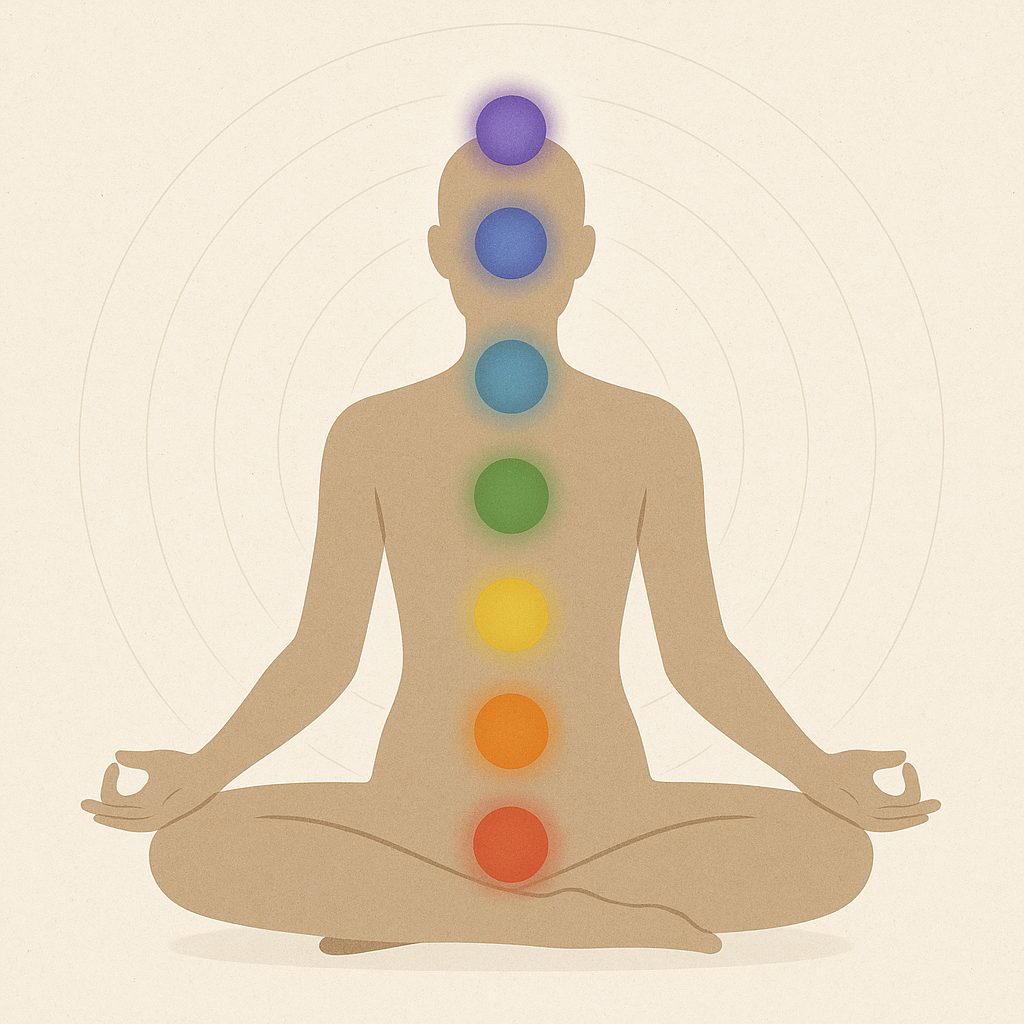
In traditional Indian medicine, the body is understood as being crossed by a current of energy that moves through a series of crucial centres. These centres, known as Chakras, are commonly described as wheels and, in their principal form, are said to number seven. Arranged from the lower body to the crown of the head along the line of the spine, they are thought to connect different areas of the body into a single energetic whole. When one of these points is disturbed, that balance may suffer in turn.
In short: importance of chakras
The chakras are most useful as a symbolic map for body awareness, emotional balance and attention, not as a medical system.
Use this article as a practical map: keep what helps attention become steadier, question anything that sounds absolute, and connect the idea back to repeatable daily practice.
For many people, the appeal of this vision lies in the fact that it does not separate the body from inner life quite so sharply. A period of strain may be felt in the chest, fear may settle low in the belly, and mental exhaustion may seem to cloud the head itself. The language of the chakras gives shape to those experiences, offering a way of understanding why emotional pressure can feel so physical, and why physical unease can sometimes carry an emotional undertone.
It is from this perspective that work on the Chakras has long been recommended, particularly where chronic stress, depression or other persistent forms of discomfort begin to take hold. Meditation and relaxation are among the best-known approaches, and sound-based practices have also found a place in this tradition of support. Mental Waves builds on that idea through a dedicated range of recordings designed for relaxation and Chakra work, with targeted sound tracks intended to act directly on these energy centres.
What matters here is not the promise of a dramatic transformation overnight, but the quieter possibility of restoring a little movement where life has become tight, repetitive or heavy. People often turn towards chakra work not because they are chasing something exotic, but because they recognise a familiar feeling: the sense that something in them is no longer flowing as freely as it once did.
The Seven Invisible Circles
What chakras are meant to represent
The word chakra comes from ancient Sanskrit and means “wheel” or “circle”. That image matters, because chakras are traditionally pictured as spinning centres of energy rather than fixed physical organs. In Indian medicine, they are understood as key points that gather, organise and connect different parts of the body. This tradition goes back more than 5,000 years. While the seven main chakras are the best known and most widely worked with today, many ancient texts refer to far more — sometimes more than 88,000 throughout the human body.
Chakras are most clearly described within traditional Indian medicine, but the idea of energy points is not limited to one culture alone. Other practices, including Chinese acupuncture, also recognise subtle pathways and centres within the body. In everyday Western culture, the best-known example is often the solar plexus chakra, located just beneath the ribcage where the ribs meet the sternum. Even for people who are new to the subject, that point often feels familiar, because it is so closely associated with tension, emotion and inner balance.
There is also something quietly powerful in the symbolism of the wheel itself. A wheel turns, carries, advances. When that movement is smooth, there is a sense of continuity; when it jams, everything becomes harder. That is one reason the chakra model has endured for so long. It speaks not only to spiritual traditions, but to a very human intuition that wellbeing depends on circulation, rhythm and the ability to move through experience without becoming inwardly stuck.
- The term means “wheel” or “circle”.
- The seven main chakras are the most commonly used.
- Some ancient traditions describe many thousands more.
How energy is believed to move through the body
In this traditional view, energy rises from the lower part of the body and moves upwards through invisible channels, passing from one chakra to the next until it reaches the final centre at the crown of the head. The idea is simple: this movement should remain fluid. If the flow is blocked, slowed or diverted, the body’s overall balance may begin to suffer. From that perspective, physical or emotional discomfort is not always seen as an isolated problem, but sometimes as the sign of an energy centre that is no longer functioning as it should.
That is why chakra work is often approached both preventively and as a response to an existing imbalance. The aim is not only to avoid this gradual “clogging” before it affects wellbeing, but also to help restore movement when a chakra already feels partially or completely blocked. In practical terms, this means the chakras are not viewed as abstract symbols alone, but as a living map of balance that can be supported over time through attentive inner work.
Many people describe this less as a theory they have adopted and more as a pattern they have noticed in themselves. When they are grounded, rested and emotionally clear, they often feel more present in the body and less fragmented in the mind. When they are under prolonged pressure, the opposite can happen: breathing becomes shallow, the stomach tightens, sleep grows lighter, and thought loops become harder to interrupt. Within the chakra framework, these shifts are understood as signs that energy is no longer moving with ease.
That does not require a rigid or literal reading. Even approached symbolically, the model can still be useful. It invites a person to ask where tension gathers, where expression is being held back, where fear has narrowed the body, or where exhaustion has dulled vitality. In that sense, the movement of energy through the chakras can be read as a language of inner coherence.
Reading the Body Through the Chakras
Each chakra is linked to a different layer of experience
In the traditional chakra model, each Chakra has its own qualities and correspondences. It is associated not only with particular organs and glands, but also with the emotional states that can affect those biological systems. Seen in that light, the chakras form a kind of map of the body: not a medical chart in the modern clinical sense, but a symbolic framework that connects physical sensations, inner tensions and emotional life.
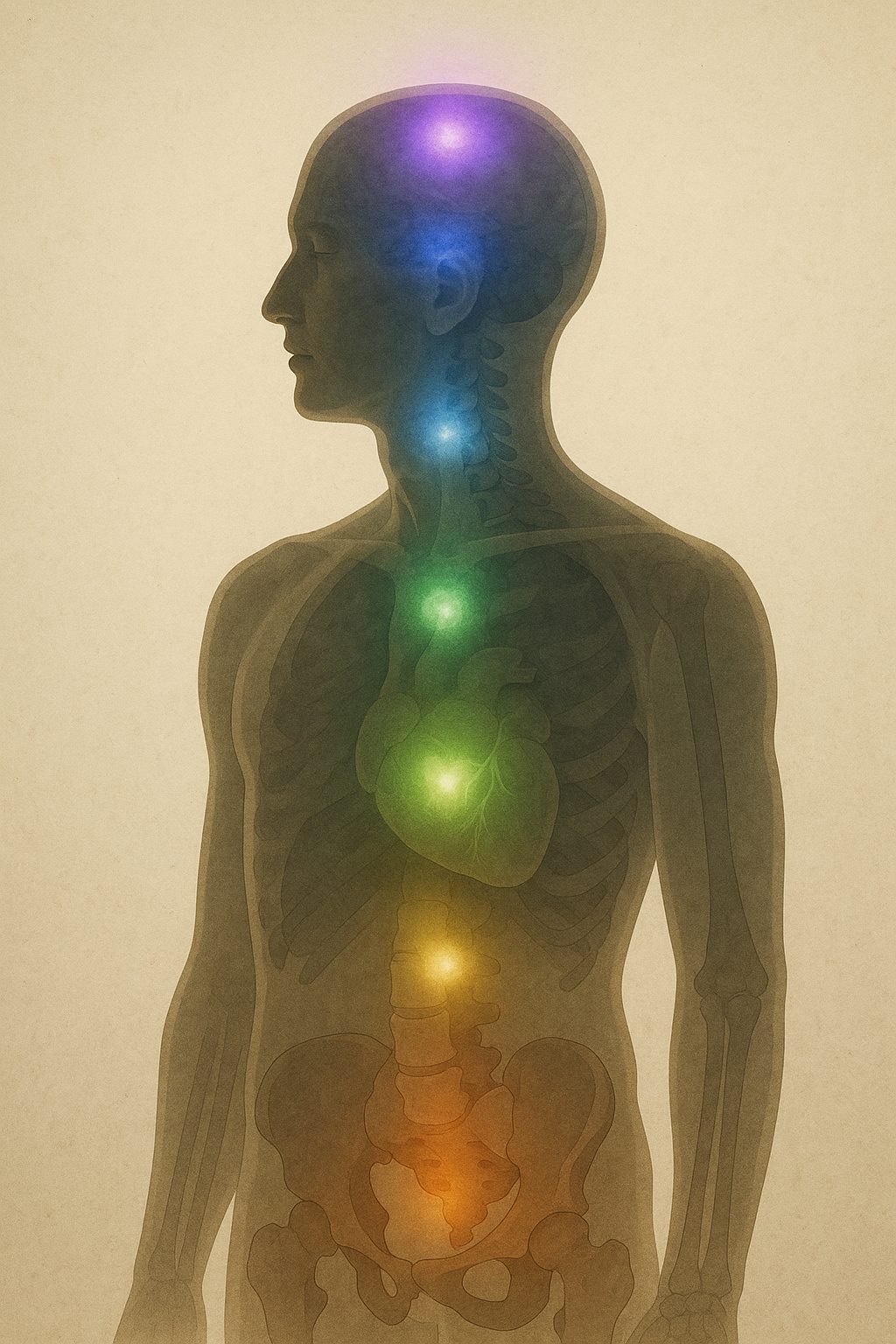
That is why some practitioners use the chakras as a way of tracing a difficulty back to its supposed point of origin. Whether a problem is experienced as physical, psychological, or a mixture of both, it is thought to be linked to an organ, an emotion, or a deeper imbalance. Working on the chakra concerned is therefore presented as a way to support better overall wellbeing, and in some cases to help the person recover more fully.
Used with care, this way of reading the body can encourage a more attentive relationship with oneself. Instead of treating discomfort as a nuisance to be silenced as quickly as possible, it asks what that discomfort may be expressing. A tight throat may coincide with words long held back. A heaviness in the chest may accompany grief, disappointment or emotional fatigue. A persistent knot in the stomach may reflect insecurity, pressure or the strain of trying to remain in control. The chakra model does not replace medical understanding, but it can deepen the personal meaning of what one is experiencing.
That is often where its value lies. It gives people a framework for noticing links they might otherwise dismiss: the way recurring emotional patterns seem to settle in the same part of the body, or the way certain life periods leave a distinct energetic imprint. Over time, this can foster a more nuanced form of self-awareness, one that is less mechanical and more embodied.
Related offer
Align your Chakras
This therapeutic music uses two specific waves to balance the chakras, your body's energy centers.
View product- organs and bodily systems
- glands and biological functions
- emotions that may disturb that balance
A serious practice, not a promise of miracles
That said, this is also an area where caution matters. Some charlatans are quick to promise miraculous remedies for serious illness, and that kind of claim deserves real scepticism. Working with the chakras is not something instant or superficial. It asks for time, discernment, sound guidance and, for many people, a genuine spiritual openness.
Approached with honesty, chakra work is less about magical shortcuts than about patient inner work. The aim is to understand what may be out of balance, to restore a better flow, and to support the person as a whole rather than chase dramatic promises. In that sense, the value of the practice lies as much in the quality of attention it requires as in the results people hope to achieve.
A grounded practitioner will usually speak in measured terms. They may talk about support, balance, release, awareness or accompaniment, rather than certainty and promised outcomes. That distinction matters. Serious inner work tends to be modest in tone because it respects complexity. A person may feel better through relaxation, meditation or sound work, and that improvement can be meaningful, but it should never be used to deny the need for proper medical care where that care is required.
There is also a discipline to this path that is sometimes overlooked. To work with the chakras sincerely often means returning again and again to the same inner knots, the same habits of tension, the same emotional defences. It can be gentle, but it is not always easy. Real change rarely comes from one striking moment alone; more often, it grows through repetition, honesty and a willingness to stay present to oneself.
Relaxation as a Practical Way to Work with the Chakras
Why inner calm matters before anything else
Working with your chakras is not simply a matter of intention. In this tradition, it also requires a particular mental and emotional state. If the mind is constantly tense, scattered or overwhelmed, it becomes far harder to act on these energy centres in any meaningful way. That is why a regular relaxation practice is often seen as one of the most effective ways to support chakra work: it creates the inner conditions in which the body can settle and attention can become more stable.
Seen from this perspective, negative thought patterns, ongoing stress and the ordinary pressures of daily life do more than wear us down psychologically. They are also believed to disturb and clog the chakras, preventing energy from circulating as it should. Once that flow is hindered, imbalance begins to show itself more clearly, not always all at once, but often through a gradual sense that something is no longer moving freely within us.
Relaxation, then, is not merely a pleasant pause in the day. It is a way of making oneself available again. When the nervous system softens, breathing deepens and the body no longer braces against everything at once, subtler sensations become easier to notice. One begins to feel where effort is excessive, where emotion has been compressed, and where the body has been carrying more than it can comfortably hold. That softening is often the first real opening in chakra work.
For some, this begins with meditation. For others, it may be breathwork, stillness, gentle movement, or simply the habit of listening each day to sounds that help the mind unclench. The method matters less than the quality of presence it creates. What supports the chakras, in this view, is not force but receptivity: the capacity to become quiet enough to sense what is happening within.
- persistent negative thoughts
- daily stress and pressure
- emotional overload
The signs of imbalance and the role of sound
In practical terms, this disruption is often associated with warning signs such as chronic stress, generalised anxiety, panic episodes and depression. Within the chakra framework, these states suggest that the centres are no longer functioning in an optimal way. That does not mean every difficulty can be reduced to a single cause, but it does explain why relaxation is treated as more than a comfort measure: it is considered part of the work itself.
Among the methods used for this, listening to sound tracks designed specifically for relaxation and meditation can be especially helpful. Their purpose is to encourage release, quieten mental agitation and help prevent the kind of energetic build-up that, in this approach, leads to blockage. Used regularly, these recordings offer a simple and accessible way to support the chakras while also creating a calmer, steadier inner atmosphere.
Sound has a particular place here because it reaches us without demanding effort in the same way as more active practices. A carefully chosen recording can alter the texture of a moment almost imperceptibly: the breath slows, the jaw loosens, the mind stops gripping so tightly. In a life filled with noise, interruption and overstimulation, that shift can be more significant than it first appears. It creates a small but real space in which the body can begin to reorganise itself.
Regularity is often more valuable than intensity. A few minutes of genuine settling each day may support the system more deeply than occasional attempts at dramatic release. Over time, sound-based relaxation can become a ritual of recalibration, helping a person return to themselves before stress hardens into something more entrenched. In that sense, the role of sound is both practical and subtle: it does not force balance, but it can make balance easier to find.
Related offer
Chakra meditation
This session is specially designed to harmonize the 7 main chakras and stimulate your energy centers....
View productThe Mental Waves Chakra Balance Framework
The Mental Waves frame is to use chakra language as a guide for attention. Each centre invites a different question about posture, feeling, breath, expression and inner alignment.
A grounded chakra practice stays embodied. Notice sensation, breathe without forcing, and let the symbol open reflection rather than turn it into a rigid explanation.
For a gentle sound-based support, receive the free 128 Hz sacred frequency session and use it as a quiet background for body awareness.
Editorial note from Mental Waves
This article keeps chakras in a symbolic and experiential frame. It does not present chakra work as a substitute for medical diagnosis, treatment or professional care.
Conclusion
Seen in that light, chakras are less a rigid doctrine than a way of reading the relationship between body, emotion and inner balance. What matters here is not blind belief or grand promises, but the underlying intuition: when stress, fear and mental overload build up, our sense of flow narrows, and we feel it everywhere. The value of chakra work lies in attention — to what feels blocked, to what keeps repeating, and to the conditions that help us settle again.
That is also why a grounded approach matters. Relaxation, meditation and sound-based practices are presented here not as miracle remedies, but as supports that may help restore a little coherence where life has become noisy or strained. Used with patience and discernment, they can become part of a more conscious way of caring for oneself. Sometimes, balance begins with something quieter than a breakthrough.
Perhaps that is the enduring importance of the chakras. They remind us that human wellbeing is rarely only physical, only emotional or only mental. We live through all of these layers at once, and when one is under strain, the others often speak. To work with the chakras is, at heart, to listen more carefully to that conversation and to respond with steadiness rather than haste.
Frequently Asked Questions About the Importance of Chakras
What are chakras meant to be in traditional Indian medicine?
Chakras are understood as energy centres arranged along the body, following the line of the spine from the lower body to the crown of the head. The word comes from ancient Sanskrit and means “wheel” or “circle”, which reflects how these centres are traditionally imagined.
How many chakras are there?
Seven chakras are generally treated as the main ones and are the best known in practice. At the same time, some ancient texts mention many more energy centres throughout the body, sometimes more than 88,000, though the seven principal chakras remain the usual reference point.
How is energy believed to move through the chakras?
Energy is believed to rise from the lower part of the body and move upwards through invisible channels, passing from one chakra to the next until it reaches the top of the head. In this view, wellbeing depends on that movement remaining fluid rather than blocked, slowed or diverted.
What happens when a chakra is disturbed or blocked?
A disturbed chakra is thought to affect the body’s overall balance because the centres are seen as linked rather than isolated. When energy no longer circulates properly, discomfort may appear, and this can be understood as a sign that one or more chakras are no longer functioning as they should.
Why are chakras described as a way of reading the body?
Each chakra is associated with particular organs, glands and emotional states, which makes the system a symbolic map of the body. This framework connects physical sensations, emotional tension and inner imbalance, helping some people trace a difficulty back to the chakra believed to be involved.
Which chakra is the most familiar in Western culture?
The solar plexus chakra is often the best-known example. It is located just beneath the ribcage, where the ribs meet the sternum, and is commonly associated with tension, emotion and inner balance, which may be why it feels especially familiar to many people.
Why is relaxation considered important for chakra work?
Relaxation is considered essential because chakra work is thought to require a calm and steady mental state. Ongoing stress, negative thoughts and daily pressure are believed to disturb and clog the chakras, so regular relaxation helps create the inner conditions needed for better balance.
What signs are linked to chakra imbalance?
Chronic stress, generalised anxiety, panic episodes and depression are presented as warning signs that the chakras may not be functioning optimally. Within this framework, these states suggest that energy is no longer moving freely, which is why emotional strain is treated as part of the imbalance.
Can sound-based practices be used to support the chakras?
Sound-based practices are presented as one way to support relaxation and meditation while working on the chakras. Listening to specially designed sound tracks is intended to calm mental agitation, encourage release and help prevent the build-up that, in this approach, is associated with blockage.